

ALL HER SHIPS Eric Otieno Sumba on Monira Al Qadiri at Berlinische Galerie, Berlin
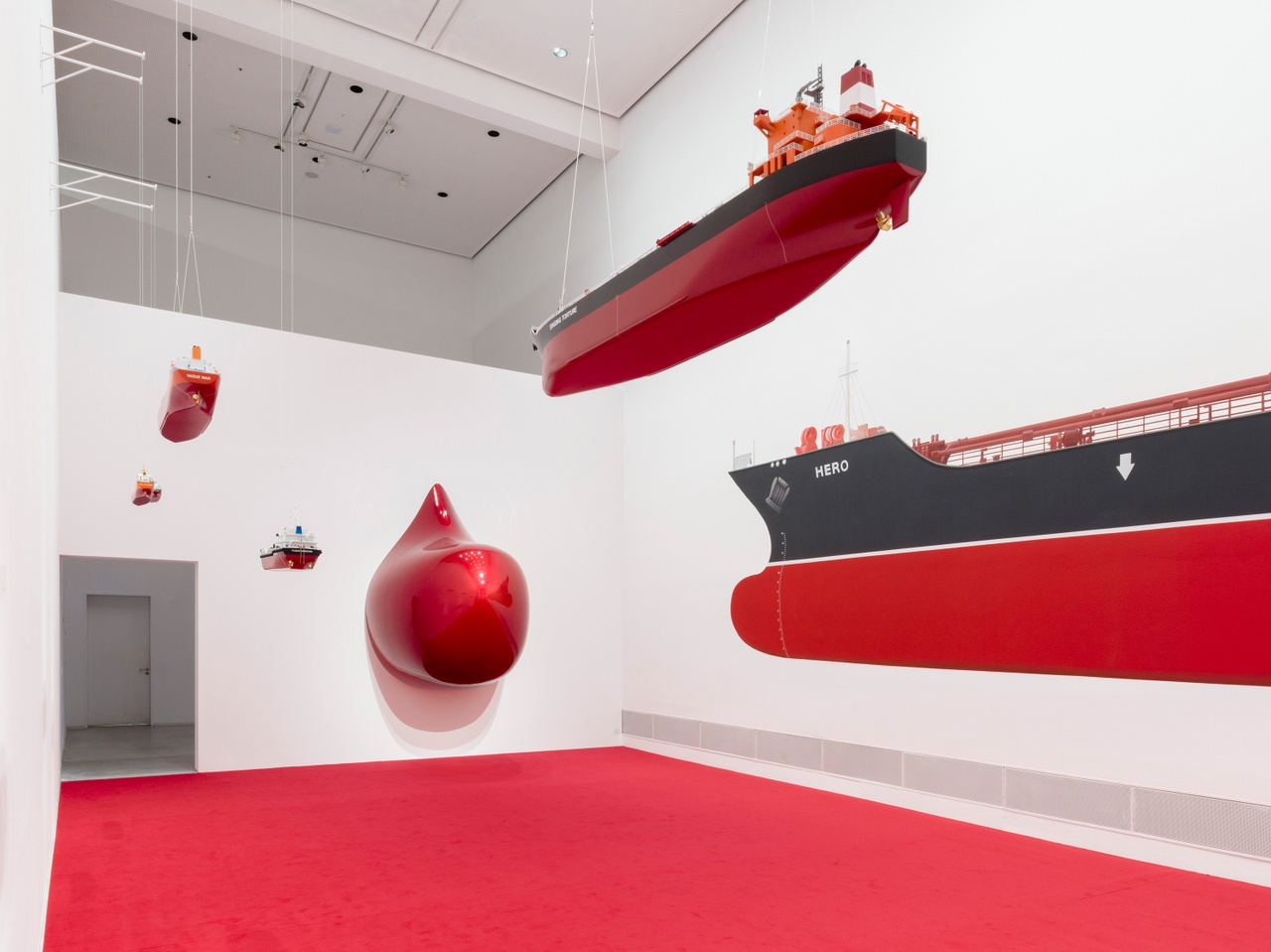
“Monira Al Qadiri: Hero,” Berlinische Galerie, Berlin, 2025–26
Well into the mid 2000s, the hulls of ships were often painted in reddish shades of paint infused with tributyltin (TBT) compounds. TBT is a highly toxic biocide that kills algae, microorganisms, and plants that accumulate on the underwater surfaces of ships. If left to its own devices, biofouling can cause a 60 percent increase in hydrodynamic friction, significantly impacting a vessel’s travel speed and fuel efficiency. TBT compounds in paints increase ship visibility underwater and prevent biofouling on the hull. Though banned, they are still available in some regions thanks to minimal regulatory capacities and oversight; in an international industry such as shipping, supply freely follows demand. It is this latent toxicity as industry standard that Monira al Qadiri’s exhibition “Hero,” at the Berlinische Galerie, alludes to by rendering the floor of the entire space in red.
There are three protagonists in this show: one is larger-than-life, while the other two are hidden in plain sight. The first is Hero, a 6-by-25-meter mural of an oil ship, painted well above eye level at a scale of 1:10. Hero is an archetypical oil tanker: bizarre and fascinating at once. Those familiar with Al Qadiri’s previous work will recognize a different motif here, one that opens yet another window for the artist to talk about oil after directly referencing its gooey-slick black aesthetic in Deep Float (2017) and inflating microscopic particles of the molecular structure of various oil derivatives in Benzene Float (2023). Bridging the gap between the latter work and the present exhibition is Bulbous Bow (2025), a large, shimmery-red wall-mounted sculpture that presents as a giant drop of blood but soon reveals itself to be the signature front part found on large oil tankers, used to improve fuel efficiency by reducing resistance as the vessel cuts through the water. The sculpture is a vehicle for Al Qadiri’s fascination with this tanker math: What is the point of fuel efficiency when the very reason for a tanker’s existence is to take its oil somewhere it will be consumed with reckless abandon?
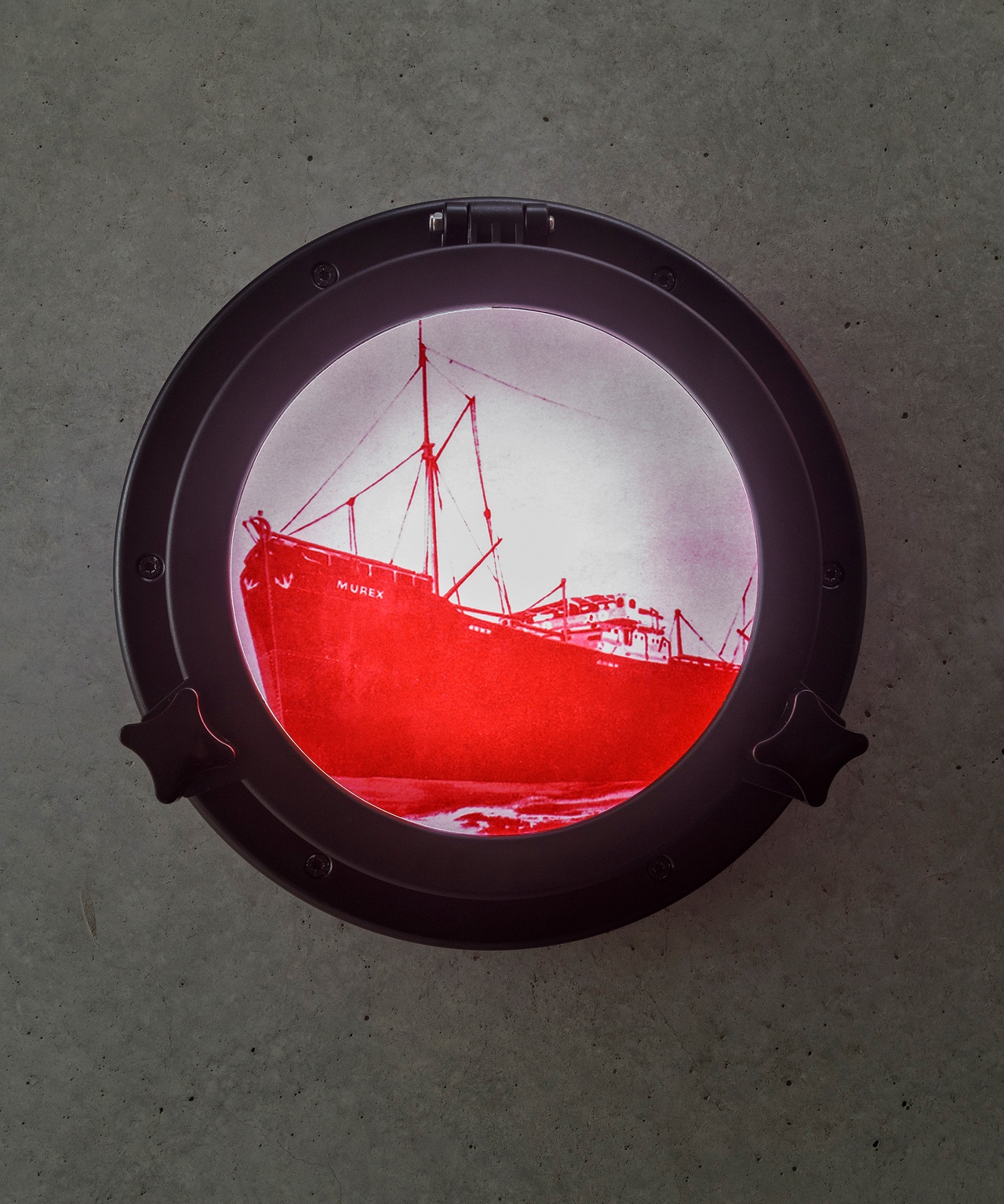
Monira Al Qadiri, “SS Murex,” 2023
As if to emphasize the degree to which our capitalist system is hopelessly addicted to and clumsily weaning itself off oil, Hero travels in the good company of eleven other oil tankers, though they are miniatures in comparison to its muralistic scale. What the smaller ships lack in size, they make up for in detail: They are handmade 3D models. Any resemblance to Nina Beier’s hanging ship installation Fleet (2024) is, fittingly, only fleeting. Unlike Beier’s cruise ship models, all installed at the same level and each carrying a surreptitious cargo of sand and sugar, Al Qadiri’s convoy of oil tankers, collectively titled Seasons in Hell (2025), is putatively carrying imaginary loads of crude or refined oil. Crucially, these ships demand unusual viewing angles, with some positioned at eye level and others in the depths of Al Qadiri’s reddened stand-in for the seafloor. Each bears a curious name: TRICKS OF MADNESS, SEA OF FLAMES, or PARADISE OF SORROW, to name a few. Some appear to bear two different names at their sterns and bows; a bright orange model carries the inscription INFAMOUS GLORY/RAVAGING SUN, while a red-and-black vessel nearby sports PAGAN BLOOD/VAGUE WAR at either end of its hull.
At this point, we have already encountered the second protagonist of the exhibition, the French renegade poet Arthur Rimbaud (1854–1891). All of the tankers’ names are borrowed from “A Season in Hell” (1873), an extended poem that was written and published by a barely 20-year-old Rimbaud just before he quit writing poetry entirely. In an adjacent room, we find more from the French poet; this time, a spoken adaptation of his poem “The Drunken Boat” (1871) plays over footage of old oil tankers being decommissioned and taken apart by hand via the beaching method used in the shipyards of Chittagong (Oh Body of Mine, 2025). The environmental cost, even beyond oil spills, is enormous, as various hazardous materials enter the local ecosystem with disastrous consequences for water systems, and so ultimately for plants and animals. Lacking sufficient ship recycling capacities for all vessels currently sailing under its flag, the EU recommends beach recycling in Turkey, but a majority of these ships still land in Bangladesh, from whence the deeply unsettling images in the film come.
“I am preempting the end of oil, I really want its reign to end,” the artist told me in an interview back in 2020. [1] “I’m trying to create monuments to this strange time because when it’s over we will have nothing to commemorate it by.” Her work has lost little of its urgency in the time since. If anything, her thematically consistent engagement has avoided predictability, thanks to the artist’s seemingly endless curiosity about oil; in every new work, a nerdy new twist, angle, or point of view awaits discovery. In 2023, she showed Gastromancer, which features two large red murex shell sculptures suspended in a red room. The work, not shown in this exhibition, explores the effects of TBT compounds on female murex snails, which have been observed to change their gender after exposure to the chemical.
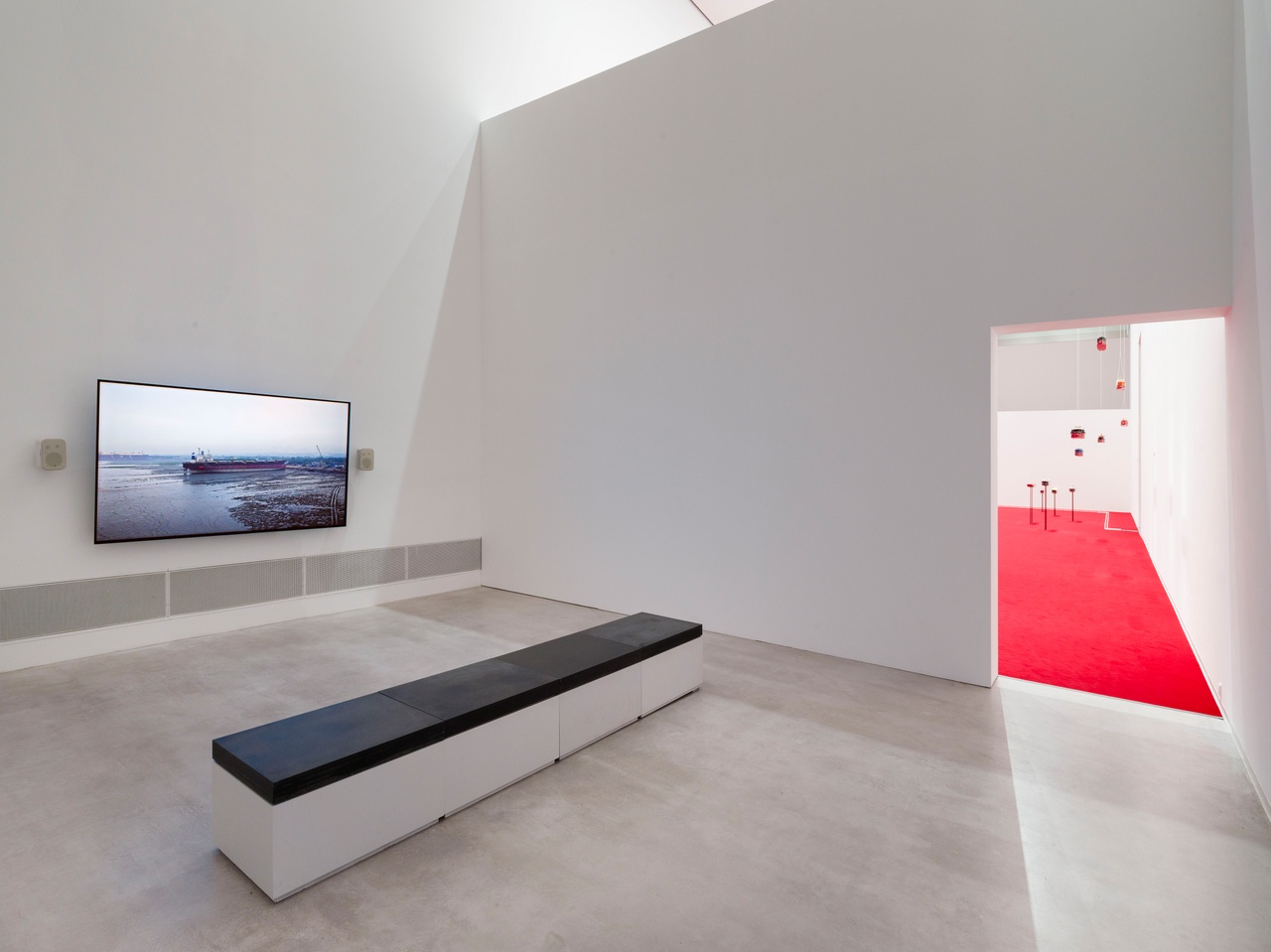
“Monira Al Qadiri: Hero,” Berlinische Galerie, Berlin, 2025–26
The murex snail makes an understated encore as the third and final protagonist of the present show. In the SS Murex series (2023), a line of lightboxes in the form of ships’ portholes are arranged along two walls. Each shows a tanker named after the spiky snail, whose shell was a popular decorative item in Victorian-era England. Alternatively, at least some will have been named after the first modern oil tanker, which was itself named after the aforementioned snail by the founder of the formerly Dutch, now British petro-multinational with a penchant for having a solitary scallop shell as its logo. While the murex’s name is now regularly emblazoned on tankers’ sterns, its fate remains submerged and unseen.
By the end of the present exhibition, it is unclear if there is a hero here at all: Is it the oil tanker, braving the waters to deliver the fuel that keeps capitalism running on time? Or is it Rimbaud, now rediscovered as the poet who found language around an ecological issue long before it became a cause? Or is it the murex, the namesake of a squadron of sea-conquering oil tankers, now left to endure potential poisoning by these very vessels? The poetry makes the earnestness of it all significantly more bearable than an official report about the hazards of shipping oil ever could. At the same time, the poetry tones everything down, perhaps diluting the exhibition’s key concern for the sake of palatability. Al Qadiri leaves one guessing about her own intentions, but the show makes it abundantly clear that lives – both non-human and human – are at stake. Visitors are at liberty to decide for themselves what life is worth saving, or simply leave bemused that century-old poetry has been put to such important use.
“Monira Al Qadiri: Hero,” Berlinische Galerie, Berlin, July 11, 2025–August 17, 2026.
Eric Otieno Sumba is a writer, independent researcher, and editor at Haus der Kulturen der Welt in Berlin.
Image credits: 1. + 3. photo © Roman März; 2. photo © Markus Tretter
Notes
| [1] | “Monira Al Qadiri on the End of Oil and Documenting Petro-Culture for a Post-Oil World,” interview by Eric Otieno Sumba, GRIOT, September 2, 2020. |