
GENEROUS REFRACTIONS Alice Blackhurst on “Salon” at Lismore Castle Arts
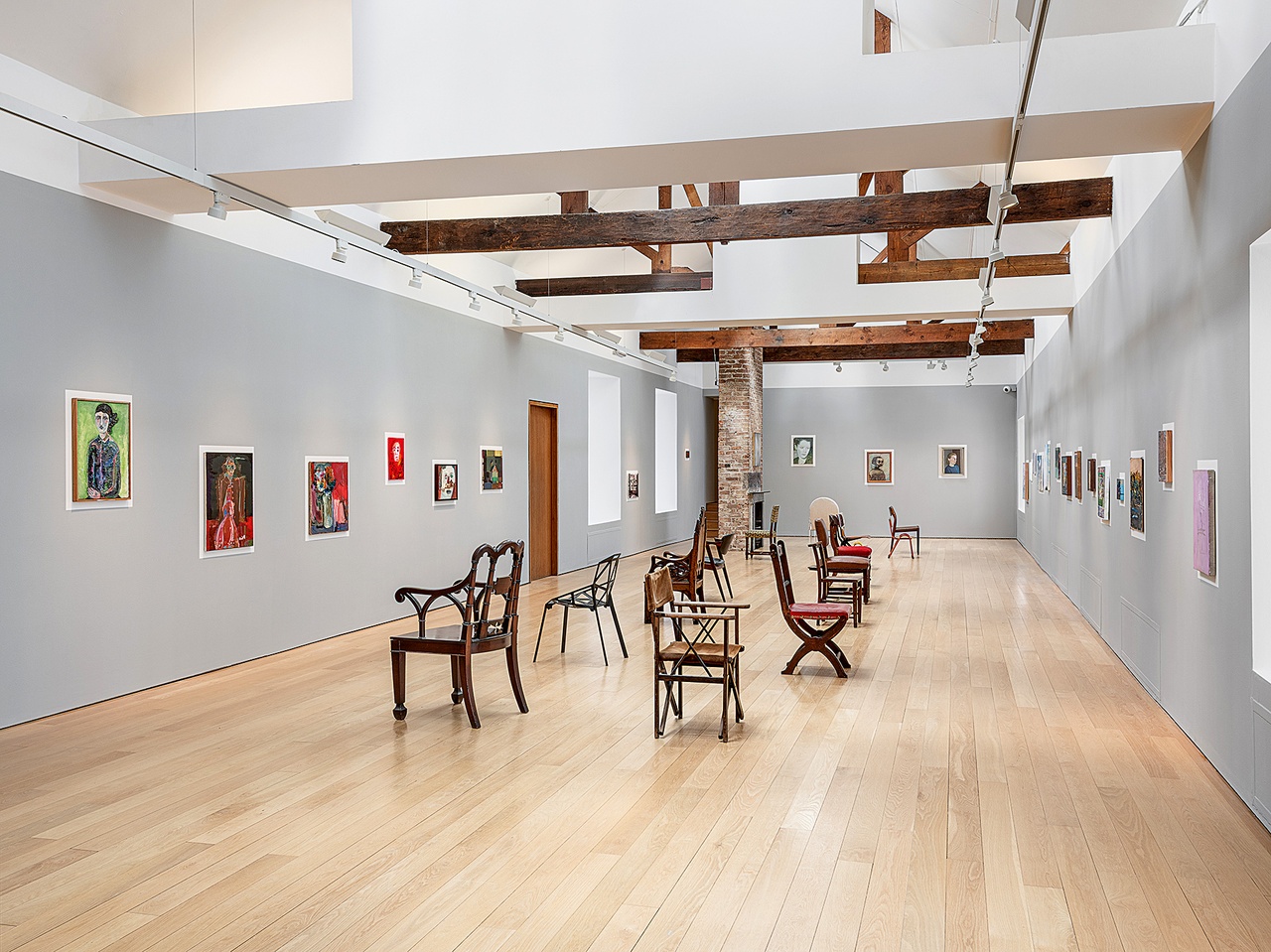
“Salon,” Lismore Castle Arts, 2026
In recent years, the capacious term and concept of the salon has been stretched over a range of cultural events and gatherings. In dialogue with the tradition of the illustrious Salon du Louvre as well as the early 20th-century Parisian urban model animated by popular salonnières such as Gertrude Stein and Natalie Clifford Barney, the idea of the salon has since been utilized to signify a range of gatherings trafficking in intellectual exchange and a collaborative vision of the arts. [1]
According to these loose criteria, fashionable book clubs, artistic workshops, creative residencies, and a slew of brand-adjacent events all have the capacity to be repackaged within the bracket of the “salon,” whose etymology, despite the myth now assigned to the word, originally indicated a humble hall or house before it evolved to connote a more expansive reception room. This progression in the term’s field of resonances – from the domestic to the communal – underscores both the concept’s mutability and its simultaneous ambivalence, oscillating between public and private space. The question of whom exactly the salon model serves, hosts, receives, and supports remains, to this day, a knotty one to answer.
A new group painting show at Lismore Castle Arts in Lismore, Ireland, curated by Matthew Higgs, takes its cue from the more inclusive, improvisational, and perhaps more generous aspects of the salon tradition, where – in interwar Paris, London, and Dublin, for example – amateurs could share space with established artists and try out new ideas outside of formal market economies. [2] Applying this idea to the realm of contemporary painting, Higgs’s approach to the cultural legacy of the salon is to gather 44 works from a heterogeneous, intergenerational group of artists in an intimate gallery comprising two rooms within the grounds of Lismore Castle, which was built in the 12th century on the site of a former ancient monastery in County Waterford. Lismore is now an established center for contemporary art (additionally hosting two off-site spaces holding permanent works by Roger Hiorns, Eilís O’Connell, and Franz West), and its spoils further include a Gothic Revival dining hall and ornamental landscaped Victorian gardens. This dramatic backdrop makes nods, perhaps, to the more flamboyant iterations of the salon model – such as Barney’s self-christened “circle of enchantment and inspiration” on the Rue Jacob in Paris and its flair for drama, spectacle, and display.
Titled simply “Salon,” the exhibition removes any definite article from its title thereby jettisoning expectations for definitive statements or grandiose ambitions. Most of the 42 painters exhibited – with the exception of Chantal Joffe, Caroline Coon, and Stephen McKenna, the only artist to have two works featured – are, in Higgs’s words, art-world “outliers.” [3] Inspired by the template of the “salon hang” – made famous by the Salon du Louvre’s maximalist ethos of cramming as many paintings as possible onto its walls, and where visitors had to resort to an accompanying livret to identify artworks – Higgs similarly dispenses with all wall labels and therefore any frontally explicit acknowledgments of authorship. The result of these omissions is to suggest a collective or collaborative effort, where the holistic “whole” is valued over individual “parts.”
Further, the deferential spacing between works typically witnessed in group shows of this nature – implemented to draw boundaries between artworks and to strictly avoid any confusion between different artists’ outputs – is renounced in favor of proximity between paintings. While the effect is not oversaturated (at least compared to the historic Salon du Louvre), this choice makes it difficult to appraise any individual piece without considering its links to others in the show. And these links are rarely obvious: For example, most viewers will not know that two exhibited paintings, Daisy (2025) and Kwitcherbellyachin (2021), are the products of a mother-daughter pair, the artists Karen Barbour and Daisy May Sheff, though their adjacent placement inescapably evokes a kind of filiation. “Salon” therefore becomes a meditation on aesthetic relationality and direct cross-pollination between works rather than a tepid buzzword or placeholder for the loose circulation of ideas.
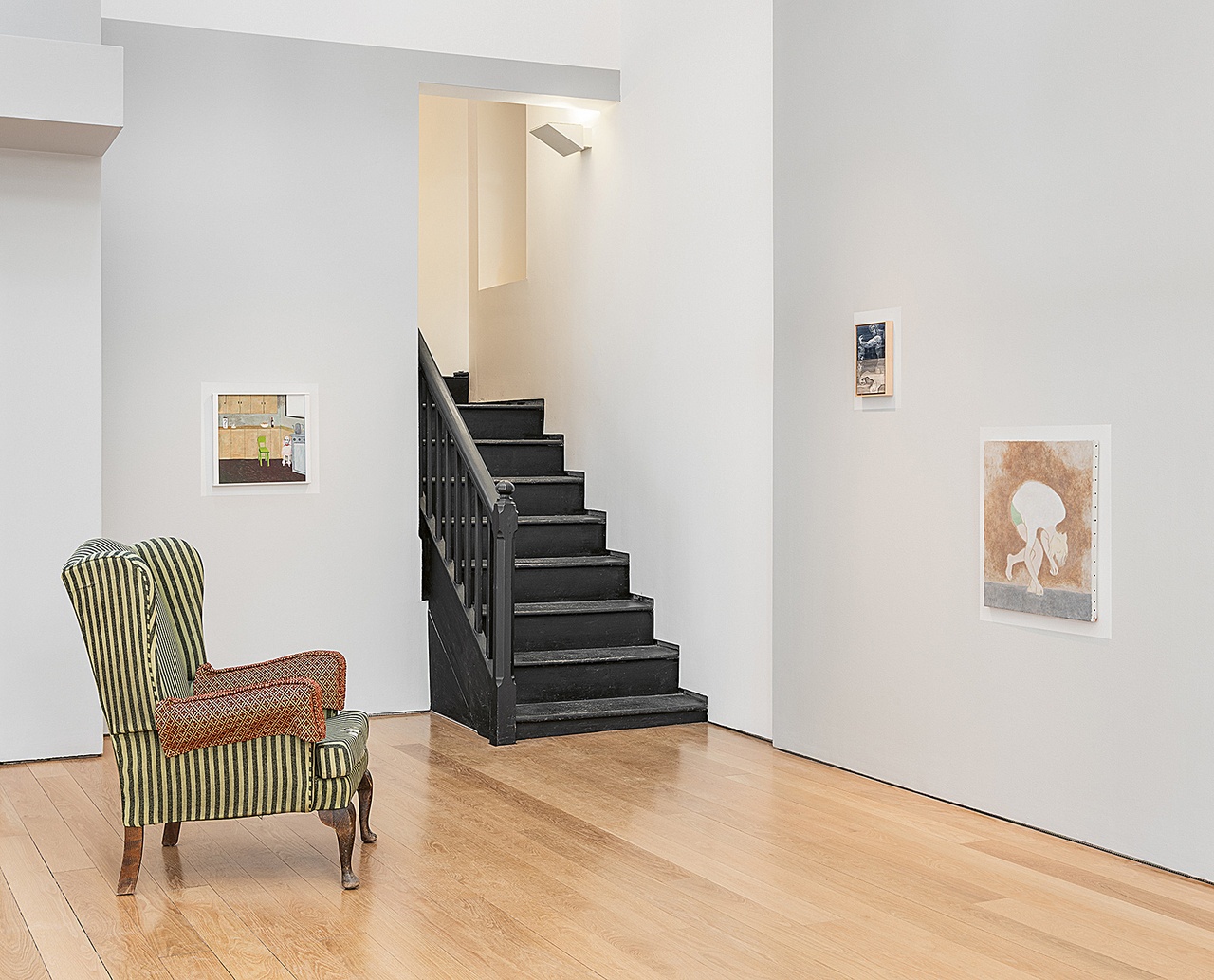
“Salon,” Lismore Castle Arts, 2026
Another way “Salon” departs from the established norms of the group painting show is via its incorporation of a diverse cast of chairs, locally sourced from Lismore, into the exhibition proper. Though part of the exhibit, these seats, ranging from stately parliamentary-style chairs to humble school stools to art deco bathroom furniture, come with the intention that the viewer use them to contemplate the collection of paintings from a sitting as well as a standing position. In shaking up the usual gestural politics that characterizes exhibitions of this manner – typically inciting a more kinetic walking through of rooms – “Salon” draws attention both to questions of accessibility and inclusion in contemporary art spaces and to Western culture’s generalized favoring of verticality, or of postures of “uprightness,” as Adriana Cavarero has written, over reclining, seated, or horizontal positionalities. [4] In most gallery contexts, the seating is either rendered as neutral and homogeneous as possible – designed to fade into the general install – or even obscured as a design feature, discouraging easy usage. The way the chairs are organized in “Salon” – sometimes directly facing the walls yet more often arrayed at an askew angle – in addition to the singularity of each chair’s aesthetic features, rejects any impartial position. It elicits presence: a rooting-into of the specific time and space of this intentionally artful gathering and a slower contemplation of the works curated to arrest our gaze.
The exhibition’s focus on communality and on dissolving individual authorship into a more plural assembly should not discount the richness of the paintings selected, many of which justify careful study. The works are mostly of a figurative nature, with a robust representation of florals (Coon and Carole Gibbons’s vivid contributions), clouds (by McKenna, Verne Dawson, and Na Kim), still lifes (Mike Silva, Jennifer J. Lee), and portraiture (Amy Sheffer, Alastair MacKinven, and Elizabeth Magill). Pádraig Timoney’s Broken Mirror for Glas 3 (2023) tilts a gloomy Irish landscape and its iterative wash of grays into more abstract territory. The placement of the work – hung above a fireplace to nod toward its trompe l’oeil of a looking glass – reminds the viewer to keep looking out and not to expect any easy reflections of the artist’s, or the curator’s, aims. Rather than smooth reflections, “Salon” instead generates refractions. A lineup on the back wall of three portraits – by Kaye Donachie, Denzil Forrester, and Diana Cepleanu – of three subjects, all positioned to gaze in the same direction, evokes Richard Prince’s photographic triptych Untitled (Three Women Looking in the Same Direction) (1980) yet lends new texture to the reference via painting’s haptic sensualities.
Higgs’s sole focus on painters at his “Salon” somewhat restrains the potential for interdisciplinary dialogue, even if several of the works reference other art forms and modalities. (David Byrd’s Woman Stooping [2012], painted following the artist’s time spent working at a mental asylum in New York, evokes classical marble sculpture, and Margot Bergman’s Bait [2002] transforms the found object of a thrift-store canvas-board painting into a Cubism-inflected portrait of a face via additional brushwork). Yet constraint, as well as the lived coordinates (and sometimes limitations) of working as an artist, is an important motif within the show. Many of the pieces were produced within domestic contexts as opposed to bigger studios, and the only larger-scale painting is the late MacKinven’s Untitled (2019), shown in the second, windowless room at the rear of the gallery, where the absence of any natural light magnifies the piece’s matte, meditative poignancy. In the same room, a spectral intimacy haloes works such as Caroline Walker’s Night Change (2022), a tender portrait of a mother and an infant (furthering the exhibition’s interest in showing depictions of parents and their children), and Magill’s John & Yoko (2023), a lush depiction of the famous couple looking out onto a nocturnal New York scene, and inserts a shadow chamber within the exhibition’s otherwise more colorful tumult of works and chairs.
The productive dissonance that “Salon” weaves amid its constellation of singular paintings – none of which conform to any fixed or stable idea of what painting should be – ultimately might evoke the “counter-salons,” or salons des refusés, that formed in 1863 as a response to the Louvre’s more sanitized, official gatherings, to give the pieces rejected by the official jury another chance at exhibition and exposure. Such counter-spaces, in wanting to provide alternative reflections and indeed refractions of the status quo, resonate with Michel Foucault’s famous definition of heterotopias as contexts that “presuppose a system of opening and closing that both isolates them and makes them penetrable.” [5] In today’s fickle economy, tying the idea of a salon to a new exhibition might furnish an alluring, penetrable hook to attract culturally savvy audiences. Yet Higgs’s “Salon” does not court the concept in a brittle, superficial manner. It succeeds, much further, in establishing a space for lesser-known positions and for our engagement with them, something that is becoming increasingly rare in the economically strained art world. This “Salon” isn’t interested in mere footfall. Instead, it endeavors to make viewers sit and stay.
“Salon,” Lismore Castle Arts, April 25 – October 25, 2026.
Alice Blackhurst is a writer and critic based in Paris, where she is currently lecturing at the Department for Comparative Literature, English, and Creative Writing of the American University in Paris.
Image credit: Courtesy of Lismore Castle Arts, photos Jed Niezgoda
Notes
| [1] | To name just a few examples: Salon D’Été (Paris); the European Writers’ Salon (Madrid and various locations); the London Literary Salon (London); the Literary Saloon (New York); Salon Rógaire (Dublin); and Studio Salon (online). |
| [2] | See, for example, the New Irish Salon from 1923 in Dublin, the Nardal Salon in Clamart, just outside of Paris, and Holland House in London. |
| [3] | Conversation with Matthew Higgs, April 25, 2026. |
| [4] | Adriana Cavarero, “Recritude: Reflections on Postural Ontology,” Journal of Speculative Philosophy 27, no. 3 (2013): 220–35. |
| [5] | Michel Foucault, “Of Other Spaces,” Diacritics 16, no. 1 (1986): 22–27, at 26. |