

AIR CONDITIONS Alex Bennett on Grant Mooney at Chisenhale Gallery, London

Grant Mooney, “Untitled,” 2025
My first visit to “sphere music,” Grant Mooney’s solo exhibition at Chisenhale, coincided with the gradual withdrawal of Storm Amy, a record-breaking extratropical cyclone that dissipated over London. As if by aeromancy, the synchronism served Mooney’s amorphic material system, making palpable its interfacing between atmospheric conditions and their atomized behaviors. Within the storm’s loosening eye, airflow created a space of pressure in the interior double doorway of Chisenhale Gallery’s exhibition space – a compressed suspense resulting from Mooney’s removal of all 126 glass panes from the high windows that span the gallery’s far wall. As one of five works featured in this spare exhibition (all 2025), these incisions mobilize the influx of air, light, vapor, and other molecular mixes into this former veneer factory, allowing interior and exterior weathers to become involuted. [1]
As permacrises evolve, meteorological phenomena have become inextricable from the social and structural conditions of global power’s fossil-fueled desires. Astrida Neimanis identifies weather as both a “context and milieu” that manifests “external conditions that structure one’s quotidian existence,” with irrevocably embodied implications. [2] Our intra-acting atmospheres attest to weather not as extrinsic, then, but as always already “anthropogenic,” [3] circulating as lived abstractions that both pervade and exceed our field of experience. Even the air qualities of atmospheres are asymmetric distributions, reterritorializing weather as microclimates that drift unevenly within, through, and outside us: impurities, gases, and pressures rolling in on the weaponized breeze. As “the weather actually becomes us” [4] in this naturalcultural system, we, in turn, internalize the weather by weathering its increasingly conditioned expressions.
Analogous to weather*ing*, Mooney’s sculptures perform their own kinds of transitivity, taking in the ineffable energies of spatial atmospheres as their direct objects. With the removal of the gallery’s windowpanes, Mooney deregulates the climatic control that is usually a given of interior environments, where stabilized temperatures and humidities diminish the risk of overexposure or degradation. If, as Lev Bratishenko and Melanija Grozdanoska write, air conditioning in exhibition environments is a mode of climatic disciplining that restricts unruly embodiments as much as it organizes “an attempt to slow down time” [5] by delimiting extra deterioration, then Mooney’s embrace of atmospheric infiltrations convolutes timescales. While galvanizing the immediate environment, fluent aeration carries with it the charge of other, more distant meteorological streams. Every cut pane brings into relief the making of an inside and an outside at once, distinguishing the boundary between them as not inherent and isolable but dynamic and contextual. As the storm spills into this space and temporalities of weathers permeate, Mooney aids viewers in acknowledging the difference between weather and climate. The eco-philosopher Timothy Morton distinguishes this difference in his theorizing of the global climate system as a form of “hyperobject” – that which exceeds human perception in its massive distribution yet exerts real effects on one’s world. Asserting that “we are always inside an object” [6] – most profoundly our ecological fallout – Morton’s theory derives from object-oriented ontology (OOO), an anti-correlationist philosophy that insists on the primacy of objects, things, and matter: Everything is an object that has a life beyond us, and by consequence, our subjective apprehension of perceived objects remains utterly partialized. In particular, Mooney’s gesture brings into relief the climatic hyperobject’s dilution – what Morton terms its “phasing” – into the perceptible and locatable experience of the weather, in this case a cyclone. “In the mesh of interconnectivity, the sieve through which hyperobjects pass,” he writes, “smaller things become indexes of the hyperobjects inside which they exist.” [7] Weathers are thus decanted essences of higher dimensional climates, yet Morton’s conception of regional weather is not only symptomatic of global warming. For weathers are also felt through their faintest trace, like “this delicious sensation on my arm”; our multiform weathers thus expose “how the whole is always less than the sum of its parts.” [8] Emanating the energies that produce them, Mooney’s sculptures invoke these smaller things that likewise index, or hold together, exchanges of phenomena as mutually constitutive.
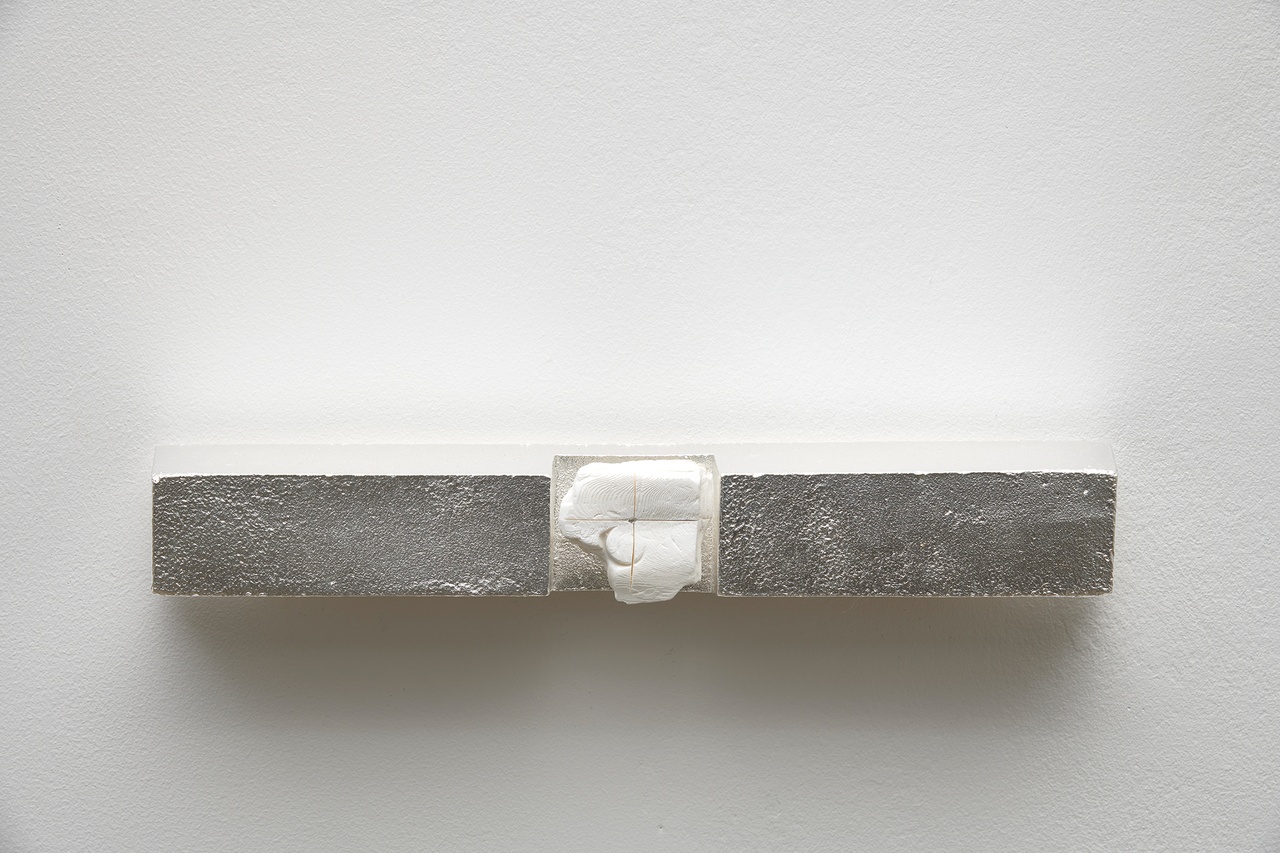
Grant Mooney, “Fe.(i),” 2025
That this unglazed space, felt through the slimmest effect of a stressed threshold, would condense a more situated awareness of the volatilities within betweenness is a Mooney signature. The economies of form that typify his graceful materialism are belied by latent, slow-motioned behaviors – resistances, dispersions, revealments – that configure sculpture as an expanded conductor of permeability and phenomenality. While partly related to OOO’s argument that objects have intrinsic capacities, Mooney’s attunement to the dynamism of material entities abridges the materialist philosophy within systems that animate relationality, avowing the many networks that structure relationships with the object world. This proximate understanding of the contingent nature of form itself can be traced back to Mooney’s study of metalsmithing and jewelry making. Techniques associated with this trade are themselves characterized by causative shifts: sanding, condensing, filing, casting, soldering, polishing, etc. Privileging these interactions for their ability to disturb essentialisms of form, Mooney realizes an atomized sculptural intra-action that affects the objects in situ and the bodies passing through.
Nowhere is this more charged than in the infinitesimal immersivity of the diminutive Fe.(i). Occupying the wall furthest from the entrance, the work comprises a centered fragment of cuttlebone that is recessed into a cast-iron ingot electroplated with silver. Commonly used as a material for casting metal, cuttlebone’s mineral composition is determined by the conditions of the seawater in which the cuttlefish in question existed, endowing both material and technique with singularity. Here, Mooney ennobles a study of cuttlebone as an ornamental subject in itself: the topographic delineations of its chalky surface are modulated in ultrathin increments, allowing it to scintillate in the shifting light. The parenthetical metals also disrupt material integrity: over time, the electroplated silver will oxidize, reflecting greater adherence to its atmosphere by changing color as it registers exposures to air, light, and moisture. Differences will accumulate to vivify continuity. Activations are at their most pronounced in Fe.(i), its surface dimensioned as not merely a boundary but a site of intractable multiplicities. Since this fishbone arrives, à la Morton’s phasing, as also an indexical relic of warming waters, Fe.(i)’s pressured intimacies – its tightening of reactivity via the fusion of seemingly opposing materials – brings a pang of perviousness to matter and to mind, insisting on a “realer real” [9] that diagrams energies beyond itself: acidifying seas; toiling currents; resuspending sediments; prickling spindrifts.
As a demonstration of forces, “sphere music” inhabits specificities of form as it overflows or undoes this same form. The oblong space is commanded by two disassembled low-speed industrial fans, Stalls (r.) and Stalls (r.) ii, which osmose the formal strategies of Minimalism. Spread across the floor, two immaculate rotary motors face the entrance, their cables neatly wound, while the corresponding blades are stacked in threes and fanned out like wings. Every component has been treated to exhaustive techniques of refinishing and reshaping. Freshly lustered, the brushed aluminum steel blades reflect light in washy yet filamented ways that verge on chatoyancy; countless hairline striations contour each blade’s deft fold, as if sheets of heavy metal were but taut spools of fine wire. Decoupled from use, these fans are deprived of the legibility of their former life, one that might have had them integrated into this building’s very infrastructure. Instead, their arrested mobility, lateral placement, and excessive treatment introduce, as artist Richard Artschwager put it, “breathing space” that oxygenates the object’s possible meanings. [10] Excess of presence makes the fans’ absented conductivity more apparent; without their rotary power, the Stalls recircuit what Mooney terms a “character of action” that catalyzes preconditions for indeterminacy, revealing a dialectical intertwining of excess and permanence, difference and coherence. As such, Stalls deviates from the “literalist” specter of Michael Fried’s infamous essay on Minimalism and transmits emphasis elsewhere; namely, to the space between reduction and rotation that these gleaming surfaces evidence. Caught between the material world and its rhetorical abstraction, the Stalls reverberate with their own poetics, which transpire, to quote literary theorist Viktor Shklovsky, from a “blizzard of associations.” [11]

Grant Mooney, “Stalls (τ.),” 2025
Despite escaping formalization, the fact that these fans are found objects remains significant. In part, it situates aspects of Mooney’s practice within lineages of the assisted readymade, in which he restores an earthly abidance, grounding the object as a site available to physical processes that eschews the found object as a merely fetishized encounter. The undone materiality and inverse densification of surface across the Stalls at once unsettle and reaffirm their constitution. It is to make, per Shklovsky, the “stone stony.” [12] Mooney’s investment in site-responsiveness nuances this engagement. For this exhibition, he spent six months in the city and met with several industrial fabricators, including a metal foundry established in 1880 that was local to the gallery. The resulting network of collaborators enables a process of production that puts one (the artist) into a dependent relation to others; by engaging with the artisanal craft of metallurgy (upon which foundries depend), Mooney stays close to the embodied labor of skilled practitioners whose knowledge circulates as an informalized oral history. Affirming that subjecthood matters as much as the independence of objects might, this inherently socialized process leverages greater relational depth in the creation of works that in themselves metonymize modes of relational becoming.
Using the force of wind as a form of sonic release, the titular work of “sphere music” arrives without obvious audibility. In collaboration with the artist Winona Sloane Odette, Mooney installed an aluminum wind harp on Chisenhale’s roof; its vibrations are visualized via a spectrogram on a monitor affixed to the gallery’s ceiling. As a work that is self-composing in its most elemental mode, filiations with “anti-form” practices within Minimalism (which privileged the immanent properties of materials) are discerned in how Mooney tunes into the vibrational as a way of feeling the materiality of sound. Vibrations are frequencies are dependencies: they afford connectedness because sound moves between and brings into contact objects, bodies, and their spatial parameters. The harp’s infrasonic, authorless, and extradiegetic score is imaged by the spectrogram in corporealized pulses of reds and yellows. In taking the aerodynamic pulse of the building’s mercurial atmosphere while registering the surrounding airflow as a sonic capacity, Mooney brings the physical conditions of the building into acoustic relief and shapes the space in its entirety as a latent instrument, even if the fugitive winds are present as a dissident visualization of hearing otherwise.
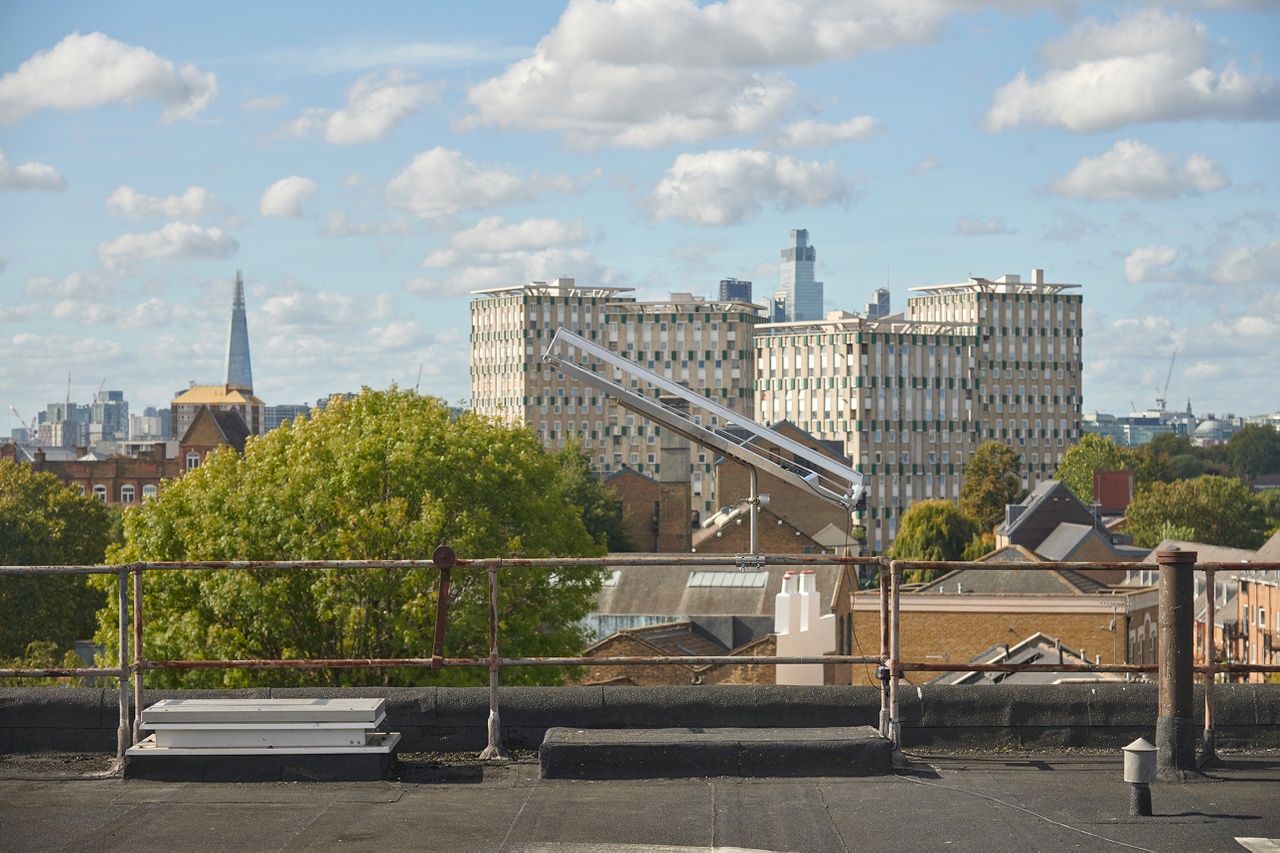
Grant Mooney, “sphere music,” 2025
In the exhibition’s notes, Mooney cites the notion of “panaurality” or an “all sound,” as described by theorist and historian Douglas Kahn, which hypothesizes planetary rotation as a pervasive sub-subliminal resonance. Orchestrating the universe as a kind of sonic fossil might risk quieting the situational particularity of vibrations and weathers alike; the horizonal thereness and risks of infinitude in “sphere music” are seemingly dependent on the thin airs of viewers’ faith. But as with weathers and vibrations, this would forget our implicit enmeshment within Mooney’s system, which composes the possibility of feeling in common. “We share the air, share the night, share time, too – and share, so often, the degradations of all three,” Anne Boyer writes. [13] With Mooney’s conveyance of air as an anatomy of possibility, deliberately frustrated legibility is used to shape affective presences that afford one a sense of both being here and elsewhere. It is about distance as a metric of relation that is always already in the air.
“Grant Mooney: sphere music,” Chisenhale Gallery, London, September 26–December 7, 2025.
Alex Bennett is a writer and critic based in London.
Image credits: Courtesy of the artist and Chisenhale Gallery, photos Andy Keate
Notes
| [1] | Incidentally, flurried airstreams had whipped at the pulverulent ceiling, its synthetic disintegrations snow-dusting the concrete floor. |
| [2] | Broadening conceptions of “the weather world,” Neimanis draws on discussions from scholars including Christina Sharpe and Kristen Simmons that conceive of climates not as reducible to single events but rather as rooted in “matters discursive, structural, material, and environmental.” Astrida Neimanis, “The Sea and the Breathing,” e-flux Architecture, May 2020. |
| [3] | Ibid. |
| [4] | Roni Horn, “Writing: Weather Reports You,” Artangel, February 2007. |
| [5] | Lev Bratishenko and Melanija Grozdanoska, “The Weather,” e-flux Architecture, February 2022. |
| [6] | Timothy Morton, Hyperobjects: Philosophy and Ecology After the End of the World (University of Minnesota Press, 2013), 17. |
| [7] | Ibid., 77. |
| [8] | “Four Questions for the Author: Timothy Morton, Being Ecological,” Orion, September 22, 2018. |
| [9] | Tavi Meraud, “Iridescence, Intimacies,” e-flux Journal 61, January 2015. |
| [10] | Artschwager’s much-cited quote originates in a conversation with Jan McDevitt in “The Object: Still Life,” interviews with Richard Artschwager and Claes Oldenburg by Jan McDevitt, Craft Horizons 25, no. 5 (1965): 30. |
| [11] | Viktor Shklovsky, Knight’s Move, trans. Richard Sheldon (Dalkey Archive Press, 2005), 70. |
| [12] | Viktor Shklovsky, “Art, as Device,” Poetics Today 36, no. 3 (2015): 162. |
| [13] | Anne Boyer, “The Heavy Air,” The Yale Review 108, no. 4 (2020): 34–43. |