

“I THREW AWAY THE REINS / BECAUSE THERE WERE NO REINS” Bruce Hainley on Trisha Donnelly at the Drawing Center, New York, and Tower MMK, Frankfurt am Main
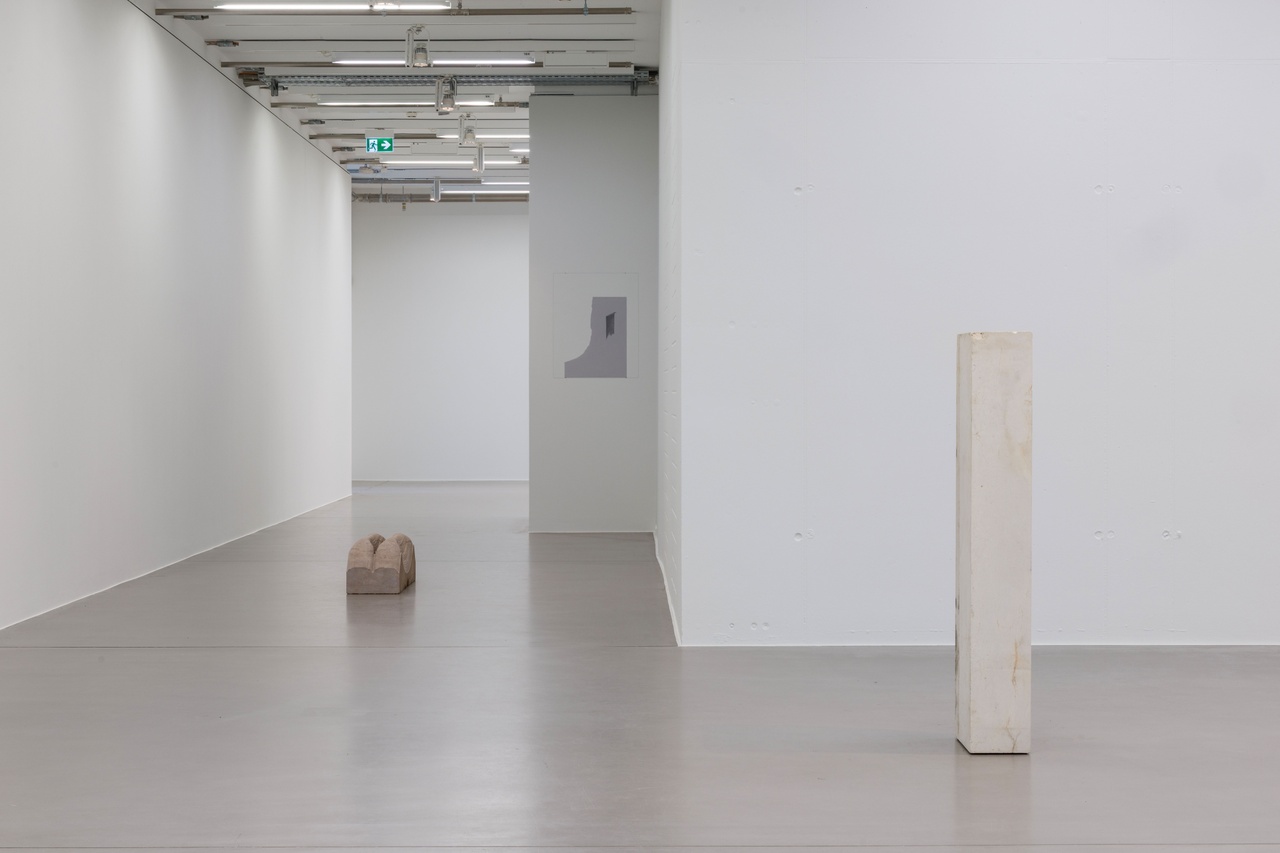
“Trisha Donnelly,” Tower MMK, Frankfurt am Main, 2026
Now where was I?
I had aimed at an even colder open. Because love is colder than death. Certainly, things weren’t going to start with anything about an early untitled video of Trisha Donnelly’s, her figure rising into midair with her hair a mane to arrive at an iconic pose of an infamous musician (Aaliyah, for example), only to fall out of frame before rising up again for another pose. The anecdotal nature of an early work deployed to set up some kind of critical parley remains a moth-eaten tactic, and I have little interest in arguing for how rising and falling – gravity, as fundamental force, solemnity – how some alluring of the ecstatic courses through her work, or how the sign in all its specificity is suspended. However, I like moths. I like the word, moth. I like the moth in mothering. Conveniently, the video can accentuate how much preparation and postproduction (forethinking and groundwork) that led, that leads still, to her series of gestures in silence (pre-handheld devices, pre- so much of what they entail, and yet, proleptically, projected at that scale, in color) remains invisible: the professional-sized trampoline, tests that led to the placement of the camera, decisions for no sound, for slow motion, etc. The labor and doubt that whet the marvelous were never her point or even her pursuit but persist as no small part of her tact. Such tact. Ballasting, despite the ongoing American destruction, ignorance, and vulgarity of this moment. Which is why, when the opportunity to see the artist’s dual exhibitions (in collaboration with two of the most compelling and compellingly different curators, Olivia Shao in New York, Susanne Pfeffer in Frankfurt) arose, I wanted to consider the shows as if they could become – however mistakenly, across oceans, time zones – projections of one another. I say there were two exhibits, but, of course, as Lydia Davis long ago schooled anyone paying attention, in her translation of Maurice Blanchot’s La folie du jour, “because there were two of them, there were three.”
1
In Manhattan, mostly works on paper, all glazed (panes usually held in place by tiny nails, permitting animals to be in the galleries), the majority lined up, drawing after drawing, in two rows (one with almost three times as many works as the other) hung on opposing walls of the gallery. For some the artist used pencil or graphite and colored pencil, elsewhere a “mixed technique,” and for still others she placed “isometric tracing paper” on top of nontransparent paper, making it difficult, at times, to discern exactly what came before what. An especially provocative configuration proffered a small sheaf of drawings in a plastic document sleeve dangled on top of a somewhat larger drawing; point-blank, most of what was resolutely present, there but protected, remained, if not invisible, unavailable. More than a few of the works appeared to be sui generis contour drawings (one of folded sunglasses [?]), while not readily legible words or runes or characters organized others. There seemed to be instances in which forms and figures set forth in those of her videos arose. Gravity and/or its resistance could be felt in all the lines.
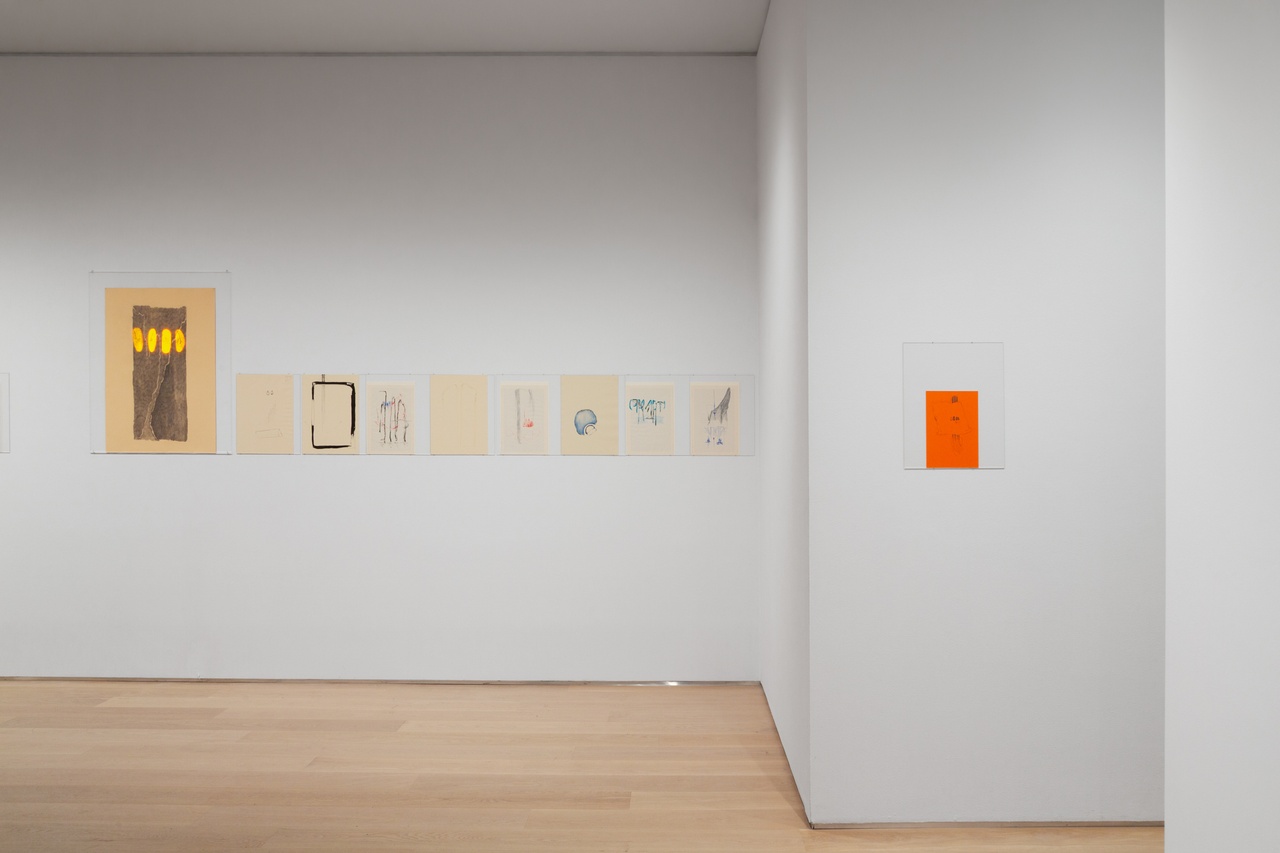
“Trisha Donnelly,” Drawing Center, New York, 2026
Additionally: a poster-sized print (perfect for a teenager’s bedroom); a low, green stonework of Verde Lipsia marble honed into a soft-edged, rectangular prism, one side of which featured an undulating line of carved indentations between pockets of carved clusters of what I’ll call negative gills; and a hybrid-combine video-drawing, the video seemingly helping to hold the drawing – an outline of a sort of slender, gently tapered obelisk (?) or blade (?) or file (?), “pinched” or “grooved” about a quarter down from its top – to the wall. While the dark pencil lines making up the central object float it in the middle of the paper, it’s actually enfilade, with a cascade of similarly shaped sketches receding in faint (and feinting) outline, echoing or sequencing or phasing into perspectival deep space. The objects point attention to the lower left of the paper, where a projection “beneath” them silently whirs, gloaming of bobbed twitterings Jean Painlevé would have loved, teenage plankton at a discotheque. (This remarkable invention from 2010, a study of marking, drafted as well as projected, proves an early test or version for later combinatory works in which the artist casts a “still” video image directly over and in line with a digital print of what is being projected.) In a contiguous exhibition (three because there were two; c.f. Blanchot, above), “Voice of Space: UFOs and Paranormal Phenomena,” also organized by Shao, Donnelly’s audio-CD recording Untitled (Bells) (2007) pealed, near a recent drawing in ink, graphite, and colored pencil, blue, canary yellow, grey, deliberated fallings, risings, around (or accommodating) a quasi-ocular gape or void. This separate group exhibit displayed, near its starting point, the second part of Donnelly’s syncopated diptych, Untitled (Drawing through the Wall) (2004), radiating blue, fringey, cosmic rays, para-Kirlian, surrounding the absent form depicted in its other part, which hung, two galleries away but directly in line with it, at the entrance to the Drawing Center’s galleries. To see Donnelly’s works in the context of this “flying saucer-less exhibition” about “contact between the known (the self, in many cases),” as Laura Hoptman acknowledges in the preface to the show’s tight catalogue, “and the unknown (the Other in any guise),” however much we remain others to ourselves, proved elucidating: a genealogy between speculation and evidence, Stanley Brouwn’s ink-stamped instruction to “USE THIS LIGHT/ brouwn” and an Arapaho ledger book visionary drawing attributed to B Henderson, in which the eyes of a deer or coyote are connected by orange buzzing lines of energy with the sun while emitting blue electric between it and a floating figure held in something like a papoose-rocket. Correspondences between the two shows looped into feedback, even (somewhat) contextual feedback, but not solution. Without going through (even if not working through) Donnelly’s exhibition, there was no way to reach “Voice of Space” – and its part of Untitled (Drawing through the Wall) sent you back out through her exhibition to what operated as preface or prelude to both shows: the poster-like print of a partially shadowed lunar sphere in a digitally rendered aesthetic, floating in space similarly grey but punctuated, below the “planet,” by a vivid electric red glyph, and, then, the initial part of Untitled (Drawing through the Wall), its dense pencil strokes soft as mole pelt, its shape something seemingly (hip?) bonelike and/or driftwoodlike, yet leathery, perforated, equestrian.
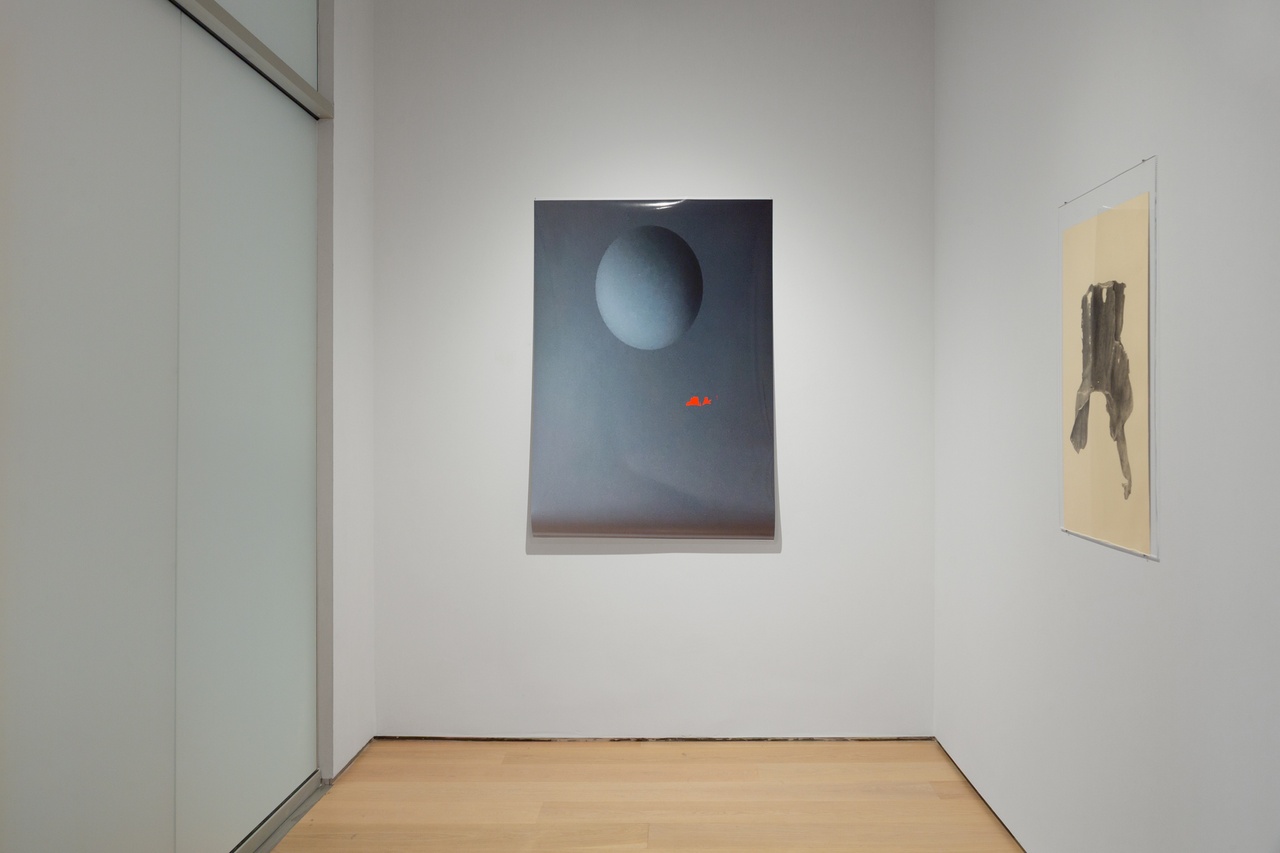
“Trisha Donnelly,” Drawing Center, New York, 2026
At this point, I feel the need to séance Antonin Artaud. “It is no longer the astral world, it is the world of direct creation that is taken back here beyond consciousness and the brain.” Which was something AA stated not long before he decided to transform (or be transformed?) into “one enormous white stone on the boulevard de la Madeleine, at the corner of rue des Mathurins, as if fired from the recent volcanic eruption of Popocatépetl.” Those two Paris streets do not actually intersect, but perhaps his point is that they could be construed or excruciated to. Given such spatial dynamics and Popocatépetl imponderables, recall AA’s underscoring of the givens an artist can disrupt, especially in light of Donnelly’s Untitled (Drawing through the Wall) spanning her own drawing enterprise as well as exemplars of the paranormal frequencies of “Voice of Space.” In Van Gogh le suicidé de la société, the jeremiad in which Artaud grapples with astral worlds, eruptions, and representation, AA italicizes part of a letter from Van Gogh to his brother Theo, dated October 22, 1882: “What is drawing? How do we achieve it? It’s the act of working one’s way through an invisible iron wall that seems to stand between what we *feel *and what we can do. How must we go through that wall, for it is no use hitting it hard? It seems to me that we must undermine that wall and go through it with a file, slowly and patiently” (in Catherine Petit and Paul Buck’s translation).
In Frankfurt, at the TOWER MMK (which from the outside, not incidentally, appears to be an office building), various stone works, drawings, analog photography, video, combinatory devices of both photography and drawing as well as video and digital photographics, water, embroidered cotton, evergreen offerings, and office furniture. For example: The Secretary (2010), a wooden desk. The voice of the Tower’s audio description, accessible via QR code, relays: “A solid, cognac-colored desk is standing all on its own in the middle of the room. No other installations have been placed nearby. In fact, they are only visible from a distance. If you stand close to the outside edge of the desk, facing the work, the window ahead of you comes into view. Depending on the lighting conditions within the venue at the time, it either reflects the interior space or provides a view of the outside.”
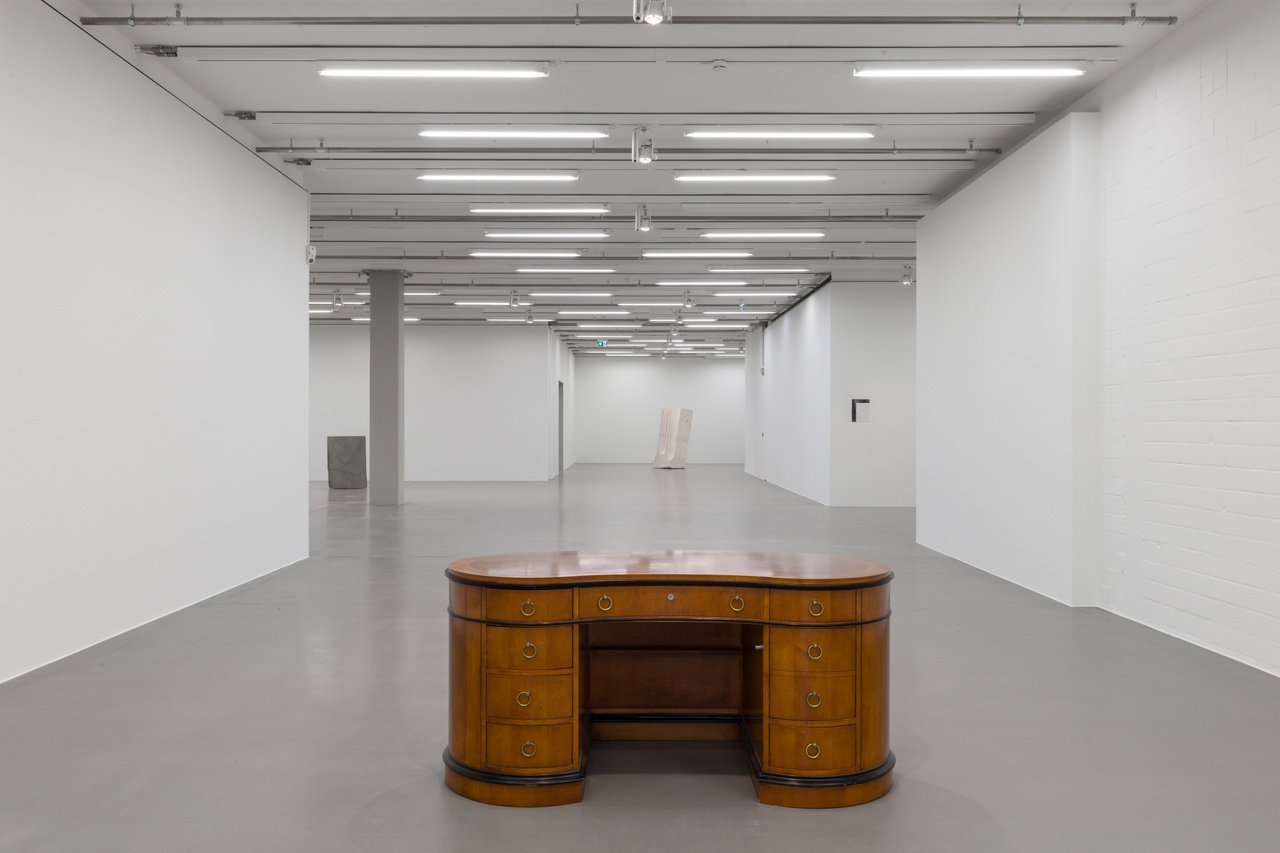
“Trisha Donnelly,” Tower MMK, Frankfurt am Main, 2026
Let me reconnoiter for a moment. A mental moment. This matter of accessibility in relation to an artist about whom the dopey narrative continues on, drooling, that she’s somehow constantly saying “No,” that hers is an art of refusal, with her pursuits slotted as obscure, resisting categorization or easy reference, resolutely otherworldly, mysterious. Basta! Which isn’t to say that the male voices relaying descriptive information about the works on view detailed every little thing (there was no mention, for example, of a second keyhole tucked in the knee-space of the desk) or that with such direct description anyone should abandon thinking for themselves. For both solo exhibitions, detailed, artist-approved (or -provided) information and descriptions were supplied via museum accessibility programs: At the Drawing Center, the artist led one of the TDC’s ASL DrawNow! workshops, for which Donnelly, assisted by two ASL interpreters, gave a tour of the show, work by work, open to all questions, translated between those fluent in ASL (the majority) and those who, like the artist, are not; at the Tower, half of the works had detailed audio descriptions, to help alleviate physical, sensory, and cognitive barriers. To be clear: These initiatives were not art and were not performances. See this decision as a way of emphasizing translation as foundational to artistic perception, reception; acknowledging the “foreign” (the “unusual,” even the “unnatural” and “unspeakable”) as determined by vantage. Who isn’t foreign to someone – even to oneself? And in this vicious moment of rabid anti-immigration, shouldn’t everyone be embracing as many alphabets, as many communicative modes, as possible? Something is always lost in translation, and art is a management of various kinds of loss, although it is not only that. Note the drawing tucked away in the Tower with part of it torn away – or the drawing on top of the photograph, hiding being seen. The decision to employ various kinds of museum accessibility structures throws away the reins of so many tired tales about the artist’s methods and affects. Tales flush to no small degree with misogyny. Reconnoitering, cont’d: “History can be at once concrete and indecipherable. Historian can be a storydog that roams around Asia Minor collecting bits of muteness like burrs in its hide. Note that the word mute (from Latin mutus and Greek μύειν) is regarded by linguists as an onomatopoeic formation referring not to silence but to a certain fundamental opacity of human being, which likes to show the truth by allowing it to be seen hiding.” Art objects have an ongoing, special relation to such muteness, and this passage from Anne Carson’s Nox demonstrates that being seen hiding isn’t the same as hiding. What thinking person isn’t resistant to and more than a little skeptical of so much of the explanatory, educational folderol of what has become habitual in the art-entertainment industrial complex? Donnelly hasn’t even been mute – she’s ruthlessly explicit, and has been for over two decades. To make new work for close to 50 solo gallery and institutional shows in 25 years, to haul tons of precisely carved stone into a gallery, this labor, however else it might be interpreted, is hardly an act of refusal. Makes me flash on her early color photograph Blind Friends (2001), for which the artist instructed a large group of bundled-up unsighted people on a beach to walk in the wind’s direction and pictured them heading off every which scattershot way. In terms of vision, sensing, or following instruction, who is more “blind”? Those depicted or those looking at the picture?
“Trisha Donnelly,” Tower MMK, Frankfurt am Main, 2026
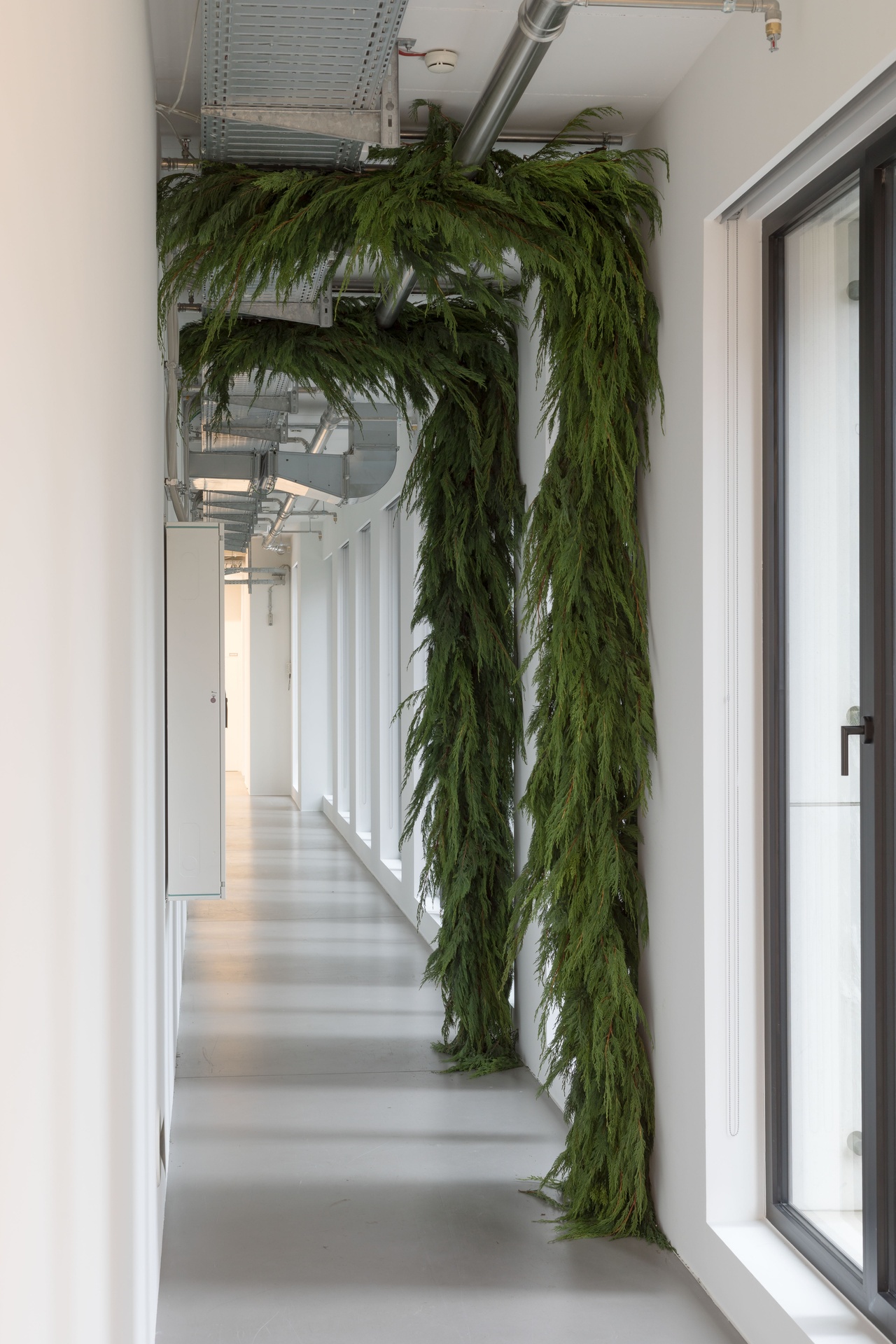
So, to return to The Secretary: It is a writing desk, an escritoire, often the site of one employed to handle correspondence, correspondences (do I have to cf. Baudelaire?), to keep records as well as to record, answering calls, coordinating transactions, receiving transmissions. For me to burble that it’s “about” reception, whether of people or broadcast signals, doesn’t really cover it. There needs to be some reckoning with the fact that sometimes “real objects are so packed with meanings both literal and metaphorical that they explode into symbol,” as Jacques Rivette pointed out. The secretarial is often (still) seen to be women’s work – yet the executive secretary at her secretary remains on alert, alive to the secretive and secretory. To extrapolate, the secretary cites the ancient network of the crossroads, librarian cross-referencing, sites of orientation and choice, all via a desk whose surface, depending on which way the viewer faces the object, is oriented either to the inside (to the space of the gallery and, by extension, to interiority) or to the world outside. Both of which become part of the glinting thing the artwork is, reflected on and/or in its surface. The artist’s preliminary, preparatory decision to rearrange walls, paint some of them a different hue, expose windows usually hidden, position works so that they are responding to and/or coordinated by aspects of the architecture, clears the ground so that the work might be seen – but is not the art itself. (I wish I had time to get into Donnelly’s switchboarding of the discreet and the discrete, but that will have to wait for another time.) Few artists are as attuned to the architectonics of vision as well as the (para)senses and their potential consequences. What is reflected on The Secretary’s surface from the window it’s nearest to? A green park with trees, the Taunusanlage (named for the mountain range) and, frequently, people in the park – but then Frankfurt, and then the world, Ukraine devasted but still resilient, Gaza genocided, Tehran, Lebanon, bombed to catastrophe. If you cannot see these things, look again. Such dialogics and dialectics: the world as well as the world as will and representation; the spoken and the unspeakable; the unseen and the seen. Donnelly folds these things upon one another – kept in line with one another. The projection on top of a picture of what is projected causes a folding space that flares and glows – and can be read allegorically. Untitled (2025): her two parallel, upside-down L-shaped, partial-archlike arrangements of Leyland cypress branches, greenery running the full height of the wall, a window between them, and across the ceiling (revisiting the artist’s prior garlands and verdant gatherings of long-needle and white pine, bay leaves, and Leyland, as well as, long ago, her exquisite hierarchies of orchid leis). Installed in a somewhat narrow corridor with full-length windows (a facility space that hadn’t been opened to the public for eight or more years), the hangings became a votive complement or alternative to three white metal fuse boxes. With the artificial light in the corridor switched off, daylight, when there was daylight, streamed through the windows, where office buildings on the other side of the street shadowed pedestrians and traffic. “Under the ceiling, [the careful arrangement of cypress branches] direct the visitor’s gaze,” the audio description points out, “to the metal pipes affixed there. […] The installation emits a strong coniferous smell, not only in the corridor but also in some other parts of the exhibition.” Energy hub. Green dynamo.
Trisha Donnelly,” Untitled,” 2025
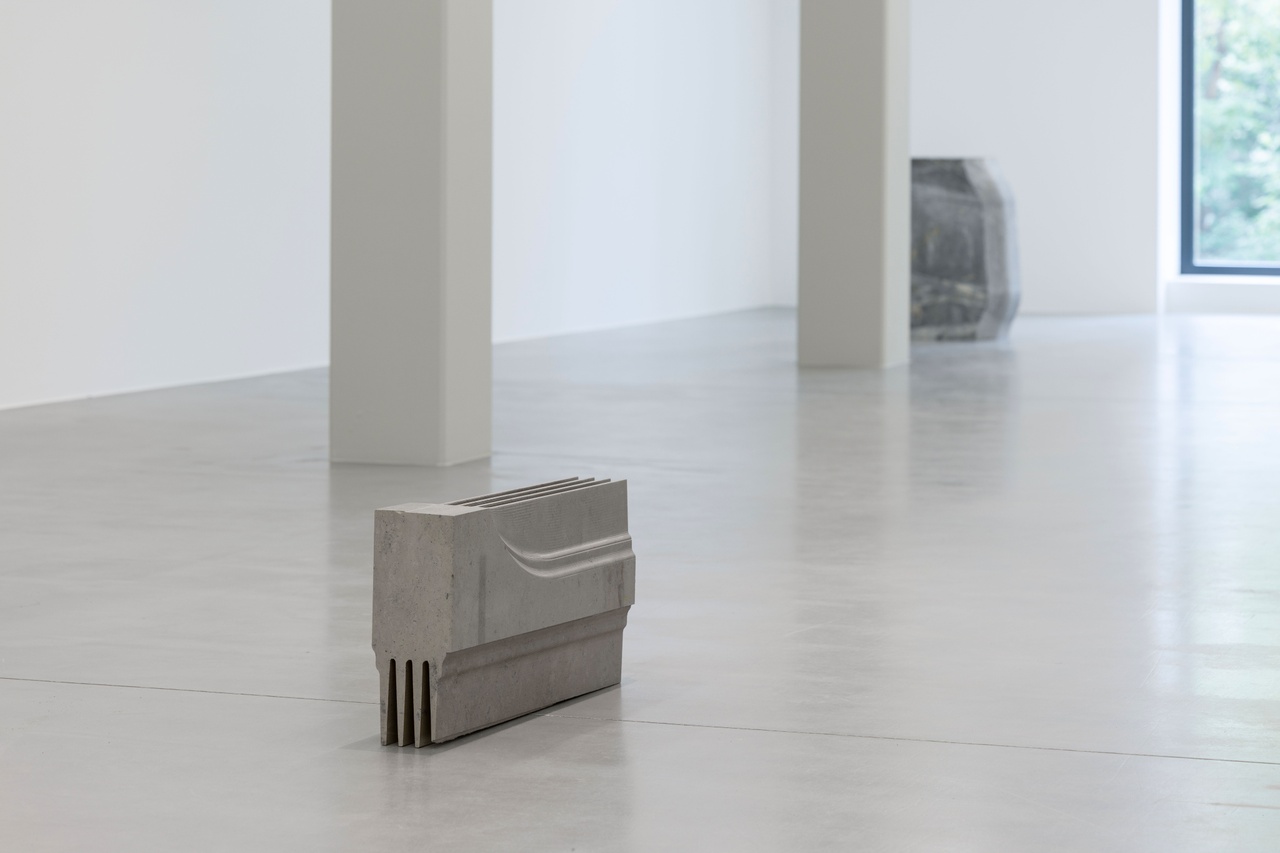
Whatever the influence of or engagement with the paranormal, landscapes, ocean waves, cloud formations, unsettling in their forbearance of crass human timelines and laughable events, have long reverberated in the artist’s work – sometimes directly, at other times flipped, repeated, manipulated. From at least her operatic intervention at The Shed (but really, long before), the Earth – Mother Nature – has been a crucial material of, and not merely reflected in and refracted by, the artist’s investigation and veneration: actual redwood and Scots pine, other verdancies, along with arboreal depictions, floral and faunal interlopings, fog, and other atmospheric conditions, not to mention the buzzing of mental weather and mood freaking many kinds of her work. You shouldn’t have to be Silvia Federici, Octavia Butler, Leontyne Price, or Jay DeFeo to notice how this concern ties, mitochondrially, to the female, to women’s bodies, commons, and knowledge, and to the motherboard of futurity. Yet, as Ariana Reines counsels: “To perceive in oneself – let alone in another, or in an image – an origine du monde means to confront what appears to be a disclosure and is in fact infinitely veiled and impossible to lay bare.” Such veilings are sedimentary. The stone works – not ruins, not sci-fi props, not henges, not sepulchering, not abstractions, and absolutely not all doing the same thing – expand the ministry of her endeavors to confront the unbearable liteness of being. With gravity, with heaviness, its resistance. The sculptures’ grooves, furrows, ridges, prongs, and gullies, the various cuts, chiselings, and attuned incisions into their variegated hues, not only demonstrate the precision and resistance of mark-making that should gird any making of marks but also petrify harvested signals – or find the sedimented signs (ancient, geological data) already communicated there. With the sculptures, the artist mediates the magnificent, fundamental, geological material with the clarity of her cuts, refinements. Marble and slate are metaphoric rocks. I mean, metamorphic rocks! Limestone, sedimentary. The geological materializes time, its processes, differently than many things it grounds. I was going to claim that Donnelly’s carving aberrates gravity with the exactitude of grace, but, instead, return to Artaud’s italicization of Van Gogh. Rally to the stone works the artist’s various delineations across media, her methods to expose connections between what we feel and what we can do – and to working through the walls between them with a file, slowly, patiently.
2
Not quite analogues, two textual tours d’horizon were offered for the two shows. At TDC, the “unspeakable” via Lao Tzu’s beholdenness, in chapter 6 of the Tao Te Ching, to the female “root of heaven and earth”; it is “dimly visible” and “seems as if it were there / Yet use will never drain it.” At Tower MMK, “those unassuming things, that occupy / A silent station in this beauteous world,” as sung in versions of William Wordsworth’s The Prelude. “Mimic hootings to the silent owls” that any poet-artist hopes will be answered. The Prelude arrives via the exhibition booklet’s reproductions of pages photocopied or scanned by the artist of an early scholarly edition of Wordworth’s epic – to be clear, text but also pictures of the book’s pages with reproductive warping intact. For one of the double-page spreads: verso, recto, both the 1805 and the 1850 versions of the poem, where, “the moon up,” the poet takes “a shepherd’s boat” and pushes from the shore onto the “lake […] shining clear.” Everything is silent, and the poet has sights on the “elfin pinnace” in the distance. The embarkation can be read as an allegory for the push into the sparkling night of artistic endeavor, its “troubled pleasure,” its ordeals. But Wordsworth also provides a reason the sublime should never be confused with the beautiful: The sublime always entails some aspect of terror, of oblivion, of the unknown, and, to pull in Lao Tzu, of the “unspeakable.” Suddenly, with “voluntary power instinct,” the huge cliff, the poet shudders, “Rose up between me and the stars, and still, / With measured motion, like a living thing, / Strode after me.” The supposedly inanimate animates and overwhelms. The poet steals back to the shore “with trembling hands.” Let the sudden trespass into the sublime unsettle relations with both the natural and digital, and let them leave anyone trembling. Nothing about this Wordsworthian gloss should be taken as mere coincidence in terms of what Donnelly proffers. No one should ignore the warping of the text’s representation and/or reproduction. The different versions of The Prelude speak to repetition and revision in any artistic endeavor over time. See the stone works as corresponding, living things, striding after the artist, striding after us. Some vibration of ancientness and unlikely presence. “No one before him had so naturally brought perception and consciousness together, had charted the growth of the mind without over-objectifying it,” Geoffrey Hartman remarked, “and so not only anticipated developmental psychology but made us inherit unforgettably, after the Enlightenment, and in the dawn of the Industrial Revolution, a sense of ‘unknown modes of being.’” He continues:
Even if we discount Wordsworth’s prophetic fear that nature was fading from the human mind, who before him conveys so succinctly the mutual dependence of nature and imagination? His own term, actually, is “mutual domination,” which moves the issue beyond epistemological niceties. Each poem becomes a new test of the imagination, or where the world fits in. […] Temporal complexity shapes a poetic instrument containing very subtle eddyings that cannot be fixed in the amber of neoclassical verse. The poem of this mind reacts on itself, composing even “blind thoughts” that usurp the attempt to write, and compel Wordsworth to revise his self-understanding.
“Unknown modes of being,” “subtle eddyings,” and “blind thoughts” require new forms and ways (in each outing, at every juncture) to capture life’s shimmer and density, and, yes, terror – “the plenitude of meaning and the confused evidence of the sign” – as well as to attempt “an incessant improvisation of the universe” (to pull in Rivette again). A full awareness of the world it was made in and responds to and does not shirk, however horrified it is by it. Realism – a realism like Donnelly’s, if this is what to call it (of course, it is not the only thing to call it) – cannot “be a solution if we understand the term only as synonymous with the substitution – within preexisting, interchangeable, and immutable frameworks – for conventional signs (entirely adapted to their function and context).” Across and through an array of media, Donnelly strikes new forms, sometimes with the oldest methods of making (stone carving), elsewhere with new modalities, often pitching the givens of a material or technology (whether marble or a digital file) against the thing itself in trying to see and sense, demonstrate and document, the not-yet-articulated that can nevertheless be shown – usurping surety, compelling a revision in self-understanding and understanding tout court. Her sculptural and photographic investigation allows certain turbulences (grieving, rage, and trippy goofiness) to extrude. The first passage photocopied from The Prelude puts forward lines that could provide a précis, retaining crucial blanks and gaps of transmission: The artist “impresse[s] upon all forms – the characters / Of danger and desire, and thus did make / The surface of the universal earth / With meanings of delight, of hope and fear, / Work like a sea.” Elegance doesn’t always result in eloquence, which is one reason Donnelly’s architectonics of display often abandon elegance for lucidity, however “awkward.” The sublime still requires documentary techniques. Perhaps rapprochement rather than mutual domination. The slim, white, embroidered cotton sleeve hanging by itself, only seemingly innocuous, recalled precedents of her wave (and wavelength) harvesters, albeit miniaturized.
Trisha Donnelly, “Untitled,” 2018
3
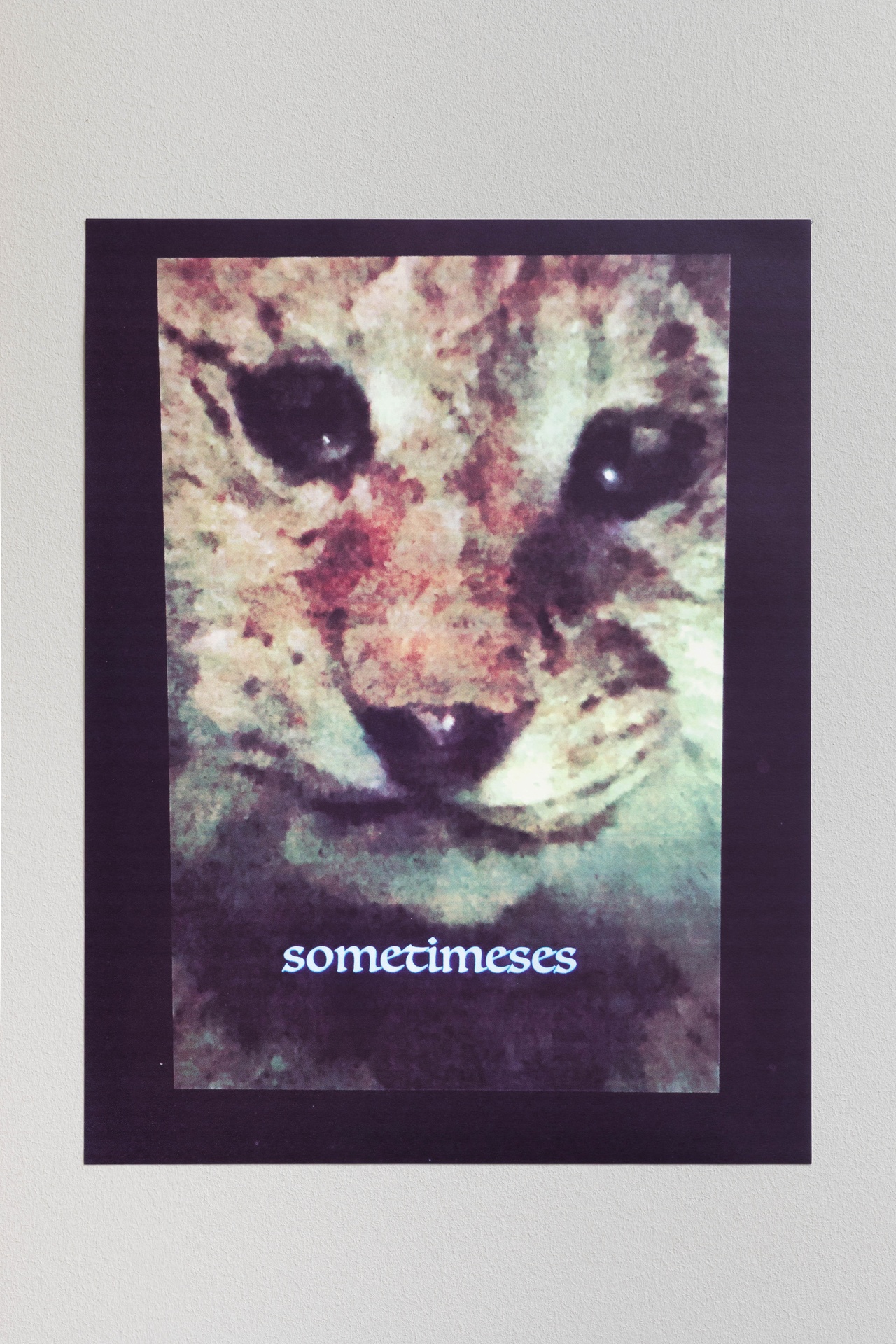
Untitled (2016): A low, rectangular, jet black basin of carved slate filled with water, placed on the cement floor, the work is “positioned […] where the windows look out to Taunusanlage Park. […] Depending on your own position or the time of day, the water might reflect either the ceiling or the windows. […] The rectangular slate structure frames the water it holds just like the black window frames behind it surround the glass. […] The surface tension of the water supports specks of dust and other airborne particles that have landed within the predefined frame.” So even the microscopic and microbiological can, again, depending on your own position, appear under the purview of the givens of Donnelly’s endeavors. Scrying device and aperture, contrafactual stand-in for a light-emitting screen. Water offering in ongoing drought, at the level of the creaturely. “The basin and the windows, as well as the exhibition space and the outside world, are engaged in an ongoing dialogue with each other – and with the other objects in the room.” Her moves across and through – as well as combinations and juxtapositions of – different media could be understood as a syncopation of different temporalities, time signatures, sometimes resonant and harmonizing, sometimes jamming and disruptive. Some time some times sometimes sometimeses. The young bobcat, adorable on the poster over the word sometimeses, could be announcing tour dates. And yet the watch – timepiece and sentinel – points to the untimely. The untimely as it lances the instant of this grim moment. Satin operator at the secretary-switchboard delineating the real, its almost obsolete diction, “which at its most sorrowful has an air of deep festivity, like one of those trees that turns all its leaves over, silver, in the wind.” Such activity makes strange matter.
“Trisha Donnelly” and “Voice of Space: UFOs and Paranormal Phenomena,” The Drawing Center, New York, October 17, 2025–February 1, 2026; “Trisha Donnelly,” Tower MMK, Frankfurt am Main, September 27, 2025–March 22, 2026.
Bruce Hainley lives in Houston, Texas.
Image credits: 1. + 4.–7. © Trisha Donnelly, 1. courtesy of Galerie Buchholz; 2. + 3. courtesy of The Drawing Center; 5. courtesy of Florac Works, Paris and Blondeau & Cie, Geneva; 4. courtesy of Matthew Marks Gallery, Manizeh and Danny Rimer Collection; 6. + 7. courtesy of Museum MMK für Moderne Kunst, 1. + 4. + 5. photos Frank Sperling; 2. + 3. photos Daniel Terna; 6. + 7. photos Axel Schneider