

PARTICIPATORY ART BY PROXY David Homewood on Charlotte Posenenske at Mehdi Chouakri, Berlin
“Charlotte Posenenske: SERIE E,” Mehdi Chouakri, Berlin, 2025
Shortly before her withdrawal from the art world in 1968, Charlotte Posenenske initiated a novel critique of the artwork as commodity. To minimize the influence of the market on her art, and in a bid to broaden the art’s accessibility, the artist stipulated that her works be sold only at cost price, in unlimited editions. Fabricated from common materials such as cardboard, steel, and composite board, her “inexpensive” and “eternally reproducible” minimalist sculptures were, she claimed, “prototypes for mass production,” factory-produced, and hence reproducible from standardized blueprints. [1] In Posenenske’s vision, her work could be fabricated anywhere, by anyone; if a new object was required, an order could be placed. Confounding modernist norms of originality and authenticity, her mass-reproducible machine-made art of the late 1960s was pitched against the studio virtuoso’s one-of-a-kind masterpiece. Yet 60 years on, norms of originality and authenticity persist in the market and the museum, and Posenenske’s once-radical art is not immune. The recent exhibition of a group of sculptures from her Series E (1967–68) at Mehdi Chouakri illuminated ongoing processes of value formation in and around her work.
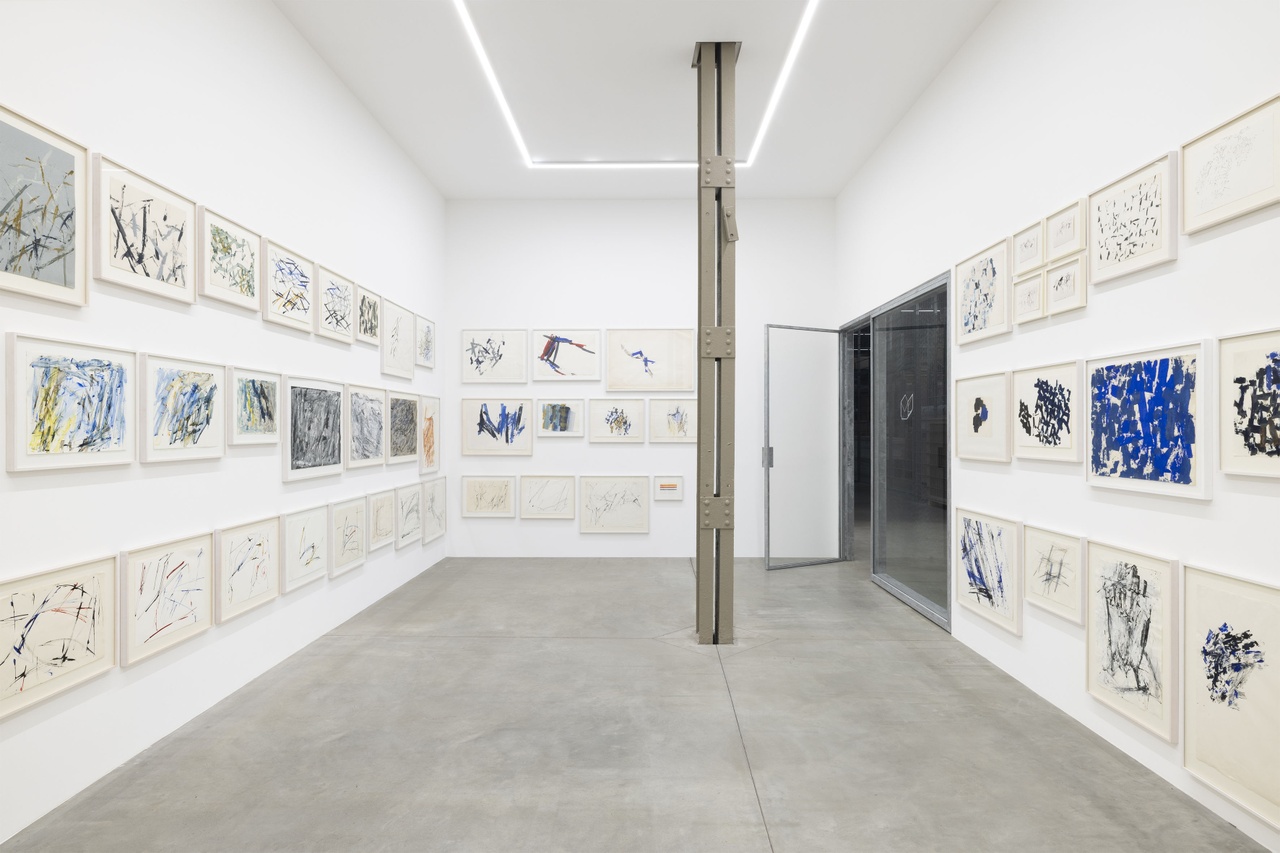
Mehdi Chouakri has handled the Posenenske estate since 2021, rebranded as the Archiv Charlotte Posenenske. Despite its name, the “archive” is more than a collection of documents. Dedicated to making the artist’s work accessible, it encompasses an exhibition space located in the gallery’s premises at Wilhelm Hallen, a former iron foundry in Berlin-Reinickendorf. Other art and material pertaining to Posenenske’s life regularly accompanies rotating displays of her work. When I visited, crammed into the small office-like room were 92 framed works on paper, stylistically varied abstractions Posenenske produced in the 1950s and 1960s. The archive’s window has been branded with a small graphic logo, an isometric diagram of one of her minimalist sculptures. In the storage area further down the hall, boxes of flat-packed works were stacked high on warehouse shelves, awaiting dispatch.
“Archiv Charlotte Posenenske,” Mehdi Chouakri, Berlin, 2025
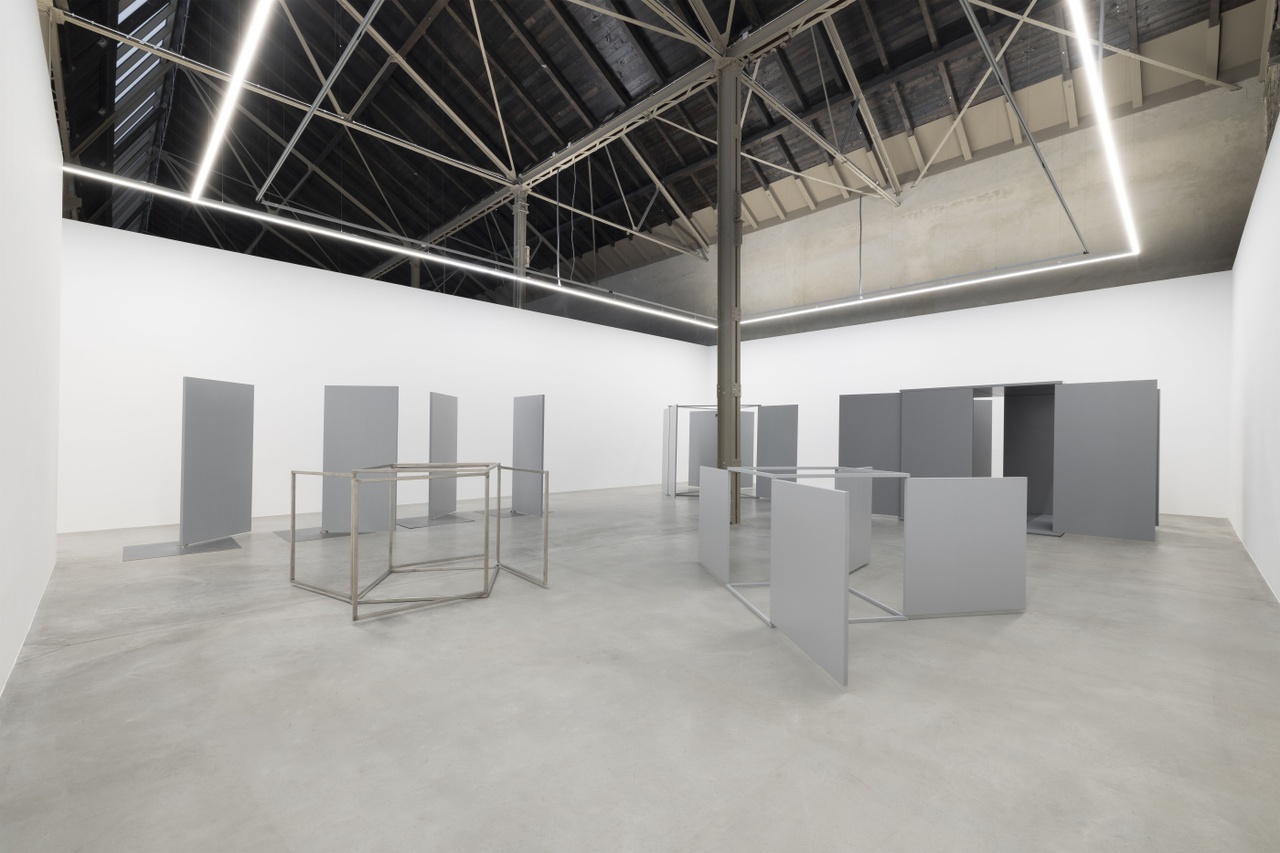
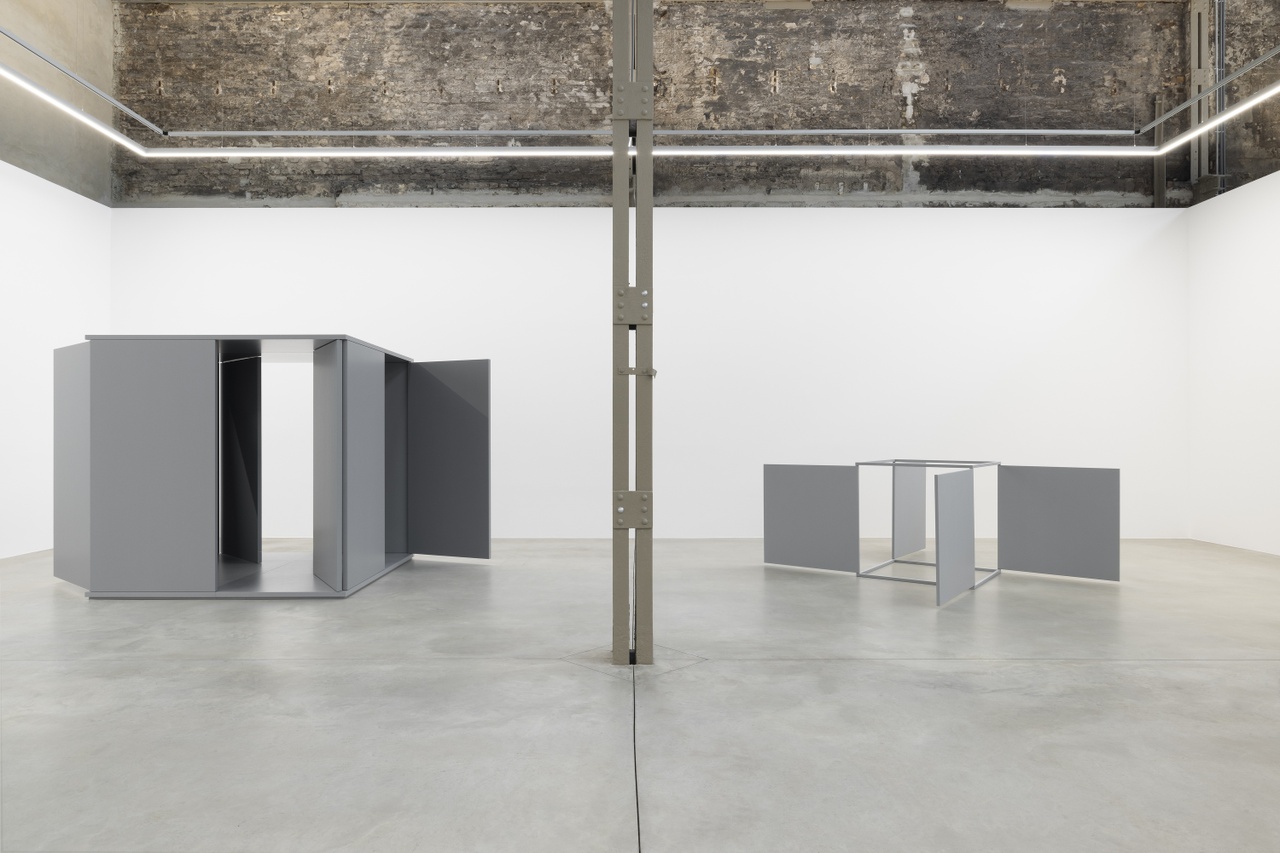
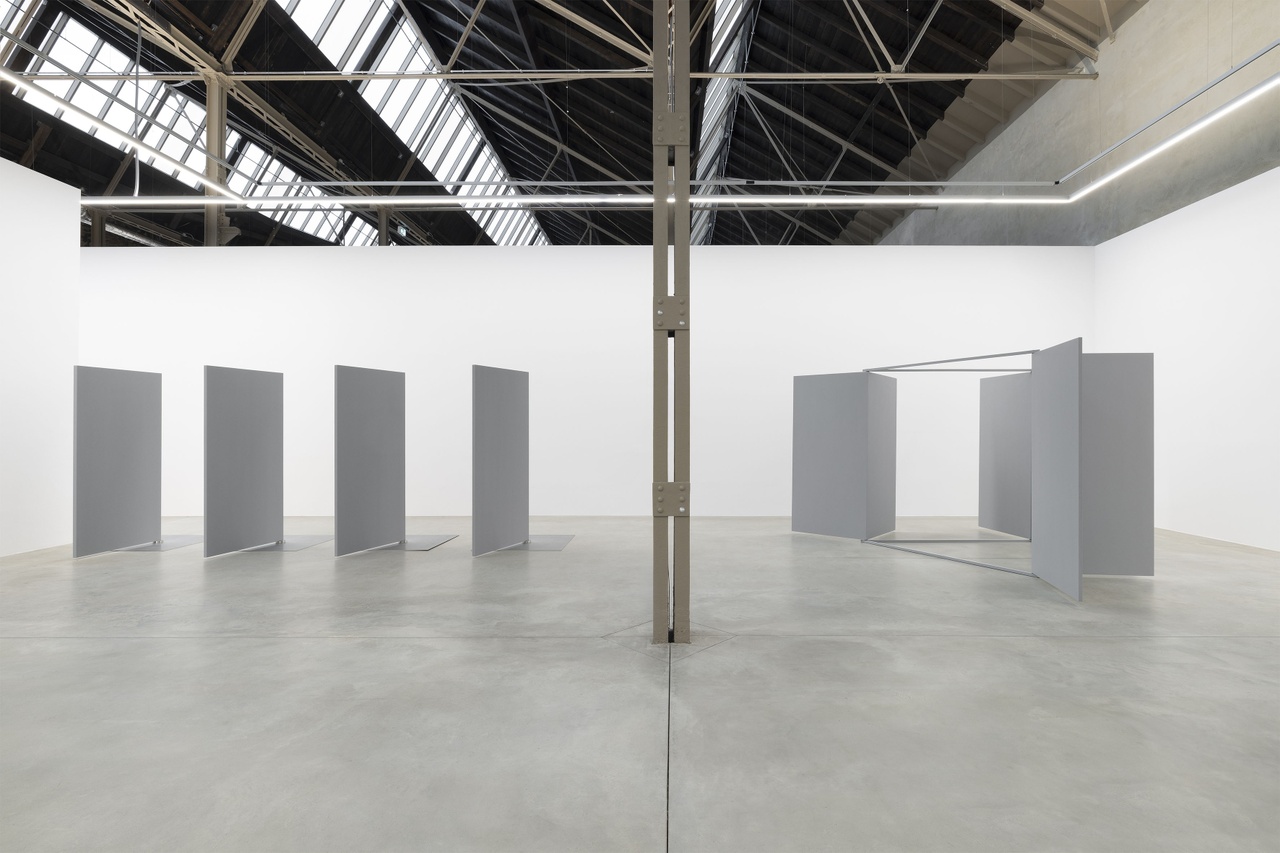
Presented in the main exhibition space across from the archive were five works from Posenenske’s Series E, shop-made stainless-steel structures featuring moveable parts meant to be freely adjusted by the spectator. Four of them were titled Drehflügel, the German term for turning leaves or revolving vanes. One of the Kleiner Drehflügel consisted of a metal frame alone, a one-meter-sized hollow cube with hinged squares on each side. The other Kleiner Drehflügel was identical to its sibling, except with paneled sides. Two larger pieces, each specified as Großer Drehflügel, immersed the spectator in their two-meter-high quasi-architectures: one, a frame hinged to eight panels, two per side, which closed to form an upright rectangular prism; the other, a frame hinged to six panels that closed into a triangular prism. The fifth work, a row of four panels reminiscent of swinging doors, was – as indicated by its title, Linearer Raumteiler, vierteilige Rekonstruktion eines Konzepts von 1967 (1967/2015) – posthumously fabricated from a plan unrealized by the artist.
Posenenske’s signature works are Series D and DW (1967), joinable modular stainless-steel or cardboard pieces resembling industrial air ducts or pipes. Crucially, the artist specified that the exhibition curator decide the formal configuration of her work. In Series E, by contrast, the skeleton of the work is fixed, and its wings are rotated by visitors. The works elicit audience involvement, challenging the customary detachment of aesthetic contemplation. “They can always be rearranged into new combinations or positions,” Posenenske wrote. [2] “I leave this alteration to the consumer who thereby again and anew participates in the creation.” And because they are encountered in public (the artist later decided that her work must be housed in publicly accessible collections), participants engage not only with the object but also with each other. As in contemporaneous work by Carl Andre, Lygia Clark, or Franz Erhard Walther, the sculptural apparatus is not an end in itself; it is equipment for communication and collaboration. There is an element of fun too, as suggested by an anecdote of how art dealer Dorothea Loehr burst out of a Großer Drehflügel at the reception of Posenenske’s 1967 exhibition at her Frankfurt am Main gallery, surprising its patrons. Such blurrings of gallerist, artist, and viewer are facilitated by Posenenske’s work.
“Charlotte Posenenske: SERIE E,” Mehdi Chouakri, Berlin, 2025
The Mehdi Chouakri press release stressed the participatory character of Posenenske’s art, claiming that the collected works “broke the museum taboo of untouchable art.” “In turning the vanes,” the text stated, “the formerly passive spectator becomes an active participant.” But the exhibition didn’t quite fulfil this promise. Touching the works was forbidden, I was informed by a gallery assistant, who performed her officially designated role as an “activator.” She alone was permitted to handle them. The limited accessibility of the works afforded a curious sort of interactivity: The exhibition interpellated visitors as participants, only to immediately revoke their status as such. Visitors thus engaged with the works remotely, via the activator, by asking the assistant to position the “Flügel” in a certain way, or by requesting permission to step inside the works. The ensuing comedy of miscommunication perhaps wasn’t, in the end, too far from Posenenske’s ludic intention, because it encouraged a form of interaction, albeit not directly with the works. Then again, the indirect participation seemed slightly perverse given Posenenske’s original intention – rather than activating the spectators, the activator kept them at bay.
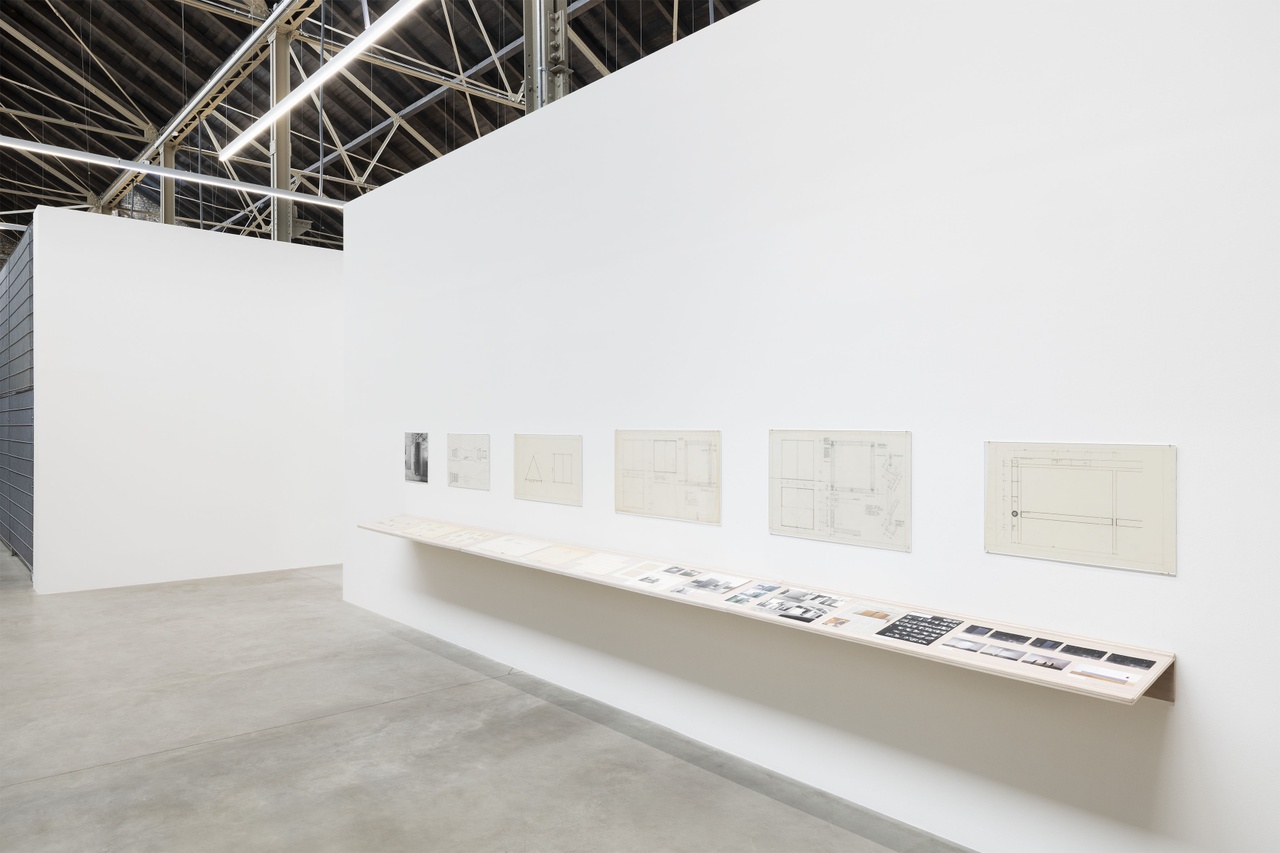
Touching the work was of course forbidden for reasons of conservation. Such measures, unfortunate insofar as they contradicted Posenenske’s aesthetics of accessibility, are nonetheless common and often necessary to the exhibition of historical works of installation and kinetic art. At Wilhelm Hallen, Series E’s semi-functionality was evidence of its real capture by the commercial and museological paradigm of the precious artifact that Posenenske’s project was meant to resist. Yet the artifactual status of these estranged works of participation art was complicated. All five objects were produced by the artist’s estate in the 2000s, overseen by Posenenske’s second husband, Burkhard Brunn – they were gleaming new antiques, oxymoronically authentic simulacra. In fact, very few of the artist’s works manufactured between 1966 and 1968 remain, and only three versions of Series E works, now in public collections, were realized in her lifetime. Across from the archive, a vitrine display of drawings, diagrams, photographs, posters, and newspaper cuttings documented the origins of these three Drehflügel. Two photographs of a freshly fabricated work on the floor of a metal workshop showed off its proximity to technical objects. Other images were part self-portrait, part product demonstration: Posenenske inspecting the surface of a Großer Drehflügel or, mid-conversation, leaned against a different Drehflügel at the Frankfurt airport, clad in a beret and trench coat.
“Charlotte Posenenske: SERIE E,” Mehdi Chouakri, Berlin, 2025
While the vitrine contained copious information about the early history of Series E, the posthumous career of these works, chronicled only in a few installation shots, deserved more attention. In my view, one of the most remarkable features of Posenenske’s oeuvre is that the bulk of the “1966–68” work was fabricated after her death – not as unlimited reproductions but licensed products. The framework for her posthumously manufactured oeuvre was drawn up in 1985, when, after her cancer diagnosis, the artist greenlit her friend Paul Maenz’s proposal to organize, in tandem with Burkhard Brunn, a retrospective exhibition of her work at his Cologne gallery. That same year, Posenenske willed her estate to Brunn and licensed him to order the fabrication of “authorized reconstructions.” She didn’t live to see the opening of her Cologne survey in December 1986, or the smaller show that preceded it at Galerie Grässlin-Ehrhardt in Frankfurt am Main, her first solo exhibition in nearly two decades. At the time of Posenenske’s death, her work, stored neatly in an attic, had largely faded from art-world memory. Brunn soon became an effective advocate of it; between 1988 and 1990 he initiated (with Maenz’s help) a series of displays in German galleries and presentations in public spaces, including the Lufthansa airport hangar, Deutsche Bank headquarters, and central train station in Frankfurt.
The rediscovery of Posenenske’s art coincided with the institutionalization of minimalist and conceptual art in the 1980s, and the mass refabrication of work by artists as well as dealers, museums, and even collectors. [3] This took various forms: the replacement of damaged works, the materialization of unrealized plans, and the editioning of historical works, from artist-sanctioned remakes, to collector Giuseppe Panza’s semi-legal fabrications of Judds and Flavins, to belatedly canonized artists such as Ian Burn making new versions of his previously unexhibited minimalist experiments. The authorized reconstructions of Posenenske’s works are a fascinating chapter in the afterlife of so-called dematerialized art’s critique of authenticity. It is a chapter ridden with contradictions, with an outcome ambivalent to Posenenske’s intention: The auratic rematerialization of the dematerialized form was structured according to the commercial and institutional primacy of the rare, authentic object – the logic she had once hoped to evade.
From today’s perspective, the uncertainty over the authenticity of reproduction of minimalist and conceptual art has seemingly been settled. More often than not, authenticity resides not in the artwork, but in its certificate of authenticity: Paperwork decides what art is. The show at Mehdi Chouakri’s Wilhelm Hallen premises was therefore business as usual. Still, a memory of old-fashioned authenticity, mysteriously residing not in the paperwork but in the object, lingered over the show. In lieu of physically engaging with the reconstructions, my own viewing took the form of a forensic examination of metal hardware, boards, and shades of gray paint, in search of clues to provenance. [4] Looking became an exercise in the objective comparison of industrial forms, a redundant authentication ritual.
“Charlotte Posenenske: SERIE E,” Mehdi Chouakri, Berlin, 2025
The unlimited production wished for by Posenenske would have made her artworks more like other mass commodities than traditional artworks, negating the market’s fetishization of originality and authenticity. But that dream never materialized; instead, the licensed production of her work was overseen for 35 years by Brunn. Inarguably, his skillful management of Posenenske’s estate was instrumental to her eventual post-millennium recognition as a protagonist of international 1960s art. His careful editioning of Posenenske opened a situation whereby pieces were drip-fed to museums worldwide for decades. Success came at a price, however. Although the authorized reconstructions accorded with Posenenske’s dying agreement with Brunn, their limitedness contradicted the artist’s radical original vision of her art’s unlimited reproducibility. Shortly before his own death in 2021, Brunn officially ended the refabrication scheme. In a sense, his death was her second passing. Posenenske’s oeuvre was finally closed, or as closed as it could be.
If the artist’s authorized editions ensured her posthumous recognition, the stipulation that her minimalist work be sold at cost price to publicly accessible institutions has prevented galleries from jacking up the prices of her works and deterred speculative collectors. How much, then, does a Posenenske cost? The Series E works in this exhibition weren’t for sale, and their prices weren’t available. The prices of the works in the archive, many of which were for sale but not bound by her cost-price rule, weren’t disclosed. The price tag affixed to one of her cardboard Series DW works (or four parts of one, the minimum order) is roughly €40,000, which may seem like a lot. Then again, it may merely reflect the costs of operating a commercial gallery, and the research and publishing initiatives of the archive. How many salaries, properties, fairs, advertisements, etc. could be included in the cost-price equation? One wonders whether Posenenske’s cost price rule, rather than demystifying the economics of art, now serves primarily as marketing spin.
“Charlotte Posenenske: SERIE E,” Mehdi Chouakri, Berlin, September 6–December 19, 2025.
David Homewood is a writer and curator based in Berlin.
Image credit: all photos Andrea Rossetti
Notes
| [1] | Charlotte Posenenske, “Manifesto” (Offenbach, February 11, 1968), Burkhard Brunn website. |
| [2] | Posenenske, “Manifesto.” |
| [3] | See Susan Hapgood, “Remaking Art History,” Art in America (July 1990) 114–23, 181. |
| [4] | The paperwork for the artworks was probably somewhere, and it was probably in order, but the provenance of certain works was confusingly communicated. In the exhibition pamphlet, the Linearer Raumteiler and two Großer Drehflügel were dated 1967–2015, 1967/68–2018, and 1967/68–2021, meaning that they were fabricated in 2015, 2018, and 2021. Meanwhile, the two works titled Kleiner Drehflügel were listed simply as 1967–68 – making them prototypes. Despite this, an activator informed me that the lone prototype in the show was in fact one of the Großer Drehflügel. The giveaway was that its doors are heavier than the other Großer Drehflügel, she said. When I later phoned the gallery, I got a different story from a different employee, who explained that there were certainly not prototypes in the show, because the three extant Series E prototypes are now housed in permanent collections – though she couldn’t positively confirm the dates of all five pieces on display. |