

DEATH AS A HOUSE Alex Turgeon on Dennis Cooper and Zac Farley’s “Room Temperature”

Dennis Cooper and Zac Farley, “Room Temperature,” 2025
Room Temperature (2025), the third collaboration between writer Dennis Cooper and filmmaker Zac Farley, offers a filmic portrait of a US family operating at the precipice of its nuclear half-life. Set in a small bungalow situated in the desolate suburbs of the California desert, the film follows the family as they transform their house from a private home into a public haunt – a form of makeshift attraction designed to frighten visitors, who are invited to navigate their way through the performance of immersive, spatialized horror scenarios. Envisioned through the trashy camp horror aesthetics emblematic of a pop-up Halloween store, Room Temperature is true to, yet an expansion on, Cooper’s unnervingly tense and challengingly exquisite literary prose. Together, Cooper and Farley tint the narrative spaces between subjects and their environments with a perpetual sense of the macabre, foregrounding a form of queer emotional stiltedness found in the film’s eroticized yet violent exchanges between youth and adulthood. Room Temperature employs domestic architecture as a narrative substrate upon which these ill-fated acts unfold: The home becomes a metaphor for the supernatural interchange between subjects and objects, rendered through its uncanny reverberation between container and cadaver.
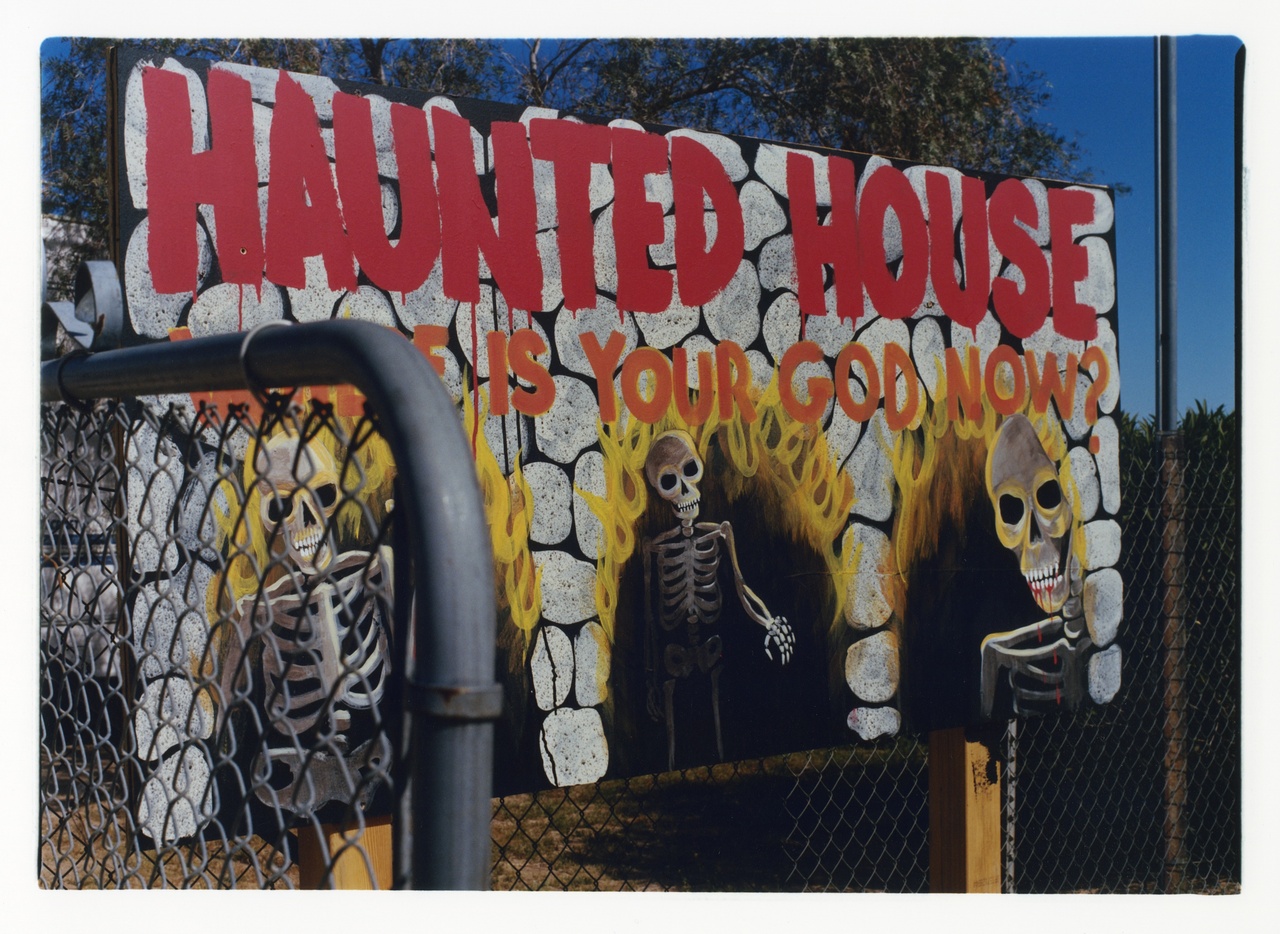
The film opens with Paul, a high school janitor (played by Chris Olsen), quietly mopping up one of the school’s restrooms when he is greeted by a teacher (Lili Tanner), who, seemingly prompted by his youthful appearance of strawberry blond curls paired with a faint pubescent moustache, inquires how Paul thinks the students perceive him. “Perhaps sideways, with a slight tilt down” he answers after a pregnant pause. Paul’s response sets the direction in which Room Temperature begins to unfurl, describing the slow downhill skew of the film’s narrative toward the basin of the bathetic as both a conceptual tool and a literary device. Late one night, Paul happens upon an isolated house on the outskirts of town. It appears to him as if it were an apparition, formed as a cacophony of flashing lights and billowing smoke, soundtracked by loud erratic industrial music surging from the confines of the otherwise nondescript residence. Formally, the house evokes an earlier project by Cooper, Zac’s Haunted House, a “novel” created from a collection of looping GIFs in honor of Zac Farley and published by Cooper’s Kiddiepunk imprint in 2015. Composed from a dense accumulation of cyclical animations clipped from different cinematic genres, interlaced with overt combinations of blood, guts, and high school, the novel feels dredged from the uncanny recesses of the 2010s Tumblr blogosphere. In Room Temperature, the grown-up filmic version, however, the house is an extrusion from the two-dimensional digital book into a spatially immersive architectural subject, equally imbued with its predecessor’s cavalcade of horrific referents. A silhouette eventually emerges in the doorway, to which Paul exclaims, “What’s wrong with your house?!” After receiving no response, he adds, “I’m not against it.” His sudden projection of kinship with the architecture before him invites the subjects and objects of Room Temperature to begin to intermix; this positions the house as both a centralized subject and a site that establishes the characters’ interrelations with the spaces they will eventually come to haunt.
Dennis Cooper and Zac Farley, “Room Temperature,” 2025
Room Temperature’s narrative is mapped via the practical mundanities integral to the process of setting up and dismantling the haunted house. The film offers little evidence linking the house’s resident family to any broader community engagement with Halloween, with even fewer grounding referents that situate the film within any chronological marker of our contemporary moment. This intentional lack informs the overall feeling of disconnect between the family and any recognizable reality, a severing reinforced by the claustrophobic spaces they inhabit. Absence surrounds and fills the interiors these disparate familial subjects inhabit; rooms feel found rather than lived in, with no evidence of technology, no telephones to call out from or screens to escape into. It is both cold and stale and yet pastel-colored and glaringly bright; it is as intentionally artful as it is disassociating. If home is where the heart is, then this one evokes a profound feeling of disdain.
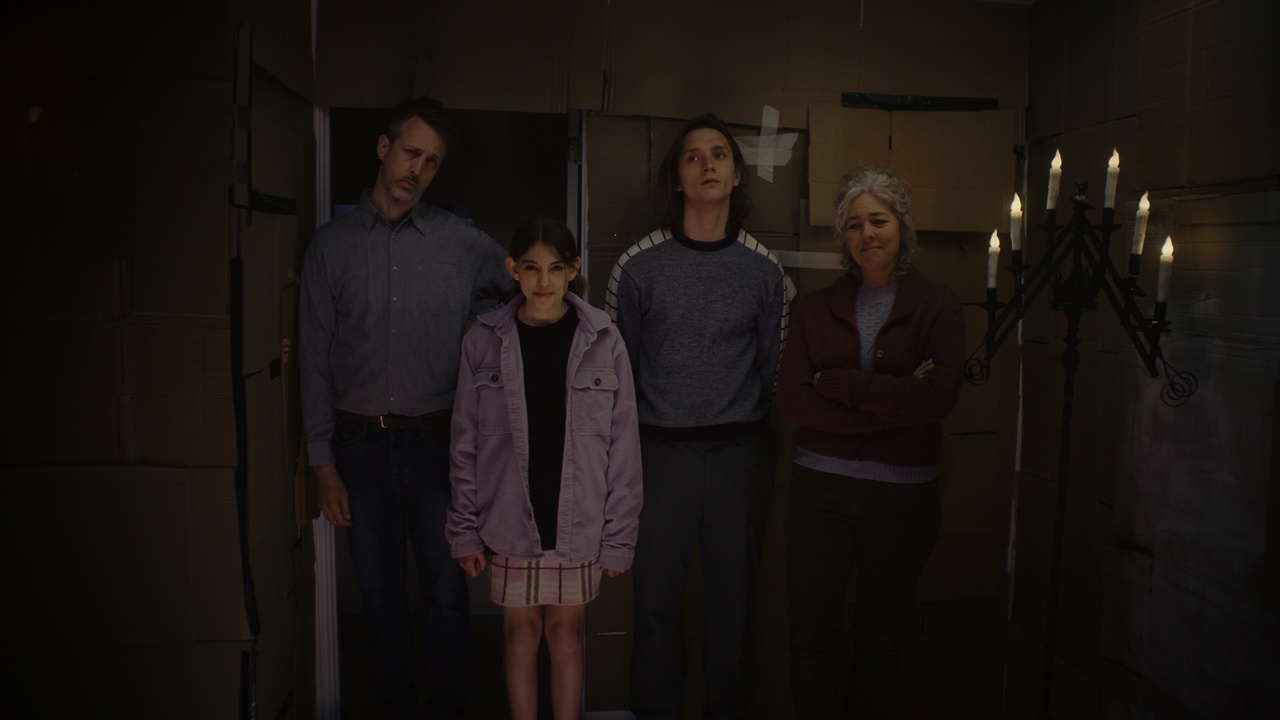
When Paul returns to the house the following day, he finds the resident family sitting around a picnic table in their front yard. In this moment, we are introduced to what is indeed a family affair: the mother Beatrice (played by artist Stanya Kahn), son Andre (Charlie Nelson Jacobs), daughter Marguerite (Virginia Adams), and Dad, the otherwise unnamed father (played by artist John Williams) are all engaged as producers and actors for the haunt’s staging, as is Extra, the family’s long-term French homestay (Ange Dargent). Cooper and Farley waste no time in establishing the patriarchal dynamic of the family unit, where the father acts as the sole author of the overtly loose, if not completely improvised, narrative sequence of the haunt project. This familial dynamic might feel trite, but it quickly conjures the archetype of the failed artist aged out of his prime: creatively irrelevant, misguided by his ill-thought-out ambitions, doomed to the very limitations he refuses to acknowledge. In one scene, we see that the living room carpet has been mapped out with blue painter’s tape, supposedly marking the position of a ride-on amusement train intended as an added feature for the horror show. However, as Paul points out to Beatrice, the scale of the room and the size of the train are incompatible, meaning the idea cannot be realized. Comically, the following scene depicts the father aggressively tearing up the tape out of what seems like frustration at both his own poor planning and the conditions he is supposedly forced to work under. The moment becomes an eerily apt metaphor for the demise of artistic ambition turning into an act of self-destruction. It is made clear that the family has maintained this haunt tradition for some time, as their affected ambivalence to the father’s lame performative fantasies reads as apathetically subordinate. Ultimately, the haunt is revealed to be a thinly veiled excuse for the father himself to perform the mock killing of his family to dramatic, albeit contemptible horrific effect – to which the father explicitly clarifies that he does indeed hit his kids.
Dennis Cooper and Zac Farley, “Room Temperature,” 2025
As the staging of the haunt unravels, Extra, “artistic” by his own definition, is the only member of the troupe who sees the family’s project as a site of creative potential. Having been with the family since he was a child, much to the father’s resentment, Extra emerges as an object of both desire and ridicule. He explains that throughout his life people have had the overwhelming desire to hit him and attributes this collective impulse to his positive outlook and gentle nature being at odds with his hostile surroundings, to which he constantly falls victim. He is an outsider, as signaled by his fitting name but also by his comparatively tall and slender frame, long blond hair, and thick Parisian accent. Compounded by this difference, Extra’s creative ambitions toward the haunt antagonize those of his host father, who sees Extra as a pariah – as a symbol of the threat of a younger generation and an effeminate influence on his son Andre. Later, we come to understand that Extra and Andre are more than just host-siblings – they are, in effect, lovers. In describing their relationship, Andre expresses his appreciation for Extra by stating that “his ass is a really good painting that has a little nail on the back so you can hang it on a museum wall.” Through this framing, we come to understand Extra as a defenseless aesthetic object, as if waiting to be destroyed. Shortly thereafter (spoiler alert), we are witness to the father fatally bludgeoning Extra on the head, a final act of defeating any challenge to his patriarchal sovereignty. The blunt, almost slapstick violence renders Extra inert, collapsing his subjectivity into an object that can easily be manipulated, a hollow vessel or cheap decoration that the father buries in the backyard.
Room Temperature’s intentionally pointed bathos is realized through the presentation of the haunt itself. Like a bad play, it is laid out through a series of awkward, ill-defined horror tableaux intended to leave attendees incapacitated with fear, yet it reads more like an off-site art school installation than bone-chilling immersive theatre. Cooper and Farley frame the haunt as both pathetic and an enduring action of ambition, much like how the life of an artist is so often defined. The fallacy of this provisional horror is laid bare by the return of Extra as a benevolent specter. Visualized through the camera’s floating perspective, his invisible presence is articulated by weightlessly navigating the constricting architecture of the now-transformed house. His ghostly reality underscores the fallacy of this haunt through his own actual haunting. With his return, the collapse of what’s left of the family’s values is revealed by the haunted house’s failure as a critically successful, coherent project – as both a family tradition and a creative ambition. Through this collapse, Room Temperature envisions a stilted critique of heteronormativity haunted by the enduring legacy of the domestic. What Farley and Cooper achieve so well in their collaboration is the additional, if not extra, subject of the house as a hybrid form of tertiary protagonist. Through the chintzy aesthetics fundamental to the US horror product, the film positions the home as a vacant vessel, like a cadaver dressed up in the illogical terrain of normativity. It is within this territory that the bizarre horror logistics of the haunt feel explicitly mundane in contrast to the actual horror internalized by the family itself. Ultimately, the dead metaphor of the home is reanimated by the ghost of what the family unit could never fully create but ultimately only destroy.
Dennis Cooper and Zac Farley, Room Temperature (US/France, 2025).
Alex Turgeon is an interdisciplinary artist based in Toronto.
Image credit: © Octo Production, courtesy Local Films