

FRANK GEHRY (1929–2025) By Sylvia Lavin
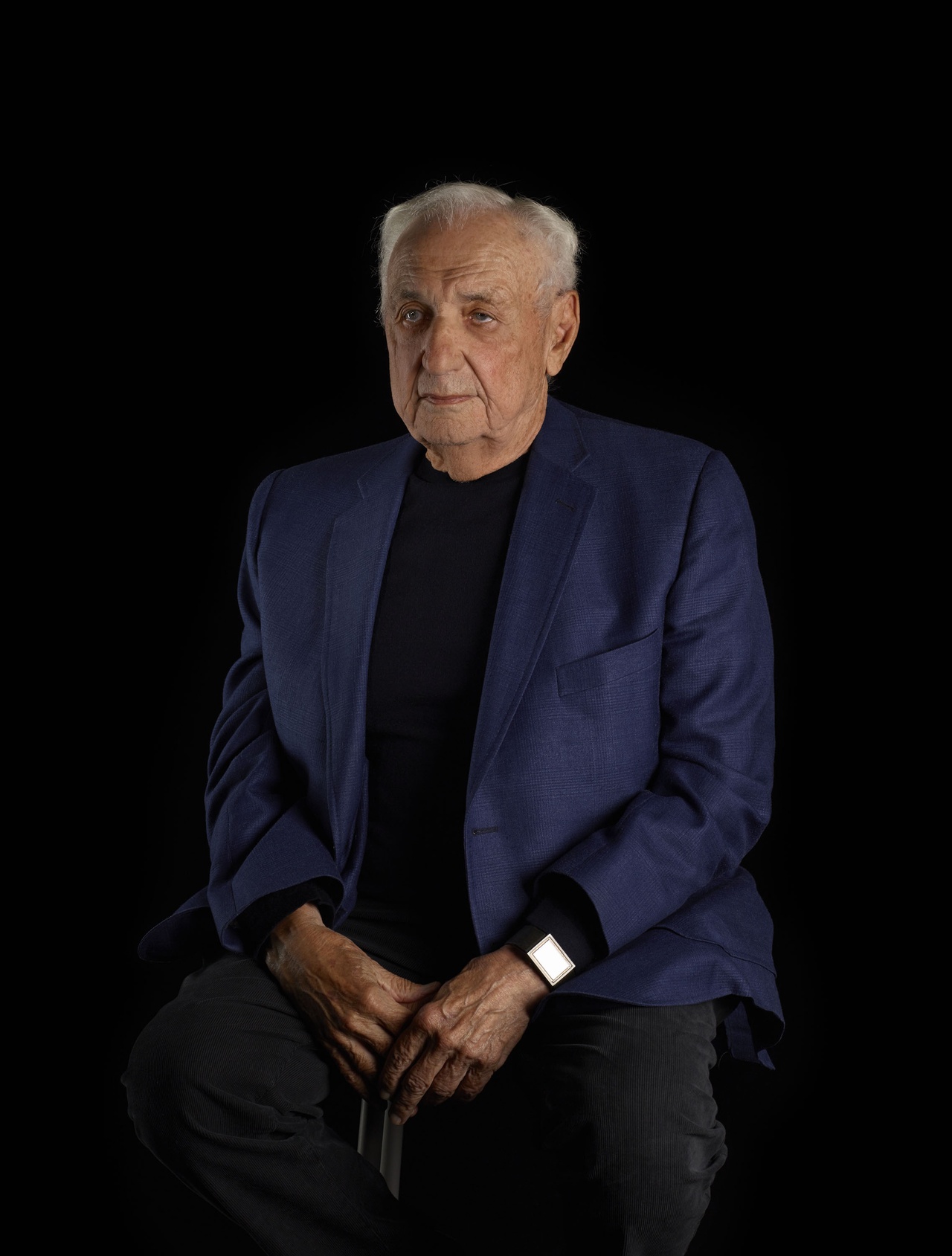
Frank Gehry, 2017
After making every possible exertion to keep working with vigor and grace during recent months, Frank Gehry passed away in his home on December 5, 2025. The outline of his monumental career is well known and typically organized around key moments of sudden transformation: when, in 1954, he changed his name from Goldberg to Gehry; when the design of his own house made him an overnight sensation in 1978; and when the Guggenheim Bilbao seemed to click a new map of global cultural tourism into place in 1997. These shifts are generally linked, respectively, to the burgeoning conformism and assimilationist policies of the United States in the 1950s, then to his immersion in the art world of Los Angeles during the 1970s, and then to his use of digital tools to discipline unruly geometries in the 1990s. It is also commonly repeated that unlike peers such as Robert Venturi, Peter Eisenman, and Rem Koolhaas, Gehry was intuitive rather than analytic, expressive rather than strategic, a dreamer rather than a pragmatist. What is less noted, however, is that this narrative was of his own devising, a carefully crafted discourse designed to make architecture as effective as possible in a world dominated by technocrats, real estate speculators, and the art market. His passing is an incomparable loss to the architectural community, but it also demands that we seize the opportunity to better define the nature of Gehry’s achievements and contributions.
Nothing happened to Gehry overnight; he worked hard to define and master his field, studying every detail of the catalogue of architectural components from which most buildings are constructed – while still in the army, when moonlighting for John Portman, and while working for Victor Gruen Associates, then one of the largest architecture firms in the United States. By the time he established his independent practice in 1962, Gehry could identify the measurements and tolerances of every component of a building at a glance. As a student of urban planning, he learned that architecture begins not with a sketch but with a real estate pro forma and became determined to become a decision-maker in that process. He recognized that cities like Los Angeles are organized around strips and monuments rather than by houses and housing. Putting these lessons together during his early career yielded small apartment buildings just standard enough to be inexpensive to build but nonstandard enough to pique interest and, today, even affection. When working with Chuck Arnoldi on a residence in 1981, he encouraged densification, putting three units on a lot where there might have been one, making a house into a small city within a city. And when he stripped the architectural niceties off the small house in which he and his wife Berta would raise two sons, removing drywall from the interior to unmask the building’s bodily functions and famously rewrapping it in chain-link and plywood, his material choices exposed both the nimbyism of suburbia and the extraordinary care taken by construction workers when they become aware that their work will be seen. In the process, Gehry added new kinds of value to the neighborhood, without the sentimentalities of beautification.
His archive reveals the almost interminable effort he exerted to produce these effects: hundreds of drawings and models for even the simplest projects, each iteration striving to make the most of what was at hand, from cardboard to unlikely commissions. For the graphic designer Lou Danziger, who owned a small lot in a decaying industrial area, Gehry made innumerable studies to determine exactly how to deploy what appeared to be nothing more than a few boxes created by commercial efficiencies and covered in materials used by freeway engineers, in order to simultaneously capture the light and silence needed for creative work. Such professional competencies and inventiveness, developed in numerous small projects, enabled Gehry to become a critical collaborator of large-scale developers like the Rouse Company, which not only hired him to design a corporate headquarters but was also convinced by him to rethink its approach to a shopping mall. Rather than allow it to be driven by maximum profit generated within, Gehry embedded Santa Monica Place in the surrounding urban fabric, again adding value to an entire district as well as to the mall. Even the parking lot was conscripted into this effort, as an enveloping safety screen that doubled as an urban marker and solar filter.
This combination of precision in construction, strategic awareness of the economic and urban forces shaping architecture, and repeated demonstrations that a design could command more ideas with fewer means – fundamentally modern, even modernist axioms – undergirded Gehry’s access to what would become his best-known commissions. In 1983, when MOCA was busy raising funds to hire an international architect and build a formal museum, it hired Gehry, then considered merely a local architect, to adapt an industrial building in downtown Los Angeles as a temporary exhibition hall; his interventions were so strategic that even astute critics could not distinguish what was found from what was designed. Too beloved to be temporary, the building consistently outperformed Arata Isozaki’s permanent structure and, even following a significant renovation in 1996 when it was renamed the Geffen Contemporary, it remains the most experimental space for showing art in Los Angeles.
With the authority that came to him both from the cultural capital he earned – not only by contributing to but also by shaping the art world – and from the technical expertise he demonstrated to builders and businessmen, Gehry was ideally positioned to recognize the potential of and, importantly, gain access to technologies emerging from aeronautics and the military and adapt them to civil construction. This is what made the soaring sails of the Fondation Louis Vuitton and the buoyant volumes of Bilbao technically possible, but his multivalent stature is also what made it possible for Gehry to insist that Walt Disney Concert Hall incorporate a public park within its footprint and to convince government and philanthropists alike to fund a wide range of public projects, from camps and music programs for underprivileged children to urban plans that provide access to the outdoors in shade deserts worsened by the climate crisis.
Over the course of his long career, Gehry worked in a range of idioms but always used form to modulate attention, to attract its focus when appropriate, to protect from its intrusiveness when necessary, and to redirect it to the public good whenever possible. His most visible impact lies in the unleashing of nonstandard geometries that have reshaped buildings across the globe, but his most lasting impact may be the way he modeled how an individual can exert agency even when confronted with seemingly overwhelming external forces. Such boldness takes not only inspiration but also, and more importantly, effort and expertise. From architects who use their cultural capital to build housing for skid row, to firms that focus on the craft of those who labor with even the basest of materials, and to small offices that use digital tools to build large projects, Gehry’s impact is invisibly at work, expanding the lexicon of architectural form but more importantly extending the range of architecture’s capacities. He was still working even shortly before his death, when he made a statement that lays down a challenge to architects working today and offers a goal for those who will work in the future: Reviewing a design with one of his partners, he said, “We can do better.”
Sylvia Lavin is a widely recognized historian and curator of architecture whose work covers a spectrum of geographies and periods. She is currently finishing her next book, Architecture Amid the Trees, an arboreal media history of architecture. She is professor and Interim Dean of the Princeton University School of Architecture.
Image credit: © Catherine Opie, courtesy of Regen Projects, Los Angeles, Lehmann Maupin, New York, Hong Kong, and Seoul, and Thomas Dane Gallery