

WHY, ACTUALLY? Tom McDonough on Christopher Williams’s “Radio Play”
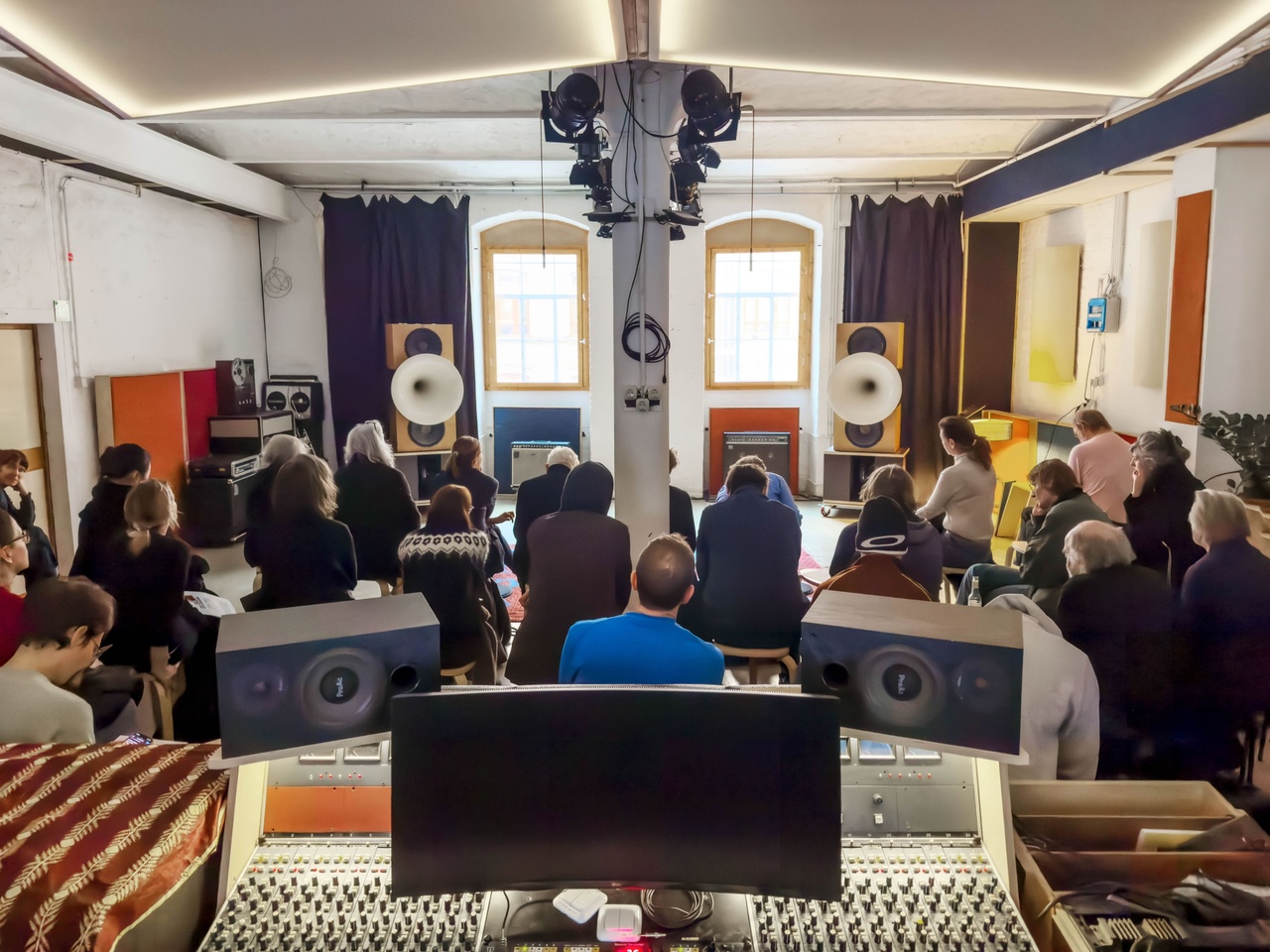
Christopher Williams, “INKLUSIVE 1972. INCLUSIVE 1974. RADIO PLAY. LONG PLAY VINYL. TOTAL DURATION. 81MIN. 30SEC.,” listening session, Morphine Room, Berlin, January 19, 2026
On a chilly midweek afternoon this winter, two dozen or so listeners could be found perching on stools or lounging on the floor of a small Kreuzberg recording studio-cum-project space. Artists, students, and critics, they had gathered at Morphine Raum on January 19th to hear around 90 minutes of vinyl released by artist Christopher Williams: the double LP Radio Play, which presents two new versions of Inklusive, a Hörspiel written in 1971 by playwright Franz Xaver Kroetz, first broadcast for audiences in West Germany and later, in modified form, for those in the East; and, as something of an encore, Pedagogical Prop, a 12-inch 45-rpm record anthologizing key moments of those longer soundtracks. [1] As heard over acoustician Mo Stern’s custom-built far-field studio monitors, the sound was notably crisp, pure, and resonant. But to what, precisely, was the audience meant to be listening? To the story, of course, with its bare-bones plot about a working-class West German couple on a package holiday in Italy, where they try to relax and enjoy their “free time,” following the advice of travel brochures while continually fretting over money. The narratives of the two versions differ slightly, and one could easily parse the ideological justifications for the changes Kroetz made, with the Eastern adaptation tending toward a more explicit critique of the misery of capitalist tourism and leaning on irony to drive its message home. As with his photographs, however, Williams was asking us to attend to more than that message – instead, the audience assembled before Morphine Raum’s exquisite sound system was tasked with listening for the ideology transmitted by the contact, the physical channel linking addresser and addressee. Could a distinction between the capitalist West and the so-called workers’ state in the East be audible, pressed into the very grooves of the vinyl?
When Williams made the two new recordings of Inklusive at Berlin’s Nadel Eins Studio in fall 2023, Stern, serving as sound engineer, had sourced vintage audio equipment from West and East Germany, ensuring that each version was captured on a signal chain whose components were true to the time and place of Kroetz’s original radio broadcasts, transmitted first on Südwestfunk (1972) and later over Rundfunk der DDR (1974). Williams wanted to test the idea that sound recordings might possess an “ideological thumbprint” of the social order that produced them, much as a bullet bears the traces of the particular barrel out of which it has been shot. [2] Hence the press release for the double LP of Radio Play – which came out in summer 2024 on the record label of Chicago gallery Corbett vs. Dempsey – provides precise specifications for the albums, including comparisons of their respective durations, surface areas of program material, and weights, humorously noting the physical distinction between the two versions: “THE RUMORS WERE TRUE. NEW DATA CONFIRMS THAT THE DDR DISC IS 5g LIGHTER THAN ITS WESTERN COUNTERPART. / A significant difference by any measure.” [3] This tongue-in-cheek remark points toward the larger challenge of differentiating the qualities of Western and Eastern sound: Just as five grams can hardly be distinguished by the human hand, the respective characteristics of the two signal chains prove elusive to the ear. Straining to hear a “socialist” soundstage as opposed to a “capitalist” one at the January listening event, I came up short, my attention returning instead to the artless language and spare dialogue of Kroetz’s two protagonists on their prepaid vacation along the shores of the Adriatic.
That subject matter had represented a shift in Kroetz’s typical milieu, away from the margins of society typical of his earliest plays and toward “the seemingly less precarious ‘normality’ of everyday life in our consumer society.” [4] From his first emergence in the late 1960s, the Bavarian playwright was writing works for the stage whose settings among the “little people” – whether lumpen, prole, or petit bourgeois – and sensational themes placed them firmly in the genre of the “folk play” as it was then being reinvented. Even as Kroetz shifted his focus in Inklusive to the representation of vacation and holidays, his radio play remained rooted in this form. To mention the folk play is inevitably to recall Bertolt Brecht’s own reconsiderations of the genre. Already in 1940, Brecht had written: “Indeed, one may posit a need for a theater that is naïve yet not primitive, poetic yet not romantic, and grounded in reality yet not merely topical. What might such a new folk play look like?” [5] To that question, one could well respond: It looks like the plays of Kroetz. But in the early 1970s, Kroetz’s reference points were less Brecht – to whom he would turn in earnest only after joining the reconstituted German Communist Party in 1972, and even then, only with some reservations – than other interwar dramatists who similarly aimed at reinventing the form. In the words of one theater historian, “the simplicity of realistic form and the immediate accessibility” of folk plays like those of Ödön von Horváth, “as well as the seriousness with which they exposed the miserable lot of ordinary, usually middle or working class provincials,” deeply appealed to Kroetz in his search for a theater suited for a working-class public. [6] His apprenticeship in Munich’s underground theater scene alongside Rainer Werner Fassbinder, and the sense of disillusionment that followed the failed revolutions of 1968, had made him suspicious of the dramatic speech found among Brecht’s characters. “If the workers at Siemens possessed the linguistic level of Brecht’s workers, we would have a revolutionary situation,” he remarked in 1971, around the time of Inklusive’s composition, stating that the honesty of the folk play, by contrast, allowed characters to be left “devoid of speech and perspective.” [7]
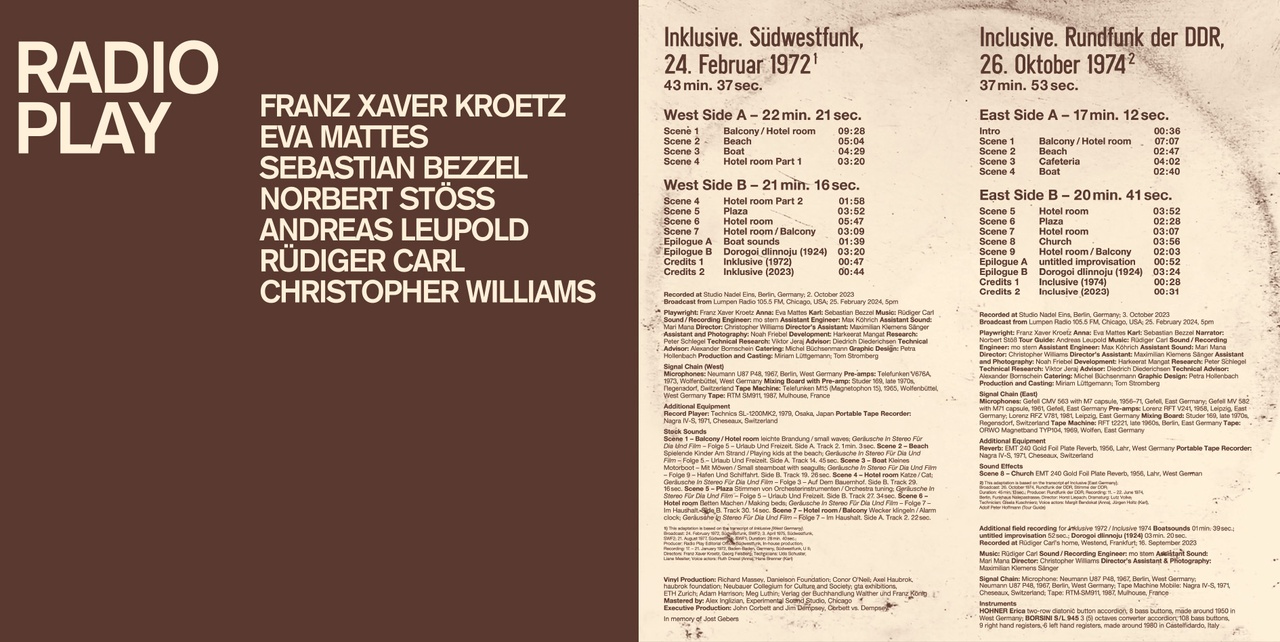
Christopher Williams, “Radio Play,” double LP, Corbett vs. Dempsey, 2024
Indeed, the conversation of the young couple in Inklusive, referred to in the script as She (Anna) and He (Karl), consists largely of clichés that mask a failure to comprehend their own alienation. In one scene, as Karl complains about the unexpected charges for various extras on their holiday, Anna interrupts him: “I wouldn’t even think about that if I were you; let’s just enjoy this moment and not let anything bother us.” “Exactly,” Karl replies laconically. [8] Anna’s tone here, along with her use of the subjunctive, make clear that she shares Karl’s anxieties – just as his quick assent belies his underlying dissatisfaction. Their words serve to disguise this frustration at the same time as they dissemble the couple’s inability to truly account for it. The oft-repeated refrain of “exactly” (genau), which punctuates the script as an all-purpose reply, is symptomatic: Like much of their speech, it works not to prolong but to curtail communication, allowing them to avoid problems rather than confront them. Anna and Karl’s package holiday, however, will not permit them such an easy escape; they find themselves caught between the desire to believe that “on vacation, different rules apply” (as the promotional material has assured them) and the inescapable realization that “even holidays are no exception” – that, even here, the iron laws of money are still in effect. [9] This gap between promise and reality, however, opens up a narrow space for reflection, a nascent questioning of the order in which they live. As the couple prepares to return home at the end of their two-week vacation, their regret at having to leave spurs a wider reflection:
Inklusive ends on Anna’s tentative question, which Kroetz declines to answer within the play, leaving that responsibility to his audience.
Radio Play restages this Volksstück some half-century after its first broadcasts, and listeners today might find themselves asking the same question as Anna: Why, actually? Williams has provided some indications, describing his commissioning in 2020 of an English translation of Inklusive – the germ of the future LP, released not as a record but as a book – as part of an “ongoing attempt to formulate a model of reflexive, contingent, or provisional realism, in relation to photographic production.” [11] “Realism” in photography has traditionally been identified with the so-called “straight” tradition, from Eugène Atget to Diane Arbus, with its assumption of an indexical transparency of image to referent, and sound recording presents an analogous situation. But Williams’s photographs, despite their impeccable technical clarity, have long troubled any notion of referential transparency. Each asks to be carefully unfolded, its multiple layers of reference resisting the immediacy of disclosure seemingly promised by qualities such as even lighting, sharp focus, and typological comprehensiveness. His 2003 triptych of a Kiev 88 – a Soviet clone of a 6 x 6 medium-format Hasselblad camera, manufactured in the Arsenal factory, a onetime armaments plant in what was then the Ukrainian SSR and the subject of a 1929 Aleksandr Dovzhenko film – offers a characteristic instance. “Within this one object,” Williams has said, “you have this political history with a capital ‘P’: the Russian Revolution; a well-known film representing that revolution and reflecting upon the position of that revolution in history; the appropriation and displacement of the means to produce photographic apparatus; and then you have the idea that it’s a collectable and a consumer product. Built into my photograph of the Kiev 88, there is the idea of social change.” [12] But what makes such a picture reflexive, or conditional, is the frame within which it appears – that is, Williams’s practice as what he calls a “displaced operator,” directing the documentation of this Cold War relic, some 14 years after the collapse of the Soviet Union, in the Los Angeles studio of a commercial photographer. This distancing works precisely to trouble viewers’ access to the political history he references, suspending the functional object between advertising image and artwork and foregrounding precisely the hermeneutic challenge of interpreting this history from today’s perspective.
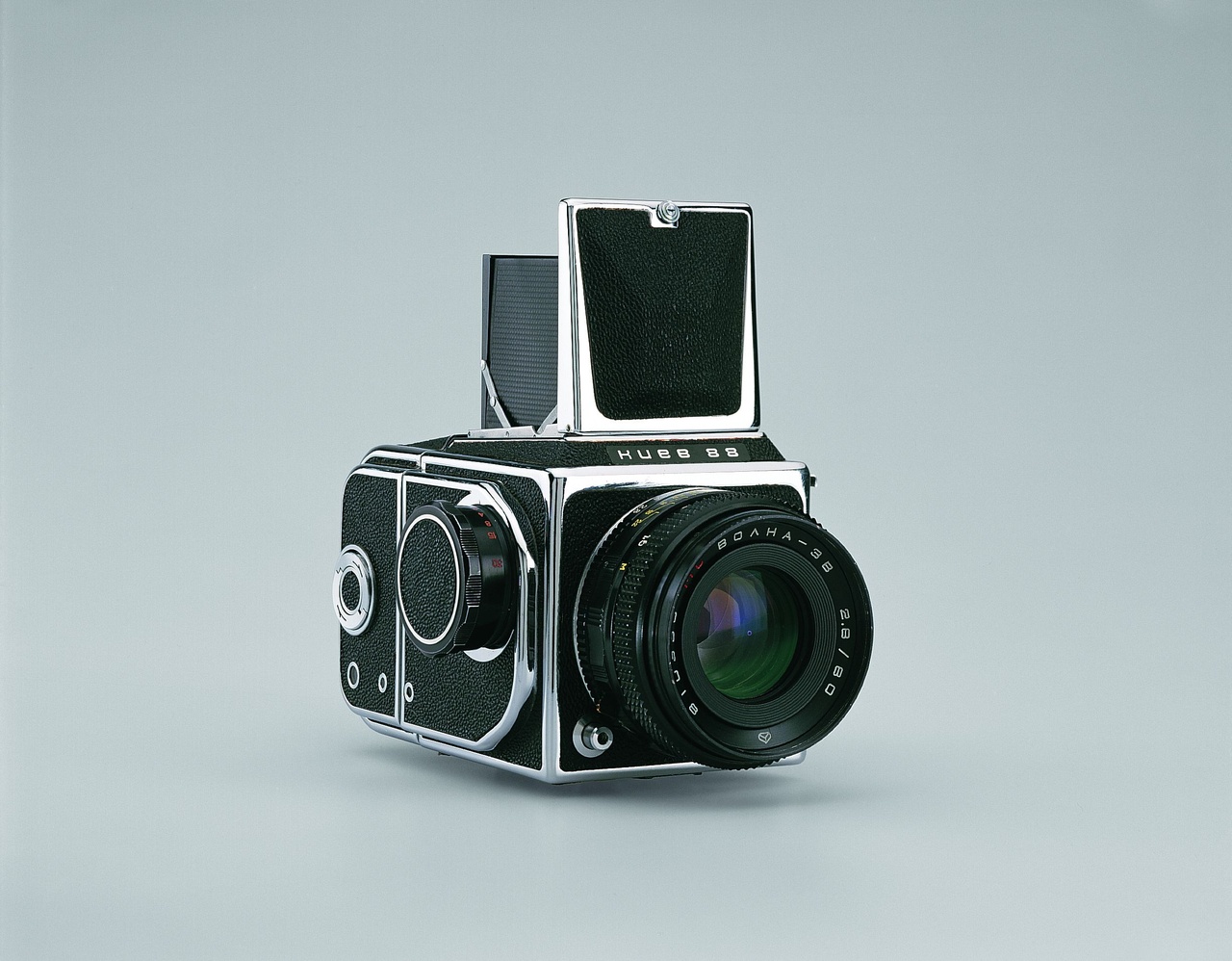
Christopher Williams, “Kiev 88, 4.6 lbs. (2.1 Kg) Manufacturer: Zavod Arsenal Factory, Kiev, Ukraine. Date of production: 1983–87. Douglas M. Parker Studio, Glendale, California. March 28, 2003 (NR. 1),” 2003
Something similar is true of the Radio Play LP as well. While the purely typographic front cover, very much in the Studio Williams house style of sans serif capitals against a uniform brown field, offers us the album title and the names of its principal contributors, the back cover provides a wealth of technical information printed over a photo of a worn record jacket that “ages” this new album. We are caught between past and present, between radio transmission and recorded sound. What had been heard on air in the 1970s by distracted listeners is now subject to close attention, one could even say a kind of fetishized listening. Vinyl is, after all, the reanimated domain of audiophiles and obsessives, and the playback equipment at Morphine Raum is of the highest order. Williams has played on these very attributes, releasing a remastered version of Radio Play on the FMP / Free Music Production label just one year after the first album came out. (Markus Mueller, head of FMP and executive producer of the reissue, half-joked that the sound quality was so superb, he could tell what kind of chair accordionist Rüdiger Carl was seated on as he played a musical interlude for the album.) As in many of Williams’s photographs, there is a level of perfection in the registration that is rather at odds with the scrappy origins of the source material. Kroetz’s folk play becomes something to be attended to with an unforeseen focus, and perhaps the ideological thumbprint most in evidence is neither that of West nor East, but of our own moment. Earlier, I used the term “contact” to name the physical channel that links addresser and addressee, yet we might have to admit that ultimately Radio Play operates today in a space of non-contact. And yet this is by no means an indication of resignation on Williams’s part. Sitting in Kreuzberg on that January afternoon, paying such close attention to these recordings, I came to think of them as addressed not simply to the audience present that day but to multiple times: The play at once recalls its pasts and anticipates future developments. This is the strength of his adaptation – its recognition that any “realism” worthy of the name today – reflexive, contingent, or provisional – seeks less to be transparently “of its time” than to be anachronic, a signal chain preserving these historic traces for publics not yet formed. Perhaps that’s why, actually.
Christopher Williams, “Radio Play,” listening event, Morphine Raum, Berlin, January 19, 2026.
Tom McDonough is an art historian, critic, and professor at Binghamton University, State University of New York. He is the author of several books on art and cultural theory.
Image credits: All images courtesy of Christopher Williams, 1. photo Uwe Walter
Notes
| [1] | An earlier listening event, consisting of selections from Radio Play, was held at Spiritland Kings Cross in London on October 13, 2025. |
| [2] | Christopher Williams in conversation with the author, February 27, 2026. |
| [3] | “RADIO PLAY AVAILABLE FOR THE FIRST TIME ON LONG PLAY VINYL,” Corbett vs. Dempsey press release, August 2024. |
| [4] | Thomas Thieringer, “Vorwort,” in Franz Xaver Kroetz, Weitere Aussichten ..., ed. Thieringer (Kiepenheuer & Witsch, 1976), 7. Emphasis in the original. |
| [5] | Bertolt Brecht, “Notes on the Folk Play,” in Brecht on Theatre, trans. John Willett (Hill and Wang, 1964), 154. Translation modified. |
| [6] | Denis Calandra, New German Dramatists (Macmillan, 1983), 19. |
| [7] | Franz Xaver Kroetz, “Liegt die Dummheit auf der Hand? Pioniere in Ingolstadt – Überlegungen zu einem Stück von Marieluise Fleißer,” Süddeutsche Zeitung, November 20–21, 1971. |
| [8] | Kroetz, “Inklusive,” in Weitere Aussichten ..., 103. |
| [9] | Ibid., 107 and 101. |
| [10] | Ibid., 112. |
| [11] | Christopher Williams, “At Home He’s a Tourist,” in Inklusive: Franz Xaver Kroetz, 1971, ed. Christopher Williams, trans. Maximilian Klemens Sänger (Verlag der Buchhandlung Walther und Franz König, 2020), n.p. |
| [12] | Christopher Williams, quoted in Mark Godfrey, “Cameras, Corn, Christopher Williams, and the Cold War,” October, no. 126 (2008): 125. |