
INAPPROPRIATIONS Cecilia Bien on Jessi Reaves at the American Academy of Arts and Letters, New York
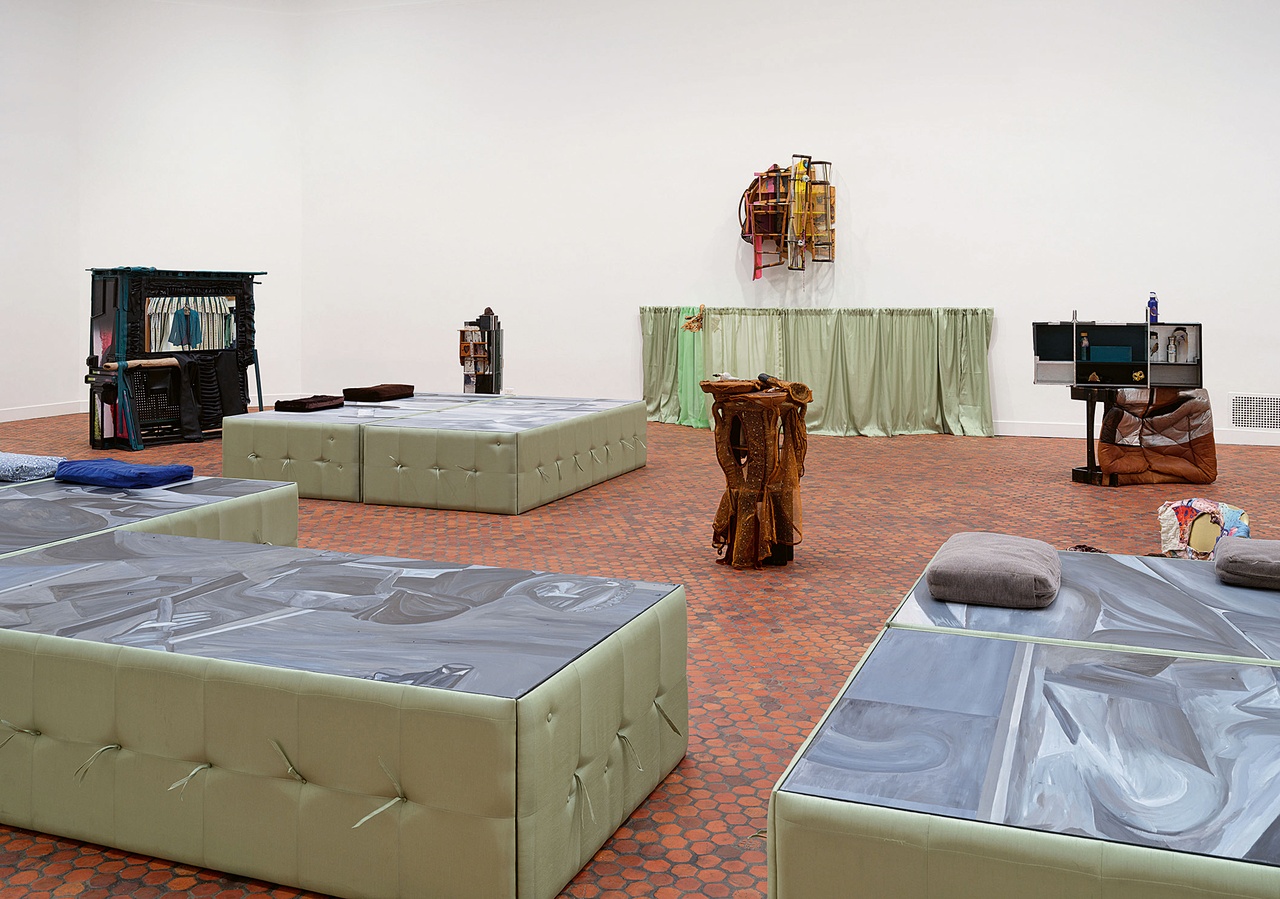
“Jessi Reaves: process invented the mirror,” American Academy of Arts and Letters, New York, 2026
For “process invented the mirror,” first presented at the Walker Art Center in Minneapolis and now on view at the American Academy of Arts and Letters in New York, Jessi Reaves raises the stakes of her deranged and labor-intensive sculptures. Over the past 10 years, Reaves has rerouted her training in upholstery into an artistic practice with a growing conviction for making funky the given. Here, her sculptures are increasingly functionless, dense, and devoid of economy, reflecting a by-now well-hewn confidence in Reaves’s artistic method. Her current engagement with available materials is ever more feral and rigorous, producing an originality that forces focus on the sculptures’ objecthood. Their awkward materiality defies the credence of lineages that typically secure an object’s status as art.
The sculptures in “process invented the mirror” are indigestible. They confound the role of furniture despite their shapely likeness. The familiarity is seductive and bewildering, with misrecognition engendered by the intimacy of homemade qualities and kitsch embellishments that evoke a shadow side of banal furnishings, latent and repressed, undermining expectations of utility. Entering the exhibition, one finds on the floor a box made of cheap plywood flooring, titled Center console (the extent of the damage) (2025). The cube-shaped structure is made of multiple compartments, two of which contain dingy velvet hearts in mustard-yellow haphazardly nailed inside. The lid, with rhinestone heart shapes adorning its underside, is propped up, revealing a heart cushion quilted in a brown velvet fabric also found throughout the exhibition. Sepia-tinted photographs of a car’s center console are crudely cut and collaged onto one side, framed by hacked metal strips frenetically tacked down at the box’s edges. Likewise discomfiting in its homeliness, Your room is the same as when you left (2025), mounted on the institution’s wall, features chopped-up wicker chairs constructed as a shelf, with sections wrapped in vinyl and ornamented with fake flowers, owl-head stickers, and gnarled party ribbons, like the kind found attached to a deflated balloon. The incoherent pileups of vernacular materials are not without their quaint charm; however, they leave viewers grasping for an orientation and logic that might explain how these elements came together in the first place.
Such instability triggers discursive provocations – in the exhibition curator’s press release and previously by critics – that are enlisted to disrupt value hierarchies among craft, design, furniture, and taste. The notion of craft historically carries a pejorative charge when positioned to exclude the nonconceptual or noncritical from the domain of fine arts. As a term, it has been relegated to definitions of community-oriented and domestic projects. Writing in the 1980s, Lucy Lippard reframed craft within the vernacular as a site of cultural agency, describing it as a mode through which “the people” might speak outside the protocols of high art. [1] By positioning the vernacular within a lineage of art rooted in the commons, craft as a category could be redefined. Its integration into contemporaneity has, in turn, yielded a reliance on heavy discursive framing. Like her RISD peers of Eckhaus Latta, who also emerged in the 2010s exhibiting DIY styles in art-world contexts as a fashion brand, Reaves presents firmly within the domain of art, which demands her work to be seen as such, keeping the tensions of categorization cool and unresolved. Her material-driven approach generally avoids recourse to discourse production, insisting that defined hierarchies collapse through form rather than explanation.
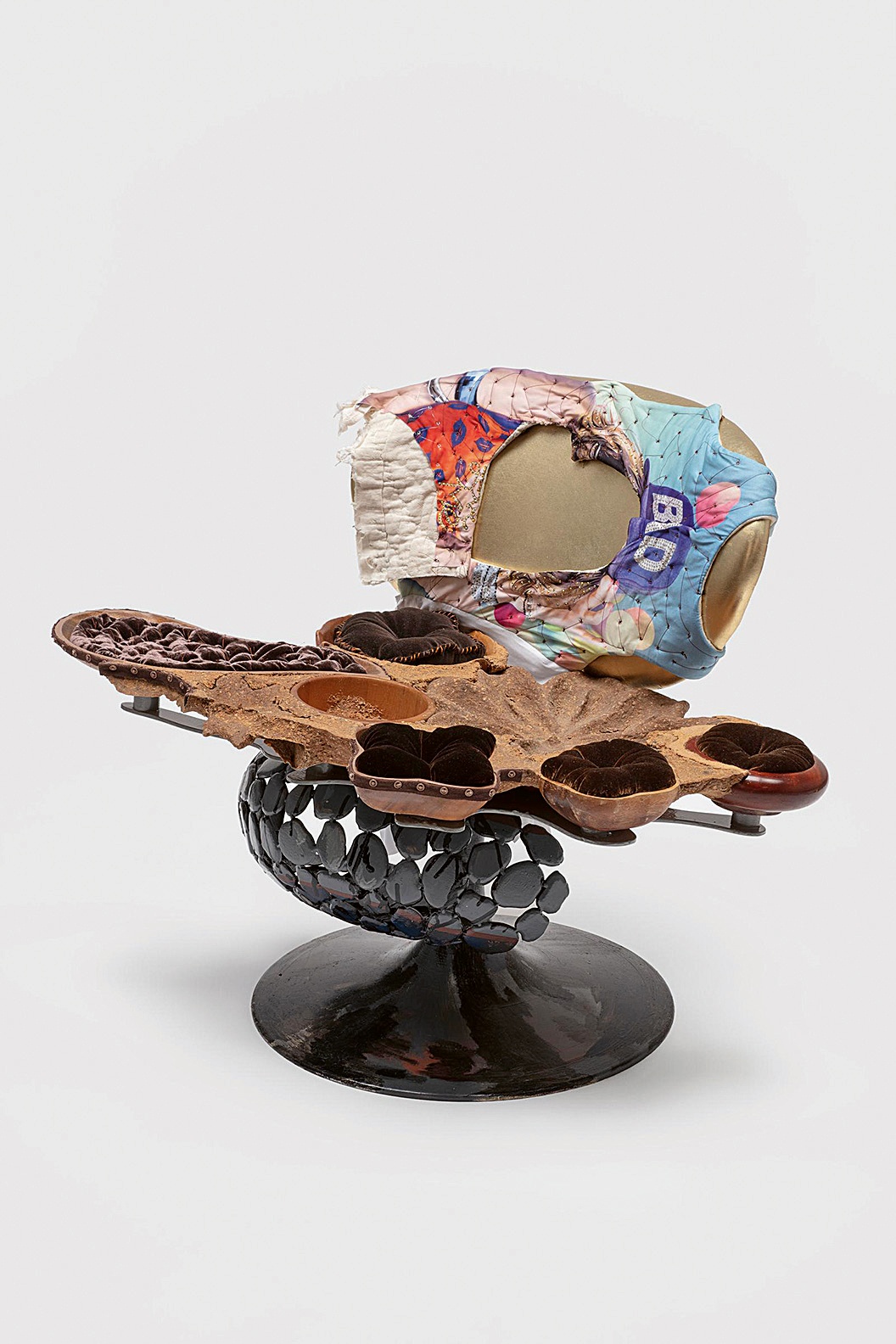
Jessi Reaves, “Wearing a costume,” 2025
It is therefore notable that Reaves invokes, as a referent, the Works Progress Administration (WPA), a New Deal initiative that encouraged artists to engage with everyday life via civil projects in the United States during the Great Depression. In Mural seating (sections 1–9) (2026), Reaves reproduced a tableau of industrial workers in grayscale acrylic on fiberboard panels, sourcing the image from a mural mounted in a West Virginia post office, painted in 1942 by WPA artist Michael Lenson. Reaves’s version was displayed as a wall mural at the Walker and is given another social function at Arts and Letters, where it mimics the kind of institutional bench for contemplating a great artwork at leisure – or at least that’s how it was received at the opening. Viewers responded to the brown velvet cushions placed on top as an invitation to sit on them, as well as on the painting itself. In the video inside the sculpture Reflection in black plastic (2025), a child plays dress-up at Timberline Lodge in Oregon, which was built in the 1930s as a WPA project and furnished by local artisans. While the WPA reference demonstrates due reverence for artistic work largely overlooked by the discipline of art history – offering a counterweight to modernist figures such as Marcel Breuer and Charles and Ray Eames, who are frequently cited in interpretations of Reaves’s sculptures – here, the reference feels overly literal and underdeveloped. A history of making is named by copying an image, instead of subjecting the actual work to the kind of transgressions that animate the surrounding sculptures. This risks tokenization and a feeling of set design within the beaux arts building of Arts and Letters. Along the walls and skimming the floor, light-green curtains in a vaguely historicizing palette reinforce the effect.
Reaves’s sensibility for working-class artisans in the United States is most astute in her attunement to the palette of a degraded present-day Americana: Reaves’s color scheme is grungy and painted over in sheer silver, like a veneer of brittle optimism, or coated in garish pink, like a quick Pepto-Bismol cure. Slapdash paint jobs in rusting tones disguise the surface of flimsy wood. Reaves has said that she wants her application to look like a bad nail-polish job: innocent and urgent. [2] YouTube hacks, shortcuts from DIY online culture, using sawdust and glue as joinery, and screws left loose so as to enable last-minute jiggering for misfit pieces, which Reaves calls the “landlord’s special,” define the artist’s aesthetic language. [3] The makeshift construction in low materials, improvised and stopgap, echoes the band-aid culture of a faded America, speaking to the real ways everyday lives are pulled together: DIY-ed and on the spot. These aesthetic choices successfully reflect a broader material condition – a culture of patchwork, accumulation, and deferred maintenance. Such treatments establish Reaves’s oeuvre away from Rachel Harrison’s elegant junk piles and Anna Uddenberg’s corporeal utilitarianism. Rather, Reaves’s sculptures mirror a built environment that continually glosses over its own failures rather than addressing them, producing a distinctly American form of excess.
These strategies pervert the unornamented and balanced proportions of designs associated with Breuer, Eameses, and Isamu Noguchi. In previous works, Reaves has wrapped her absurd shapes in translucent fabrics and used slipcovers, which at once eroticize and obscure what’s underneath. The incorporation of knockoff variants has often been described in discussions of Reaves’s oeuvre as “reappropriation,” but this term implies a recuperative gesture or act of reclamation that is largely absent here. “Inappropriation” would more accurately name her method: a deliberate misuse of modernist elements – such as an Eames-ish backrest or the base of a Saarinen-esque Tulip table – that neither explicitly subverts nor preserves them. Here, in works such as Being serious (2025) and Wearing a costume (2025), two chair-like structures with seats made out of bowls – an idiom developed in past works such as Melted natural (2020) – are outfitted in a graphic tank top with a heart cutout and in bedazzled lingerie, respectively. Upholstery couture also lends a peculiar and fragile subjectivity to a found wooden cabinet in Decoy world (after Ruhlmann) (2025), which Reaves has covered in hosiery fabric printed with metallic starbursts trimmed in velvet. Carved wooden swans – the kind of artifacts found in places like Timberline Lodge – hang from their beaks along the top edge. The futile addition of these kitsch handicrafts is superfluous and at times ridiculous, like the teenage country in which Reaves lives and works, and from which she sources materials and impulses. Yet the formal command with which they are applied emphasizes the artist’s knowing irreverence.
Reaves’s mirror locates self-reflexivity in the process of making rather than in any predetermined concept or research inquiry, producing objects that assert their own idiosyncratic coherence. Having now developed a distinct material vocabulary, Reaves has chosen to align her work with an overlooked lineage, or at least to use her objects to recognize its exclusion. In the artist’s sincere valorization of artisanal labor, a parallel art history rooted in craft, domestic materials, and knockoffs – which, per Byung Chul-Han’s theory of Shanzhai, perform their own deconstructive value – emerges. While dressing furniture up in clothes may call to mind Sarah Lucas, whose simultaneous exhibition at the New Museum includes abstracted body sculptures sitting in warped positions on chairs, or CFGNY, concurrently showing a bridge wrapped in fake fur at Amant, Reaves’s work remains committed to a logic of inappropriation. The sustained misuse of inherited forms yields to self-determined outcomes, recasting them in a light that evokes at once an uncanny attachment and intimate estrangement. Home is found in a leather-padded cabinet or a sawdust hair bow.
“Jessi Reaves: process invented the mirror,” American Academy of Arts and Letters, New York, March 14–July 3, 2026.
Cecilia Bien is a writer based in Vienna and New York.
Image credit: 1 Courtesy of American Academy of Arts and Letters; 2 courtesy of Hoffman Donahue Gallery and the artist, 1 photo Steven Probert Studio; 2 photo GC Photography
Notes
| [1] | Lucy Lippard, Mixed Blessings: New Art in a Multicultural America (Pantheon, 1990), 78. |
| [2] | Instagram post, “A coat of paint is so familiar. I always feel the innocence and urgency. I want the paint to feel like a bad nail polish job” (@jessireaves_, January 24, 2024). |
| [3] | “What Makes an Object Bad? Jessi Reaves on Making Sculpture,” Walker Reader, 2025. |