
TRANSCENDENTAL URGES IN A GODLESS WORLD Luce deLire on Mark Leckey at the Julia Stoschek Foundation, Berlin
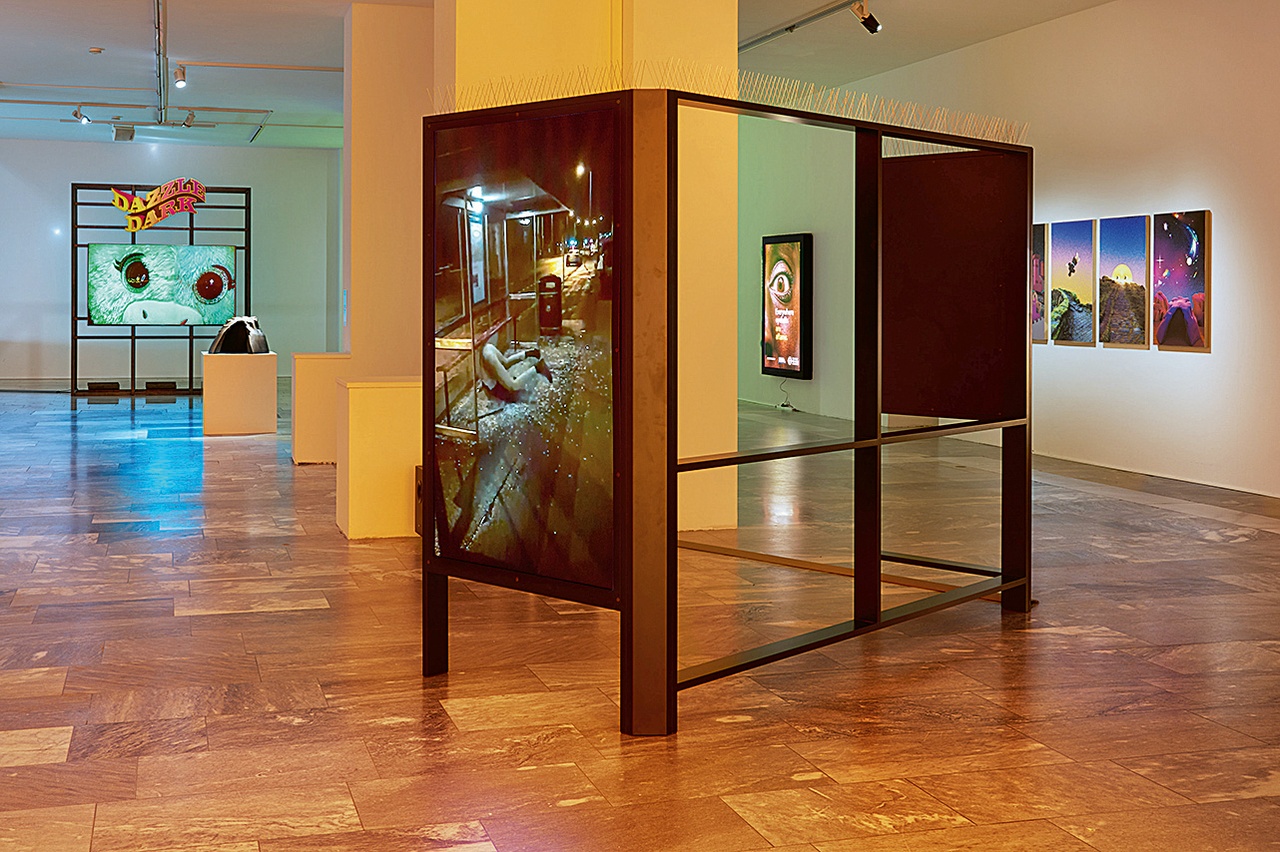
“Mark Leckey: Enter Thru Medieval Wounds,” Julia Stoschek Foundation, Berlin, 2025–26
“Enter Thru Medieval Wounds” is Mark Leckey’s most encompassing exhibition to date. It includes over 50 works, which are presented nonchronologically, stretching three decades and all three floors of the Julia Stoschek Foundation’s Berlin premises. In a recent interview with Travis Diehl, Leckey explains the title as follows: “At the end of secular rationalism, we have to go back and enter through medieval wounds. We have to go back to that traumatic point, I guess, in order to find ourselves again.” [1] To Leckey, especially since Covid, Western lives happen primarily online – heralding the alleged “end of secular rationalism.” This digitalization “flattens” the world, in that everything happens on screens – Leckey’s own life, for example. [2] According to the artist, the “medieval” alternative to this digital flattening is “mystical” experience, which is thick (as opposed to flat), “direct” (as opposed to being mediated through digital devices), and transcends language.
Elsewhere, Leckey describes an experience from his own life: “Everything felt alive and I was […] dissolved into that.” [3] This, I suppose, is what he means when he speaks of a “traumatic point” or “medieval wound” that enables us “to find ourselves again.” [4] Curiously, what he recounts was also an apparently rare moment of bliss, experienced while pushing his one-year-old daughter through a park in a stroller while listening to Judee Sill’s “Jesus Was a Cross Maker.” [5] According to Leckey, the convergence between trauma and bliss, wholesomeness and woundedness that constitutes the mystical experience, cannot be described in language. [6] Consequently, he cast his experience into art.
In the Stoschek exhibition, Carry Me into The Wilderness (2022) documents the artist coming down from his “mystical experience,” presented through an agitated voice (“It’s too much!”; “I’m crying! That’s what it is!”) and blurry phone images. [7] Throughout the six-minute video, the original material of him crying is repeated, then altered. Eventually, it transitions into an ecclesiastic hymn featuring Auto-Tune and vocoder over a gilded screen. This development is interspersed with a reproduction of Lorenzo Monaco’s painting Saint Jerome in Penitence (1398–1400), from which Leckey removed Jerome, leaving only an empty cave. We find this altered painting also on the other side of the same room, presented as a separate work. Yet another work, Ally Pally Map (2024), resituates Jerome’s cave in the park at Alexandra Palace, London, where Leckey’s above-mentioned “mystical experience” reportedly happened. [8]
In the same room on the ground floor, we find To the Old World (Thank You for the Use of Your Body) (2021), a re-creation of a bus stop, whose two side glass panels serve as projection screens. The projected videos consist of found social media footage: A teenager jumps right through one of the glass panels, to cheers of disbelief and amazement. The clip is looped nine times in a row, followed by an aesthetic decomposition akin to forensic analysis: The scene is slowed down, interspersed with rendered scenes showing the stunt from different angles. At times, we hear Leckey breaking into devotional jubilation: “Oh my Jesus Christ! Oh my God he did it!” Then we see splinters of the shattered glass, arranged like church windows.
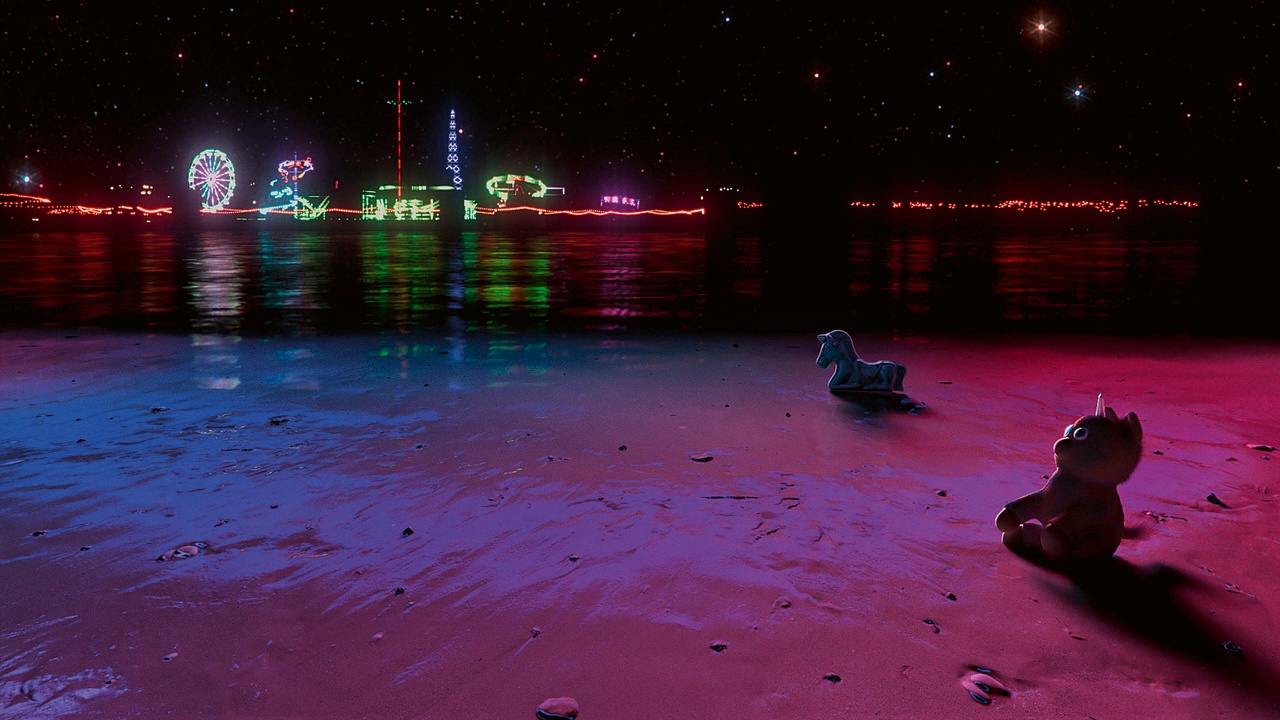
Mark Leckey, “Dazzleddark,” 2023
In his interviews, Leckey is clear that he is serious about the “mystical” quality of “direct” experiences as an antidote to the alleged orthodoxy of the inevitable death of secular rationalism. He really means it. Yet his works point in another direction: In both Carry Me into The Wilderness and To the Old World, we first see the original, somewhat desolate found footage. Then, the material is digitally altered, pitched, shredded, and Auto-Tuned into hyper-aestheticized quasi-ecclesiastic art, both visually and musically. We literally see the making of a mystical experience through isolation, augmentation, repetition, and aestheticization. In Carry Me into The Wilderness, we even see Saint Jerome in Penitence without the saint, which in Ally Pally Map indicates the site of Leckey’s “mystical experience.” Sanctity has withdrawn. In both video installations, there is an irony to the transformation from phone footage to digital relic: It is over the top and thus somewhat funny. Yet the aesthetic elevation is conducted with sincerity, leaving the joke in limbo. In the Middle Ages, one might have found similar experiences turned into tales of wonders, divine inspiration, or mystical experiences. But rather than summoning a genuine “mystical experience,” the meticulous forensics applied in both video works suggests an analysis of transcendental urges in a godless, disenchanted world. [9] They also highlight how such urges are turned into articles of faith: Yes, we do long for something more than reality. But the processes in which these experiences are (re)produced are entirely mundane: cutting, splicing, merging, spicing, repetition, recontextualizing, and so forth. Mystical experiences thus turn out to be effects of secular processes of production.
Another example of the same effect is the way in which Leckey describes his mystical experience. He says that the experience was “greater than language could describe.” [10] Clearly, that description is constituted by the transgression of language (“greater than”). Even if true, the “mystical experience” would be constituted by its limit (“greater than”), which is language. Thus, even if Leckey’s “mystical experience” really was “greater than language could describe,” both the description and the experience would nevertheless be constituted by language as that which is being transgressed. Consequently, this experience is not “direct” but rather mediated by the collapse of language – and hence by language. [11] Language does describe it – though negatively.
The exhibition room concludes with the video Dazzleddark (2023). [12] A colorful plush unicorn and a carousel horse are stranded on a moonlit beach at night, across from an amusement park. A gold star balloon appears to the sound of a machine gun. Horse and unicorn salute it with “[You] shine so brilliantly, oh sea star, light of the night. Is your own true intent … our delight?” To them, the balloon is a spiritual event, made for their enjoyment. Yet really, it is a disoriented leftover of past amusements just as the unicorn and the carousel horse themselves. The transcendental urge is real: Unicorn and horse describe themselves as being “cut off” – they yearn to overcome their isolation. This transcendental urge is projected onto an accidental figure (the balloon). As opposed to Leckey’s insistence on the “directness” of “mystical” experiences, in Dazzleddark, collective mythmaking brings about the special quality of the “mystical” object. Eventually, that same desire manifests in a collective experience that includes the viewer: “Do you want to go faster?” we hear someone ask. Then the image begins to spin at disorienting velocity. As viewers, we share this dizzying experience with the protagonists. The transcendental urge succeeds: Isolation is overcome. The desires of two individuals become a collective experience among three (or more). At dawn, the toys lie on the beach, apparently inanimate. Instead of the eternal redemption of medieval mysticism, the collective pleasures (the spinning carousel) embody finitude.
It seems to me that Dazzleddark explains Carry Me into The Wilderness and To the Old World quite well: The real-world background of Carry Me is a walk in the park with a toddler in a buggy toward the end of Covid lockdown. Here, Leckey himself had been “cut off,” isolated – and was now reentering life and possibly experiencing a special connection with his daughter. The sun is shining. Leckey starts crying. It seems that this experience was both traumatic and joyful. On the face of it, this is a case of overstimulation, caused by the intensity of sunlight and nature, combined with the simple joys of family life and paternal care, which does not fit well with cis heterosexual white masculine stereotypes, since men are commonly exempt from care work. Turning this moment into a “mystical” experience disavows that life can be exceptionally beautiful at times (given the right conditions). Why not enjoy care work? Why reify this into a transcendent marvel? Likewise, it seems that the glass-smashing leap in To the Old World was a Covid-related stunt by an alienated (“cut off”) teenager, seeking approval from and connection to his peers. Both cases seem to fit the model presented in Dazzleddark: An urge to connect can succeed, if orchestrated correctly. There is nothing mystical about it. It’s all emotional engineering. Yet more often than not, the result is reified into a relic. This is how joy and bliss become mechanisms of power. Apparently, Leckey wants to go down that path. Luckily, his works act out against him, succeeding above and beyond the artist’s esoteric intentions. But in general, we cannot rely on art to do that. So, let’s mobilize our transcendental urges in an atheistic fashion to counter their reification into objects of worship and consumption.
“Mark Leckey: Enter Thru Medieval Wounds,” Julia Stoschek Foundation, Berlin, September 11, 2025–June 5, 2026.
Luce deLire is a ship with eight sails and lays down by the quay. She holds a PhD in philosophy from Johns Hopkins University, Baltimore. Besides academic articles on topics anywhere between Baruch Spinoza’s metaphysics of infinity, postcolonial takes on social contract theory, and anti-fascism, she has published widely on art and politics. She is currently working on two books, Spinoza on Sex, Gender and Sexuality (Cambridge University Press, forthcoming) and EUPHORIA – a treatise against capitalism’s techno tyrants (notably THE BABY) and for hospitable trans lesbian Utopias.
Image credits: 2. © Mark Leckey, 1. Courtesy of JSF, photo Peter Tijhuis
Notes
| [1] | Travis Diehl, “How Artist Mark Leckey Found God in the Glitches,” Interview, September 10, 2025. |
| [2] | “Mark Leckey: Recent Work,” Sessions x Rhizome, posted March 22, 2026, by Artwrld, YouTube video, 58:17. |
| [3] | See Leckey’s own discussion of the Stoschek show (ibid.). |
| [4] | Diehl, “How Artist Mark Leckey Found God in the Glitches.” |
| [5] | Mark Leckey, “Carry Me into The Wilderness (2022),” interview posted December 2, 2024, by Gladstone, YouTube video, 2:18. |
| [6] | “Mark Leckey: Recent Work.” |
| [7] | Leckey, “Carry Me into The Wilderness (2020).” |
| [8] | Diehl, “How Artist Mark Leckey Found God in the Glitches.” |
| [9] | Ibid. |
| [10] | “Mark Leckey: Recent Work.” |
| [11] | See, for example, Avital Ronell, Stupidity (University of Illinois Press, 2003); and John D. Caputo, The Prayers and Tears of Jacques Derrida: Religion Without Religion (Indiana University Press, 1997). |
| [12] | Mark Leckey, “Dazzleddark,” posted October 12, 2023, by Mark Leckey, YouTube video, 5:20. |
With thanks to Callaz, K. M., Anna Sinofzik, Rona Torenz, and Oona Wächter.