
ADVENTUROUS MONTAGE Arindam Sen on “Pont aeri: El cinema de Warren Sonbert” at Filmoteca de Catalunya
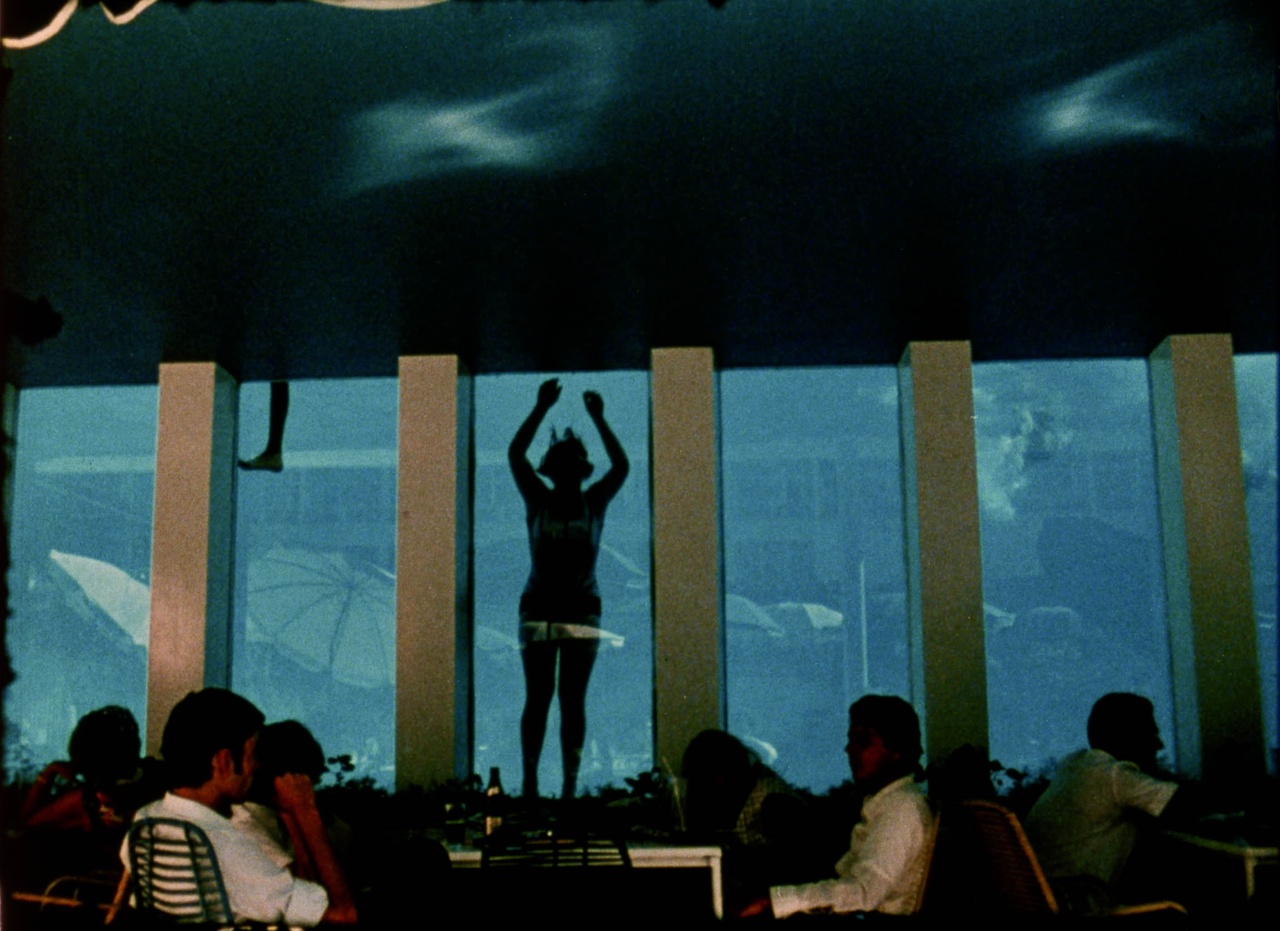
Warren Sonbert, “Carriage Trade,” 1971
Warren Sonbert shot Carriage Trade (1971) in 13 countries across four continents to arrive at a work of colossal polyphonic montage, cutting across people, places, and periods. After a total of six years of travel and editing, he finished the film at age 24. The shards of the world contained in his shots mostly last less than 10 seconds. Such filmic language, motivated by the short-duration segments that his mentor Gregory Markopoulos had devised in the celebrated film Twice a Man (1963), would remain a lasting hallmark of Sonbert’s work. As would a multivalency of meaning, a propensity he shared with Nathaniel Dorsky and Jerome Hiler, friends and fellow filmmakers who would frequently appear in his films. The durational fleetingness of a continuous shot, that disallows the viewer from luxuriating on it, triggers an ambiguity that Sonbert most cherished. At first glance, Carriage Trade is a stream of images whisking past us, emulating a rapid slideshow of postcards, like those sold by the vendor who appears early on in the film, on a street corner somewhere in North Africa or the Middle East. This shot serves as an apt metaphor – both for the rest of this film and for Sonbert’s characteristic technique of incorporating large numbers of locational fragments into all films that would follow. Carriage Trade is his only feature-length film. Along with 15 short and mid-length films, it forms part of a career-spanning retrospective that is currently on tour in Spain. Complemented by Dziga Vertov’s A Sixth Part of the World (1926), Alfred Hitchcock’s Vertigo (1958), and Douglas Sirk’s Written on the Wind (1956), which help situate Sonbert within film history, this comprehensive survey presents a rare chance to discover a filmmaker who strived to expand the freedom of cinematic expression until he passed away in 1995 due to AIDS-related illness at the age of 48.
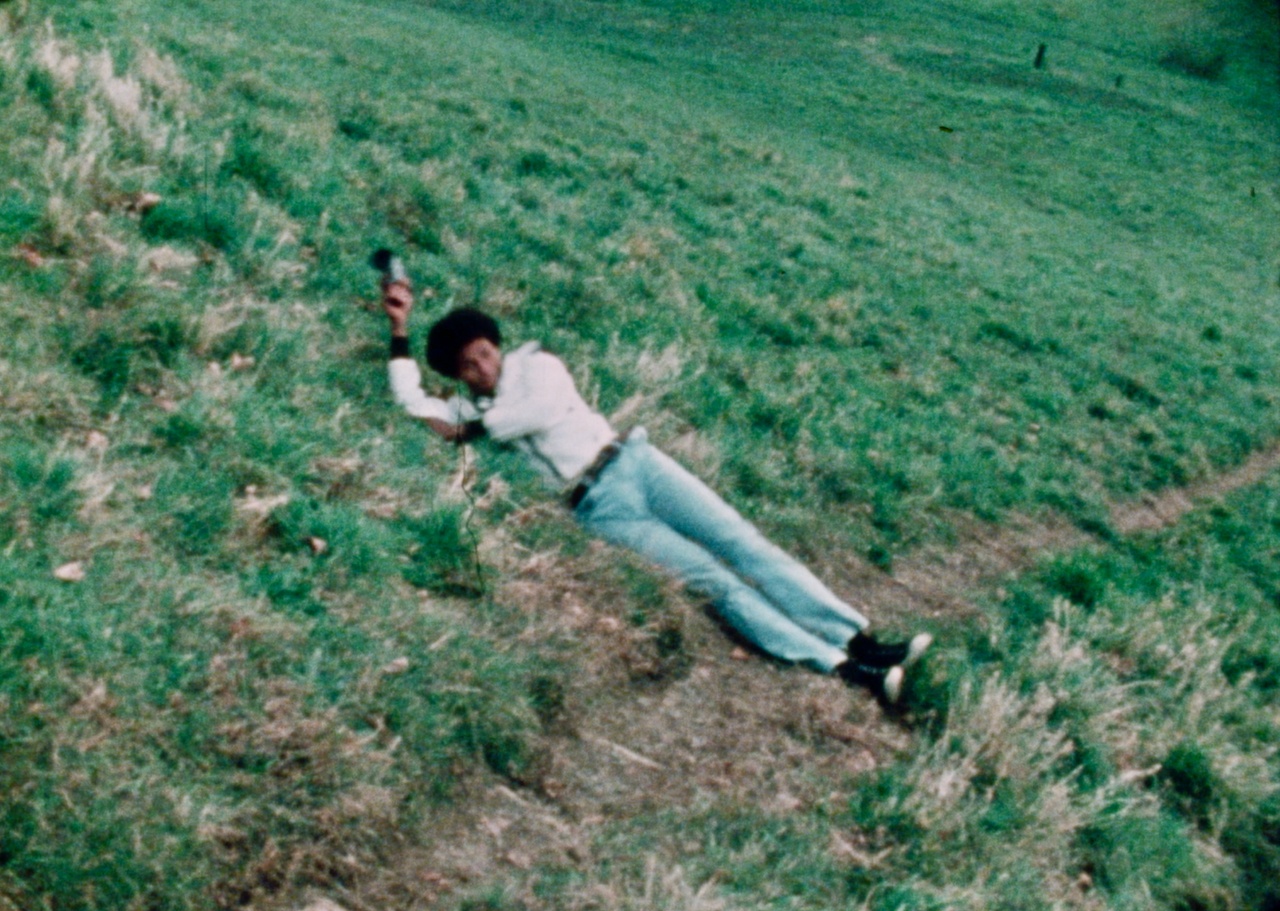
Warren Sonbert, “Divides Loyalties,” 1978
Sonbert shot his own footage, recording scenes from San Francisco, the city where he lived, to as far away as Asia and Africa. He had a penchant for public spectacles, circuses, parades, carousels, glamorous people, airplanes, and TV screens – motifs to which he would constantly return, with variations in time and place, sometimes hinting at the undercurrents of decadence and corruption in them. At first glance, Sonbert’s kaleidoscopic filmmaking may seem like an act of crude assemblage at the service of decorative impressionism; upon closer inspection, however, it becomes apparent that his compositions are carefully crafted – guided by metaphors, montage of soft resonances, deliberate chromatic variances, and basic formal dualities. In Carriage Trade, for example, the back-and-forth motion of an elephant visually chimes with a swinging movement a few shots later, and a shot of two cobras under the spell of a snake charmer resonates with several couples dispersed across the film. In Noblesse Oblige (1981), he excavates metaphors of transition in shots of tunnels, while Rude Awakening (1976) vacillates between motion and stillness, dark and light, close-up and wide-angle, people and landscapes or animals. These three films were all produced during Sonbert’s silent period, which began in 1968 with The Tuxedo Theatre – an earlier, shorter version of Carriage Trade – and lasted for 20 years. A theme, however vague or diffuse, is always a starting point. As Sonbert informs us, Rude Awakening is about “Western civilization and its work,” Divided Loyalties (1978) about “art vs industry,” Noblesse Oblige about “journalism.” [1] In A Woman’s Touch (1983), Sonbert initially set up two parallel plots, one of random women enjoying freedom in their daily lives, engaging in sports and leisure, and the other of similarly random men, authoritative in demeanor, drinking, gambling, and marching in uniform. This sharp contrast is gradually softened in the middle section of the film, of men and women now cordially interacting within a shared frame. The film then proceeds to end with a phone call, cut between a man and a woman speaking into receivers, the man assertive and dominant, the woman giving and submissive. The image of the liberated woman at the beginning of the film has withered away, gender stereotypes reinforced. The film is a lighthearted treatise on the doomed fate of heterosexual coupledom. The thematic arc is punctuated by shots of various transport modes and communal interactions. Frequent references to travel and everyday life in Sonbert’s works often led audiences to interpret their intention as diaristic, but he clearly rejected this label. Looking at the way in which his montages are steered in their final form by broader themes, understated as they might be, it becomes clear why such interpretations left him dissatisfied.
The varying locations that appear in Sonbert’s films offer a fragmented record of numerous journeys. Those weren’t motivated solely by filmmaking though: he wrote opera criticism from Europe and Australia while cruising in upper-class public places, sometimes under his Vertigo-inspired pen name Scottie Ferguson. In his films, Sonbert fought against the abject domestication of narrative when it progresses linearly toward a climactic resolution, though he never entirely abandoned it. His films thrive on open, unresolved micro-plots and coded references to multiplicities (he often filmed the forward movement of trains on crisscrossing rail tracks, making sure to cut before a vehicle chose a single track). They remain in a constant flux of detournements that rupture consolidating emotions (in Noblesse Oblige, a kitten at play is followed by someone wheeled onto an ambulance). These narrative maneuvers allegorize travel itself as an unpredictable adventure in which the journey supersedes the arrival at a destination. Exploration of such fiendish possibilities of narrative maps onto Sonbert’s own sexual politics. He wasn’t exactly a “queer filmmaker making erotic images,” as Derek Jarman once described himself to Sonbert. [2] For Sonbert, being gay meant remaining open, liberated, and explorative, to look at the world playfully and mischievously. [3] He intended to cultivate a gay sensitivity without making films about gays – perhaps also as a deliberate contrast to Kenneth Anger’s and Jack Smith’s tendency of turning gays into exotic protagonists. The erotic self-expression that one occasionally encounters in the films of Markopoulos, Tom Chomont, and Robert Beavers is also absent in Sonbert’s work. Instead, in this regard he takes after F. W. Murnau, whose mise-en-scène and camera’s viewpoint left themes and intentions ambivalent and highly codified.
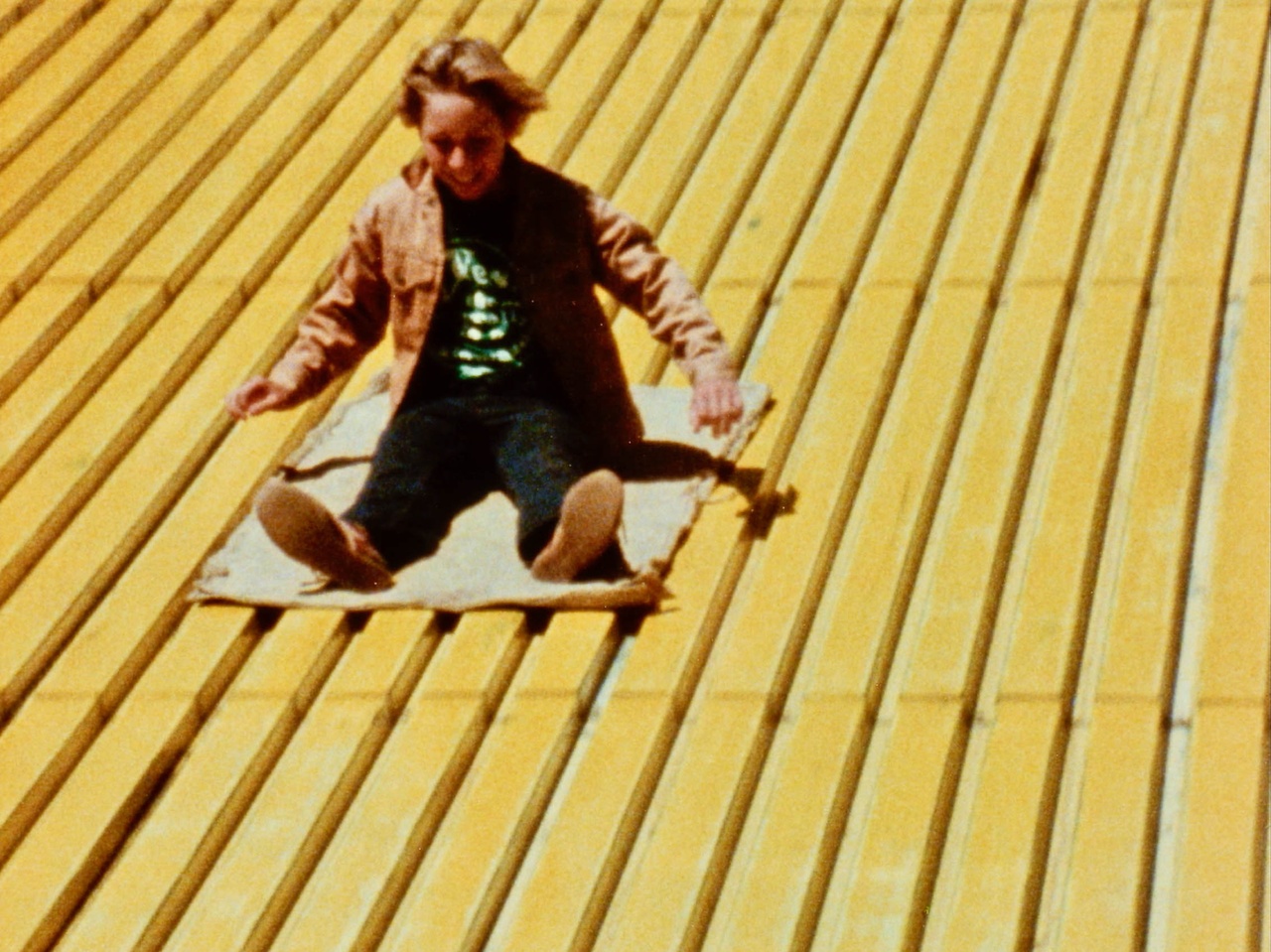
Warren Sonbert, “Friendly Witness,” 1989
Capping two decades of working without soundtracks, Sonbert made Friendly Witness in 1989 as a diptych, the first part of which is set to pop and rock songs like Little Darlin’ (The Diamonds) and Runaway (Del Shannon) – a cue for looking back at the 1960s – and the second, to Gluck’s operatic overture for Iphigénie en Aulide, a melancholic gaze cast upon a world in transition. Sonbert’s approach to music in his filmmaking is worth pondering for a moment. His silent film phase marked the blossoming of a distinct musical sensibility where a close attention to duration, repetition, attack, and pitch relation contributed to the intricacy of his visual montage. The Second Viennese School, of Arnold Schoenberg, Alban Berg, and Anton Webern, was his inspiration, its musicians removed in time from his own generation (Sonbert had no patience for Steve Reich or Terry Riley). This kind of departure mirrors Sergei Eisenstein’s, who drew upon the music of Alexander Scriabin and Claude Debussy instead of his own contemporaries, Igor Stravinsky and the Second Viennese School, for the formulation of his montage theory. Sonbert conceived Carriage Trade, Rude Awakening, and Divided Royalties as a trilogy of films in three movements, E-Flat major, D Minor, and C Major, as in a concerto, trying to loosely emulate the associated moods and tempos of classical music. In 1979, he had flatly said that to have a soundtrack in a film meant not taking it seriously. [4] His vocabulary was inflected by music references, comparing a solo image to an “isolated chord,” and montage to a “kinetic thrust.” [5] While the musicality of Sonbert’s visual montage thrives in silence, his audiovisual montage suffers when he does use sound in Friendly Witness, resulting in the kind of theatrical embellishment that he himself had earlier derided. He redeems himself in his next film, titled Short Fuse (1992), where he combined excerpts from a Yiddish song, a disco number, a Nazi anthem, Italian folk, and the Vertigo theme to intensify, contradict, or conjure an autonomy from the unfolding barrage of strong signifiers (images referencing Communism, the Gulf War, the Act Up movement, and World War II among others), balanced by less politically charged ones (animals, models, and friends).
Sonbert started making films as a teenager in the 1960s. Andy Warhol’s Factory films were a catalyst that instilled in him the ability to observe and portray the jouissance and hedonism of life adjacent to the New York underground scene, where a young, talented filmmaker was hardly an exception: Brooks, Beavers, and Chomont – all in their teens at the time, just like Sonbert – were already making astonishingly mature work. In Amphetamine (1966, with Wendy Appel), Where Did Our Love Go? (1966), Hall of Mirrors (1966), The Tenth Legion (1967), and The Bad and the Beautiful (1967), Sonbert documented the lives of his flamboyant generation – in love, shooting up drugs, going to art exhibitions, movies, concerts, and restaurants. The in-camera editing style of these films, their enchanting spontaneity, are a far cry from his later montage films. On the soundtracks, he lets his favorite pop songs rip, allowing the Shirelles, the Ronettes, Swingin’ Medallions, Martha Reeves, Betty Everett, Jackie Wilson, the Chiffons, and Frank Sinatra the freedom to emote and overwhelm with wild abandon. In the 1970s, he temporarily withdrew these films from circulation, too embarrassed to acknowledge his authorship of them.
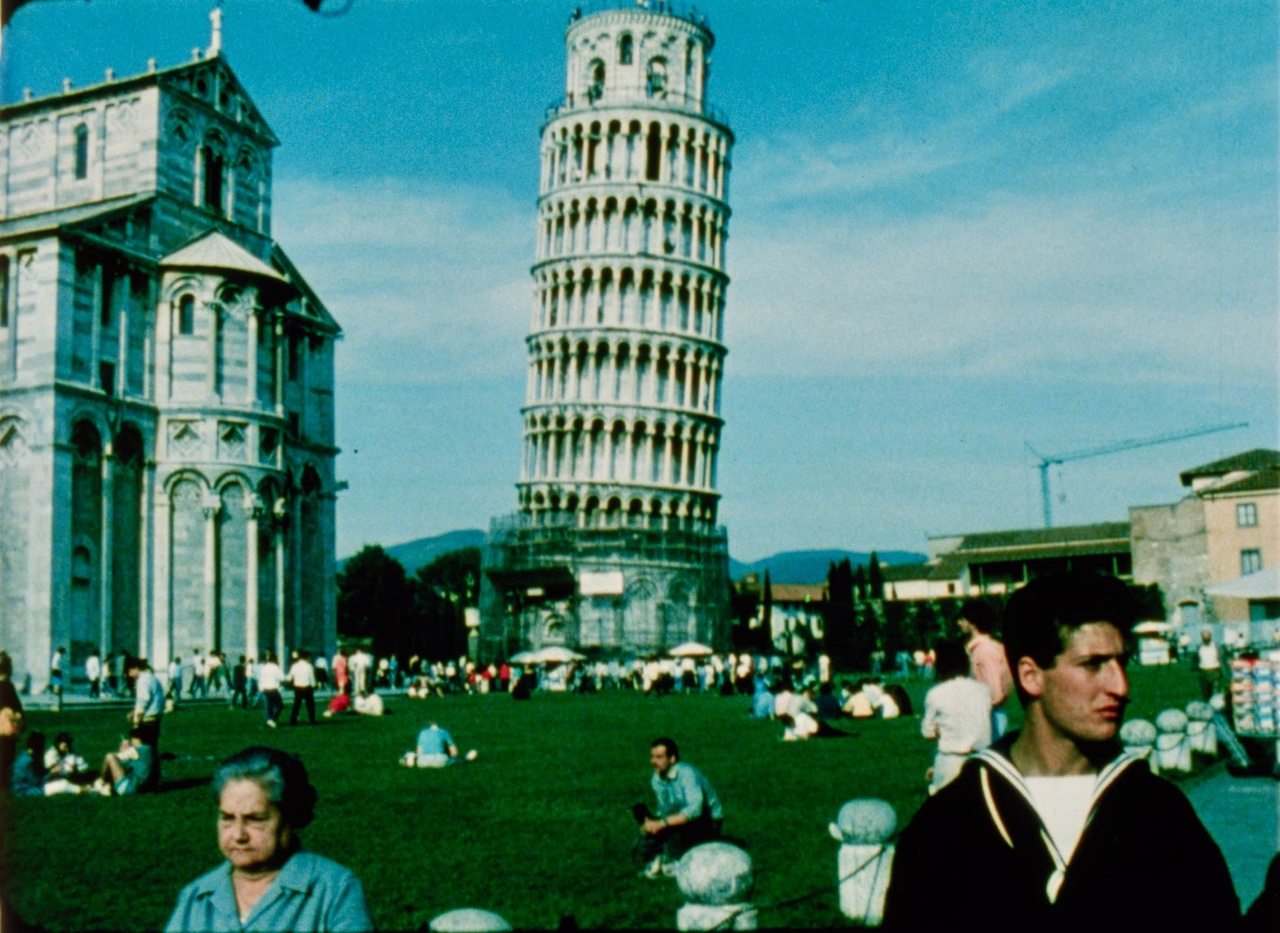
Warren Sonbert, “The Cup and the Lip,” 1986
In 1966, when Sonbert was making his first films, Annette Michelson penned her now famous essay “Film and the Radical Aspiration,” where she argued that in postwar America, cinematic radicalism was tantamount to social and aesthetic subversion. The formidable corpus of American avant-garde filmmakers with an aesthetic allegiance to Hollywood wouldn’t fall in line with Michelson’s intellectual project – and neither did Sonbert, as he was unrelenting in his intense admiration for Hollywood’s golden era, which was matched only by his adamant denunciation of the Soviet montagists, Eisenstein and Vertov – a surprise, given that their respective articulation of overtonal montage and interval theory would otherwise seem the most obvious predecessor to his own filmmaking. While Sonbert was willing to look past the primal seductions of narrative and its devices of identification in favor of the encrypted subtleties in the mise-en-scène of filmmakers like Hitchcock and Sirk, he was unwilling to accord the Soviets the same degree of nuance, since the obviousness of their political aims was left for no one to guess. What do we know instead about Sonbert’s own politics? Filmmaker Abigail Child, who dedicated her found footage musical sonata Surface Noise (2000) to Sonbert, once spoke about his complicity with bourgeois values. [6] Film critic Paul Arthur read the specter of Chernobyl in Sonbert’s The Cup and the Lip (1986) as testament to the social grounding of his films. [7] But Sonbert’s wasn’t a conscious politics of representation; his case is better made by taking recourse in Theodor Adorno’s postulation that the autonomy of fait social art, its refusal of political rhetoric, grants it its radical potential. From the vantage of the present, where the trouble with artists’ moving images is often grandstanding rhetoric, the ambiguities and uncertainties that Sonbert so dearly valued possess critical virtue.
While watching the Sonbert films in clusters at the first leg of his touring retrospective in Barcelona, the challenge of their presentation became apparent. From 1968 onward, all his films run the risk of either being perceived as one long serial work or of seeming repetitive owing to his signature montage operations on motifs of travel and anthropology. This problem of reception had already troubled Sonbert during his lifetime; he once said that he wished his mid-length films were not grouped together [8] . Such expectation is out of bounds for the rules of theatrical exhibition, but to the credit of the retrospective’s curators, Francisco Algarín Navarro and Carlos Saldaña, they mitigated such apparent redundancies by foregoing the temptation of chronological presentation in favor of screenings that combine films from Sonbert’s three distinct periods: the silent one, and the sound phases on either side. This also allows audiences to sample the broader evolution of his films, even if a viewer fails to attend all the screenings. Sonbert confessedly looked at the world with a double vision, in a Proustian and in a child-like way, [9] where sensations of connective links (editing) and the immediacy of astonishment at the world (recording) are equally important. The richness of incurred sensations is grasped and experienced only by repeated viewings over time. But given that Sonbert’s complete retrospective in Spain is the first of its kind anywhere in Europe since 2013, opportunities to do so have long been far too scarce.
“Pont aeri: El cinema de Warren Sonbert,” Filmoteca de Catalunya, September 16–30, 2026; Filmoteca de Galicia, October 1–10, 2026; Cineteca Madrid, October 16–18, and Circulo de Bellas Artes, Madrid, October 19–21, 2026.
Arindam Sen is a curator, editor, and writer interested in experimental, artists’, and documentary film. He is the cofounder of the Brussels-based experimental film platform Cinema Parenthèse, contributing editor at the Millennium Film Journal, and the author of Distant Voices (Stereo Editions, 2024).
Image credit: Courtesy of Filmoteca de Catalunya
Notes
| [1] | Warren Sonbert, “Warren Sonbert Lecture, San Francisco Institute, August 1979,” Film Culture 70–71 (1983): 161. |
| [2] | Warren Sonbert, “Fighting the Wicked: Queer Filmmaker Derek Jarman Bashes Ahead,” Bay Area Reporter 22, no. 12 (1992): 25. |
| [3] | Warren Sonbert, “Film and the Gay Touch: The Elusive Search for a ‘Gay Sensibility,’” Bay Area Reporter 20, no. 9 (1990): 32. |
| [4] | Sonbert, “Warren Sonbert Lecture,” 166. |
| [5] | Warren Sonbert, “Montage Arguments, Program Notes – Collective of Living Cinema,” New York, February 17, 1984. |
| [6] | Scott MacDonald, “Abigail Child,” in A Critical Cinema 4: Interviews with Independent Filmmakers (University of California Press, 2005), 225. |
| [7] | Paul Arthur, “Dancing on the Precipice: The Films of Warren Sonbert,” Film Comment 35, no. 2 (1999): 59 |
| [8] | David Simpson, “Conversation with Warren Sonbert,” Film Center of the School of the Art Institute of Chicago, 1985. |
| [9] | Daniel Mangin, “Friendly Advice: Warren Sonbert Makes Films About Life’s Joys and Perils,” Bay Area Reporter 20, no. 18 (1990): 38. |