
DON’T ASK ME WHO I AM: MICHEL FOUCAULT’S IMPOSSIBLE ANONYMITY by Harmon Siegel
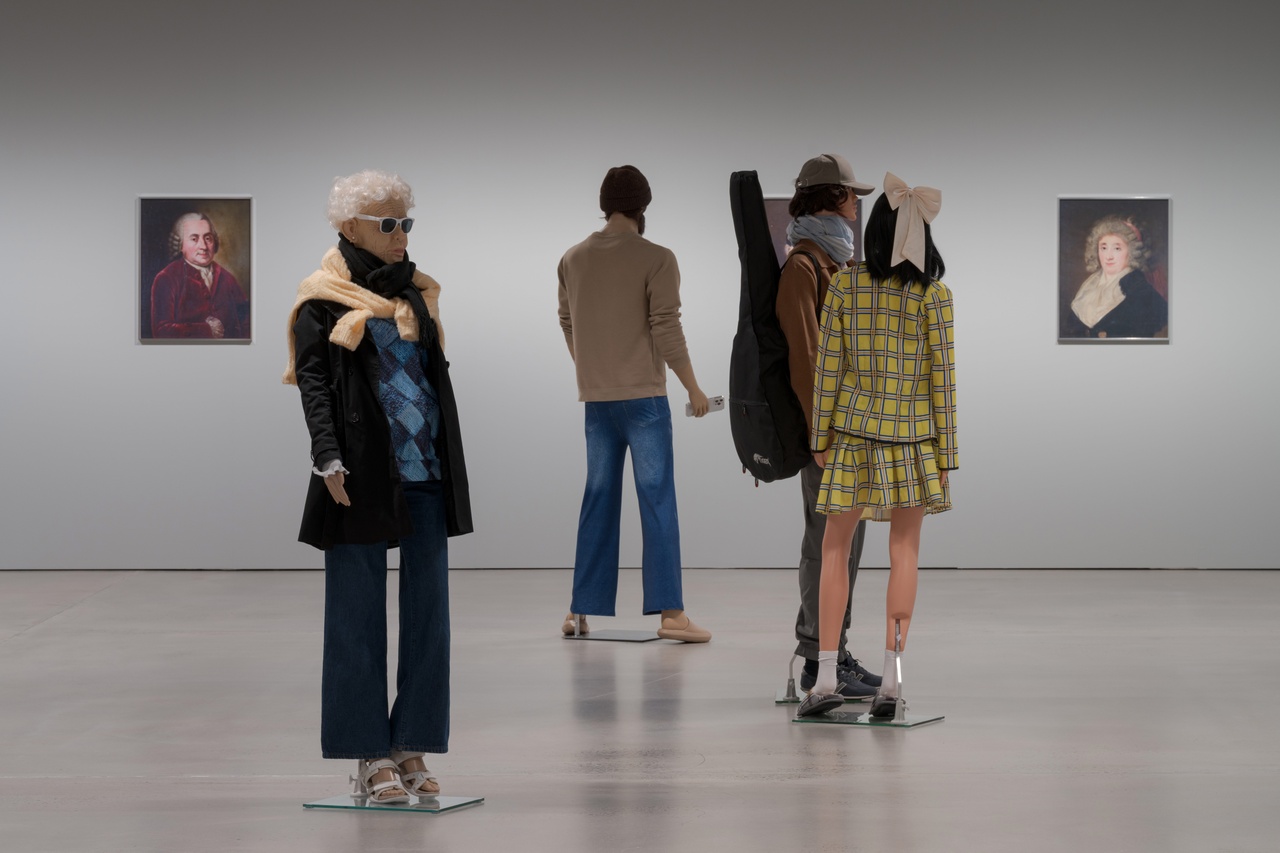
“Nina Beier and John Miller: The Populace,” AroS – Aarhus Art Museum, 2026-27
In 1980, Le Monde ran an interview with an anonymous intellectual. Calling himself “the masked philosopher,” he expressed his nostalgia “for a time when, being entirely unknown, what I said had some chance of being heard.” [1] His fame meant that readers came to his work with preconceptions. Because they already knew what he would say, they didn’t have to read.
After his death three years later, the speaker was revealed to be Michel Foucault, whose centennial we mark this year. I suppose that, by taking this occasion to ask what he means to us now, I’m betraying the spirit of his plea: “Don’t ask me who I am.” [2] But he knew this demand was impossible. We demand to know who’s speaking.
The name “Foucault” refers to a man who was born 100 years ago, who wore thick-rimmed glasses below his bald pate, who spoke with a musical lilt and authored texts that changed how we see such fundamental things as knowledge, power, and selfhood. I wonder, though, whether his critiques of these concepts are now so ubiquitous in genres such as wall texts and exhibition catalogues that we are no longer sufficiently confused by Foucault’s counterintuitive, even contradictory way of thinking. His name could stand for at least three methods – archaeology, genealogy, and problematization – that, as he himself recognized, aren’t entirely compatible. He was sensitive to this point, ventriloquizing his interlocutor: “Are you going to change again, swerve in response to the questions you are asked, say that the objections are not really addressed to your current position?” [3] Don’t ask me to stay the same, Foucault replied. Leave the ID check to the police.
When critics attacked contradictions between his texts, they assumed that an author’s work should be consistent, that we should judge what they say on Tuesday more harshly if it’s not what they said on Monday – especially if Wednesday’s opinion returns to Monday’s. This premise appears so self-evident that it usually goes unnoticed. To Foucault, however, it provided a loose thread that, if tugged on, would unravel our whole idea of authorship.
Foucault began his 1969 lecture “What Is an Author?” by explaining his motivation: to redress a flaw with his work to date. [4] Portraying himself as an archaeologist of thought, Foucault had excavated concepts such as natural history and political economy to reconstruct their original function as a means of organizing knowledge and – because how we distribute knowledge reflects and determines who counts as an authority – of allocating power.
Yet in his eagerness to dig, Foucault realized in retrospect, he took for granted a tool that he himself was using: the concept of the author. To trace ideas over time, he referenced texts by Charles Darwin and Karl Marx because that’s what historians do. He failed to ask how the texts related to the names, what a book called Capital has to do with a man named Karl, and why this is important. As Beckett asks, What matter who’s speaking?
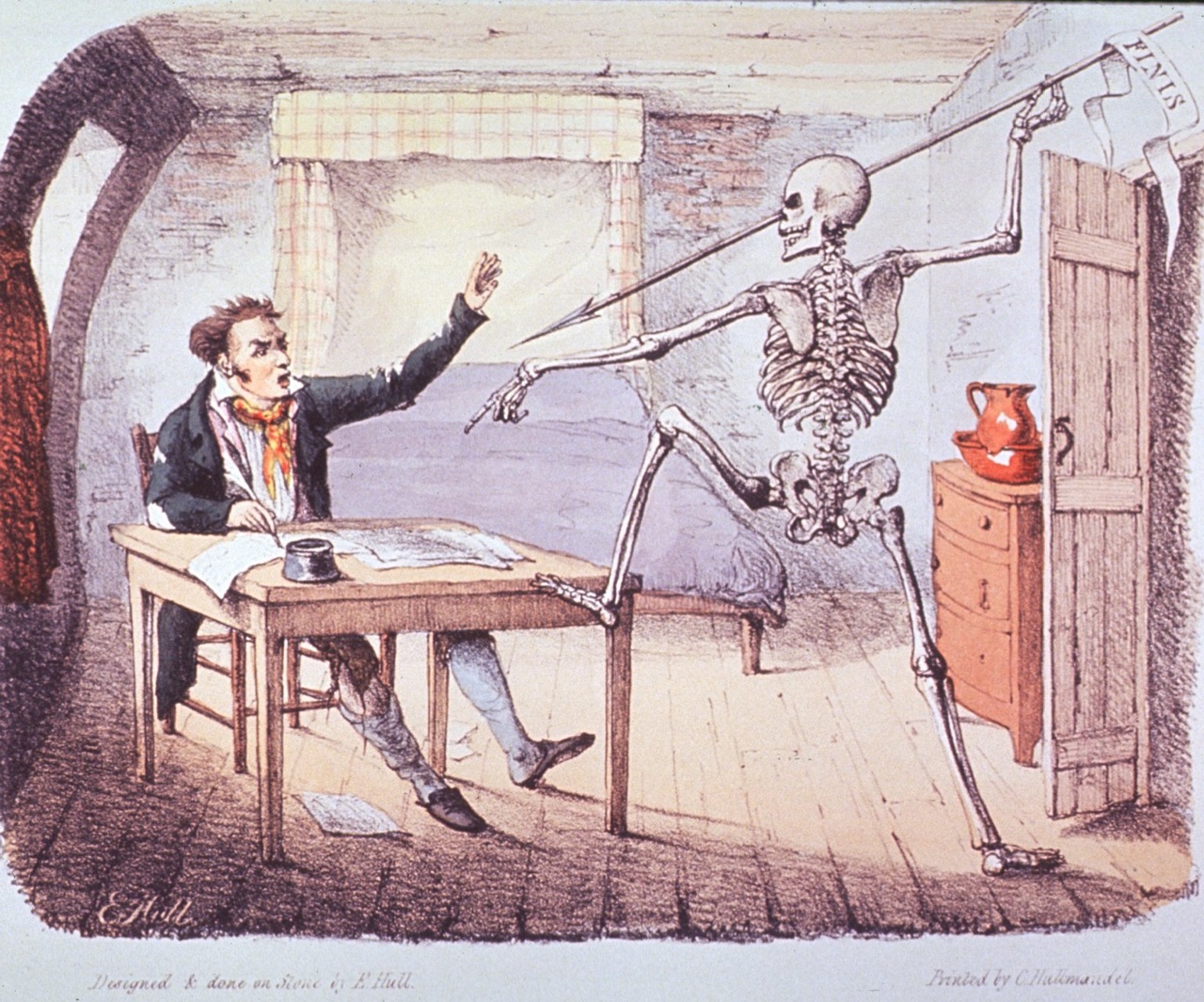
Edward Hull, “Death found an author writing his life,” 1827
Quoting this question, Foucault gives a four-part answer. (1) Authorship entails a relation of ownership between a person and a text. This means that the author can profit from their work, but it also enables society to hold the author responsible for any transgressions they commit. (2) It differentiates genres of writing according to the kind of truth they generate. Before the modern concept of authorship, narrative forms such as sagas and folk tales circulated anonymously, while scientific tracts required the authority bestowed by the phrase, such as “Hippocrates said …” Now, scientists contribute truths to an “anonymous and coherent” universe of knowledge, whereas we bind novels to the person who penned them. (3) It grounds the unity of an author’s output, such that, say, Charles Baudelaire’s letters, journals, reviews, and poems constitute a single oeuvre; each of these bears on the others because they are all derived from a single source. (4) It indexes individuality. The author has a unique biography that, when given as context, provides readers with interpretive criteria. This process neutralizes contradiction, enabling us to attribute differences within an author’s corpus to their personal development. Together, these four effects constitute what Foucault calls “the author function.”
The lecture, however, contains a fundamental contradiction between what is claimed and how this claim is made. On the one hand, Foucault traces the history of authorship to its early modern roots, contrasting it with Classical and early Christian relations between writer and text and so exposing its contingency. And because what can be created can also be destroyed, “we can imagine a culture where discourse would circulate and be received without the author function.” [5] On the other hand, he begins the lecture by locating its contents within his own career trajectory, asking his audience to hear his speech as part of a larger oeuvre belonging to the author named “Foucault.” While the lecture criticizes notions of development as a means of explaining away contradiction, Foucault gives a developmental explanation for his own contradictions. The tension points to a frustrating but crucial aspect of the philosopher’s thought: the non-optional structure of discourse.
In ordinary language, discourse occurs among individuals. I speak to you; you speak to me. To discuss the discourse of, for instance, biology, we might compare Darwin’s ideas with those of his contemporaries, uncovering their common assumptions and points of disagreement. For Foucault, however, the materials of this discourse do not originate in Darwin but through the “anonymous dispersion” of concepts such as life. [6] At first, this reorientation may seem like a way to decenter the powerful to restore the voices of authors that history has ignored. [7] In fact, the move was more radical than that, for Foucault aspired to analyze discourse without distinguishing voices at all. I don’t speak to you; a statement is made. You don’t speak to me; a counterstatement is made. In this way, discourse operates as an “anonymous field, the configuration of which defines the possible positions of speaking subjects.” [8] Foucault conceived of discourse as a field of statements in structured relations, a field that is anonymous because it is irreducible to named speakers. Viewed as a contingent historical stratum in the history of this field, the author is but a ripple produced by perturbations in “uniform anonymity.” [9]
The Foucauldian archaeologist, however, purports to excavate from an Archimedean standpoint outside the discourse that produces their own position. Only within the discourse of authorship can we think of ourselves as writers and our scribblings as works. We can’t renounce the authorial function that binds us to our work because there is neither a “we” nor a “work” prior to that very function. We can withhold our names, but that doesn’t make us anonymous.
I’m thinking of the graffitist-cum-artist Banksy, whose identity was recently the object of a nearly 6,000-word exposé. [10] Reuters journalists combed police archives and corporate filings, tracked down and interviewed witnesses, and even cross-referenced their suspects against records of border crossings into Ukraine, literalizing Foucault’s metaphor of authorial attribution as ID-checking. Yet even as it narrates each investigative twist, Reuters never says why we should care whose name is on Banksy’s passport.
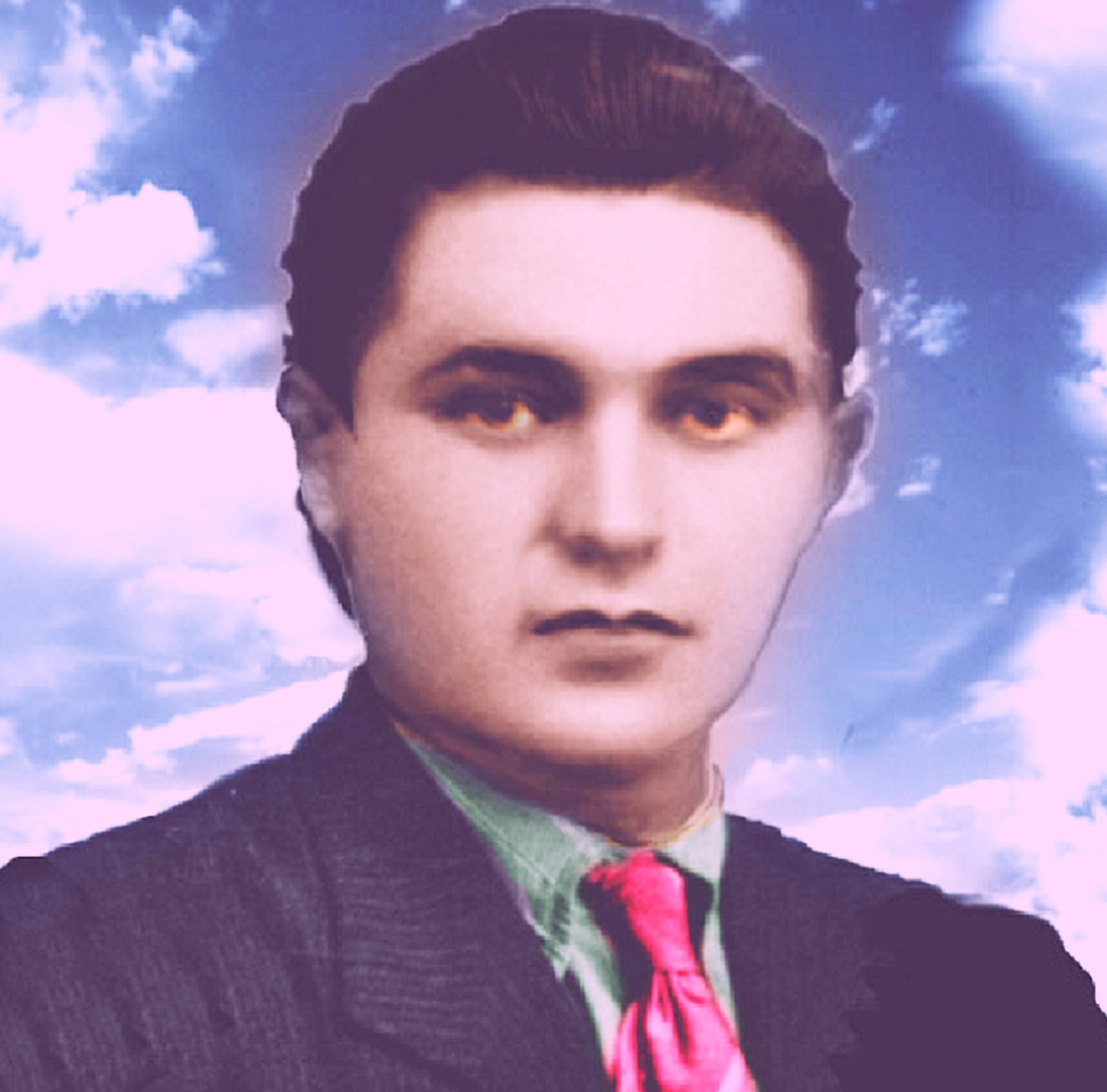
“Photograph” of Luther Blissett
Despite his anonymity, Banksy functions as an author. He profits from his work by using his public-facing “Pest Control Office” to authenticate prints (£100 + VAT) and mediate sales. Far from devaluing his work, his anonymity creates the mystique that underlies the work’s desirability. Conversely, he could be held responsible for vandalism for spray-painting public buildings, though the value imparted by his notoriety means that authorities have little interest in prosecuting the crime. Attribution to Banksy differentiates his output from mere graffiti. Other defacements are whitewashed. Thanks to years of media hype, his vandalism we honor as art. More than that, we celebrate his destructiveness itself as an authorial act of value creation, one that unifies his various non-graffiti projects (from spoof banknotes to a documentary film to a mock theme park) by exemplifying an iconoclastic attitude that underlies all he does, as epitomized by his media-spectacle shredding of Girl with a Balloon. [11]
Most importantly, we don’t need Banksy’s identity to construct a psychological profile. From his iconography (anti-imperialist, populist), his daring (painting in active war zones), and his acts of charity (fundraising for nonprofits), we assemble an image of a noble-hearted iconoclast: witty, brave, and likely misunderstood. It is therefore no surprise that, when Reuters tracked down a comic strip drawn by the 11-year-old Banksy, it found the makings of “a nimble artist with a theatrical streak.” [12]
The hunt for Banksy demonstrates in extremis how our encounter with the work precedes our construction of the author. We might imagine that the author exists first as an independent psychological being and then expresses themselves in their work. In actuality, we first encounter the work and then intuit the mind as its shaping force. For Foucault, this process revealed the relationship between authorship and psychiatric discourse. In one of his earliest essays, he asserted that the concept of authorship derives from that of madness. [13] Only with the rise of psychiatric discourse in early modernity, when creative genius became a symptom of mental abnormality, did biography start to matter. [14] Thus, Foucault claimed, the psychological aspect of author-based reception reiterates medical etiology even when not explicitly pathologizing; marks becoming physical “expressions” of underlying mental states.
With this argument, Foucault hinted at the ethical stakes of authorship in ways that critics may find troubling. If criticizing authors reiterates psychiatric discourse, can we instead criticize anonymously? Note that I’m not asking whether critics themselves can be anonymous. Even collective authors like Diva Corp cannot avoid fulfilling the author function so long as their identities and motives remain an object of speculation. [15] Rather, I’m wondering whether criticism can take an anonymous standpoint, one keyed toward the universal anonymity that constitutes discourse and so conditions the position of authors as such.
Foucault reviewed two possible answers. The first was formalist criticism. If critics judge works only by their structure, form, and internal relations, then they make the author irrelevant. But this tactic only defers the problem, for what constitutes a “work” besides the fact of being authored? Unlike Banksy, an office clerk shredding papers is not making a work. The second option, Roland Barthes’s, ignores the demarcations between oeuvres to instead analyze a continuous set of intertextual relations. This, too, Foucault rejected, arguing that such analysis leads to theology, to interpreting hidden meanings as though transposing authorial intentions onto a “transcendental anonymity.” [16]

John Miller, “Forbidden Thought Projected Onto A Sheet Of Crane & Co., Premium Pearl-White P58111, 8.5 x 11'', 32 lb, 100 % Cotton, Bond,” 2009
The most promising avenue, he thought, turned authorship against itself. He looked to authors who pursue their own “voluntary effacement,” who write not to secure their immortality, as in Scheherazade’s death-postponing stories, but to destroy themselves in a text that erases their trace, who seek not remembrance but oblivion – writers like Gustave Flaubert, Maurice Blanchot, and Raymond Roussel. [17] As I’ve already indicated (and as their enduring reception confirms), these writers could not avoid becoming authors. But in their self-reflexive investigation into the ways that texts produce authors as much as authors produce texts, they paved the way for Foucault’s own archaeology of the author concept.
Visual art has its own examples. To choose three, Michael Krebber, John Miller, and the late Lorraine O’Grady each developed their own techniques of self-effacement. Krebber, perpetually deferring the act of painting, refuses even the finality of Marcel Broodthaers’s plaster-encased poetry, this indecision postponing the moment when the maker splits from the made, when the authored creates the author. Miller, using every swerve in his career to subvert the idea of “development” as a unifying chronology, foregoes the narrative coherence that makes biography an interpretive key. O’Grady, whose reception often reduced her to an instance of her identity, withdrew her body into a suit of armor, denying viewers markers of race and gender as explanatory anchors, enacting Foucault’s image of the pre-authorial artist as a hero in black armor, a visor concealing the face. [18] These artists are, in my view, more anonymous than the merely anonymous Banksy – not despite but because we know their names.
We are left with contradiction, with Foucault’s impossible wish to experience himself from the anonymous standpoint of the discourse that made him possible. But in the end, he was an author too, his work remembered, his sainted face looking out from the spines of his books. [19] “I would like to have noticed,” he once said from his podium, “that a nameless voice had long preceded me. I then would have needed only to continue, to carry on the sentence, to lodge myself, without anyone noticing, in its interstices, as if it had beckoned to me by holding itself, for an instant, in suspension.” [20]
HARMON SIEGEL is an affiliate scholar at the Boston Psychoanalytic Society and Institute and author of Painting with Monet (Princeton University Press, 2024).
Image credit: 1. Courtesy the artists and Aarhus Art Museum, photo David Stjernholm; 2., 3. Public Domain; 4. Courtesy the artist and Galerie Nagel Draxler, photo Simon Vogel
ANMERKUNGEN
| [1] | “Le philosophe masqué,” Le Monde, April 6, 1980, 1, 18. Reprinted in Michel Foucault, Dits et écrits, vol. 4, 1980–1988 (Gallimard, 1994), 101–10. |
| [2] | Michel Foucault, L’Archéologie du savoir (Gallimard, 1969), 28. |
| [3] | Foucault, L’Archeologie du savoir, 28. |
| [4] | Michel Foucault, “Qu’est-ce qu’un auteur?,” Bulletin de la Société française de philosophie 63, no. 3 (1969): 73–104; Michel Foucault, “What Is an Author?,” in Language, Counter-Memory, Practice, trans. Donald Bouchard and Sherry Simon (Cornell University Press, 1977), 113–38. All quotations translated by the author. |
| [5] | Foucault, “Qu’est-ce qu’un auteur?,” 95. |
| [6] | Foucault, L’Archéologie du savoir, 80. |
| [7] | As in his decision to republish the memoir of a 19th-century intersex individual, using their narrative to reframe the relation of discipline to sex and titling the edition using two of the author’s names: Herculine Barbin, dite Alexina B., présenté par Michel Foucault (Gallimard, 1978). |
| [8] | Foucault, L’Archéologie du savoir, 161. To understand the relation between positions and the field, imagine a book on the history of chess structured around its most important matches. To analyze each game, we wouldn’t need to know who was playing to see tactics at work in the ways that pieces move in dynamic relation to each other. It wouldn’t even matter if the matches were played by individual opponents or by teams swapping out participants at random intervals because a player is not a person but a position that anyone can occupy, a function that explains the relations between moves. |
| [9] | Foucault, L’Archéologie du savoir, 83–84. |
| [10] | Simon Gardner, James Pearson, and Blake Morrison, “In Search of Banksy,” Reuters, March 13, 2026. |
| [11] | See Isabelle Graw, Three Cases of Value Reflection: Ponge, Whitten, Banksy (Sternberg Press, 2021). |
| [12] | Gardner, Pearson, and Morrison, “In Search of Banksy.” |
| [13] | The essay’s title, “Le ‘Non’ du père” (1962), alludes to Jacques Lacan’s pun on “no” (non) and “name” (nom), which captured the Oedipal relationship between entering language (name) and the incest prohibition (no). Michel Foucault, “Le ‘Non’ du père,” in Dits et écrits, vol. 1, 1954–1975* (Gallimard, 1994), 189–203. |
| [14] | Until the Renaissance, Foucault asserted, artists lived as anonymous heroes. A few formulaic stories were repeated over and over (e.g., the story of Cimabue fooled by Giotto repeats that of Parrhasius fooling Zeuxis), with artists’ names marking merely chronological order within a cycle of repetitions. |
| [15] | As in Rina Nicolae, “Diva Corp Is Disrupting the LA Art Scene,” Office Magazine, April 6, 2026. |
| [16] | Foucault, “Qu’est-ce qu’un auteur?,” 80. |
| [17] | Foucault, “Qu’est-ce qu’un auteur?,” 78. |
| [18] | Foucault, “Le ‘Non’ du père,” 193. |
| [19] | In the English editions of his lectures at the Collège de France, his photo appears in a halo-like circle right beneath his name. |
| [20] | Michel Foucault, L’Ordre du discours: Leçon inaugurale au Collège de France prononcée le 2 décembre 1970 (Gallimard, 1971), 7. |