

THE SPECTACLE OF THEORY Arnaud Esquerre on “Echo Delay Reverb: American Art, Francophone Thought” at Palais de Tokyo, Paris

“Echo Delay Reverb: American Art, Francophone Thought,” Palais de Tokyo, Paris, 2025–26
It seems self-evident, in the 2020s, that theories developed in the humanities and social sciences should go on to circulate in the world of contemporary art. An exhibition that forgoes any references to philosophy, sociology, anthropology, or other academic disciplines would now appear strangely incomplete. But what role do these theories actually play in such contexts? With my discussion of “Echo Delay Reverb: American Art, Francophone Thought,” I will attempt to answer this question. As Elvan Zabunyan notes in the accompanying catalogue, the exhibition responds to Naomi Beckwith’s curatorial proposition, which asks “How has Francophone thought infused contemporary art in the United States?” [1] The exhibition, according to Beckwith, offers “a retrospective view of the multiplicity and variations of contemporary ideas” by presenting an “original mapping” of these theories across the works of some 60 artists. [2] Yet rather than tracing processes of transmission, translation, or “infusion,” the exhibition operates a transformation: Theories are not so much mobilized as they are staged. What is presented is less the historical circulation of Francophone thought than its conversion into visual form: a spectacle.
To achieve this, “Echo Delay Reverb” has glued together heterogeneous lines of thought that sometimes oppose one another, as with Michel Foucault and Jean Baudrillard – the latter famously having argued that the former should be “forgotten.” [3] In place of the complexity of a history marked by rivalries and conflicts, the exhibition substitutes a smooth and decorative image of these authors and their relationships to one another as thinkers. Bringing together Simone de Beauvoir, Aimé Césaire, Gilles Deleuze, Jacques Derrida, Édouard Glissant, Jacques Lacan, and Monique Wittig, among others, under a single label of “Francophone thought” is not only simplistic. While the exhibition highlights minorities, notably with regard to race or sexual orientation, it does so by replicating a typically American gesture that, since the 1980s, has turned these Francophone authors into an exotic reserve of available concepts, without attending to their confluences, divergences, or antagonisms. The consequence of this juxtaposition is that the division of the exhibition into five major thematic sections is difficult to understand and appears arbitrary: “Dispersion, Dissemination,” “The Critique of Institutions,” “Geometries of the Non-Human,” “Desiring Machines,” and “Abjection in America.” A sixth section, smaller but more relevant, is devoted to Semiotext(e)’s “Foreign Agents” series, whose founder, Sylvère Lotringer, played a decisive role in introducing most of the French authors cited in the exhibition to readers in the United States.
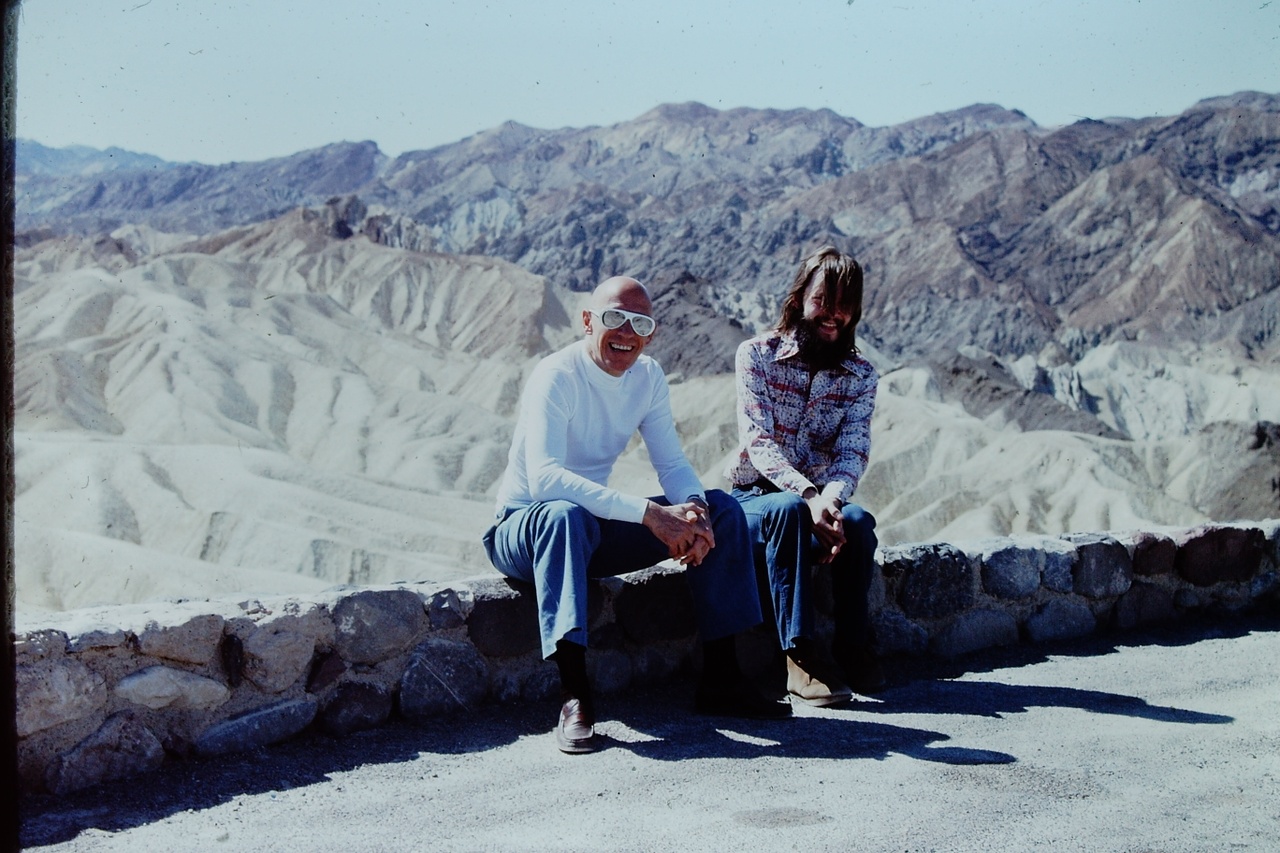
Michel Foucault and Michael Stoneman in Death Valley, California, 1975
In “Echo Delay Reverb,” the theories of these authors are used to valorize the works on view, while also serving as objects to be contemplated in their own right. Paul Chan’s designs for the costumes and sets for Gregg Bordowitz’s A History of Sexuality, Volume One by Michel Foucault: An Opera (2010) perfectly embody this operation. The books themselves, often first editions, are displayed alongside Chan’s designs not for their intellectual content but as collectible objects neatly aligned in vitrines. The spectacle of theory is a visual staging of thought that, in being enacted, carries out three operations. First, theories – particularly those based on historical documents, anthropological or sociological investigations, or clinical practice – are subject to a regime of testing and contestation that allows them to be revised and supplemented, and for determining what can be considered true or false. This is all the more important because many of these theories interrogate the question of truth. Yet, when immersed in the world of art, they generally leave this regime of scientific testing. The problem is that the criteria for evaluating what constitutes a good theory and what constitutes a good spectacle are very different. A “good” spectacle can be judged, for its part, by comparison with other spectacles or according to the reactions of its viewers.
Second, these theories are, for the most part, critical and even oriented toward practice, and as such they can have a political dimension aimed at transforming the world. To stage theory as a spectacle is to detach it from political action and its possible extension into practice and insert it, directly or indirectly, into the transactions of the art market. This critical and political dimension is here completely neutralized, except in the case of a single work, that of Cameron Rowland. For when theory retains its critical and political force, it generates a tension with the institution, raising questions about its presence and possibly even leading to its exclusion. This is precisely what happened with Rowland’s work. Replacement (2025) was supposed to see the flag of Martinique flying in place of the French flag on the façade of the Palais de Tokyo. But in the end, only a label remains in the exhibition to explain the work’s absence: “Palais de Tokyo has determined that Cameron Rowland’s artwork Replacement could be considered illegal. As a result it is no longer included in the exhibition.”
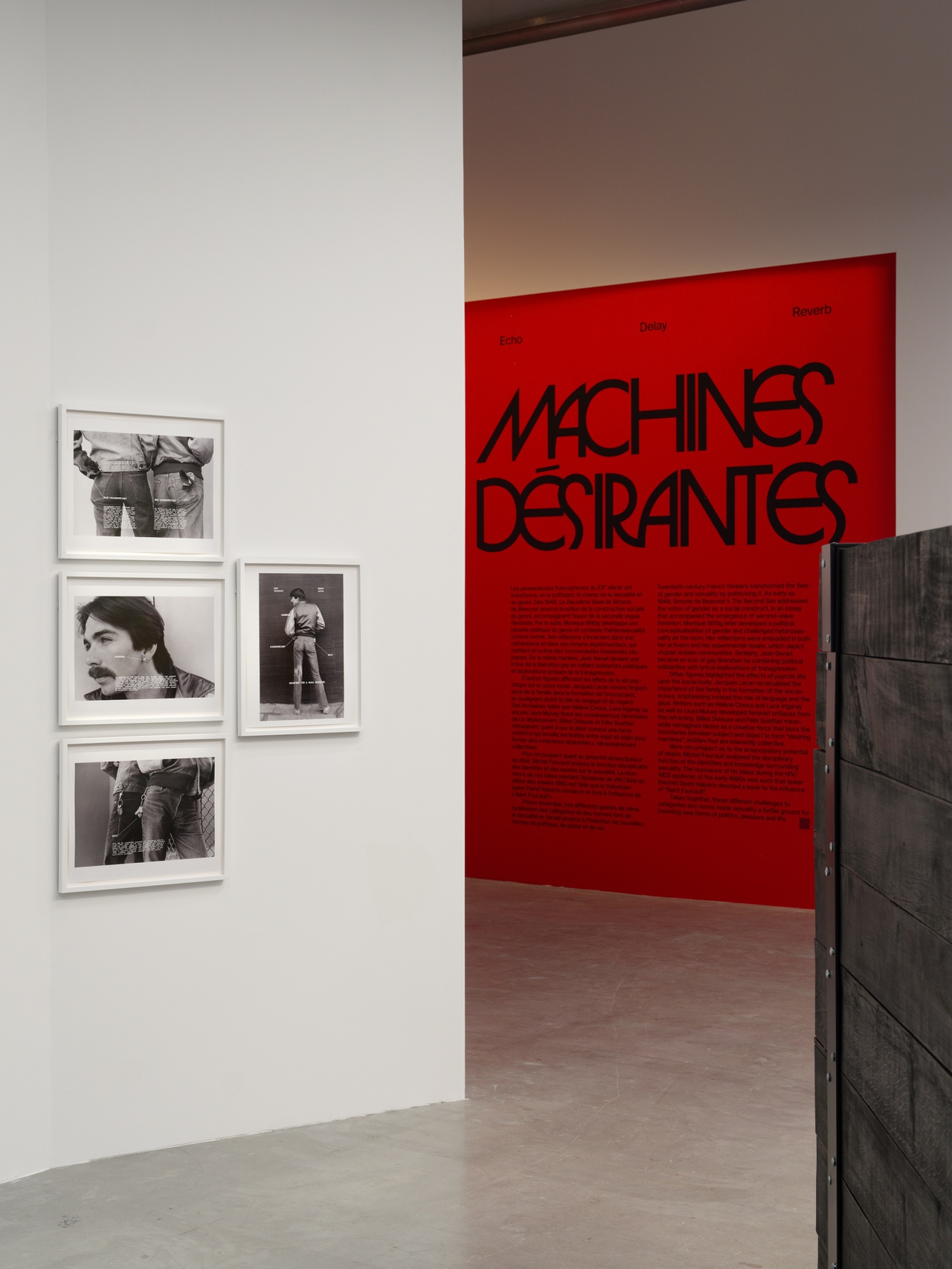
“Echo Delay Reverb: American Art, Francophone Thought,” Palais de Tokyo, Paris, 2025–26
Third, by being placed at the service of art and transformed into a spectacle, these theories have been purged of anything actually relating to art itself. Many of the “Francophone thinkers” did write about art (Deleuze on Francis Bacon, Foucault on René Magritte, etc.), yet it is as if these ideas were somehow inadmissible within the context of art in the United States. This is not only because some of these authors warned against artists using their work for artistic ends. Asked, during a conference at the Whitney Museum in 1987, about the appropriation of his theory in art, Baudrillard reportedly replied, according to Lotringer: “This is not serious. My work cannot be represented, you are making a total mistake.” [4] But more fundamentally, it is because art professionals – that is, curators and artists – seek to maintain control over what is said about art. The absence of theories on art is not an oversight: It is a condition. Acknowledging that these authors also theorized art would overturn the implicit hierarchy of the exhibition dispositif. Of all of the works on show, only those produced by Pierre Bourdieu in collaboration with artists Andrea Fraser and Hans Haacke featured the direct involvement of a theorist, and this only because Bourdieu’s methodology and sociological concepts on practices of social distinction are employed by these artists directly, not because he had a theory concerning the content of the artworks themselves.
The theories referenced in “Echo Delay Reverb” are presented primarily as sources of inspiration. Firelei Baez “draws inspiration” from Glissant’s poetics of Relation; Adler Guerrier is “nourished by” the same thinker. But, more often, it is the curatorial team that produces the connection, speaking of “resonance”: Cindy Sherman’s work “resonates” with Baudrillard’s notion of simulacra, while Mike Kelley’s photographs (The Poetry of Form: Part of an Ongoing Attempt to Develop an Auteur Theory of Naming, 1985–1996) “echo” Georges Bataille’s fascination with the Lascaux cave.
Because establishing a relation between a work and any given theory takes precedence over respect for the history of ideas, some of the thinkers referenced throughout the exhibition lived before the 1970s, and others did not write in French. Mark Dion’s Between Voltaire and Poe (2016) evokes, as its title suggests, Voltaire and Edgar Allan Poe. Torkwase Dyson’s Bird and Lava #3 (2021) is linked to Anna Tsing and Donna Haraway, two American authors who do not belong to French Theory, even if they share affinities with Bruno Latour’s work. Yet despite the broad stock of concepts available among Francophone authors, it happens that certain works are exhibited that have no connection to theory at all, such as Oscar Tuazon’s Great Lakes Water School (2023) and Words for Water (2024) or Walid Raad’s Let’s Be Honest, the Weather Helped (Libya, Venezuela, Romania, Italy, Iraq) (1998).
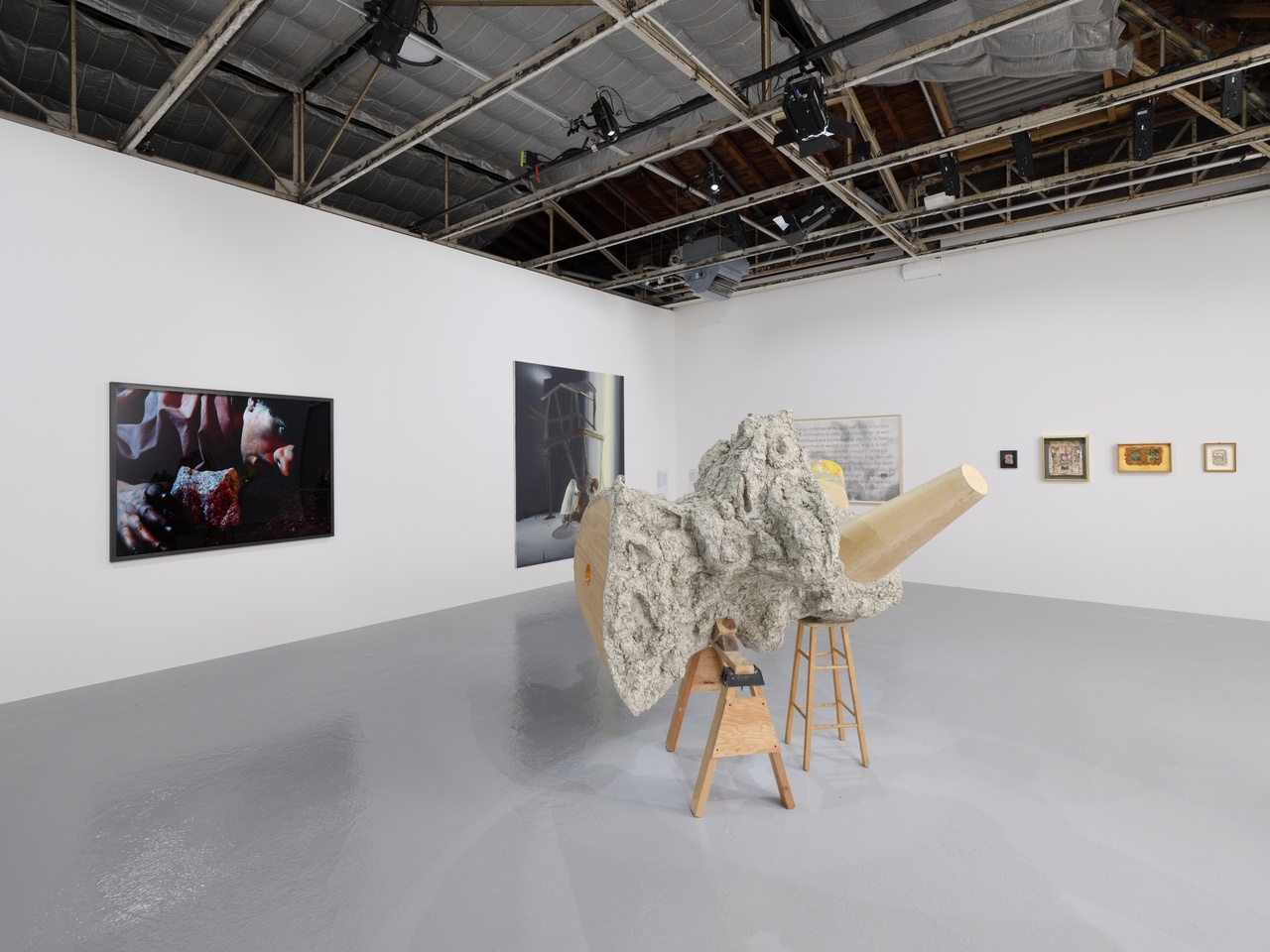
“Echo Delay Reverb: American Art, Francophone Thought,” Palais de Tokyo, Paris, 2025–26
To understand the transformation effected by the advent of the spectacle of theory, one must examine the place of the objects and social actors such theory represents. In the 1960s, consumer goods could be appropriated by artists in ways that were critical or ambivalent. Likewise, critical theory could make use of artworks to identify a movement or a historical period, or to track changes in social relations. This is notably what theories of postmodernism, such as Fredric Jameson’s, did: they relied on artworks, which could be heterogeneous, and commented on them in order to detect a new relation to the world. But in the spectacle of theory, the movement is reversed: It is theory that serves as a support to showcase artworks, on the condition that it does not itself address the practice of making art. In “Echo Delay Reverb,” Charles Gaines’s work String Theory: Rewriting Fanon #6 (2010) reshuffles phrases by Frantz Fanon to compose new sentences that are meant more to be looked at than understood: What is explained is the process of moving from text to work, not the possible interpretations of the text. No longer are consumer goods such as soup cans or soda bottles represented, as in the era of critiques of the consumer society; now, it is theory itself that is represented by artists, addressed to the art market and even the luxury market. Capitalism has, of course, been quick to exploit this change. In the 1960s and ’70s, Salvador Dalí advertised consumer goods such as chocolate (Lanvin), a medication (Alka Seltzer), and a car (the Datsun 180B/610 Wagon). In 2020, it was the theorist Paul B. Preciado who Gus Van Sant and Alessandro Michele staged in an advertisement for the luxury brand Gucci.
While “Echo Delay Reverb” stages the spectacle of theory with remarkable skill, it merely amplifies a relationship that has been in place for several years. This type of relation was already central to works by Tino Sehgal, notably This Objective, performed at the Palais de Tokyo in 2016. In that work, academics and intellectuals engaged in a new conversation each time a visitor entered the room, following rules set by Sehgal, who instructed participants not to speak about art. The result was disjointed conversations that were about nothing but the spectacle of conversation itself, with little substantive content.
The exhibition transforms French critical thought into a visual apparatus serving to elevate US artists. In the spectacle of theory, these ideas have no political consequences, no scientific consequences; they have consequences only within the art world. They serve to valorize artworks, or even to generate additional profit, according to rules set and controlled by artists or curators. To break the spectacle would require acknowledging the hermeneutic uncertainty opened up by every artwork and accepting that a theory might be employed to shape the conception, the scenography, or the artworks themselves, highlighting particular elements of reality that the theory has extracted at the cost of tension, or perhaps even conflict, with the institution and the art market.
“Echo Delay Reverb: American Art, Francophone Thought,” Palais de Tokyo, Paris, October 22, 2025–February 15, 2026.
Arnaud Esquerre is a sociologist at the École des Hautes Études en Sciences Sociales (EHESS, Paris) and at the Centre National de la Recherche Scientifique (CNRS).
Images credits: 1. + 3. + 4. photos Aurélien Mole; 2. © David Wade
Notes
| [1] | Elvan Zabunyan, “Avant-propos,” in Echo Delay Reverb: Art américain, pensées francophones, exh. cat., ed. Naomi Beckwith and Elvan Zabunyan (Palais de Tokyo; Éditions B42, 2025), 20; translation by the author. |
| [2] | Naomi Beckwith, “Un peu de langage corporel en franglais,” in Echo Delay Reverb, 36. |
| [3] | Jean Baudrillard, Forget Foucault [1977], trans. Phil Beitchman, Nicole Dufresne, Lee Hildreth, and Mark Polizzotti (Semiotext(e), 2007). |
| [4] | François Aubart and François Piron, Ce que Sylvère Lotringer n’écrivait pas (Paraguay, 2022), 116; translation by the author. |