
AFTERMARKET Chris Reitz on “No Problem: Cologne/New York 1984–1989” at David Zwirner, New York
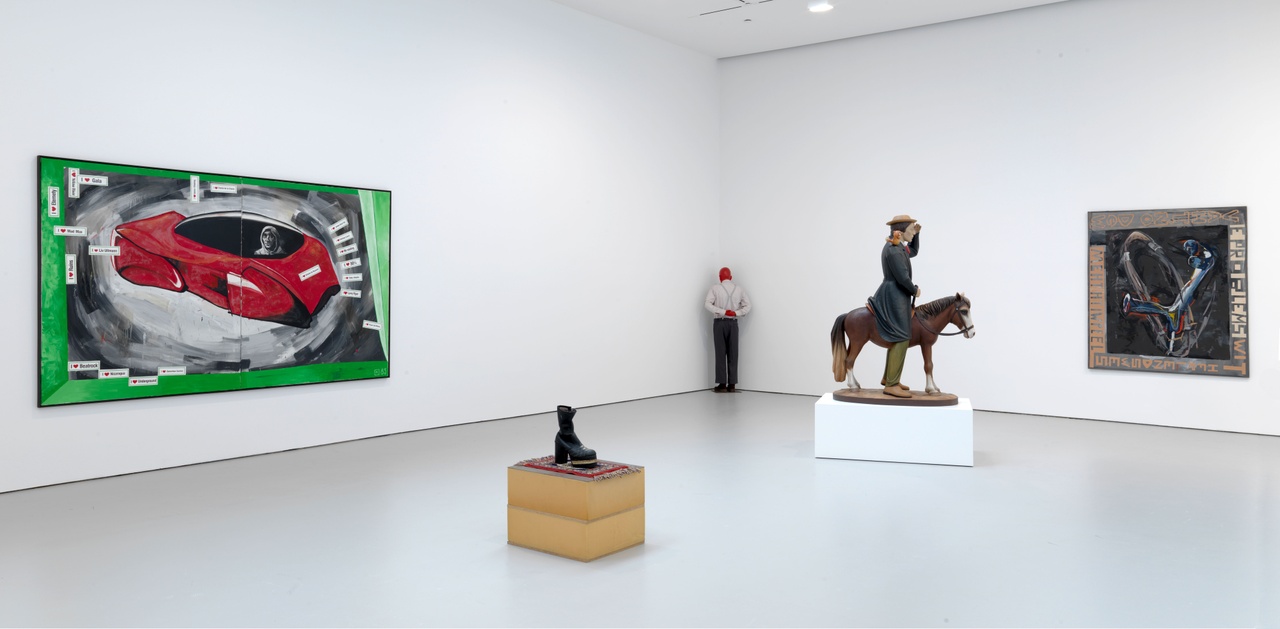
“No Problem: Cologne/New York 1984-1989,” David Zwirner, New York, 2014
In 1967, Hein Stünke and Rudolf Zwirner, the latter being the father of contemporary gallerist David, cofounded Kunstmarkt Köln, the blueprint of the contemporary art fair. Cologne was uniquely poised in the late 1960s to accommodate the emerging international art market, although no one would have thought so at the time. The city lacked an audience educated in contemporary art practice and a collector base necessary to sustain a robust gallery system (the Kunstmarkt was founded to remedy both of these issues). [1] In 1984, Kunstmarkt Köln changed its name to Art Cologne, a registration of its bygone German provincialism, and the city by the Rhine became the capital of the art market.
“No Problem: Cologne/New York 1984–1989” at David Zwirner takes the year 1984 as the point of departure for a survey of the galleries, exhibitions, and artists that constituted this nascent international network. The exhibition, which spans Zwirner’s two Chelsea spaces, looks like an art fair – the contemporary antecedent, that is. Each of the galleries is divided into single-artist rooms (or perhaps booths?) with a few exceptions, like the space occupied by both Jeff Koons and Martin Kippenberger. The show also includes work by stars Werner Büttner, George Condo, Georg Herold, Jenny Holzer, Rosemarie Trockel, Mike Kelley, Sherrie Levine, Raymond Pettibon, Richard Prince, and Cindy Sherman, among others. Having participated in an exhibition in New York, Cologne, or both between 1984 and 1989 was the criterion for inclusion, especially if that exhibition was at a young blue-chip gallery like Max Hetzler, Metro Pictures, or Monika Sprüth. To be clear, the Cologne–New York connection that the exhibition celebrates is not an artist network. Although many of the artists lived and worked in both of these cities, and many were in dialogue and even collaborated, the connective tissue here is the burgeoning international gallery system. This is the exhibition’s most important contribution – its registration of the significance of young galleries to transatlantic dialogue between artists. Its articulation, however, produces its own set of problems.
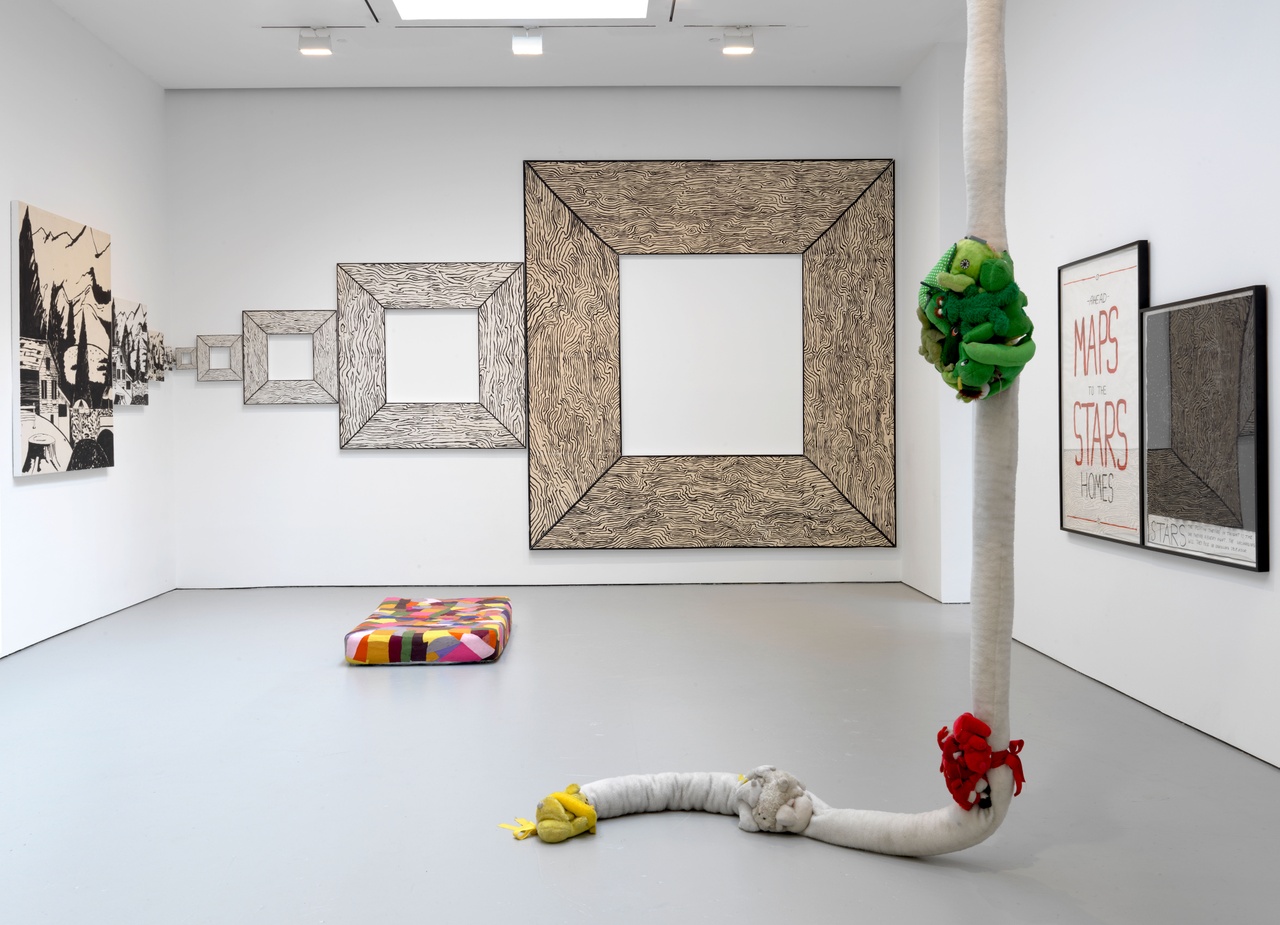
“No Problem: Cologne/New York 1984-1989,” David Zwirner, New York, 2014
One effect of the art fair-like accumulation of brand-name artists is the erasure of historical antagonisms. In New York, rival postmodernisms were articulated through criticism that pitted the Pictures Generation against masculine returns to gestural painting. In Germany, artist camps were staked out in galleries – the provocations of Hetzler’s boys against the theoretically-engaged feminism of Sprüth’s “Eau de Cologne” exhibitions and accompanying publications. A few of the rooms in the exhibition, those featuring work by Trockel, Barbara Kruger, Sherman, and Holzer, are informed directly by Sprüth’s series, and thus maintain the artists’ camp. But “No Problem’s” primary task is to highlight the exchange between Cologne and New York, not to retrace dividing lines, and so loose aesthetic, stylistic, and conceptual affinities are more legible than antagonisms. Abjection looms large, for example, and lines can be drawn from the dirty feet and pink buttocks of Sherman’s “Untitled #155” (1985) to the shit-stained shorts and priceless rare stamp in Albert Oehlen’s “Selbstportrait mit verschissener Unterhose und blauer Mauritius” (1984) to Holzer’s “in and out/each other’s holes/ecstasy they feel” broadcast in commercial neon letters for “Selections from Under a Rock” (1986). Other parallels can be drawn from the many conflations of language and the modernist grid. Christopher Wool’s interrupted words COM/EDI/AN and PES/SIM/IST (both “Untitled”, 1989) correspond with Martin Kippenberger’s broken phrase THE PERS/ON WHO C/AN’T DAN/C SAYS TH/E BAND CAN’T/PLAY, for example. From here we might connect Kruger’s assertion “I Shop Therefore I Am” in block lettering with Kippenberger’s stickers “I ♥ Jeans + Smoking” and “I ♥ Peace and Money,” each phrase quarantined from its respective picture plane in an outlined rectangle. Because it is organized like a series of interconnected artist showrooms, the exhibition encourages such associative viewing and, through it, the dissolution of stylistic, conceptual, and media heterogeneity. Such disparities are No Problem, the show insists, because the gallery can accommodate it all, and through this retrospective lens those 1980s antagonisms look more and more like commercially-savvy manufactured difference.
Nevertheless, “No Problem” is an important contribution to the history of the 1980s and, even more so, the history of the postwar apparatus of international art exchange and display. Artists in New York, Cologne, and beyond were in conversation during this decade, and these conversations were facilitated, in large measure, by engaged gallerists committed to shaping the landscape of contemporary art. On this front, “No Problem” identifies key players, spaces, and exhibitions, and I eagerly await the catalogue – which I hope will address Zwirner the Younger’s historical inscription enacted with this show, one that can easily read as a problematic claim to an art-world namesake. However, galleries were not the only loci of such exchanges. Artist bars, punk clubs, apartments, and publications all contributed to the American/West German connection (it is notable, for example, that Texte zur Kunst was founded in 1990, in the milieu of Germany’s nascent art market dominance). “No Problem” attempts to incorporate this history into the placeless logic of the art fair as well, particularly through the inclusion of issues of the influential German music magazine Spex, which fill a vitrine in the Raymond Pettibon room. But this gesture only points to what is not included in such a gallery-centric history (for example, and for reasons unknown to me, the multifaceted work of Jutta Koether, who reviewed exhibitions for Spex). Punk music was in fact a critical touchstone for many of these artists (Kelley, Kippenberger, Pettibon, Sherman, and Condo), sometimes leading them to temporary, noncommercial, and recalcitrantly local venues for performance and exhibiting art. My point is not to begrudge the gallery for failing to account for all transatlantic routes, but to put pressure on its art-fair-like organization and, by extension, the myth of uninhibited, free-flowing exchange such an organization presupposes. That is, to insist on the importance of place – even for galleries – at this moment of internationalization, and on the messiness and precarity of cultural sites. Or put another way, to account for the Kunstmarkt Köln that persists in the Art Cologne it became.
“No Problem. Cologne/New York 1984–1989,” David Zwirner, New York, May 1–June 14, 2014.
Chris Reitz is the director of the Hite Institute of Art and Design at the University of Louisville. He is the author of Martin Kippenberger: Everything Is Everywhere (MIT Press, 2023).
Image Credit: Courtesy of David Zwirner, New York/London. All artworks © 2014 the artists, photos Tim Nighswander, Imaging4Art.
NOTES
| [1] | Art Cologne’s website suggests as much:“Their project was sparked by the urgency of the need to put new life into the lacklustre art market in West Germany,” See also Christine Mehring’s “Emerging Market: The Birth of the Contemporary Art Fair,” Artforum 46, no. 8 (2008): 323–24. |