
TERMS OF EXCLUSION Gee Wesley on “Constitutive Outside” at the Carpenter Center for the Visual Arts, Harvard University
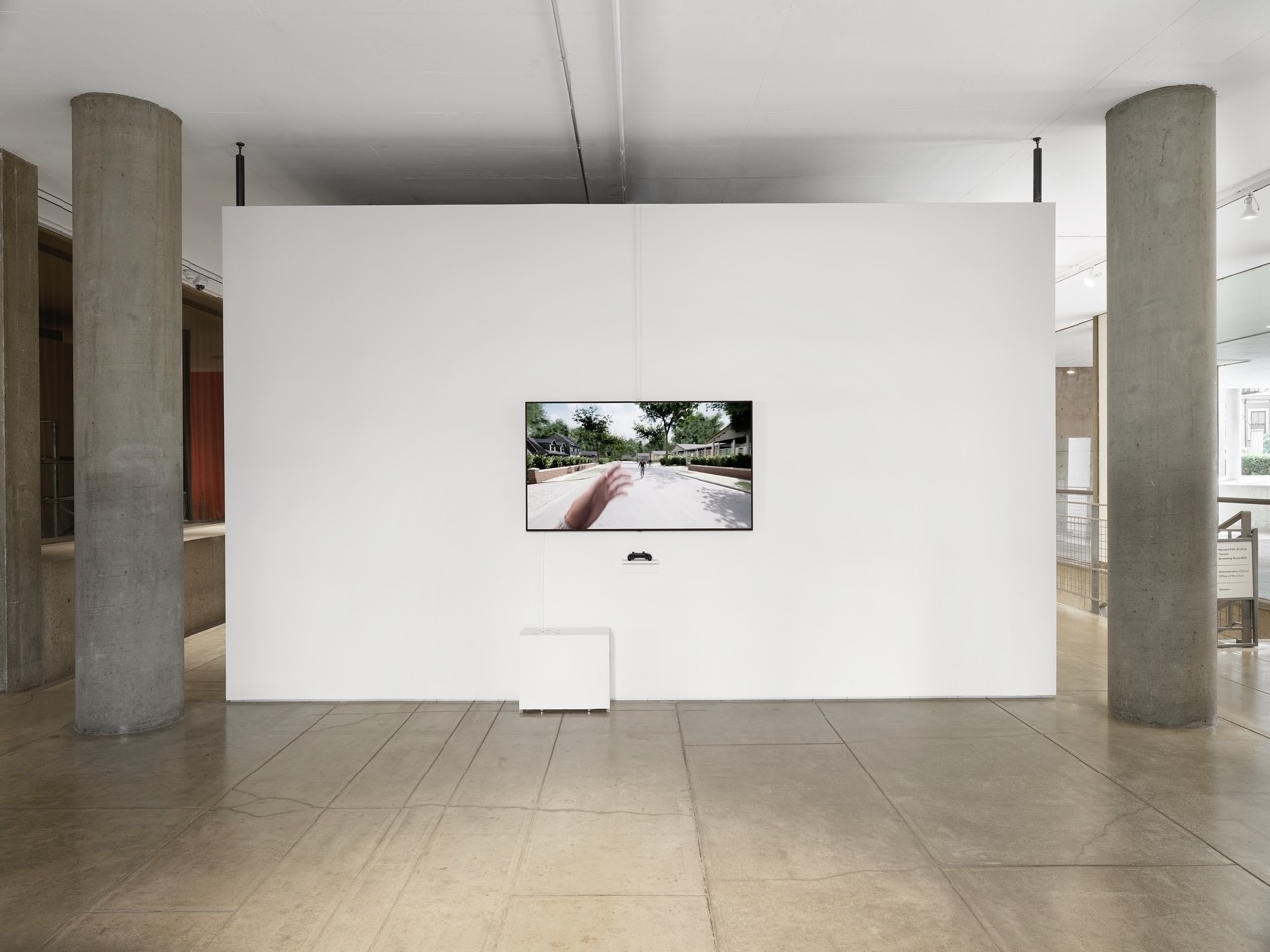
Rindon Johnson, “Diana Said,” 2019
Currently on view at Harvard University’s Carpenter Center for the Visual Arts is “Constitutive Outside,” a group exhibition of moving image works spanning projected video, virtual reality, interactive gameplay, and sculptural installation. Featuring artists Markele Cullins, Jibade-Khalil Huffman, Steffani Jemison, and Rindon Johnson, the exhibition “examines how subjectivity emerges through misrecognition, non-coincidence, and the limits of representation.” [1] The show takes its title from the work of cultural theorist Stuart Hall, who observed that identification inevitably “requires what is left outside, its constitutive outside, to consolidate the process.” [2] Although the terms Black and Blackness are strikingly unstated in the exhibition’s condensed overview, an extended guide underscores their centrality to the curatorial stakes of the show. For the exhibition’s curator, Tarik Garrett, perception, subjecthood, and race are built negatively through oppositional exclusions rather than stable, positivistic truths. As Garrett writes, “Western modernity continuously recalls blackness into action as the ground against which figures secure their legibility.” [3] Race, like the subject, Garrett explains, is not an intact essence that language simply fails to capture. Rather, subjecthood is constituted in relation to that very failure, becoming apparent when the illusion of certainty falters.
The exhibition opens at a time of various institutional breakdowns wrought by coordinated campaigns by the Trump administration targeting US institutions of culture and higher education, including Harvard, through legal actions, punitive funding freezes, and weaponization of Civil Rights legislation against Black studies initiatives and “race-consciousness” in university programming, coursework, and campus speech. [4] It’s unclear whether the elision of the term Black in the shortened overview reflected an institutional response to protect the exhibited artists, or a curatorial effort to prevent race from overdetermining the exhibition’s reception. In either case, the exhibition’s attention to misrecognition, signification, and the limits of representation raises questions around the grammars of inclusion and exclusion that underlie Black life and contemporary artistic practice. In recent years, an emergent vocabulary has proliferated to contextualize the social and cultural ruptures of Black art and life. Migrating from Black studies scholarship into gallery press releases, catalogues, and mainstream criticism, much of this language hinges on Blackness’s “outside” status, noting the transgressive and antinormative dimensions of Black experience along systemic, historical, and philosophical itineraries that emerge both because and in spite of anti-Blackness. Some of these terms reflect practices of Black resistance or socially critical ambivalence indebted to thinkers like Fred Moten (fugitivity), Tina Campt (refusal), and Édouard Glissant (opacity), while others respond to vast scholarship on interiority, or imagination, notably to the works of Saidiya Hartman (fabulation) and Moten (study). While this lexicon indexes the institutionalization of Black contemporary artistic practice and pedagogy, it also demands an accounting of the limits of this discourse. Who remains outside the frame, outside the institutions, and outside the terms of this artistic discourse?
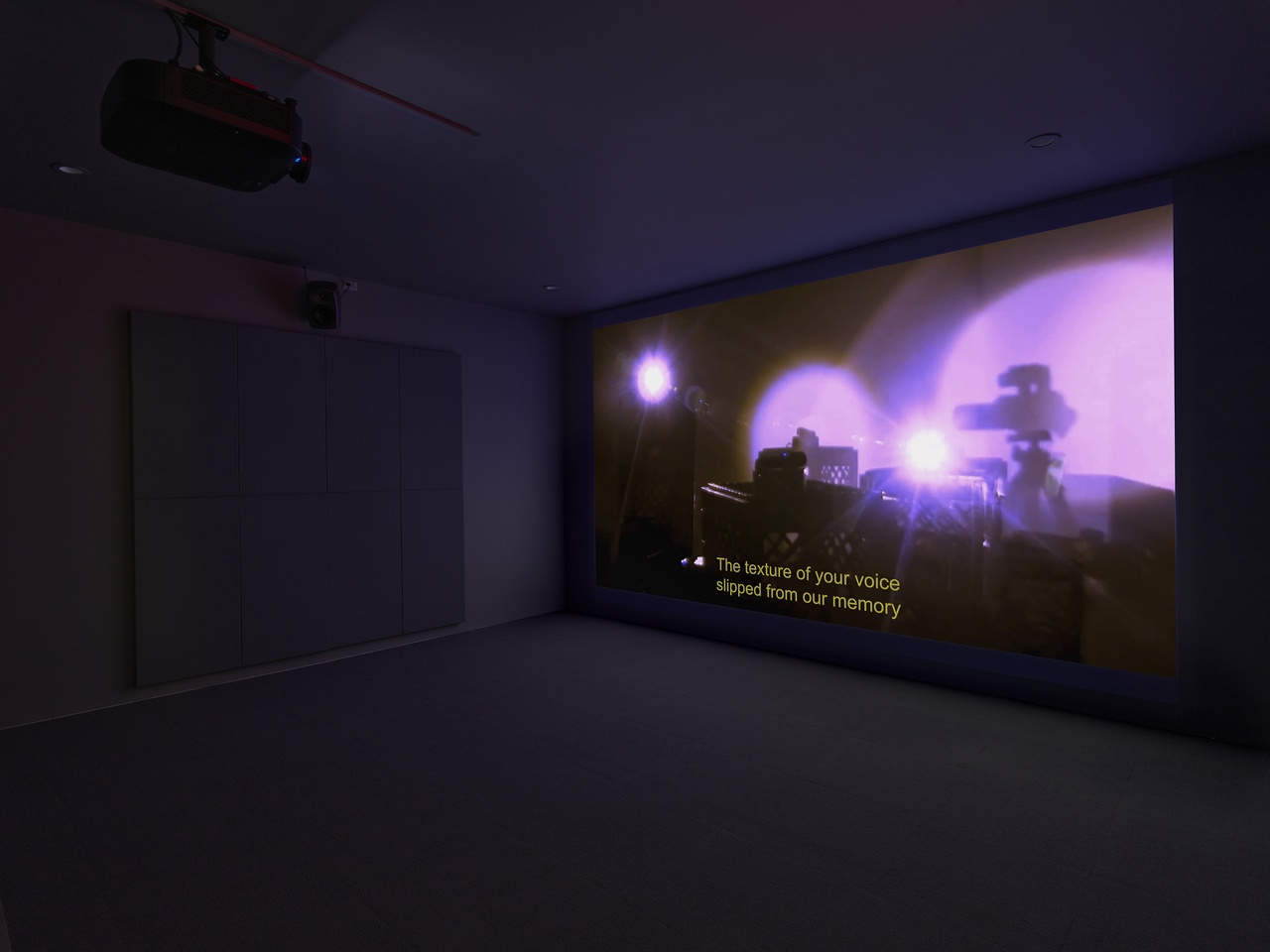
Markele Cullins, “The Mustard Seeds Inside the Serpent’s Belly,” 2026
In this exhibition, the “constitutive outside” operates on both psychic and physical registers, naming not only the alienating exclusions inherent to identity formation but also the range of spatial enclosures and public corridors where movement and visibility are fraught. In Jibade-Khalil Huffman’s PC game You Are Here (2026), visitors traverse uncanny, artist-built virtual interiors, using a controller to evade a pursuer by jumping into the roaming digital bodies of white non-playable characters. In an adjacent screening room, Huffman’s related video of the same name (2021–ongoing) montages found and original footage to the drone of a trancey synth score. Much like the game, the video offers only tenuous narrative continuity, displaying captions reflecting the mandates of contemporary capitalism: “The script is written / when you say / I’m not doing enough to expand my business.” Periodically, the home screen of Huffman’s accompanying PC game interrupts the video with disorienting intertitles reading “YOU ARE HERE / You are being followed / Jump bodies to delay your pursuer / Find the EXIT to escape.” This text casts the body-snatching avatar of Huffman’s game as a protagonist in flight, trapped in an endless deferral of inevitable capture. As with the totalizing systems of our own world, whether the game can be “won” or simply prolonged remains ambiguous. Like Huffman’s You Are Here, Rindon Johnson’s virtual reality installation Diana Said (2019) also enacts estranging modes of virtual embodiment through the surrogate selfhood of a digital avatar. Upon donning a headset, the visitor drifts along a river that ribbons through a woodland arcadia beneath towering trees to the sound of ecocritical commentaries in multiple languages. A vertical monitor captures the headset’s interior view, where clusters of computer-generated cows levitate impossibly across the virtual landscape like tumbleweeds while the warped, brown-skinned arms of the first-person avatar flail and contort before the viewer. For Johnson, the cow is a paradigmatic symbol of confinement within racial capitalism, in which organisms, ecologies, and human lives are rendered as fungible byproducts: “The cow exchanges its body for living,” Johnson reflected in a 2022 interview with Isabel Parkes. “What do I exchange my body for?” [5]
While “Constitutive Outside” credits its title to Stuart Hall, use of the term belongs to separate trajectory of scholarship. Political theorists Ernesto Laclau and Chantal Mouffe explored the concept in their efforts to reconcile Marxist materialisms with post-structuralism’s contingent and relational notion of the subject. [6] Whereas for thinkers such as Jacques Derrida and Judith Butler it describes how oppositional concepts configure each other’s meanings. As Butler writes, “Fantasy is not the opposite of reality; it is what reality forecloses, and, as a result, it defines the limits of reality, constituting it as its constitutive outside.” [7] While this instability of identity formation is among the exhibition’s principal concerns, another clear throughline is visual, auditory, and linguistic distortion that speaks to the breakdowns in representational coherence that Derrida and Butler attest to. In Markele Cullins’s projected video The Mustard Seeds Inside the Serpent’s Belly (2026), shattered beads of lavender light emanate from flashlights on rotating spinners atop plastic crates, accompanied by unspoken subtitles bearing lyrical phrases. Subsequent sequences collapse interior and exterior space, as blurred shots of treetops alternate with low-angle 360-degree pans over sparsely vegetated gravel, which Cullins overlays with ghostly afterimages and optical glares. The result is a visual poem that oscillates between a shadowy model skyline and a kaleidoscopic tableau of violet and lilac diffractions.
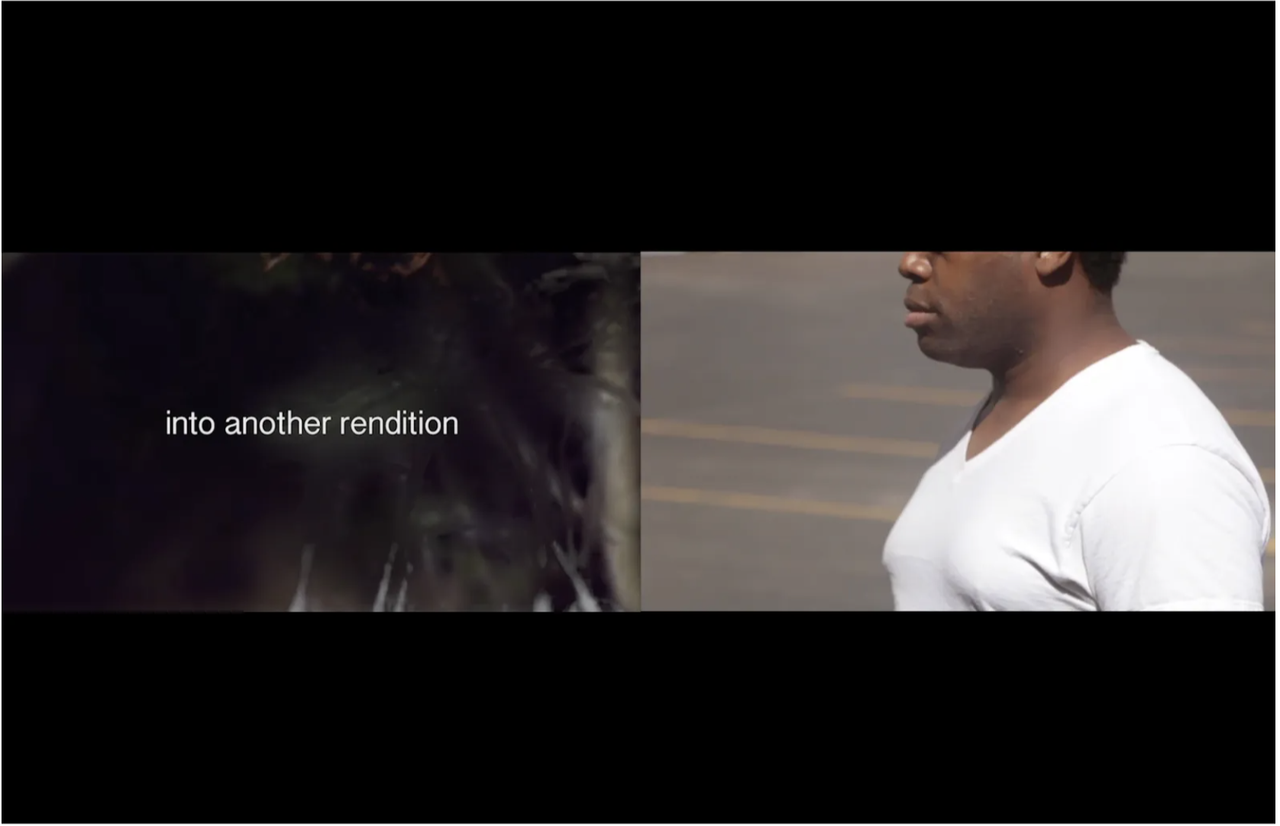
Jibade-Khalil Huffman “You Are Here,” 2021-ongoing
If the terms most commonly applied to the work of Black artists have buttressed a surge of critical reception and institutional recognition for a plurality of Black experimental practice – particularly in lens-based media – they have just as often verged on a kind of institutional flattening of the distinct conceptual textures and formal idioms of individual artistic practices under a discrete set of privileged signs that were never designed to be authoritative or exhaustive. Pressing, too, are the intraracial implications of a professional terminology that, while legible within rarefied spheres of contemporary art, risks alienating members of the general public, many of whom are Black. In that sense, the exhibition’s investment in identification offers an occasion to ask: Who is positioned outside the terms that describe Black subjectivity in contemporary art discourse?
Steffani Jemison’s standout sculptural installation Bridge (2025) embodies just such attunements, comprising a brass pipe, drawing, and video mounted to a steel lattice of climbing cubes reminiscent of a playground jungle gym. Installed against the Carpenter Center’s lower-level windows, Jemison’s grid is framed by views of the swooping ramp, brutalist columns, and concrete understructure of Le Corbusier’s sole North American building. In the video, an all-Black cast of performers weave, brace, and slither between the bars of a similar rectilinear lattice. Rather than conjuring movements of ascent or progress, their languid comportment and sinuous poses suggest ambivalent orientations of rest and repose, threading the structure’s porous boundaries between inside and outside. Contrasting the austere minimalism of Jemison’s grid are the soaring vocalizations of the soundtrack, which carries African American gospel choir music throughout the atrium. The sound grows increasingly stylized as the imagery dissolves into colorfully striated blurs, hazy abstractions of blue and white streaks, and warped double-exposed views. Opposite the monitor, a drawing hangs from the brass pipe, depicting a figure whose outstretched arms leave the frame as if dangling from horizontal bars above. While Jemison’s drawing recalls the abandon of childhood play, her grid also invokes the rigid geometric rationalism of Western modernist painting, architecture, and urban planning. Juxtaposing these rationalist and deterministic legacies, Jemison posits vernacular Black movement and the musical traditions of the Black church as an alternative experimental lineage of formal abstraction.
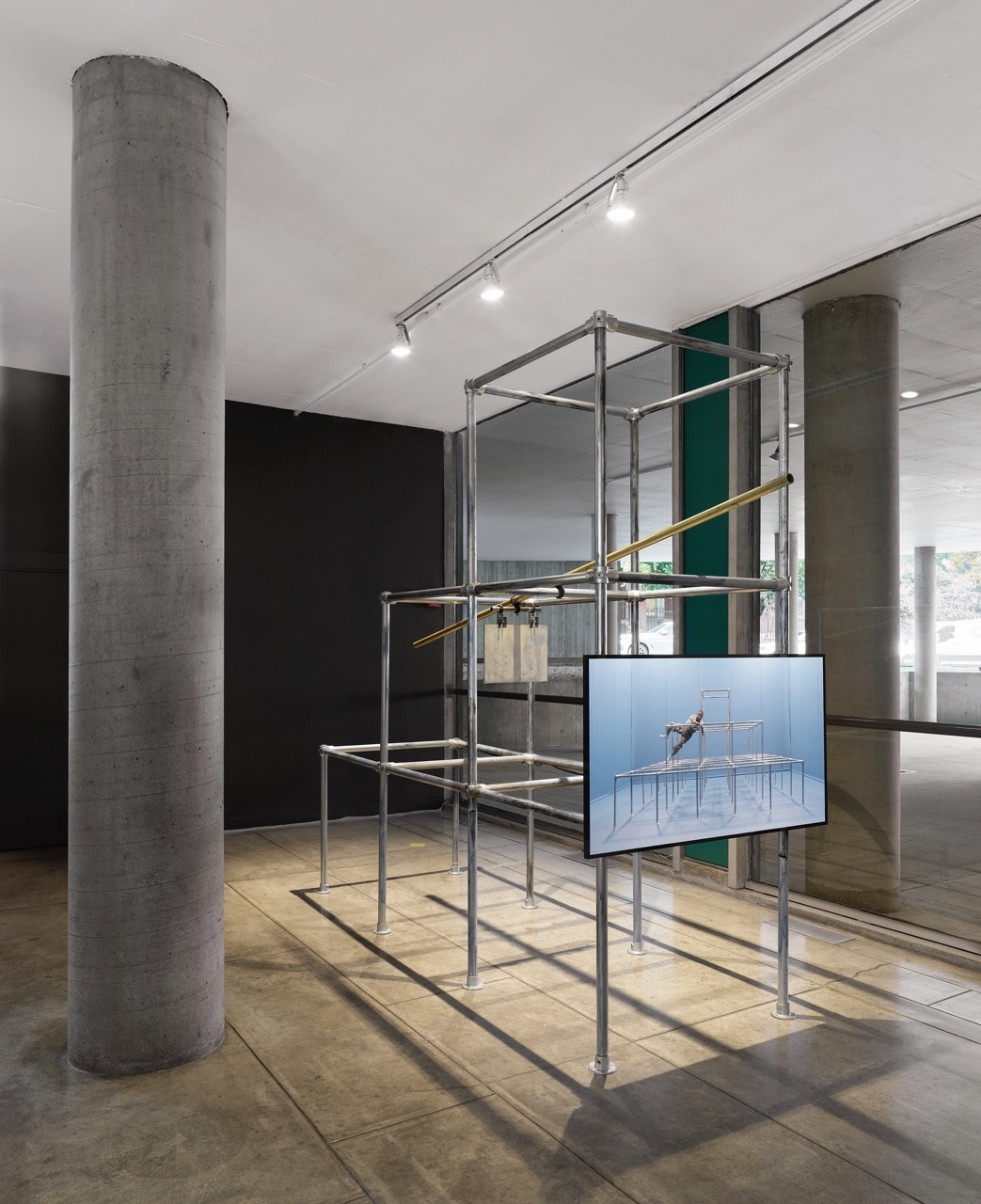
Steffani Jemison, “Bridge,” 2018
For Le Corbusier, geometric abstraction and the grid exemplified the goals of Modernist architecture and urbanism to establish universal laws of beauty for all human subjects, including “the child, the savage and the metaphysician,” [8] derived from “logic, analysis, and minute study.” [9] Similarly, Alfred H. Barr Jr., art historian and the first director of the Museum of Modern Art in New York City, championed modern painting under analogously universalizing terms of “Truth, Freedom, Perfection” [10] in the headings of his text “What Is Modern Painting?”: What is easily lost in the conservative right’s recent culture wars against the independence of US museums and cultural centers is that such institutions have never been neutral guardians of cultural heritage despite their universalizing rhetoric. Rather, collections, canons, and universities reflect society’s dominant ideologies and reproduce their entrenched structural inequities of identity.
To its credit, “Constitutive Outside” and the artists therein reflect an elaborate range of strategies that routinely cog these operations, untethering the works from the sedimented terms that threaten to constrain the expressive forms of Black artists or render them palatable for consumption. One way the exhibition excels is through the open-endedness of games, improvisation, and play mobilized across what Garrett terms “spatialized viewing situations.” [11] These environments strip viewers of their sovereign gaze and recast the acts of perceiving and understanding the work of Black contemporary artists as an unstable, contingent, and continually contested exchange. The divergent practices of Cullins, Huffman, Jemison, and Johnson stage numerous distortions, elisions, and interruptions that risk unintelligibility, verge on narrative incomprehension, and invite theoretical misrecognition. Yet, by doing so, these works exceed the very terms of identification and misrecognition inherent to visuality that might otherwise overdetermine the practice of Black artists and its circulation.
“Constitutive Outside,” Carpenter Center for the Visual Arts, Harvard University, October 22–December 13, 2026.
Gee Wesley is an arts organizer born in Monrovia, Liberia, and based in Providence, Rhode Island, where he is a PhD student in the Department of Modern Culture and Media at Brown University.
Image Credits: 1.-2., 4. Courtesy the artists and the Carpenter Center for the Visual Arts at Harvard, photos Julia Featheringill; 3. © Jibade-Khalil Huffman, courtesy the artist and the Carpenter Center for the Visual Arts at Harvard.
NOTES
| [1] | “Constitutive Outside,” Carpenter Center for the Visual Arts, Harvard University, accessed November 9, 2026. |
| [2] | Stuart Hall, “Introduction: Who Needs ‘Identity’?,” in Questions of Cultural Identity, ed. Stuart Hall and Paul du Gay (Sage, 1996), 3. |
| [3] | Tarik Garrett, “Constitutive Outside,” gallery guide for “Constitutive Outside: Markele Cullins, Jibade-Khalil Huffman, Steffani Jemison, and Rindon Johnson” (Carpenter Center for the Visual Arts, Harvard University, 2026) |
| [4] | US Department of Education, Office for Civil Rights, “Dear Colleague” letter, February 14, 2025. |
| [5] | Isabel Parkes, “No Word Can Hold the Person: A Conversation with Rindon Johnson,” Flash Art, no. 339 (2022). |
| [6] | Ernesto Laclau and Chantal Mouffe, Hegemony and Socialist Strategy: Towards a Radical Democratic Politics (Verso, 1985), 12. |
| [7] | Judith Butler, Undoing Gender (Routledge, 2004), 29. |
| [8] | Le Corbusier, Towards a New Architecture, trans. Frederick Etchells (Payson and Clarke, 1927; repr., Dover, 1986), 29. |
| [9] | Ibid., 4. |
| [10] | Barr, Alfred H., Jr., “Truth, Freedom, Perfection,” in Defining Modern Art: Selected Writings of Alfred H. Barr, Jr., ed. Irving Sandler and Amy Newman (Abrams, 1986). |
| [11] | Garrett, “Constitutive Outside.” |