
TO TAKE THE PISS OUT OF ART AS IDEA Felix Vogel on “Conceptual Art and Christine Kozlov” at Raven Row, London
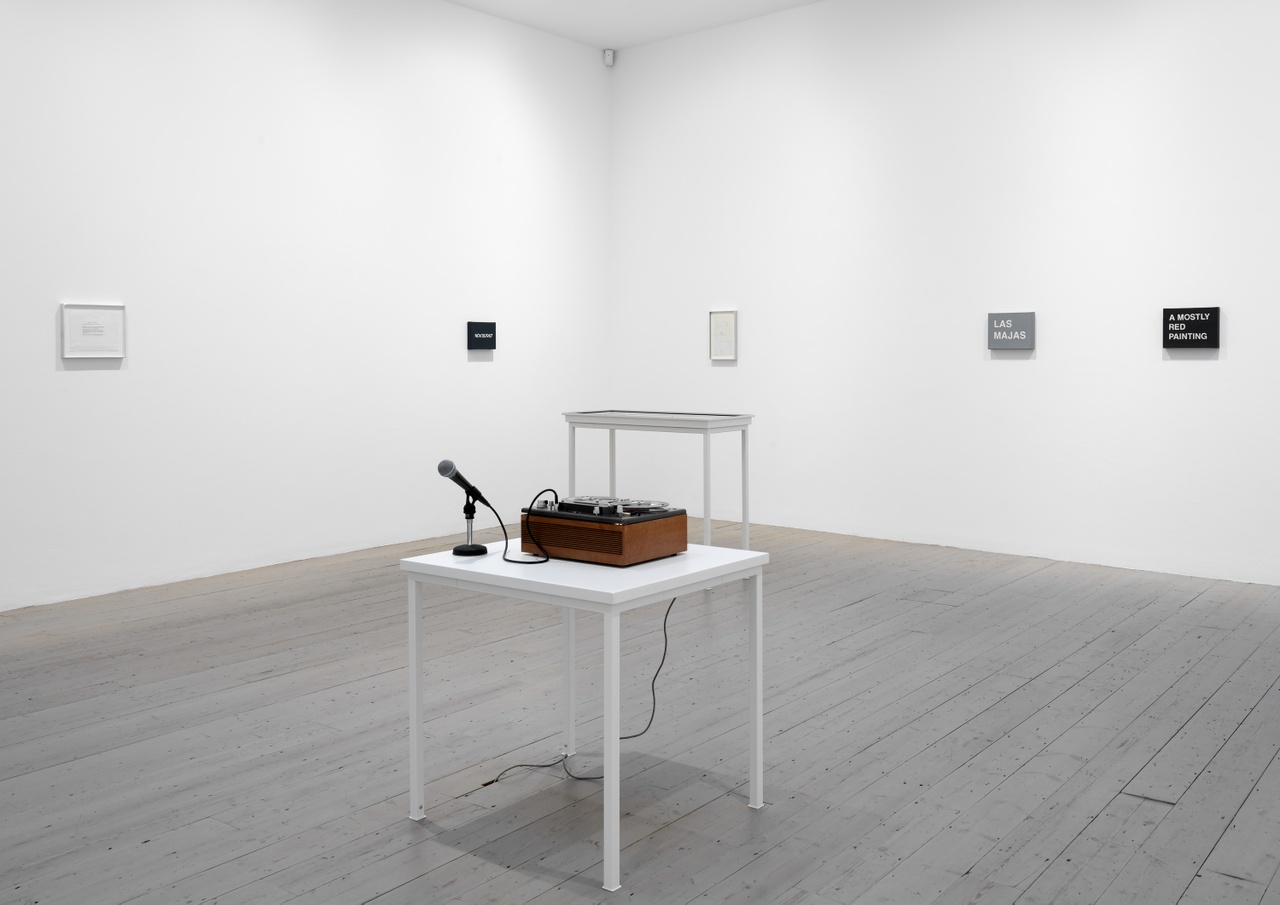
“Conceptual Art and Christine Kozlov,” Raven Row, London, 2026
Christine Kozlov’s Neurological Compilation: The Physical Mind Since 1945 (Project I: The Bibliography) (1969) was in all likelihood the most widely seen work of the artist’s lifetime: shown as part of Lucy Lippard’s “Numbers” exhibitions between 1969 and 1974 at numerous venues across Western Europe, North America, and South America, it consists of nine ring binders containing 554 typewritten pages listing the titles of what purports to be every article published in the field of neuroscience between 1961 and 1969. Authors and journal names – conventionally the very elements that establish authority and ensure discoverability – are omitted; only the titles remain. To give an impression of the list’s specific poetics: “Antidromic Responses of Hypoglossal Motoneurons,” “The Role of the Trigeminal Nerve in Olfaction,” “Evoked Responses in the Auditory Cortex of the Squirrel Monkey,” “The Na+K+ Activated ATPase as a Mechanism for Inhibitor Neurons.” Roughly estimated, there are around 12,000 such titles in total.
At first glance, the work fits seamlessly into that tradition of conceptual art which elevates serial accumulation, cataloging, or bibliographing to a governing principle – as in Hanne Darboven, Art & Language, or On Kawara, and works by the latter two are represented alongside Kozlov’s in the exhibition, thus framing her work with pieces by artists from her immediate network rather than situating her in isolation. But Neurological Compilation is better understood as a surprisingly early meta-commentary on precisely this form, which was already solidifying into convention by 1969. In a note from the 1990s – itself a kind of cataloging of Kozlov’s work, displayed right at the start of the exhibition and thereby framing the show with her own words – she writes: “Neuro. Compl. was work trying to take the piss out of art as idea,” crossed out and corrected to: “was a joke on art as idea.” In other words, a joke on the principle propagated by her then-partner Joseph Kosuth, which declares the idea alone to constitute the work. Neuroscience is the science of what produces ideas: the brain. Kozlov’s bibliography would, then, amount to the literal determination of Kosuth’s idealism – “art as idea” thrown back to its neural, corporeal, and therefore emphatically non-dematerialized foundation.
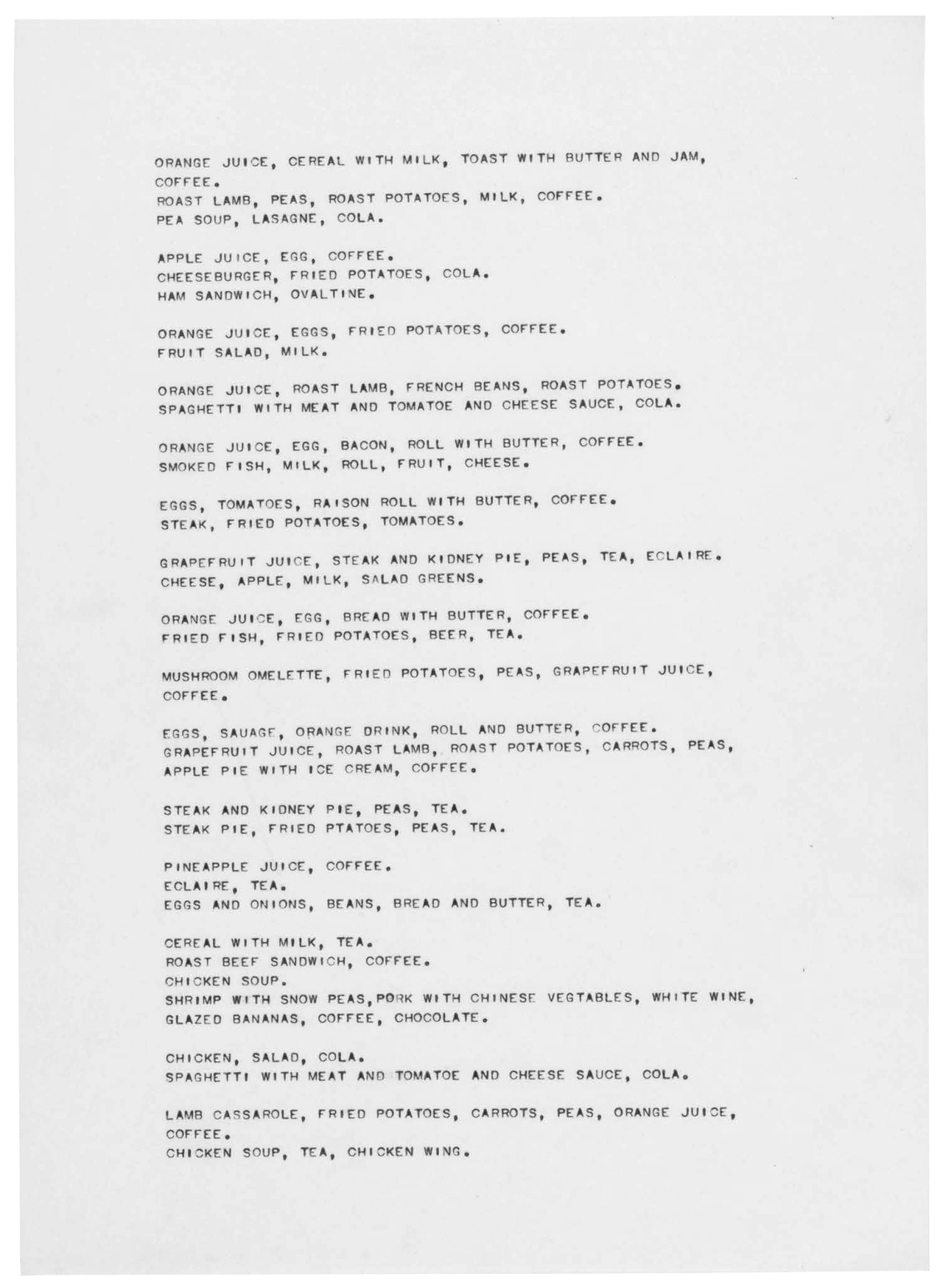
Christine Kozlov, “Eating Piece,” 1969
As in other works by Kozlov, such as Eating Piece (1969), which lists all the food and drink the artist consumed between February 20 and June 12, 1969, a materialist perspective is certainly discernible, but it also reveals her deep interest in questions of neuroscience, a discipline otherwise entirely absent in conceptual art (unlike philosophy, linguistics, or political theory). This is, in fact, remarkable, given the (supposed) primacy of thought on which this art grounded itself. Nor did conceptual art show much interest in biology more broadly – a field not unrelated to neuroscience – with Kozlov representing a notable exception. The exhibition includes a number of works in which she compiles biological, and specifically zoological, texts: Untitled (Social Structure of Bees) (1965–67) draws on material about the social life of the honeybee; Archeozoic, Proterozoic, Precambrian, Paleozoic (1971) on the anatomy, evolution, ecology, and cultural history of the crocodile. These works aim neither at something like artistic research avant la lettre nor at straightforward knowledge transmission – in Social Structure of Bees, for instance, the text is crossed out and overlaid with honeycomb patterns, rendering it largely illegible – nor do they reduce the work to the purely linguistic articulation of an idea, as both the conventions of conceptual art and many of Kozlov’s own works might suggest. It is, frankly, difficult to say precisely what these works are doing, not least because of the temptation to parse them through familiar art historical categories: Passages from Social Structure of Bees read like a feminist critique, as an allegory of the artistic production of the time, such as when the text notes that “Males or drones are larger, more plump, and a little stupid and lazy.” But is the concept of allegory sufficient here? What does it achieve? Or is the concern rather with the structure of language and its social function – the sociolect of biology made strange by its displacement into an art context, thereby pointing to “the language-use of the art society” [2] itself? Either reading would constitute, again, a meta-commentary on conceptual art and its gendered social relations.
And this is precisely the challenge posed by Kozlov’s work: that it fits, on the surface, quite easily into a received reading of conceptual art yet remains fundamentally at odds with it. For all my criticism of that dominant reading, I find myself reproducing the very mechanism I set out to critique: The work of women artists in conceptual art is, more often than not, either absorbed into the existing narrative or positioned as a feminist footnote – added to the canon without displacing it. For what is regarded today as conceptual art is the outcome of a series of decisions – in exhibitions, essays, anthologies – through which a heterogeneous field around 1970 was retrospectively consolidated into a coherent movement, in which one specific tendency, grounded in an analytic philosophy of language, assumed normative authority, and it is precisely this consolidation that systematically displaces Kozlov’s work from the center. Would things look different if, to name but one example, Alexander Alberro had included Kozlov on equal terms alongside Dan Graham, Joseph Kosuth, Sol LeWitt, and Lawrence Weiner in his still-authoritative study of early conceptual art in New York? [3] Not as tokenism, but because Kozlov was in fact at that center – developing work of at least equal radicality, exhibiting alongside all of these artists, and indeed showing their work herself in the short-lived Lannis Gallery (later renamed as the Museum of Normal Art), which she ran with Kosuth. The established narrative may now have been supplanted by a revisionist history of conceptual art (even if such revisionism is unthinkable without the earlier norm it criticizes), whether in the form of “Global Conceptualism” or a feminist revision in exhibitions such as “WACK! Art and the Feminist Revolution” (in which, incidentally, the artist was not represented). However, even this revisionism offers Kozlov no better place: for one version of it she remains a footnote, while for the other her work is too indebted to the analytic tradition to represent what was repressed by it. Kozlov fits none of the dominant narratives that stand ready to accommodate her.

“Conceptual Art and Christine Kozlov,” Raven Row, London, 2026
It is all the more astonishing, then, that the exhibition at Raven Row manages both to present Kozlov’s work as unique and to retrospectively situate it within the canon of conceptual art. I was initially skeptical of the title and the announcement that works by predominantly male artists would also be shown (though at least Adrian Piper, Lizzie Borden, and Joan Jonas are included). Is her work not sufficient on its own? The exhibition makes it clear, however, that something else entirely is at stake in Kozlov’s practice; the other positions are not there to validate it or confirm its relevance through comparison. What the exhibition demonstrates instead is, on the one hand, that Kozlov was involved in numerous collaborations – with Robert Rauschenberg, Art & Language, Lizzie Borden, and the band Red Krayola, among others – and that many of her works can only be understood as part of a collective practice. On the other hand, almost all of the works by the male artists in the exhibition – many bearing dedications – come from her own estate, highlighting the central position she occupied within the network of conceptual art.
The exhibition is equally notable for refusing to read Kozlov’s withdrawal from art around 1980 as the logical fulfilment of a trajectory already latent in her work – a stance underlined by the inclusion of an unfinished piece from the early 1990s addressing the Gulf War. There are, admittedly, numerous works concerned with absence, erasure, or failure: among them the self-explanatory 271 Blank Sheets of Paper Corresponding to 271 Days of Concepts Rejected (1968); No Title (Transparent Film #2) (1967), consisting of a roll of film that was never exposed and is not intended for projection; and what is probably her best-known work, Information: No Theory (1970), which comprises a tape recorder manipulated so that whatever is recorded is erased before it can be played back. It is less the “deliberate suppression of representational information” [4] that characterizes these works than their enacted insurmountable materiality. The unexposed film reel turns the support material of a potential film into a subject in itself; the 271 blank pages do not simply refer to a number of “rejected concepts” that are no longer intelligible as such but also reveal their material precondition, in the form of a substantial stack of paper; and Information: No Theory allegorizes not an idea of futility or mere self-reflexivity but the necessity of the apparatus-based, technical-material infrastructures of a work. In this sense, “a joke on art as idea” is perhaps the most accurate description of Kozlov’s relationship to conceptual art as a whole: not rejection, not affirmation, but an objection from within, against an art that regarded its own material conditions as a problem to be overcome.
“Conceptual Art and Christine Kozlov,” Raven Row, London, February 19–April 26, 2026.
Felix Vogel is a professor of Art and Knowledge at the University of Kassel and a member of the documenta Institut. Conceptual Art: A Feminist Topography, c. 1970, coedited with Paula Stoica, is forthcoming with b_books in summer 2026.
Image credit: Courtesy of Raven Row, photos Marcus J. Leith
Notes
| [1] | The exhibition has been curated by Rhea Anastas in collaboration with the Christine Kozlov Estate and Alex Sainsbury. |
| [2] | “Introduction,” Art-Language: The Journal of Conceptual Art 1, no. 1 (1969): 10. |
| [3] | Alexander Alberro, Conceptual Art and the Politics of Publicity (MIT Press, 2003). |
| [4] | Anne Rorimer, New Art in the 60s and 70s: Redefining Reality (Thames & Hudson, 2001), 189. |