
AFTER LOOKING James Voorhies on the 59th Carnegie International at the Carnegie Museum of Art, Pittsburgh
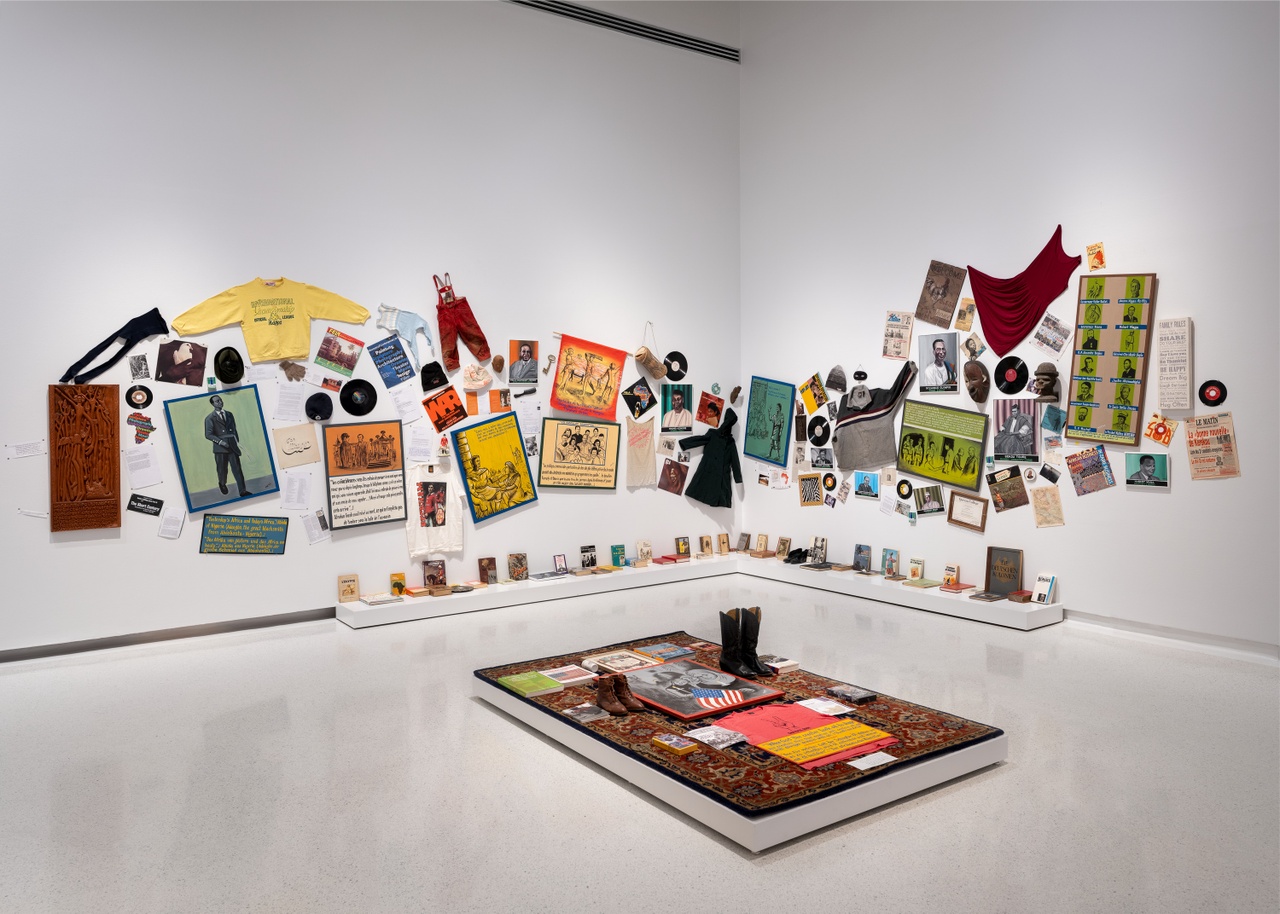
Georges Adéagbo, “Le Socialisme Africain,” 2001–2004, version 2026
For much of the 20th century, a dominant narrative of modernism centered on artistic autonomy. Clement Greenberg grounded that principle in medium specificity, maintaining that painting and sculpture should remain true to their distinctive qualities. Michael Fried subsequently defended that autonomy against Minimalism, objecting to its solicitation of the spectator because he believed the spectator’s spatial, temporal, and bodily experience of the work introduced an aspect of theatricality that negated its status as art. For Fried, the modernist work instead had to be wholly present through visual immediacy at any given moment, a condition he termed “presentness.” [1] While artistic practice has always been entangled with personal, political, and social forces, this modernist legacy still exerts an extraordinary influence over how art is discussed, exhibited, and judged.
Today, however, such assumptions no longer provide an adequate framework for thinking about the production, exhibition, and experience of art. Recent criticism of exhibitions ranging from the Whitney Biennial to “documenta fifteen” has remarked upon and in some cases lamented the growing prominence of research and explanatory frameworks, reasoning that artworks have become illustrations of arguments or documents marshaled in support of broader ideological claims, with artistic practice taking the form of research and knowledge production. The implication is that aesthetic experience has been sacrificed to political aspiration, displaced by language and the expectation that engagement with the “work” can continue through reading, discursive programs, and reflection – later and somewhere else. Indeed, what appears before us is often less a complete statement than a fragment of a vastly larger line of inquiry within an artist’s or curator’s broader practice.
The 59th Carnegie International makes this transformation unusually visible. Drawing its title from a commissioned essay, “What if the word we,” by the Egyptian writer and journalist Haytham el-Wardany, the exhibition takes a linguistic proposition, rather than an image, as its conceptual point of departure. El-Wardany recalls a moment when another future seemed possible through a collective capable of inventing its own language. For el-Wardany, every attempt to speak for a unified collective risks becoming exclusionary and fixed, rendering it inoperative. The pronoun thus remains aspirational and fractured. El-Wardany proposes a reorientation: Perhaps, he writes, we is “a matter of listening, not a matter of speaking,” and that, in the midst of devastation, it is important to learn to hear the we in order to rise from its weight. [2]
The exhibition is centered at the Carnegie Museum of Art, but it doesn’t stay there. Extending throughout Pittsburgh to partners including Mattress Factory and the Children’s Museum, the exhibition takes shape through performances, publications, broadcasts, and public programs. At the museum, projects occupy exterior grounds and multiple galleries, often in dialogue with the permanent collection. Along the way, I found myself drifting between works in the International and unexpected encounters with an Italian Futurist painting by Carlo Carrà or a familiar work by Marsden Hartley. The catalogue functions less as documentation than as an extension of the exhibition through essays, interviews, and visual projects. It, too, invites wandering and cross-referencing.
Just outside the museum in the Fountain Plaza, Ginger Brooks Takahashi’s Perilla People’s Garden (2026) presents an arrangement of woven planting beds and benches that carve out a welcoming refuge amid the bustle of downtown Pittsburgh. Centered on the plant Perilla frutescens – known as shiso in Japanese and deulkkae in Korean and often classified as an invasive species – the project creates a social space organized around the plant’s complex cultural histories. As Takahashi remarks, a garden can “shift our awareness about histories of settler colonialism” and “connect the dots between the past and the present,” ambitions pursued through writing and public conversations. [3] Inside the museum, herbarium sheets, audio recordings, and fragrances connect botanical research to diasporic and cultural memory.
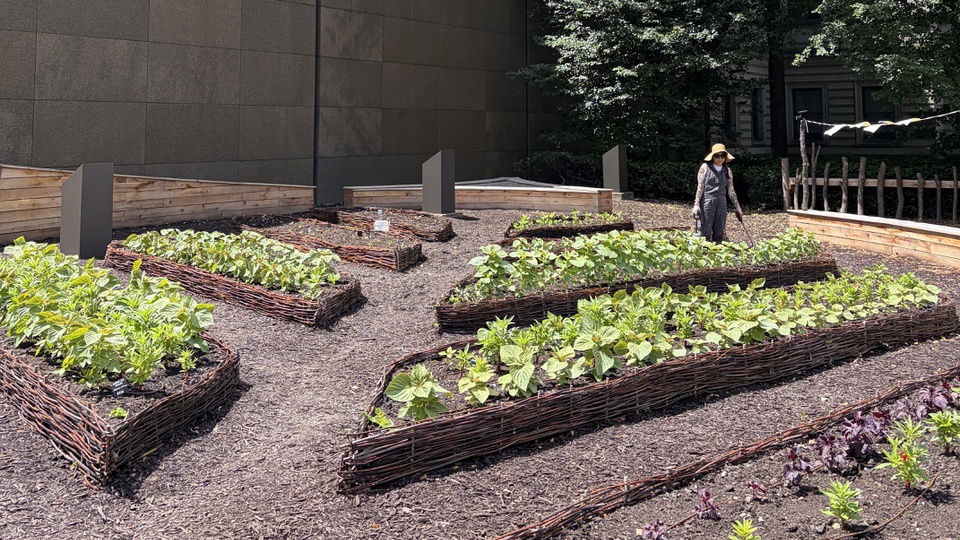
Ginger Brooks Takahashi, “Perilla People’s Garden,” 2026
Elsewhere in the museum, many artworks appear less as autonomous objects than as public manifestations of multiyear investigations that crystallize in exhibitions. Georges Adéagbo’s installation Le Socialisme Africain (2001–04/2026) assembles books, records, posters, clothing, rugs, newspapers, found objects, and works by artists in Cotonou, Benin. It offers a cross section of Africa’s representations through material culture that shapes how the continent is imagined. Originally commissioned by Okwui Enwezor for The Short Century: Independence and Liberation Movements in Africa, 1945–1994, the installation, not exhibited for more than 20 years, is presented here with additions specific to Pittsburgh, including black-and-gold team apparel and sports ephemera. I have taught Adéagbo’s work in graduate seminars, yet encountering it again reminded me of how insistently his installations resist fixed readings: The arrangements and combinations of objects, texts, and images take on new meanings as they are reconfigured for particular places and publics and encountered within changing social and political conditions.
Adéagbo’s work, organized around linkages among family histories, sociopolitical transformations, and the enduring challenge of how to live and learn together, is situated in the same gallery as that of the late Donald Rodney. A member of Britain’s BLK Art Group, Rodney, who lived with sickle cell anemia, died in 1998 at age 36. He frequently incorporated X-rays, medical tubing, and other clinical materials into works that explored the intertwined realities of bodily vulnerability and racial violence. Rodney’s works stopped me in my tracks. In Visceral Canker (1990), for example, fake blood circulates through medical tubing connecting the heraldic symbols of Queen Elizabeth I and the slave trader John Hawkins, linking national history to the corporeal. Nearby, Doublethink (1992) assembles inexpensive sports trophies whose plaques invoke racial stereotypes surrounding Black identity. Together, the works recall the vulnerability of the human body and the violence and contradictions of the body politic that shapes it.
Rodney’s work is placed in dialogue with films by Black Audio Film Collective and John Akomfrah. Black Audio Film Collective’s Three Songs: On Pain, Light and Time (1995) includes Rodney reflecting on learning to live with continual pain. John Akomfrah’s The Genome Chronicles (2008), conceived in response to the deaths of Rodney and of Akomfrah’s mother, days apart in 1998, interweaves footage from Akomfrah’s travels with Rodney’s Super 8 recordings made during hospital stays. The relationships among the works give form to el-Wardany’s understanding of “we” as neither fixed nor given, but continually formed without erasing the differences among individual voices. In this way, they produce a network of collective memory. Rodney’s presentation demonstrates how aesthetic experience can make history feel immediate – not as a distant object of study but as something that presses upon the present.
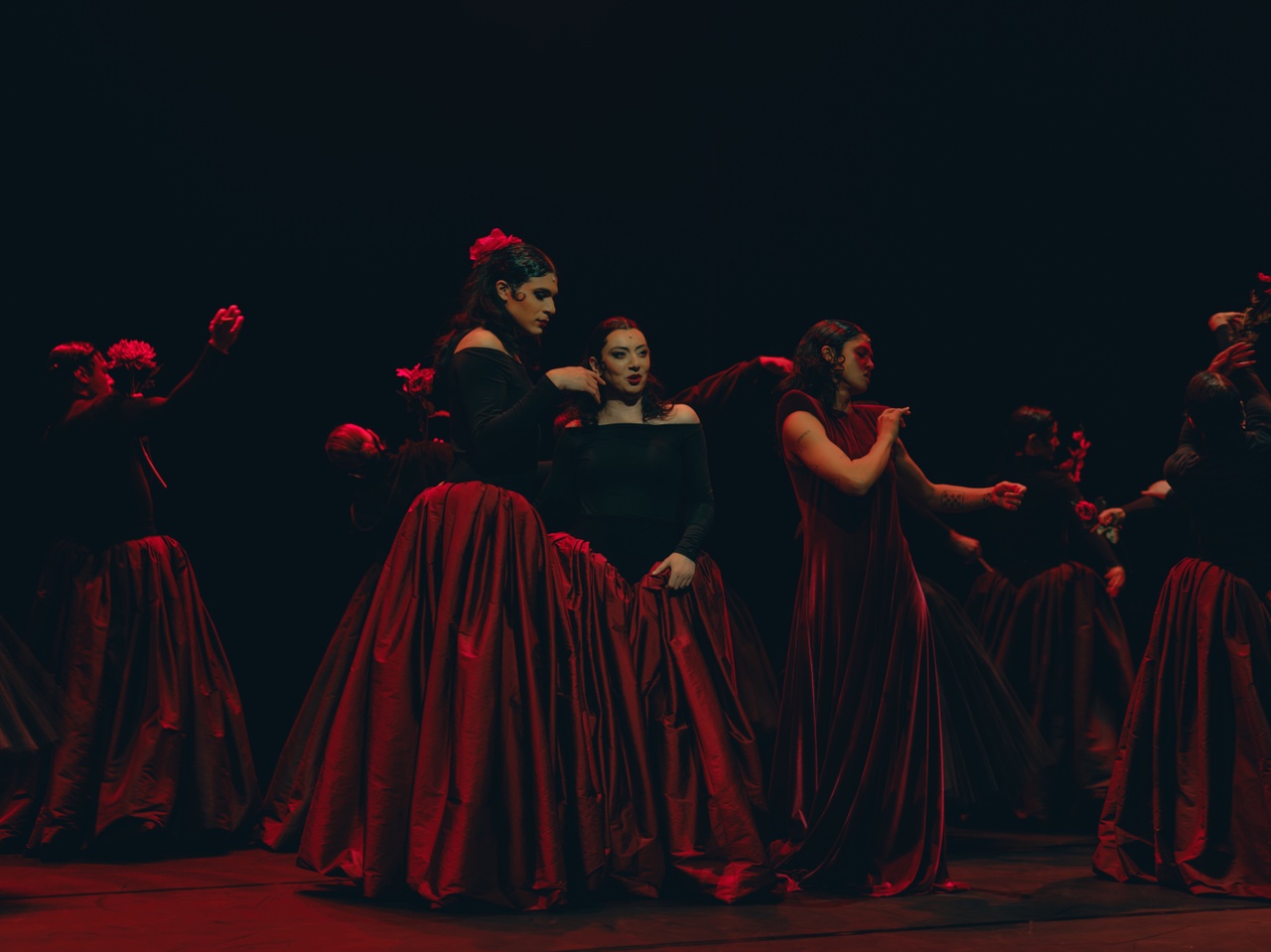
Wu Tsang, “Carmen” at Royal Theatre Carr., Amsterdam, 2024
Another group of artists – including Wu Tsang and Li Yi-Fan – show how political and historical concerns are inseparable from sensory experience. Atmosphere, scale, sound, and materiality imbue their works with an immediacy and openness that do not defer their significance to another time or place. Wu Tsang’s on our way to the general strike (2026) emerges from their engagement with Georges Bizet’s Carmen. The video and sound installation begins with the opening scene of the Louis Lumière’s Workers Leaving the Lumière Factory (1895), one of cinema’s foundational images, depicting industrial labor and collective movement. From there, Tsang’s magisterial 41-minute video assembles materials from stage productions and films into a commentary on the opera’s afterlives, foregrounding both flamenco’s status as a symbol of Spanish national identity rooted in marginalized communities and fantasies of otherness surrounding Carmen. Rather than seeking an authentic Carmen, Tsang offers an ever-shifting constellation of representations in which the character remains ungraspable, continually remade through the desires and anxieties projected onto her. Installed within the 1907 Hall of Architecture, which houses a collection of full-scale plaster casts of monuments across Europe, the Middle East, and Asia, the work acquires an additional resonance. Both the hall and Tsang’s project are organized around the persistence and reanimation of cultural forms and the enduring Western gaze onto the Other.
Li Yi-Fan’s What Is Your Favorite Primitive (2023) turns to the computational systems that mediate perception and social life. Created using a custom-built video game engine and motion-capture technologies, the 37-minute video takes the form of a mock technology keynote delivered by a shape-shifting avatar that reveals how thoroughly screens and computational systems structure work and everyday life. Traversing reflections on Renaissance perspective, photography, animation, gaming culture, and artificial intelligence, the video returns to the physiological and psychological conditions of human vision that form the foundation for computational renderings of three-dimensional space. Li examines increasingly automated modes of image production and the forms of perception and labor they now organize, asking what possibilities remain for creative and individual thought. What Is Your Favorite Primitive is saturated with explanations, monologues, jokes, and digressions, yet none of these resolves what, precisely, we are looking at. The video’s unsettling humanoid figures and traces of digital puppeteering reveal not simply the possibilities of technological production but also its limits, exposing how human action becomes conditioned by systems beyond one’s control.
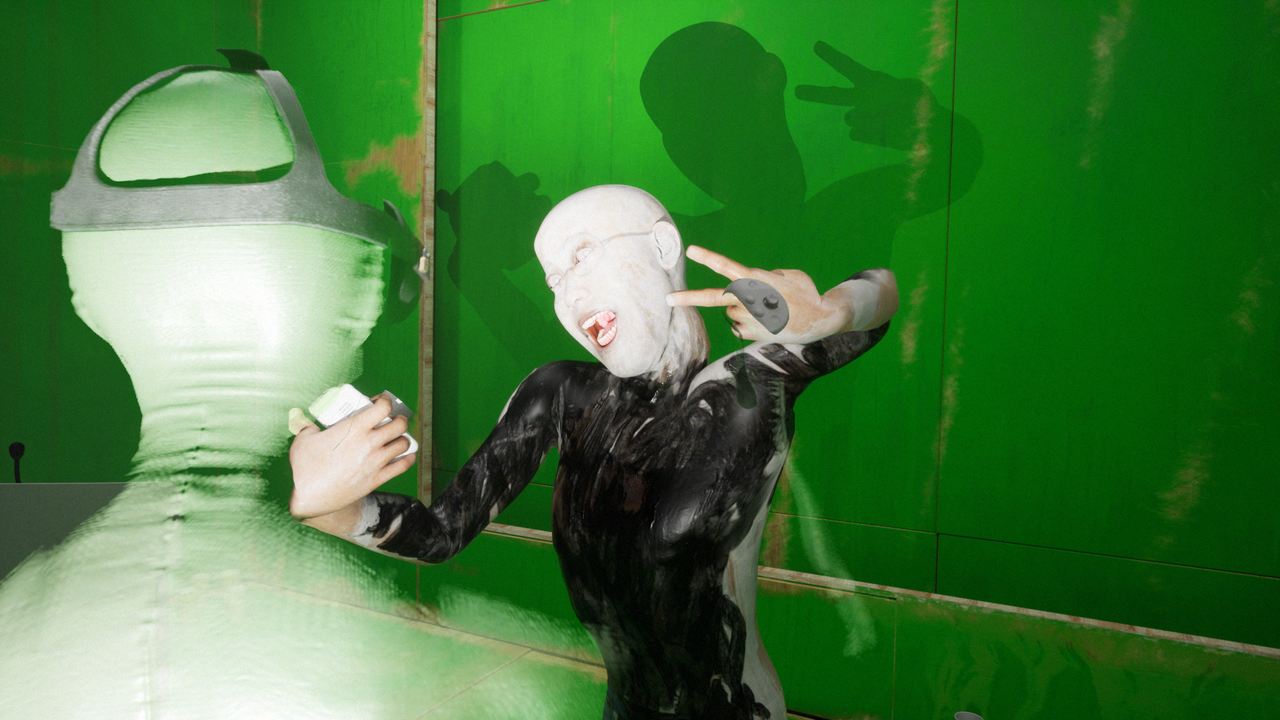
Li Yi-Fan, “What is Your Favorite Primitive,” 2023
The exhibition’s atomized and dispersed structure reflects a longer historical turn. From conceptual art and institutional critique to the emergence of New Institutionalism in the early 2000s, artists and curators have increasingly treated exhibitions as sites of research, conversation, and participation alongside spaces for viewing objects. Aesthetic experience has consequently expanded beyond the object’s perceptual immediacy to include learning and engagement shaped by language and social exchange, distributed across multiple sites and durations. Such developments have challenged the assumption that meaning resides solely in what unfolds between spectator and object inside the gallery. They have not foreclosed modernist aesthetics but have changed the conditions of reception and amplified the role of language within them. This expanded field might be understood as a form of postsensual aesthetics. The term, however, does not position sensual and cognitive engagement in opposition or imply that art has moved beyond lived, bodily experience; rather, it describes how meaning develops through their interplay instead of being anchored exclusively in an immediate physical encounter with the object. [4]
Ultimately, “If the word we” points toward an expanded understanding of aesthetic experience – where it occurs and what it can be. The modernist desire for visual immediacy and the transformative promise of looking have not disappeared. They are simply insufficient to account for the changes that have reshaped artistic production, curatorial practice, and the conditions of reception and distribution. “If the word we” suggests that art’s enduring force lies not in the autonomy of the object but in the exhibition form to reorganize attention, bring ideas into the public realm, and initiate, however provisionally, new ways of being in relation to one another. In doing so, the combination of art and its exhibition context shifts the conditions of aesthetic experience – and perhaps what we call looking.
59th Carnegie International, “If the word we,” Carnegie Museum of Art, Pittsburgh, May 2, 2026–January 3, 2027.
James Voorhies is an independent curator, writer, and art historian based in Berlin. He is the author of Postsensual Aesthetics: On the Logic of the Curatorial (MIT Press, 2023) and Beyond Objecthood: The Exhibition as a Critical Form since 1968 (MIT Press, 2017).
Image credit: 1. Photo James Voorhies; 2. © Carnegie Museum of Art, Pittsburgh, photo Zachary Riggleman; 3. Photo Inès Manai; 4. Courtesy of the artist
Notes
| [1] | Michael Fried, “Art and Objecthood” [1967], in Art and Objecthood: Essays and Reviews (University of Chicago Press, 1998), 148–172; see his discussions of the beholder (153), duration (164), and modernist “presentness” (167). |
| [2] | Haytham el-Wardany, “What if the word we,” in If the word we: 59th Carnegie International, ed. Michelle Piranio, exh. cat. (Carnegie Museum of Art, 2026), 45. Exhibition curated by Kathe and Jim Patrinos, Ryan Inouye, Danielle A. Jackson, and Liz Park. |
| [3] | Ginger Brooks Takahashi in conversation with Eric Crosby, July 21, 2025, in Piranio, If the word we: 59th Carnegie International, 14–16. |
| [4] | For a discussion of postsensual aesthetics as encompassing both sensual and cognitive encounters, rather than signaling a departure from lived, bodily experience, see James Voorhies, Postsensual Aesthetics: On the Logic of the Curatorial (MIT Press, 2023), 9, 11–12. |