
KEY IMAGES, COMPREHENSIVE VOCABULARIES Jonathan Odden on Hanna Hur at Greene Naftali; Nate Lowman at David Zwirner; Lynda Benglis at Pace; and Rita Ackermann at Hauser & Wirth, New York
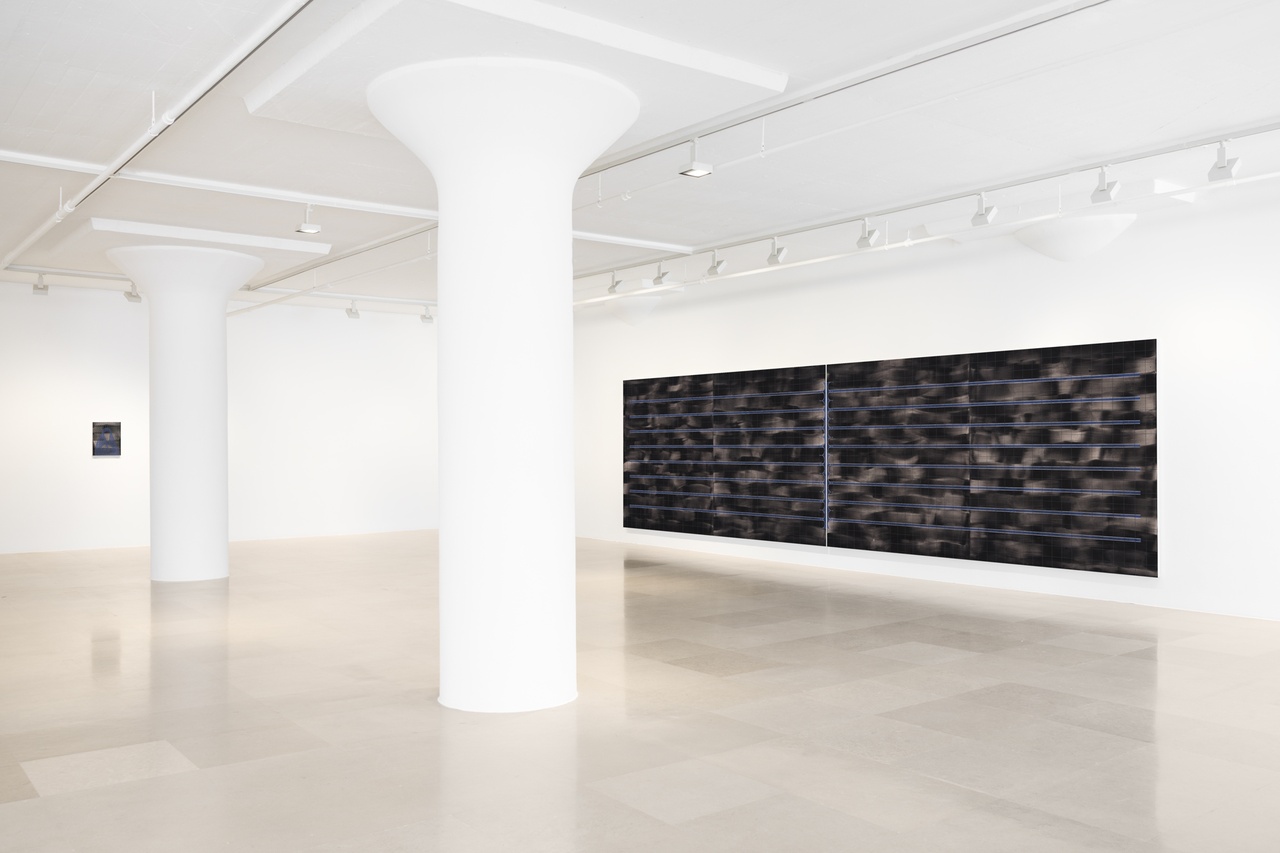
“Hanna Hur: Annunciation,” Greene Naftali, New York, 2026
The tall, north-facing windows of Greene Naftali’s eighth-floor loft space provide a diffusion of light that gives a glitter and luster to the frit in new paintings by Hanna Hur currently on view, works that probe the boundary between inherited pictures (in this case, religious iconography) and patterned abstraction. Throughout her show, Hur’s works (all 2026) hover on the cusp of Marian imagery – see the hands and ultramarine garments in Auto Annunciate – while never straying from the repeated gestures, the grids and circles, that form her practice. For example, Angel xv, which stretches across nearly eight meters of the show’s main sightline, alternates between bands of Marian blue and more evocative swishes of gray-black acrylic, a pattern set within a repeating geometric grid subdivided into four columns. The semicircles bounding the inner edges of the center two rows (two canvases are joined here) reveal Hur’s attention to working at different scales, with meticulous draftsmanship and a looser pull of the painter’s brush. These forms have an almost arithmetic quality, acts of operational attention playing out over canvas. If the grid afforded the scribe and devotional image-maker a formula and vocabulary of space, then what interests us here are the visceral, fleshly details mapped over this substrate. Of particular note, therefore, is the smallest work in the show, Annunciation, which through a repeated pattern of circles and squares purses into something resembling a biblical wound or yonic gash.
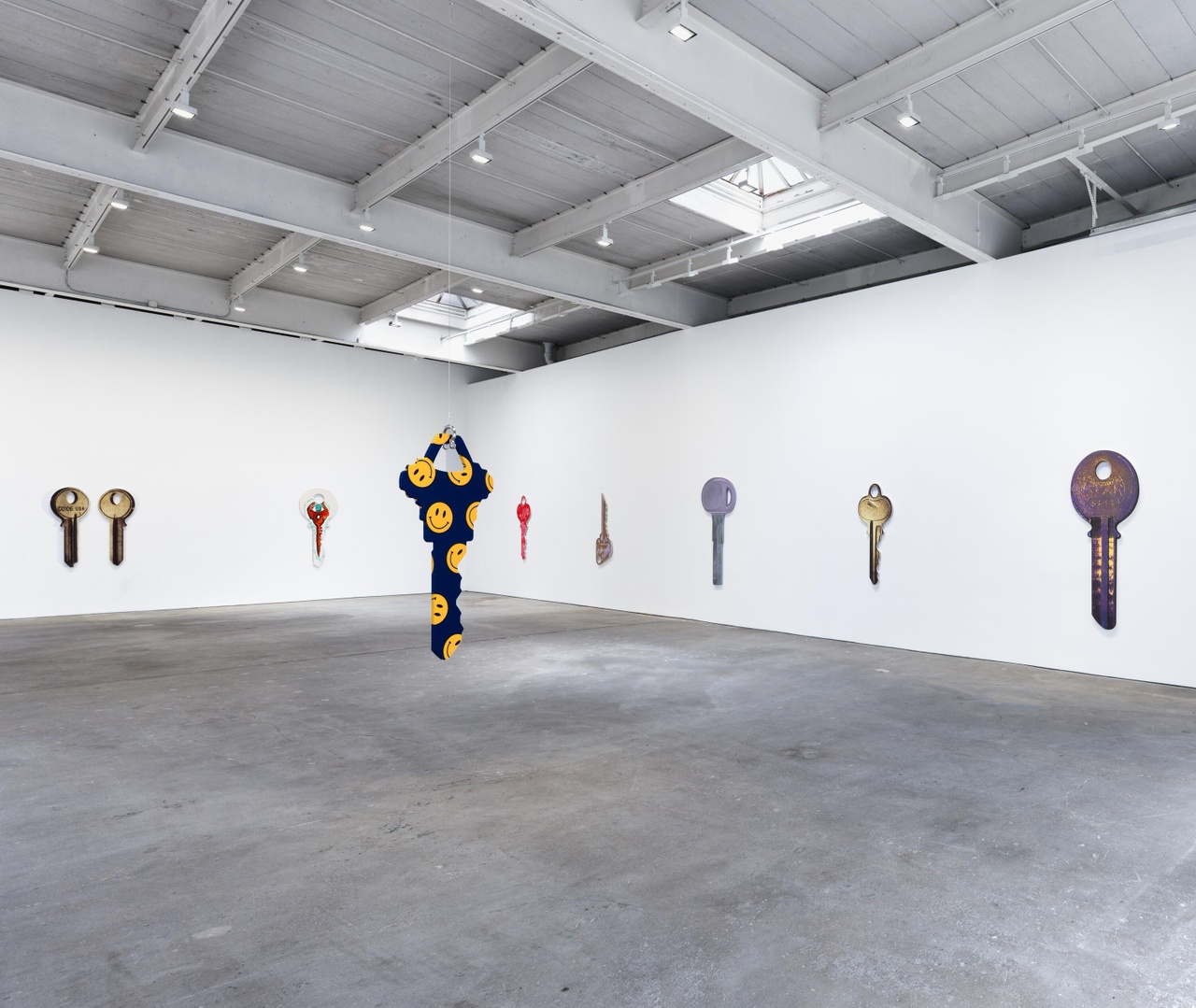
“Nate Lowman: Hanging Out,” David Zwirner, New York, 2026
Nearby at David Zwirner are new paintings by Nate Lowman, perhaps less labial but no less invested in the tension between abstraction and figuration. Here, 14 canvases that have been custom-shaped – a signature technique of the artist, all from 2026 and roughly a meter and a half in length – hang around a single, vast gallery space that still carries traces of the industrial garage it once was. At the time of my visit, its massive doors had been drawn up, opening the space completely to the street. As if connected to the street, then, the canvases are all modeled after that daily detritus and essential tool for escaping to supposedly safer, private places: oversized house keys. Some are hyperrealistic, like Golden (Gonna Be), where Lowman has captured the imperfections, groove, and cut of brass with deft silk-screening. Others are more abstract, like Bouboulinamou, which transposes graffiti from Greece discovered and documented by the artist, rendering the key form more as a support. Then there are novelty keys – smiley faces and polka dots – that hint at the exchange and intimacy behind giving someone access to a space. Like much of Lowman’s work, access to an altered sense of scale is important throughout this show. It draws attention to the subtler details of objects we too often abstract into the background, the habitual movement from verisimilitude to the idea of a key: what it might evoke as memento or outsized memory.
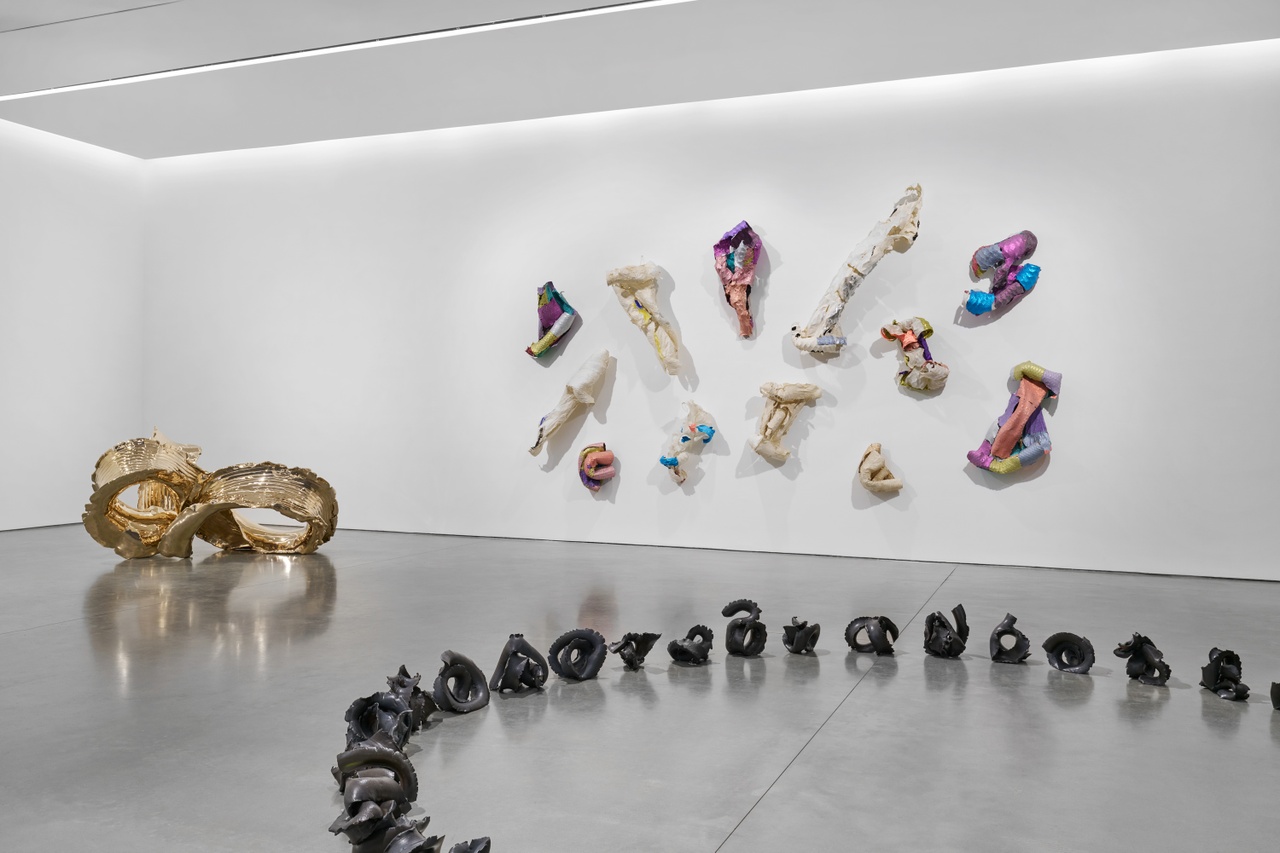
“Lynda Benglis: KNOTTING, TYING, FOLDING,” Pace Gallery, New York, 2026
Far more tactile and playing with scale in a different way is a collection of historical and recent works by Lynda Benglis at Pace, ranging from the early 1970s to the 2020s. Though the show’s title, “Knotting, Tying, Folding,” points to Benglis’s process, a more curious detail demonstrated here is how acts like knotting, typing, and folding contract or compound scale depending on the material worked. Here, Benglis is at her best when working across many materials: artist-made paper over chicken wire, sprayed metals on wire, cast bronze, cast glass, glazed ceramics, and so on. Though the main wall with its cluster of colorful contortions, glitter, and painting is striking, it’s really in the act of moving between the various pieces of the show that the grouping becomes noteworthy. The ways in which the pieces translate similar gestures across media and materials proves endlessly eminent, always protean. The most compelling works on their own, however, might be the cast glass clusters assembled on a tiered plinth near the front of the gallery. Desert Pupfish (1985), for example, is a fascinating mixture of opacity, hard edge, and rough surface. Considering how little disposition glass has for Benglis’s typical repertoire of gestures – famously, spilling and layering accretions – the fact that she can knot, tie, and fold it proves more than a little captivating.
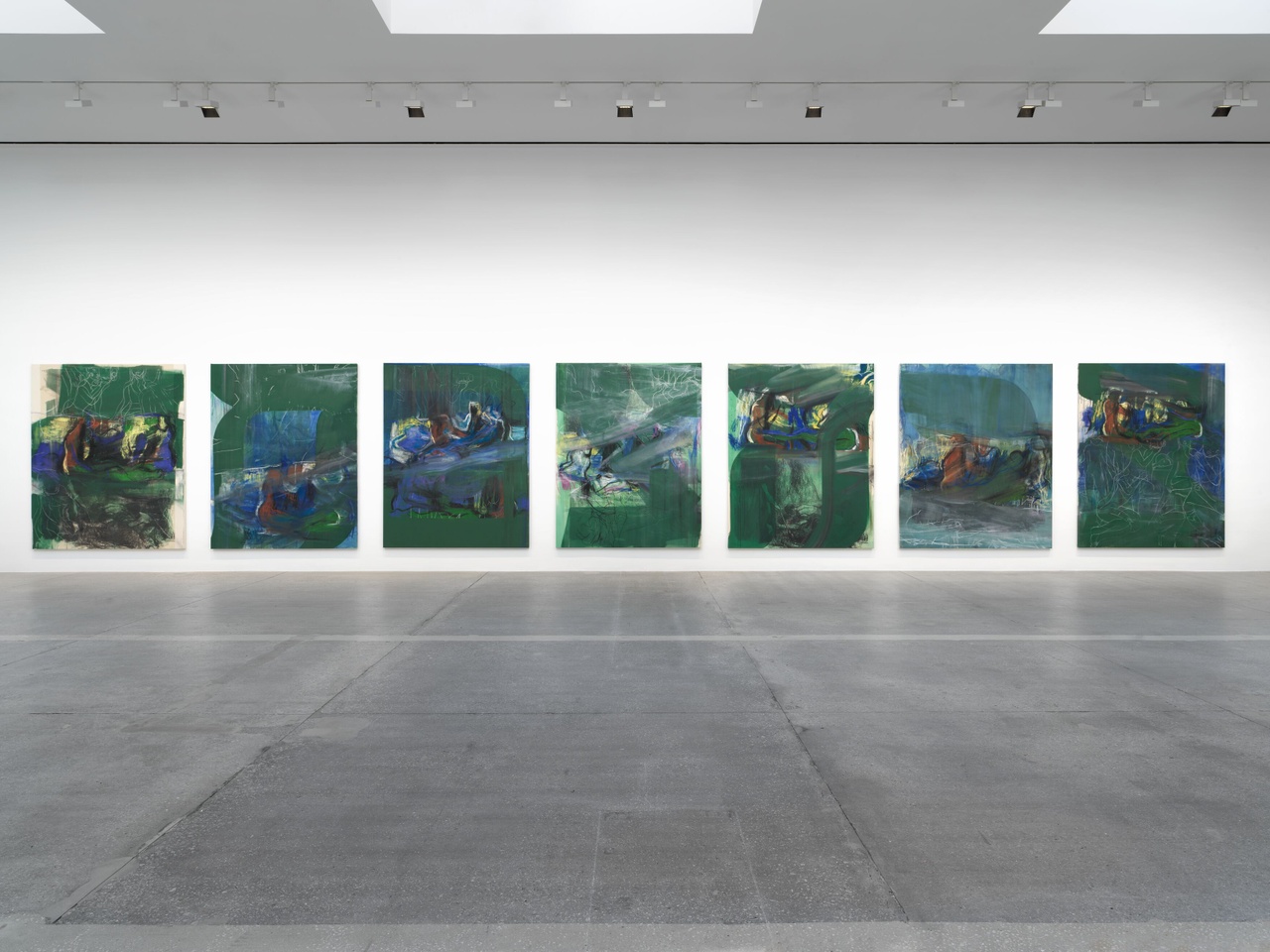
“Rita Ackermann: The Chemical Alphabet,” Hauser & Wirth, New York, 2026
Further downtown at Hauser & Wirth’s new outpost in SoHo – another one-time garage now parking art in its white cube – are new paintings by Rita Ackermann. In these works, the artist, much like Benglis, explores a lexicon, but instead of the vocabulary of material, she turns toward that of line and language. Process, however, remains paramount. “The Chemical Alphabet” consists of 14 large canvases, each built up with silkscreen motifs and grounded by a single Hebrew letter painted in green acrylic chalk paint (a continuation of her ongoing chalk paintings). These letters fill the canvases from edge to edge. Atop this substrate, the artist outlines a recurrent motif of young women posing, recording each other (with a vintage camcorder), and returning the viewer’s gaze, sometimes in grouped sets and other times as single figures. Shelter from the Storm (2026), for instance, begins with a dark silkscreen of two figures in a field, evoking a Jean-Baptiste-Camille Corot or Jean-François Millet landscape, as if they are praying the Angelus. Bounding these figures and stretching to the edge of the canvas is the letter ה, over which Ackermann has layered yellow, red, and blue oil pastels. Abrasions and other effacements remove traces of her initial mark making, yet the pigment and color cling to the base of chalk paint. Forms repeat in alternative compositions and constellations across the show. In that multiplicity, then, Ackermann seems to share Hur’s interest in inherited forms, those emergent images of human history that each artist reworks and makes her own through their practice.
“Hanna Hur: Annunciation,” Greene Naftali, New York, September 10–October 31; “Nate Lowman: Hanging Out,” David Zwirner, 19th Street, September 10–October 24; “Lynda Benglis: Knotting, Tying, Folding,” Pace, 540 West 25th Street, September 11–October 24; “Rita Ackermann: The Chemical Alphabet,” Hauser & Wirth, Wooster Street, September 9–October 17, all New York, 2026.
Jonathan Odden is a writer and art historian based in New York City.
Image credit: 1. Courtesy the artist and Greene Naftali, New York, photo: Júlia Standovár; 2. Courtesy David Zwirner; 3. Courtesy Pace Gallery; 4. © Rita Ackermann, Courtesy the artist and Hauser & Wirth, photo: Dario Lasagni