
GENERATIONAL LOSS Paul Sietsema on “Nature Morte 1982–1988” at Ehrlich Steinberg, Los Angeles
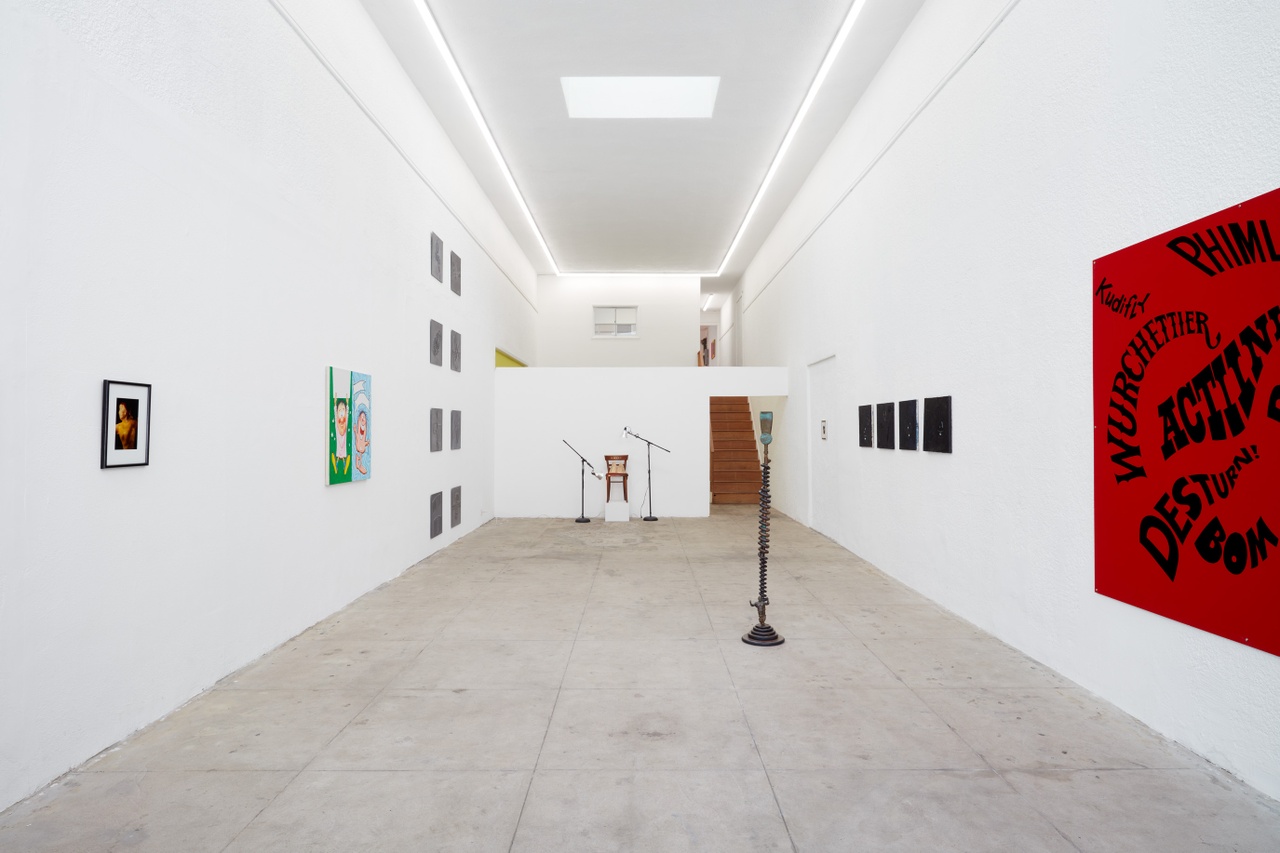
“Nature Morte 1982–1988,” Ehrlich Steinberg, Los Angeles, 2026
In 1982 artists Alan Belcher and Peter Nagy opened Nature Morte, an alternative gallery in the East Village neighborhood of Manhattan. The two first met at their day job at Betatron, a small short-lived graphics studio on West 57th Street, doing magazine layout during the pre-digital era of paste-ups and mechanicals, when the profession of editorial design still largely consisted of hand-crafted processes involving chemicals, darkrooms, and sharp blades. The duo’s No Wave analog ingenuity was an instrumental aspect of the gallery’s larger presence, as evidenced by the promotional ephemera now on display in Los Angeles, where Ehrlich Steinberg recently dedicated an exhibition to Nature Morte.
Nagy and Belcher’s background in scrappy analog typography and interest in progressive graphic communication and advertising was also reflected in their choice of artists. The work they showed at Nature Morte was disparate, [1] but like much of what was being made just after the heyday of the Pictures Generation, it explored the growing awareness of art as a commodity. The gallery, at 204 East Tenth Street, was a 20-minute walk away from Soho stalwarts Mary Boone, Leo Castelli, Tony Shafrazi, and Sonnabend, which provided fodder for critique, as they showed mostly Neo-Expressionism, Neo-Geo, and Street Art by the likes of Julian Schnabel, Jeff Koons, and Keith Haring. These more established galleries, with their aggressive commercialization and formulation of a speculative market, helped birth the art market we have now. Within the context of an arms race, the neoliberal exuberance of the conservative Reagan era was shadowed by the looming threat of nuclear annihilation, leading to a potent mix of posthuman, capitalist, and social critique. As of 1981, upper-tier tax cuts and corporate deregulation were in place, enriching the US economic elite. By 1984, high-volume electronic trading was underway, systematizing the potential for the technologically enhanced avalanche that caused 1987s Black Monday, one of the largest stock market crashes in history. If this wasn’t enough, the gentrification that the many artist-run galleries in New York unwittingly participated in finally caught up with them, causing rents to rise out of reach. Nature Morte was contemporaneous with these political and economic developments, opening in 1982, and closing its doors in 1988.
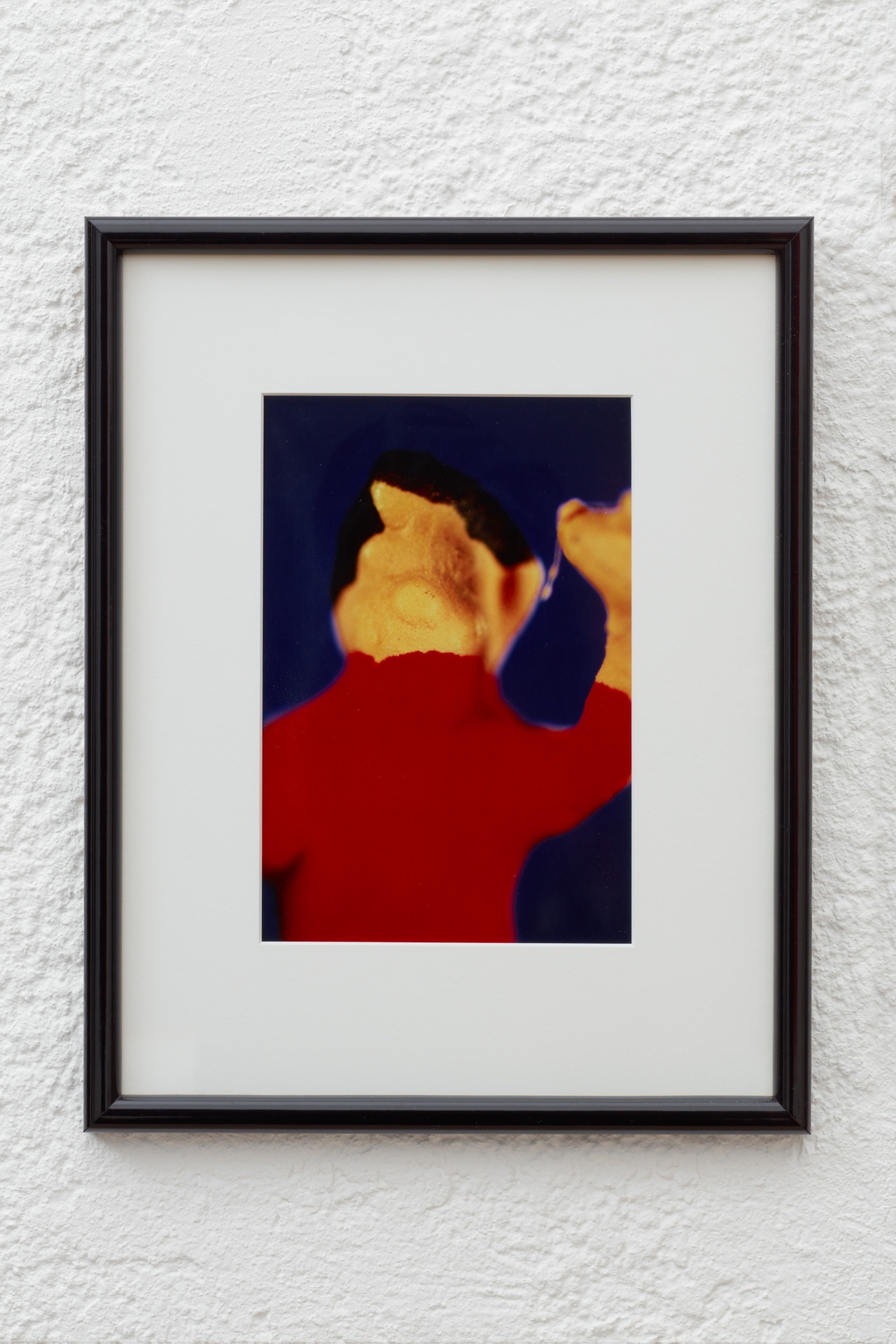
Allan McCollum and Laurie Simmons, “Actual Photo,” 1985
The show at Ehrlich Steinberg acts as a kind of contextual time machine, with the scale and character of the works regularly being presented at the present-day host gallery rhyming with those of the now-defunct New York space. During a bloated stretch in the art and financial markets reminiscent of that of the 1980s, the Los Angeles art scene of the last decade has seen an era of rampant expansion, with multiple international and New York–based galleries opening alongside homegrown upstarts, many of which have since closed. There is also a timely repeat in the scale of technological change experienced in both eras; today, we find ourselves in the midst of a seismic transformation with the proliferation of artificial intelligence, while the 1980s sat on the precipice of the digital age. With the riptide of various markets growing ever stronger, and the contagion of ultra-conservative politics, “Nature Morte 1982–1988” offers a model for art’s navigation of a troubled mainstream.
In hindsight, the early 1980s was a moment of clarity. The “greed is good” ethos of the yuppie movement made for an easy target, and the sign of the times – capitalism’s grift – was visible on the surface of things. The critiques of these East Village crusaders (artists and dealers associated with Nature Morte, Cable Gallery, Cash/Newhouse, and Vox Populi, among many others) often interjected themselves formally into the pre-existing matrices of capitalized interfaces outside of art to shed light on those within – and vice versa. Decades earlier, and despite many philosophical differences, the Frankfurt School had laid a foundation for the ideas of the late-1970s French theory takeover (Gilles Deleuze, Jean Baudrillard, Roland Barthes) – in which the fallout of late capitalism and evolving technologies transform reality into a system of signs, simulations, and desires – to then become synthesized in New York.
Within the sphere of this French poststructuralist moment, and first shown at Nature Morte in 1985, the photographic collaboration between Allan McCollum and Laurie Simmons titled Actual Photo (1985) is an exploration of replicative disfiguration. The Ehrlich Steinberg show includes three examples from the series, all depictions of busts with features that are either missing altogether or just hinted at with grotesquely malformed bumps and twists. The objects captured by the camera are not people at all, but rather commercial micro-scale plastic models: physical records of inhibited sculptural figuration, where gross material limitations overtake even the most dexterous attempts at likeness. These visages are further abstracted by their method of fabrication; the molds from which these casts are made degrade due to high-volume production causing generational loss. The family-portrait-sized matted and framed photographs that present them are silver dye bleach prints, a then-elite process known for its color intensity and extreme sharpness, often used for advertising and display but here employed to further invoke the uncanny through extreme proximity to an unknowable subject.
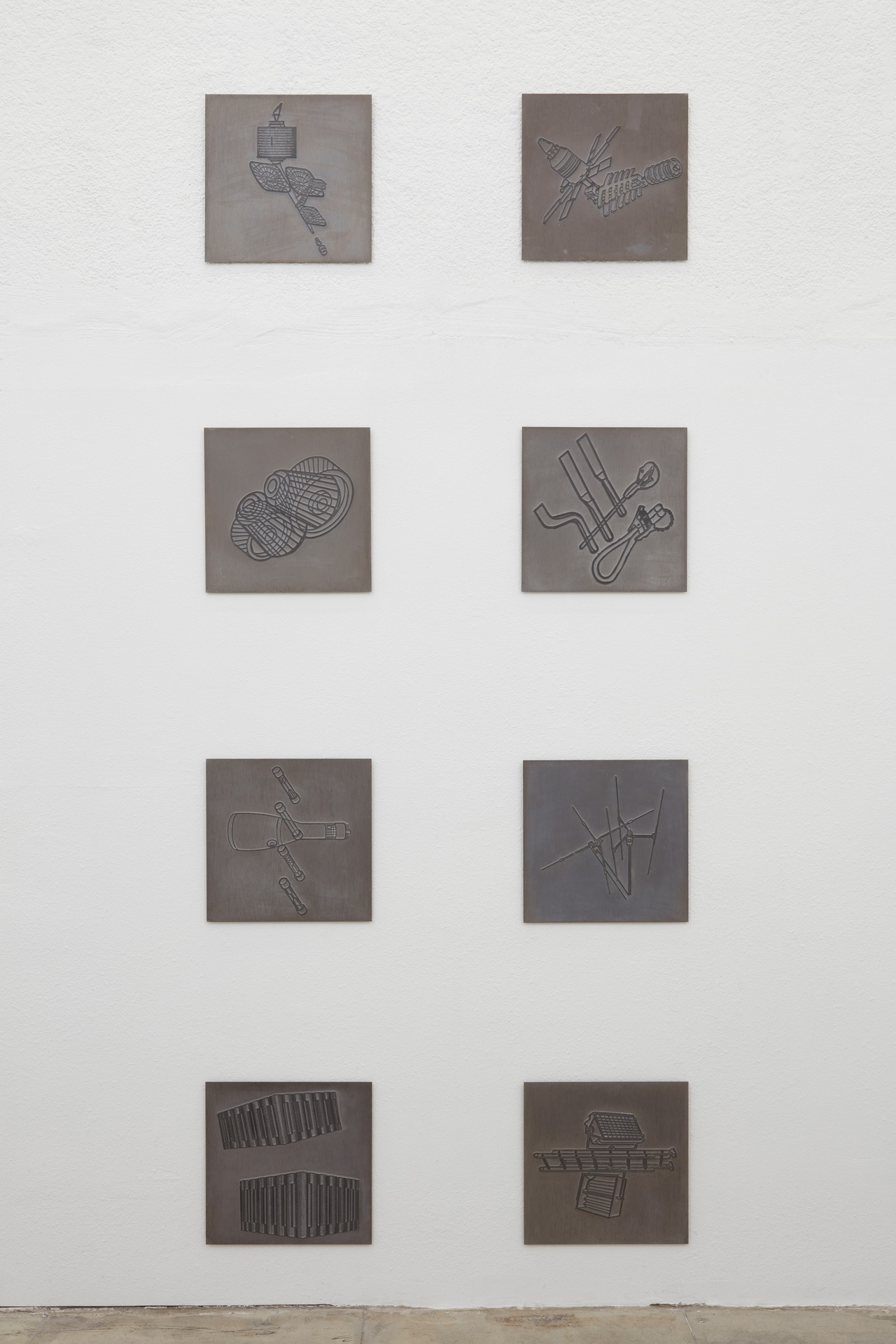
Peter Nagy, “Industrial Culture,” 1987
McCollum and Simmons’s Actual Photo also conjured nucleomituphobia, the era’s new anxiety disorder, by evoking the mangling effects of the incinerating wave of a nuclear blast, while Joel Otterson’s Euro-Chic (1986) subtly invoked the artifacts of the aftermath of such an annihilation. The latter work, a lean upright metallic totem, started with Otterson discovering a detergent bottle that had washed up on a beach in Italy, manifesting for him a dystopian talisman. Reproduced in bronze, it now sits atop an assemblage that mixes found and cast metal objects – in brass, copper, bronze, and iron – to make a closed circuit of formal and cultural associations. An intestinal spiral of plumbing pipe rife with knuckles connects the detergent bottle with the muscular torso of an action figure that rises like a genie from its end. The totality rests on a hierarchically stacked ziggurat of cast-iron free weights that rounds out the allusions to an absent body. Along with the variously worked evenly patinaed metals – cast, chased, welded, and coupled – a text of industrial signatures marks this new relic: inscriptions on the weights, the sleeved fittings of the pipes, the geometric ball of yarn molded into the detergent bottle, and the stiff features of the action figure come off as infrastructural hieroglyphs, perhaps meant to be decoded by some future viewer.
Peter Nagy is represented by a multi-part wall work, Industrial Culture (1987), comprised of eight acid-etched magnesium plates, climbing the wall in rows of two. Technical drawings of mostly indecipherable industrial objects jut from their deeply engraved surfaces. They combine arms-race pragmatics with Dada machine eroticism and promote the intermediary technology of analog image production as a primary object. One makes out what might be antennae, auto parts, hand tools, industrial lamps, and ladders, etc. reconfigured and grouped in ways that create hybrid satellites of information and display. The harsh clinical style of the technical drawings and the industrial production technique equalize the subject matter and subjugate it to the presence of the image, allowing it to float as a pure fantasy of post-human technology.
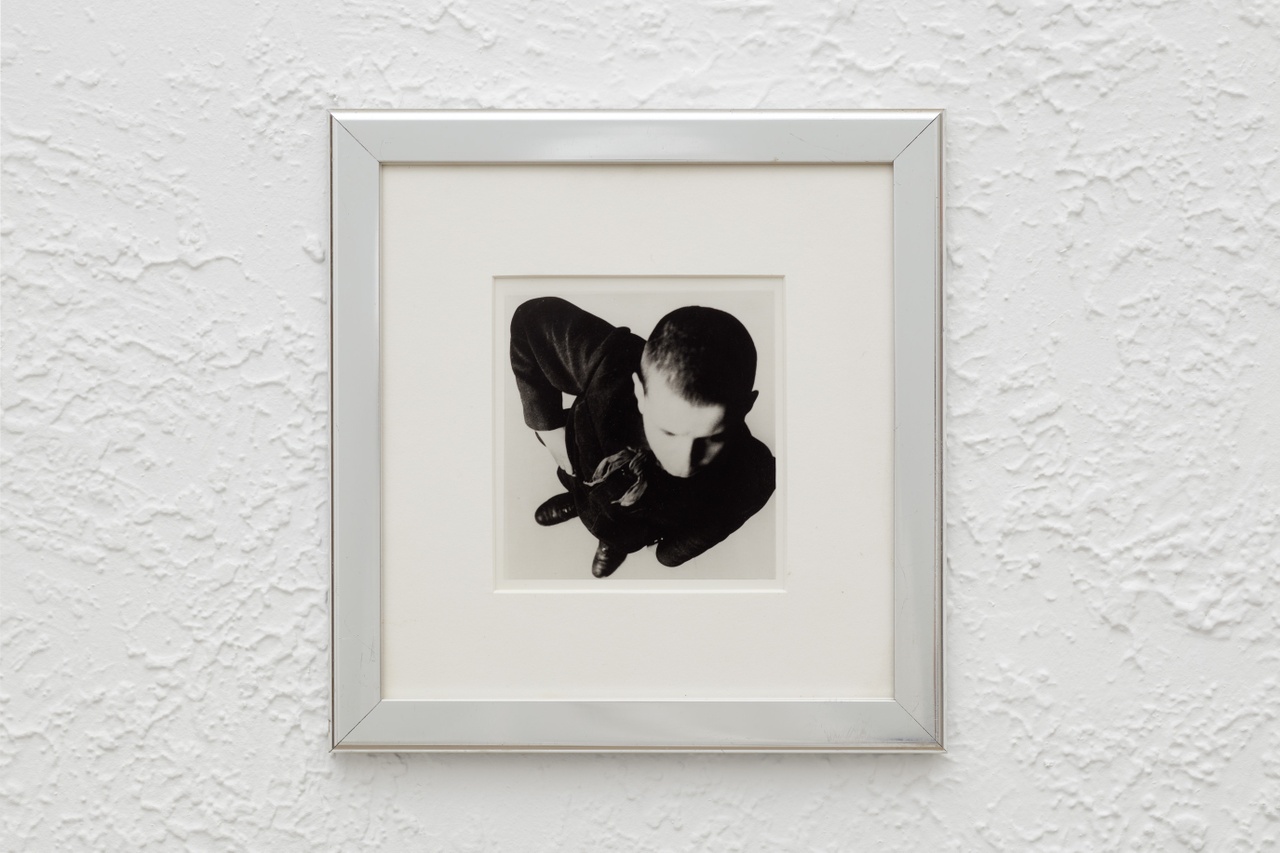
Sherrie Levine, “After Rodchenko: 3,” 1985
Bridging the Pictures Generation with the East Village scene and beyond, artist Sherrie Levine’s After Rodchenko: 3 (1985) takes the groundbreaking mechanized vision inherent to the Russian constructivist’s 1924 original and compounds it with her signature invisible labor, the re-photographing of a book illustration – itself already a copy of a copy. Cultural value is added by updating the iconic works originative existence to join the contemporary state of accelerated, ever-present reproduction, delineating the new perimeter of the replicant. Levine’s artworks of the time importantly functioned with a kind of invisibility; they were recontextualizing interventions, sociopolitical interjections within the set circuits of art.
US government guidelines limiting television marketing and mandating educational programming were removed in 1984, allowing the free market to creep further into viewer’s leisure time – and Gretchen Bender’s TV Text & Image (SELF-CENSORSHIP) (1986) registers this shift: An institutional monitor displays the continuous present of broadcast television, while vinyl lettering stuck to its screen spells out the parenthetical phrase of the title. The opaque black shapes contrast with the dynamism of commercial television, exaggerating its twitchy movements and bright colors, throwing the system into high relief. Bender’s piece reminds us that even by passively participating in this media paradigm we are implicated in acts of self-censorship. Shadowed by a corporate agenda, every image that comes on the screen is suspect and can no longer be taken at face value. The microcosm of the then-new media landscape reflects onto the art world completing the circuit of this structural metaphor, the words that modify our vision letting neither rest. [2]
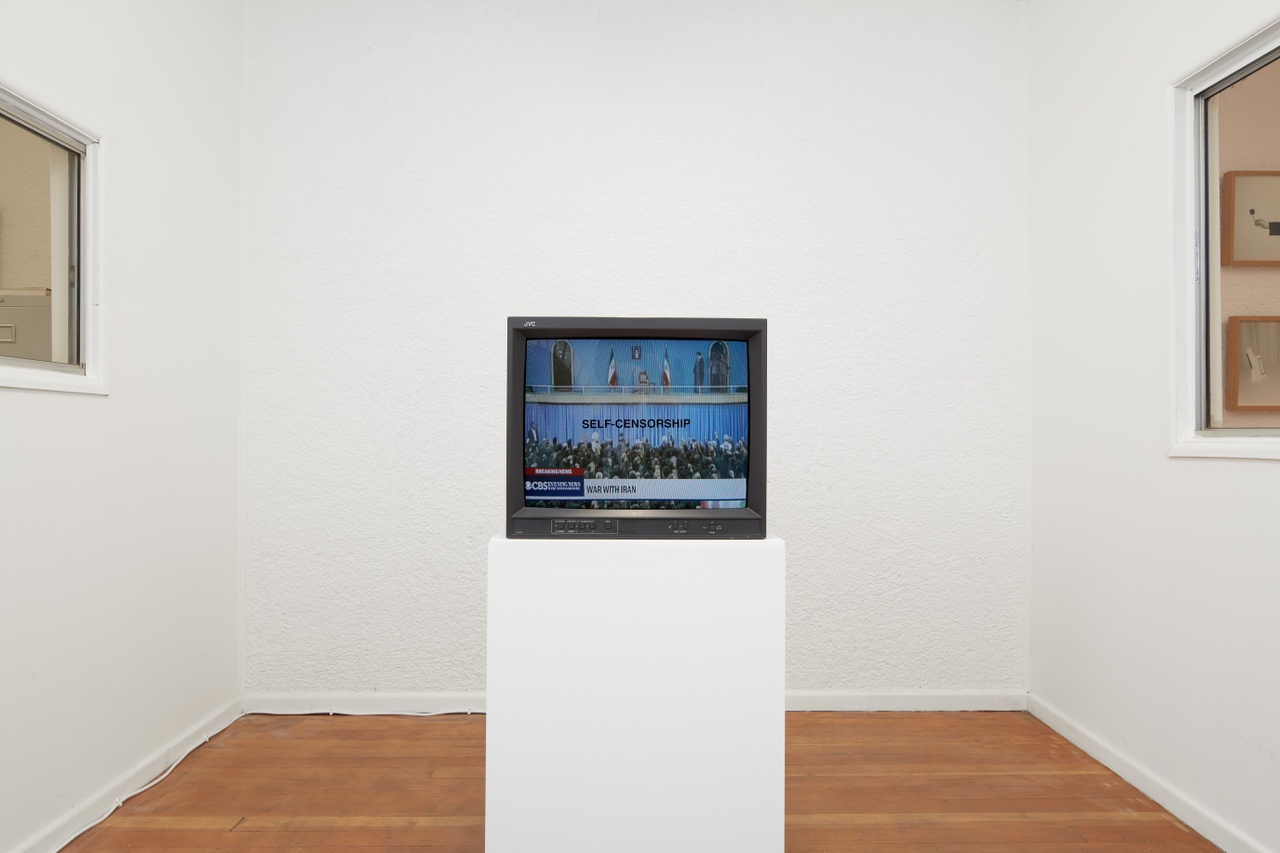
Gretchen Bender “TV Text & Image (SELF-CENSORSHIP),” 1986
Louise Lawler’s installation Interesting, which filled all 190 square feet of Nature Morte in 1985, the last time it was seen, is the centerpiece of the Ehrlich Steinberg show. Taking aim at the state of the art world around it, the work’s corporate-inspired supergraphics envelop its surroundings in the always-overdetermined color chartreuse. Hovering around a fable moralizing the pitfalls of greed, [3] three brightly colored framed photographs hung on one of two large diagonal bands of the key color. These images all displayed the same toy, an angry-looking Japanese hybrid weapon/dinosaur, the Gaiking Bazoler. Accessorizing itself through multiplicity, this die-cast beast is featured in three positions against three different color backgrounds: red, green, and blue. Angry, sharp, and dangerous looking, the toy was meant to spoof the increasingly commodified, mostly paint-based art of 1980s New York and referenced both the accessorization of successful movements through mimicry and repetition, and the fierce competition in the overloaded gallery system amid the booming economy. This prickly little robot seems ready to explode this compromised system from the inside out. Spelled out on an adjacent wall is the word “Interesting,” with “interest” knocked out of one of the diagonal graphic bands – referring to the return on an investment – while the striated “ing” is graphically extended onto the white of the gallery wall. The whole word could be seen as an evaluation delivering a death knell of judgement to the artwork, or even the art world, a seemingly innocuous dismissal that is anything but. Both back in New York and now here in Los Angeles, the resulting hyped, businesslike feel of Lawler’s installation syncs with the gentrification that once transformed Nature Morte’s New York neighborhood – and that has given rise to the LA gallery district that is home to Ehrlich Steinberg.
With all the ire directed at the archetypal opposition between art and finance, there are universal similarities in the way both function that might be helpful to keep in mind. In Artforum in 1989, Kate Linker wrote regarding Lawler’s installation: “the point is not simply that the artwork is transferrable, like currency, but that its valuation (or, in contrast, its devaluation) depends upon the same absence of a fixed referent that leads to the uncontrollable iteration of its meaning.” [4]
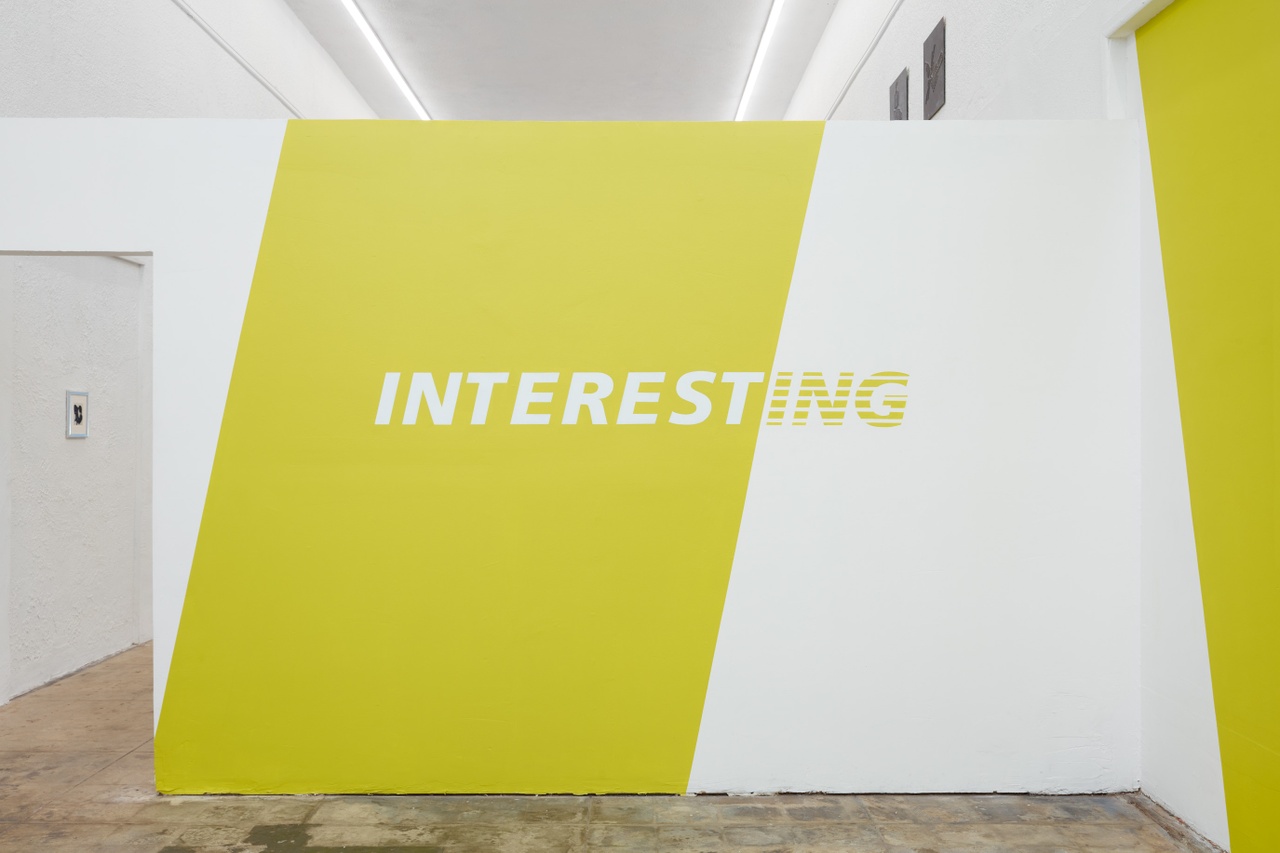
Louise Lawler, “Interesting,” 1985
Lately, the importance of symbolic value in an artwork, its uncontrollable iteration through meaning, has been diminishing in relation to financial value, which prior to 2024 had been rocketing to unprecedented heights. This is the biggest loss, the imbalance of virtue and value. Both art and finance are endemic to humanity’s long evolution, and the dynamics they are subject to are unavoidable, but with the current state of extreme wealth disparity, the chances of critical voices being heard seems to be growing further out of reach while the importance of these voices increases exponentially. To look back and see such a productively antagonistic symbiosis, to see so many artists processing their reactions to capitalism’s creep, and to so many other pressing socio-ideological issues, through such pointed work leaves me feeling utterly nostalgic and more than a little jealous that time machines don’t yet exist. Of course, if they did, and we travelled to the future, we might find the agency of every person has been terminally diminished and look back to our own time with even more nostalgia, or melancholy, or regret, or whatever AI’s natural language generation is calling the formerly human feeling at that point.
“Nature Morte 1982–1988,” Ehrlich Steinberg, Los Angeles, February 24–April 18, 2026.
Paul Sietsema is an artist living in Los Angeles.
Image credit: Courtesy of Ehrlich Steinberg and the artists, photos Evan Walsh
Notes
| [1] | As was the show at Ehrlich Steinberg: In addition to Belcher’s and Nagy’s own output, it featured works by Gretchen Bender, Jennifer Bolande, Louise Lawler, Kevin Larmon, Sherrie Levine, Ken Lum, Allan McCollum, Richard Milani, Joseph Nechvatal, Joel Otterson, Steven Parrino, Richard Pettibone, David Robbins, Laurie Simmons, Not Vital, and Julia Wachtel. |
| [2] | Today’s equivalent of this critical occlusion would be placing text across the screen of a smartphone and viewing a social media feed through the static phrase. Television’s colonization of attention in the 1980s prefigured the phone’s monopolization of it now. |
| [3] | Rendered in red press-type applied directly to the chartreuse wall, the fable reads: “In time past was a dog that went over a bridge, and held in his mouth a piece of meat, and as he passed over the bridge, he perceived and saw the shadow of himself and of his piece of meat within the water. And he, thinking that it was another piece of meat, forthwith thought to take it. And as he opened his mouth, the piece of meat fell into the water, and thus he lost it. He that desires to have another man’s good often loses his own.” (Aesop, “The Dog and His Shadow,” translation adopted from William Caxton, 1484) |
| [4] | Kate Linker, “Rites of Exchange,” Artforum 25, no. 3 (1989). |