

BLACK ANONYM: ON THE DREAM AND CURSE OF BEING WITHOUT A NAME by Rizvana Bradley
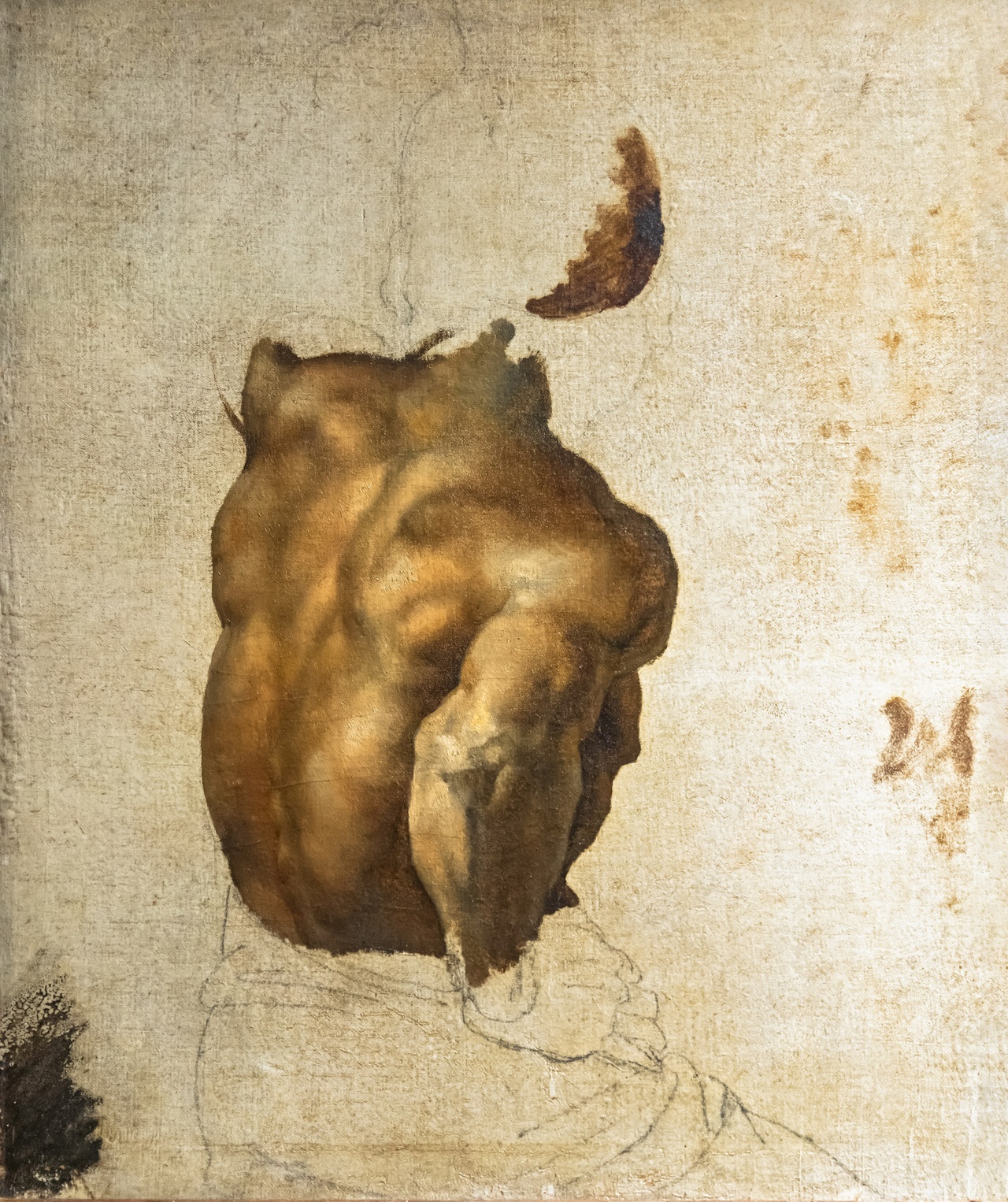
Théodore Géricault, “Étude de dos pour Le Radeau de la Méduse,” 1819
When Frantz Fanon exclaimed, “all I want is to be anonymous,” he confronted us with an unrealizable “desire to go unrecognized by a misrecognition.” [1] Blackness calls for thinking anonymity without recourse to either affirmation or lamentation. The ineluctable absence of a proper name can neither be simply refused nor simply reclaimed.
In Anteaesthetics: Black Aesthesis and the Critique of Form (2023), I trace the paradoxical predicament of blackness, which is constitutively barred from aesthetic modernity yet relentlessly called before its “racial regime of representation.” [2] The book endeavors to think about the figure of the black beyond the grammars of representation, as a projection without a real referent, which can nevertheless be put to aesthetic use. Without a place or term in modernity’s organization of “being-in-the-world,” [3] blackness is made to appear, as dissimulation. By dissimulation, we mean that nomination and appearance conspire to fashion “the formless into a figure.” [4]
The excerpt below, which is only a glimpse into a more extended exposition of these propositions in the second chapter of Anteaesthetics, “The Corporeal Division of the World, or Aesthetic Ruination,” approaches the stakes of black anonymity by closely attending to Théodore Géricault’s Study for the Signaling Black (1819) and the interpretations of this study that have found a prominent place within the annals of art history. Of particular importance is a reading that analogizes the signaling African to that art historical paragon of classical antiquity, the Belvedere Torso (mid-first century BCE). At stake in this interpretive maneuver, which transposes the ideal body of classical antiquity onto the fragmented “black body,” is not only that a dissimulation of blackness is instrumentalized in service of the aesthetic recuperation and revitalization of the European social body and human community from which blackness is expelled. [5] No less crucial is that the means of this instrumentalization require the phenomenological reduction of black flesh to bodily fragment – a fragment, however, that cannot help but bear an irreducible exorbitance. This fragment thereby threatens to contaminate the purity of the aesthetic form that would contain it.
The question of whether the model for the esquisse (initial sketch) with which the following excerpt from Anteaesthetics is concerned – namely the oil study for Géricault’s The Raft of the Medusa (1819), variously referred to as the Montauban study, the Study for the Signaling Black, or African Signaling – was or was not the historical figure known as “Joseph” (said to be a dark-skinned man hailing from Saint-Domingue, coveted by the painterly milieus of 1840s Paris), [6] has little bearing on the matter of anonymity. To make this declaration is by no means to downplay the extent or significance of anonymous black models in European art history during the early modern and modern periods, or the violence to which they were subjected. Indeed, it is safe to say that the vast majority of black models during this span of European art history remain unknown to us. Rather, I am suggesting that the deeper lesson of the uses to which “Joseph” has been put is that anonymity – to be both overnamed and nameless, to be recognized all too much and not at all – is an inevitable condition for the black in the modern world.
Every name the black is given marks an aporia. The dissimulative character of this figure’s appearance has everything to do with how he can be put to work in service of modernity’s aesthetic imagination. And yet the black figure bears a dehiscence – a cut or wounding in the order of appearance – a tearing that the aesthetic ceaselessly serves and perennially fails to suture.
Although this excerpt can only gesture to the theoretical concerns of the larger study of which it is an integral part, the stakes of this inquiry are just as pronounced in the 21st century as they might have been in the 19th. At stake is nothing less than an interrogation of the aesthetic foundations of the political and ethical grammars that delimit every horizon of possibility. At stake is the very thinkability of a world that would be saved, mourned, or overturned. As critical artistic and scholarly practices are increasingly throwing the abstraction we call the “world” into question, we must return to an inquiry that is woven through every page of Anteaesthetics: What kind of world, with its litany of names for the good, the true, and the beautiful, rests upon a foundation of black anonymity? And can we even begin to ask how such a world might be toppled without first attending to the nameless name upon which it has been erected?
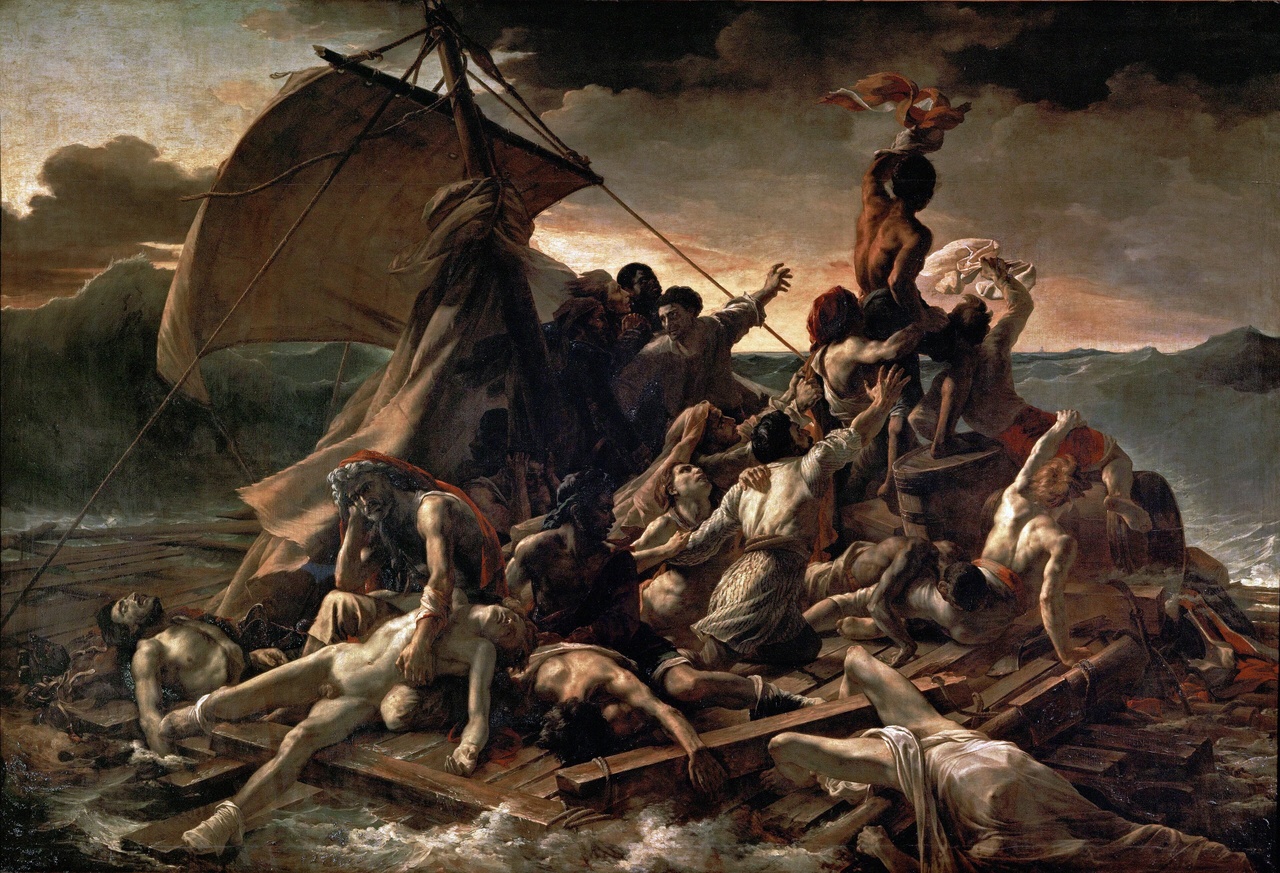
Théodore Géricault, “Le Radeau de la Méduse,” 1818–1819
Let us begin our foray into the nineteenth century with Théodore Géricault’s The Raft of the Medusa (1819) and the oil study referred to as the Montauban study, the Study for the Signaling Black, or African Signaling (1819). The Raft of the Medusa is widely regarded as the most ambitious work of an artist who was not only one of the most influential among the early painters of French Romanticism but whose oeuvre granted the figure of the black a unique importance. David Bindman and Henry Louis Gates Jr.’s The Image of the Black in Western Art goes so far as to declare that “in the work of no European artist of equivalent standing do blacks have greater prominence.” [7] The Raft of the Medusa, completed in 1819, depicts the notoriously catastrophic voyage of La Méduse, which set sail for Senegal in 1816 as part of the effort to recover France’s colonial ambitions in the wake of the Napoleonic Wars and the fall of the First Empire, during which most of what remained of its colonial territories had been lost. The story of the Medusa’s journey, which famously ended in shipwreck, its crew progressively overtaken by the ravages of murder, suicide, illness, starvation, and cannibalism, comes to us first through the narrative of Alexandre Corréard and Jean-Baptiste-Henri Savigny, who were among the survivors [8] […].
To fully attune to the aesthetic significance of [the figure of the signaling African], we must follow him from his provisional emergence in Géricault’s Study for the Signaling Black through to his final incorporation in Raft of the Medusa […]. One of many preparatory sketches and studies for Raft of the Medusa, the Montauban oil study’s relation to the final painting and the critical responses to each introduce a set of aesthetic problematics germane to an inquiry into the part played by blackness in the making, structuration, and unmaking of the corporeal division of the world […]. At stake is a complex process of aesthetic mediality, incorporation, and expulsion that subtends the transit of a black figure who, for both Géricault and those who read him, assumes a singular importance in the realization of Raft of the Medusa. In this figure’s passage from his initial, provisional studies to the final work, he is rendered the symbolic pinnacle and aesthetic linchpin, without which, we conjecture, Raft of the Medusa could not have attained its canonical status within the history of French Romantic painting […].
What do we make of the fact that Géricault’s figuration of the signaling African as the epitome of masculine heroism takes place at precisely the moment when the figure of “the revolutionary hero” is being representationally displaced by “the postrevolutionary sensualized nude”? [9] This alludes to a complex (un)gendering, which I interrogate more fully in the third chapter of Anteaesthetics, tracing the nineteenth-century rise of the sensualized female nude back through the racially gendered anteriority of black flesh and drawing out its implications for both the codification and contamination of the corporeal division of the world […].
The approximation of Géricault’s study of the African to sculpture [namely the Belvedere Torso (mid-first century BCE)], which in turn facilitates the transposition of the black onto the abstract universality of the human figure, is not merely an operation which depends upon a Eurocentric presumption of the classical nude as universal humanity’s exemplary model. More crucially for my argument, it is an operation which requires the black figure to become the (inter)mediality between painting and sculpture, just as he must become the mediator between irredeemable dereliction and exalted universality. In each instance of black mediality, he must be made malleable as clay, yet petrified as stone.
“Petrification” is a crucial concept for Frantz Fanon, introduced in the first two chapters of The Wretched of the Earth. [10] As David Marriott reads him, petrification (the etymology of which suggests being turned into stone) theorizes how “the imposition of colonial culture not only produces a certain style of embodiment (petrified, rigidified, inanimate, ankylotic), but to the extent to which all aspects of colonial culture have become racialized, the colonial body mimes or act outs various rigidities as the continuous message of its own subjugation.” Under the psychosocial economy of colonialism, “the racialized body […] [becomes] a series of discontinuous but arrested signs (of affect, movement, motility, musculature, aggression and passivity).” [11] In the theoretical language of Anteaesthetics, we could say that Fanon and Marriott direct our attention to the violently dissimulated ‘black body,’ cut and splayed. Each discontinuous fragment produced through this rend(er)ing becomes of semiotic, libidinal, and material use to the racial regime of aesthetics, even as none can refer back to either the metaphysical conceits of the human and his (social) body or to the enfleshed, antemetaphysics of black existence.
Linda Nochlin has taken Géricault’s bodies (in pieces) as exemplary of “the fragment as a metaphor for modernity,” wherein the fragment becomes the figurative expression of a loss of wholeness or totality in the face of the disintegrative force of modern experience, even as “paradoxically, or dialectically,” aesthetic modernity is equally marked by what would appear to be “its opposite”: “the will to totalization.” [12] […] At issue is not simply the sketched contours of the African body but more precisely what that body’s incompletion holds out for Géricault’s oeuvre – the radical contingency of history’s epic, transcendental narrative, which is disaggregated by this body’s immanence to the interminable upheavals of the slave trade, la traite […].
Irrespective of the idiosyncratic question of whether Géricault’s oil study relied upon the black model known as Joseph, one must not underestimate the enduring influence of the Haitian revolution upon the nineteenth-century European aesthetic imagination, whether or not that influence was explicitly acknowledged or even consciously recognized. For a general insurrection of the enslaved, as Michel-Rolph Trouillot has argued, constituted “an unthinkable history.” [13] The revenant “of the great upheaval hovered over […] [even] antislavery debates like a bloodstained ghost.” [14] […]. The historic voyage depicted in Raft of the Medusa, which marked France’s effort to reclaim its former colonial territory in Senegal following the Treaties of Paris (1814–1815) and the end of the Napoleonic Wars, must be situated in terms of France’s broader post-Revolutionary colonialist ambitions in Africa and their relationship to the Haitian Revolution. [15] […] Perhaps even more portentous than the discrete losses which shadowed the European imagination in the wake of the Haitian Revolution was the persistence of threat – a threat which the Haitian Revolution did not so much inaugurate as amplify, a threat which was (and remains) existential, immanent, and utterly opaque […].
Throughout Anteaesthetics, I stress that the singular threat posed by blackness is that of metaphysical ruination, a menace which is perennial rather than contingent, even as the vicissitudes of history may occasion and distill its convulsive disclosures […]. The signaling African becomes the mechanism for […] the metaphysical specter of slave revolution threatened to leave in ruins. Yet the immanent peril of ruination is never quite shaken. […] What is distinctive about [the analogical reading of the Montauban study] […] is not [the] instrumentalization of the figure of the signaling African toward the aesthetic reconstitution of the European social body and the universal humanity which it has always taken to be its mirror image but rather the means of his instrumentalization: the transposition of the Torso onto the African’s bodily fragment, the fleshly transmutation of paint to stone and of stone to paint, the vivisectory suture of black (inter)mediality.
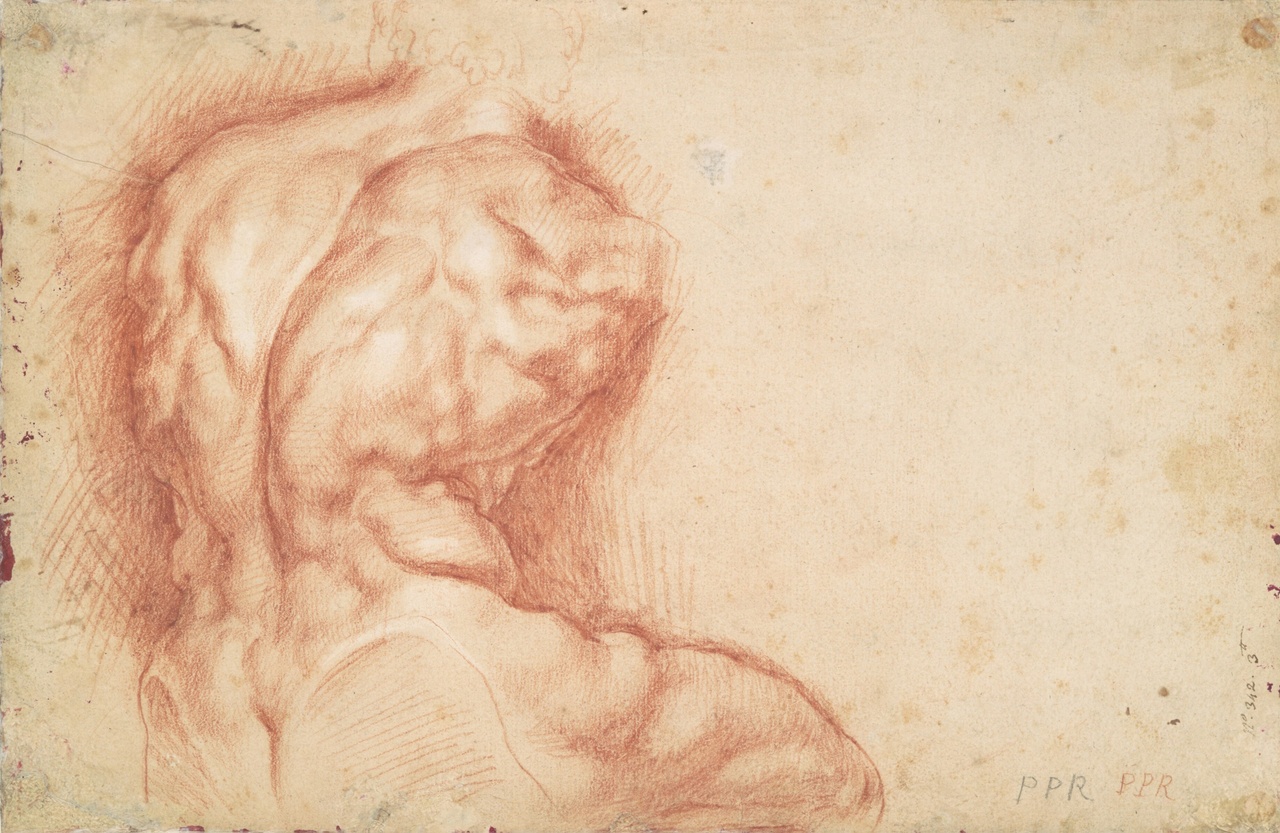
Peter Paul Rubens, “Study of the Torso Belvedere,” ca. 1601–1602
[Jacques] Rancière […] inverts the aesthetic significance of the Torso through the event of [Johann Joachim] Winckelmann’s reading, claiming that here the statue decomposes the relational correspondence of parts and whole, as well as the tether between visible form and representational content. [16] Yet even as Rancière would nominally decry the phantasmatic scavenging for, in Verity Platt’s words, “the disiecta membra of the past in order to access an ideal, animated whole in the present,” I would argue he remains invested in a “re-membering” of the Torso that establishes a general consonance with [Thomas] Crow’s reading. [17] For even as Rancière extracts from the Torso a seemingly radical contingency, the event of Winckelmann’s reading nevertheless produces an ontological map whose topological axes – history and “the people” – are not so different from those by which Géricault’s or Crow’s gazes navigate. If anything, Rancière figures the eighteenth-century life of the Torso as the inauguration of an aesthetic regime that Crow would turn to the Torso to redeem. Granted, where Crow finds the reconstitution of the social body, the redemption of the sensus communis, Rancière finds a multiplication of indeterminate social bodies, an ontological pluralization of sensus communis, which ultimately lend themselves to Rancière’s metapolitics of “dissensus” and its contests over the “distribution of the sensible.” [18] However, the dissensual incorporation of new subjects, new ideas, and new feelings into the sensus communis, which Rancière would regard as transformational, is nevertheless also the confirmation of that sensible community’s foundational interdictions. Within the racial regime of aesthetics, the black can only ever enter as the singular dereliction that cuts the border between the thinkable and unthinkable, between sense and non-sense.
A crucial argument of Anteaesthetics is that black aesthesis, as that which emerges in the abyssal cut between black existence and black nonbeing, between the dissimulated “black body” and enfleshment might become conscripted into the production or mediation of a Rancièrean aisthesis – “a thinking that modifies what is thinkable by welcoming what was unthinkable” [19] – but it can never itself be “welcomed” as the thinkable, for it is forced to bear the unassimilable, the obdurate, the irreducible, the exhaust(ion) of the world’s antiblack metaphysics. The black bodily fragment as a (dis)figurement of this cut is indeed serially made the medium for the reconstitution of the social, whether through the redemption of the old or the fabrication of the new, but only through the reproduction of its own negative sign. The black bodily fragment is a dissimulation of the absent center upon which the corporeal division of the world and its organization of (social) bodies are founded. It is a part which can neither refer to a prior or future whole nor bind or liberate the relay between its visible form and representational content, for the enfleshed existence from which it is riven is the black hole which swallows the light of representation.
Excerpted from: Rizvana Bradley, Anteaesthetics: Black Aesthesis and the Critique of Form, Stanford University Press, 2023, 406 pages. © Rizvana Bradley, all Rights Reserved.
Rizvana Bradley is an Associate Professor of Film and Media and Affiliated Faculty in the History of Art and the Program in Critical Theory at the University of California, Berkeley.
Image credit: 1. Musée du Louvre, Paris (on loan to Musée Ingres-Bourdelle, Montauban); 2. Musée du Louvre, Paris; 3. The Metropolitan Museum of Art, New York; all images public domain
Notes
| [1] | Frantz Fanon, Black Skin, White Masks, trans. Richard Philcox (Grove Press, 2008), 95–96; David Marriott, Of Effacement: Blackness and Non-Being (Stanford University Press, 2024), 27. |
| [2] | David Lloyd, Under Representation: The Racial Regime of Aesthetics (Fordham University Press, 2019). |
| [3] | See Martin Heidegger, Being and Time, trans. John Macquarrie (Basil Blackwell, 1995). |
| [4] | Yve-Alain Bois and Rosalind E. Krauss, Formless: A User’s Guide (Zone Books, 1997), 40. |
| [5] | “Throughout Anteaesthetics, I place ‘black body’ in single quotation marks in order to emphasize the specious character of the phenomenological operation both the phrase and the figuration perform.” Rizvana Bradley, Anteaesthetics: Black Aesthesis and the Critique of Form (Stanford University Press, 2023), 8. Emphasis in original. |
| [6] | See Albert Alhadeff, Théodore Géricault, Painting Black Bodies: Confrontations and Contradictions (Routledge, 2020), 165–73, for a more detailed discussion. |
| [7] | David Bindman and Henry Louis Gates Jr., eds., The Image of the Black in Western Art, vol. 4, From the American Revolution to World War I, Part 1: Slaves and Liberators (Harvard University Press, 1989), 119. |
| [8] | Alexandre Corréard and Jean-Baptiste-Henri Savigny, Narrative of a Voyage to Senegal in 1816 (Echo Library, 2007 [1817]). See Jonathan Miles, The Wreck of the Medusa: The Most Famous Sea Disaster of the Nineteenth Century (Grove Press, 2007), for a recent historical overview. |
| [9] | Carol Ockman, Ingres’s Eroticized Bodies: Retracing the Serpentine Line (Yale University Press, 1995), 4. |
| [10] | Frantz Fanon, The Wretched of the Earth, trans. Constance Farrington (Penguin Books, 1963). |
| [11] | David Marriott, “The Racialized Body,” in The Cambridge Companion to the Body in Literature, ed. David Hillman and Ulrika Maude (Cambridge University Press, 2015), 163–76, 167. |
| [12] | Linda Nochlin, The Body in Pieces: The Fragment as a Metaphor for Modernity (Thames and Hudson, 1994), 53. |
| [13] | Michel-Rolph Trouillot, Silencing the Past: Power and the Production of History (Beacon Press, 1995). |
| [14] | David Brion Davis, “The Impact of the French and Haitian Revolutions,” in The Impact of the Haitian Revolution in the Atlantic World, ed. David P. Geggus (University of South Carolina Press, 2001), 3–7, 5. |
| [15] | Darcy Grimaldo Grigsby, Extremities: Painting Empire in Post-Revolutionary France (Yale University Press, 2002). |
| [16] | Jacques Rancière, Aisthesis: Scenes from the Aesthetic Regime of Art, trans. Zakir Paul (Verso, 2013); Johann Joachim Winckelmann, The History of Ancient Art, trans. G. Henry Lodge (Boston: James R. Osgood and Company, 1880). |
| [17] | Verity Platt, “Re-membering the Belvedere Torso: Ekphrastic Restoration and the Teeth of Time,” Critical Inquiry 47, no. 1 (Autumn 2020), 49–75. |
| [18] | Jacques Rancière, Dissensus: On Politics and Aesthetics, trans. Steven Corocan (Bloomsbury Academic, 2015). |
| [19] | Rancière, Aisthesis, xi. |