
A Cage with a View Sophia Rohwetter on “Terminal Piece” at mumok, Vienna
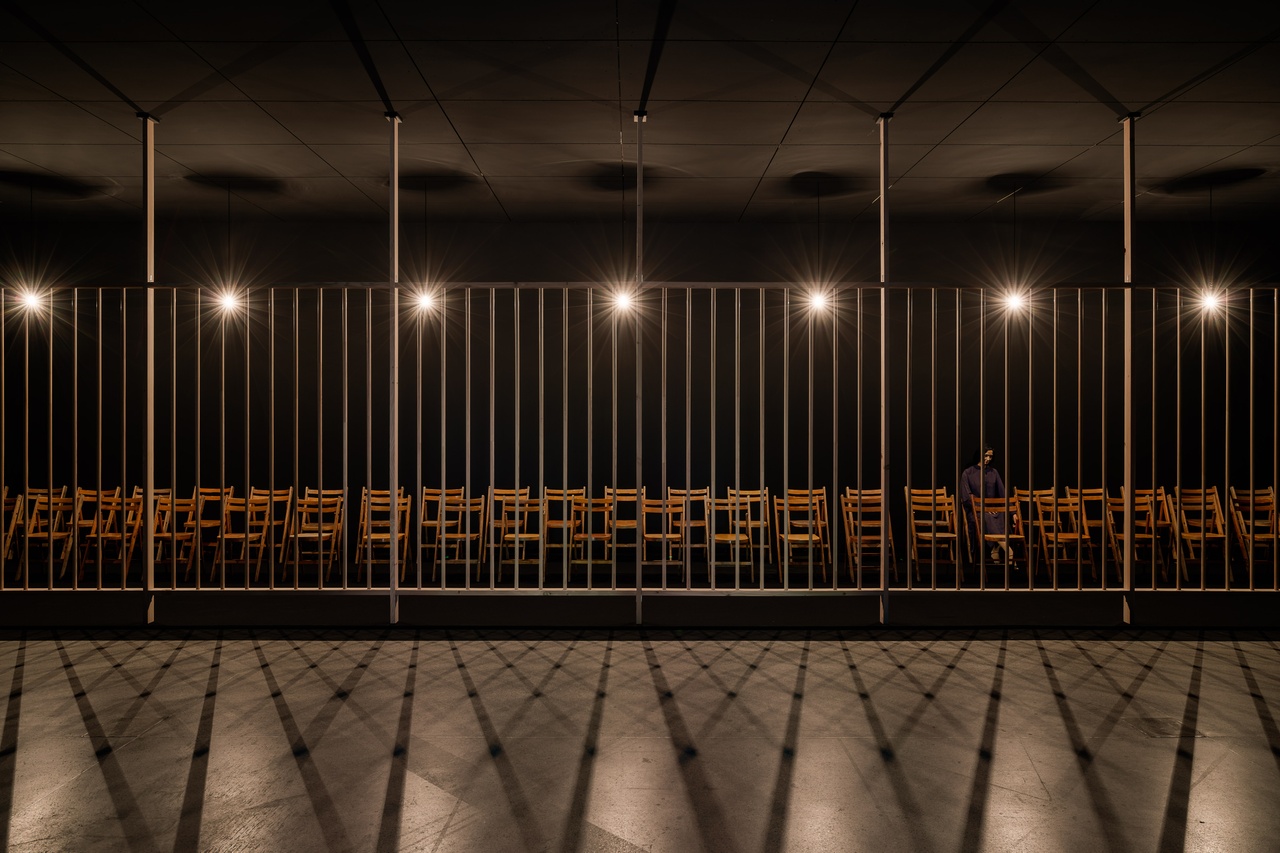
Kate Millett, “Terminal Piece,” 1972/2026
Sexual Politics, the 1970 debut book by feminist writer and artist Kate Millett, a classic of second-wave feminism, opens with a reading of Jean Genet’s The Balcony, a play set in a first-class brothel, a house of illusions where Irma, its madam, directs performances and clients act as Bishop, Judge, and General. Outside, a revolution rages, and the brothel, where roles of authority have been rehearsed, turns into a counter-revolutionary cell. According to Millett, these three characters, representing the institutions of the church, the judiciary and the military, form a social cage, itself nested inside the “cage of sex.” [1] Sexuality, so the shared thesis of both writers, is “the nuclear model of all the more elaborate social constructs growing out of it, […] the very prototype of institutionalized inequality.” [2]
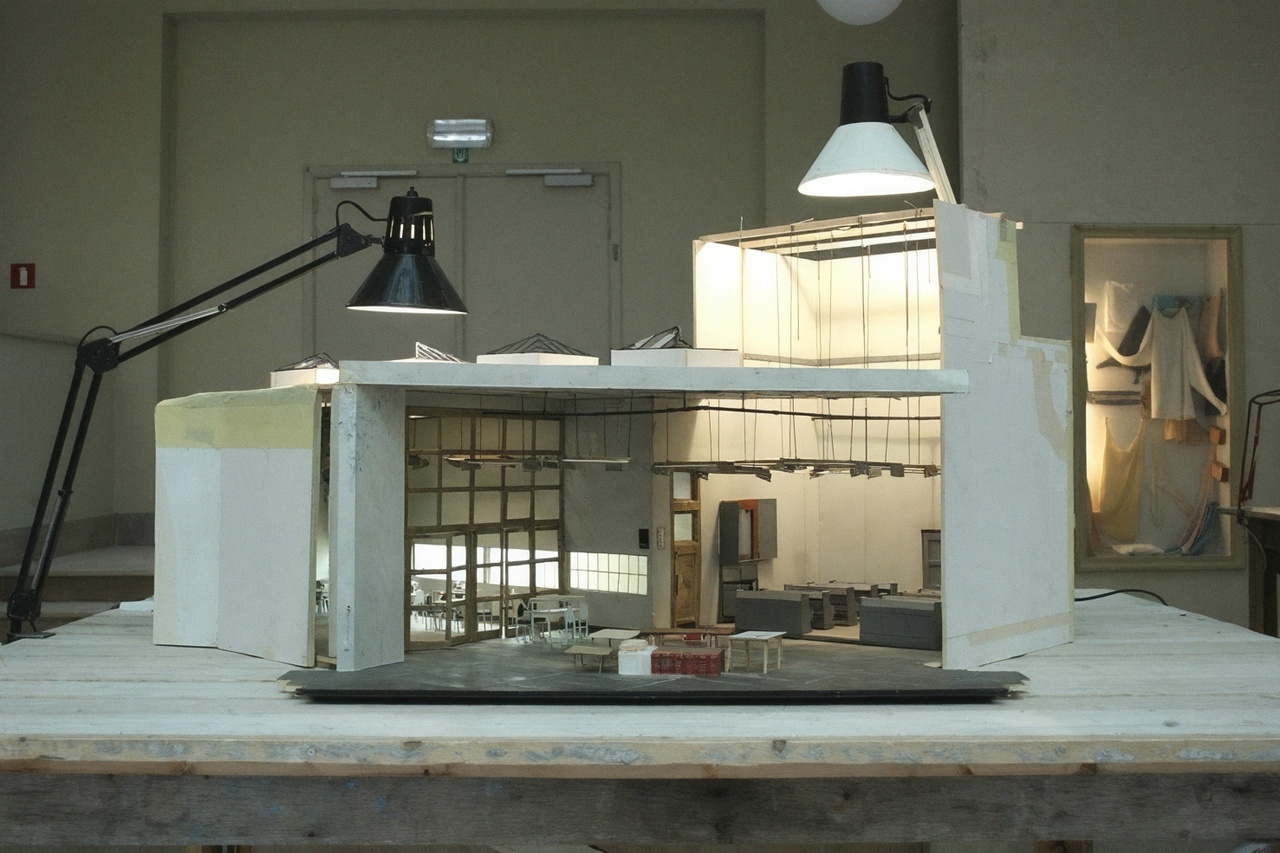
Anna Viehbrock, “Stage Design for Doktor Faust,” 2003
As an artist, Millett built cages herself, trapping objects and mannequins inside barred structures. In her 1979 book The Basement, Millett wrote that she had sculpted these “because of you,” each cage “an oblique retelling of your story,” [3] addressing Sylvia Likens, a 16-year-old girl who was tortured and murdered in 1965 by her foster mother and by the woman’s own children and their neighborhood friends and had the words “I’M A PROSTITUTE AND PROUD OF IT” carved onto her stomach before she was killed. One such cage, Millett’s 1972 Terminal Piece, is the central work in the exhibition at mumok of the same name, which features about 400 works, mostly drawn from the museum’s collection and paired with loans and new commissions. Together with Tolia Astakhishvili’s exhibition “Figure of the Child,” it opens mumok’s program under the museum’s new director, Fatima Hellberg.
Millett’s Terminal Piece, the museum’s first acquisition during Hellberg’s tenure, is a wall of wooden bars dividing a room in two. On one side, the viewer stands in the dark; on the other, a female mannequin, with long black hair, dressed in a loose navy-blue dress reminiscent of a hospital or prison gown, sits among some 40 folding chairs arranged in two rows and dimly lit by bare light bulbs. The exhibition centers Millett’s piece not as a lead into a history of 1970s feminist art but as a cue to reconsider the institution of the museum through theater and its direction of the gaze, with the cage as both stage and auditorium, and the doll both actor and viewer in some silent play on institutional violence and physical enclosures. This is where the curation places its emphasis throughout: on the immediate experience of looking rather than on an art historical narrative, a wager set against mumok’s own recent historicizing display of its collection.
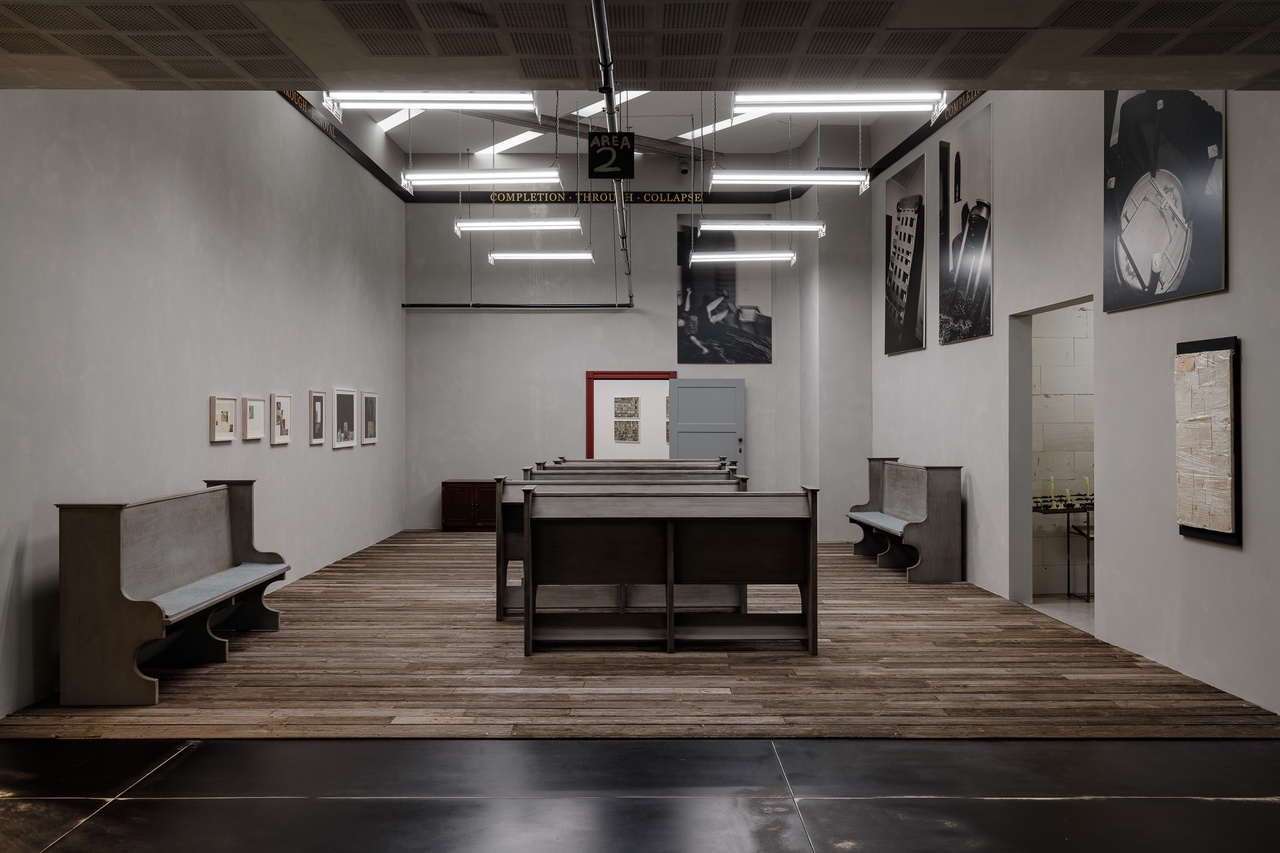
“Terminal Piece,” mumok, Vienna, 2026-2027
The drama unfolds across five acts cutting down through mumok’s monolithic basalt cube, from Act 1 (featuring Millett’s work) on the fourth floor to Act 4 on the second basement level, preceded by a Prologue on the ground floor. Introducing the idea of the museum as theatre, the Prologue stages works from the collection in an immersive scenography by Anna Viebrock that subdivides the large white cube into different domestic chambers of illusion. These are partly based on Viebrock’s stage design for a production of Ferruccio Busoni’s unfinished opera Doktor Faust, a model of which is also on view. Reframed as an exhibition display, the stage design is removed from its theatrical context, just as the works are removed from theirs and recast as props. Viebrock thus assumes curatorial authorship over the collection, while elements from her other stage settings – among them a copy of a door from Brussels’ Palace of Justice – are presented as artworks in their own right. As a dominating third figure in addition to the curator and the artist, the scenographer thus collapses the distinction between the two others. This slippage casts the museum, not unlike Genet’s brothel, into a set for a role-play, where, in the Prologue, the spectator-cum-actor first rehearses the exhibition’s main thesis, derived from Millett’s cage: that the act of looking incriminates the viewing subject in whatever scene or image of violence she witnesses.
One enters Viebrock’s staging through the “Study” (as it’s designated in the Prologue’s booklet), a reconstruction of the setting where Faust signs his pact with the devil. The room is furnished with a desk, and on it, a prop lamp and an untitled black-lacquered wooden cube by Sol LeWitt from 1963, which contains small photographic portraits of a woman set deep in square recesses on three of its sides. The cube, with a woman’s image captured inside, subtly anticipates Millett’s cage upstairs and, read through Sexual Politics, turns the basic unit of the cube into the cage of sex, the primal structure of enclosure. Elsewhere hangs a small, undated black-and-white photograph, artist unknown, of a mustached man in a suit – resembling anyone’s Nazi grandfather, perhaps a Schreibtischtäter – which turns the “Study” into the scene of a crime. A quiet, unspoken violence haunts Viebrock’s spaces throughout. From Paul Thek’s cross-shaped stuffed buzzard, the “Study” opens onto the “Church,” filled with a strange knocking sound from Leander Schönweger’s Cabinet III (2017) and photographs from Anna and Bernhard Blume’s series Holterdipolter (1977–78), in which pieces of furniture and, in one, a woman, fall through a domestic interior as if pulled by some demonic force. The “Church” leads through “Corridor 1” into the large “Hall,” which opens into the slightly elevated “Living Room,” floored in herringbone parquet and holding a vitrine of items collected by Viebrock, including a German translation of Millett’s The Basement. In the staged “Basement,” a dark room with a barred window, a dozen framed pigment prints from Lutz Bacher’s series FIREARMS (2019) – portraits of guns copied and enlarged from a book, each paired with a text on technical specifications, design, and history of use – are hung along the walls, closely together, in alphabetical order. Three chairs are standing in front of one wall, the same model as in Terminal Piece, as if to offer the viewer the doll’s seat before encountering the doll herself in Act 1 up on the fourth floor. Here, Millett’s cage is given a room of its own and is surrounded by works outside the collection, including Megan Plunkett’s photographs from the series Dissembalancer (2020–26), variations on everyday items like glue and dice caught in an upside-down bowl against a black ground. These are images of trapped motion, echoed in Kobby Adi’s False Door (2026), a large paper cutout that leads nowhere but into the museum’s white wall.
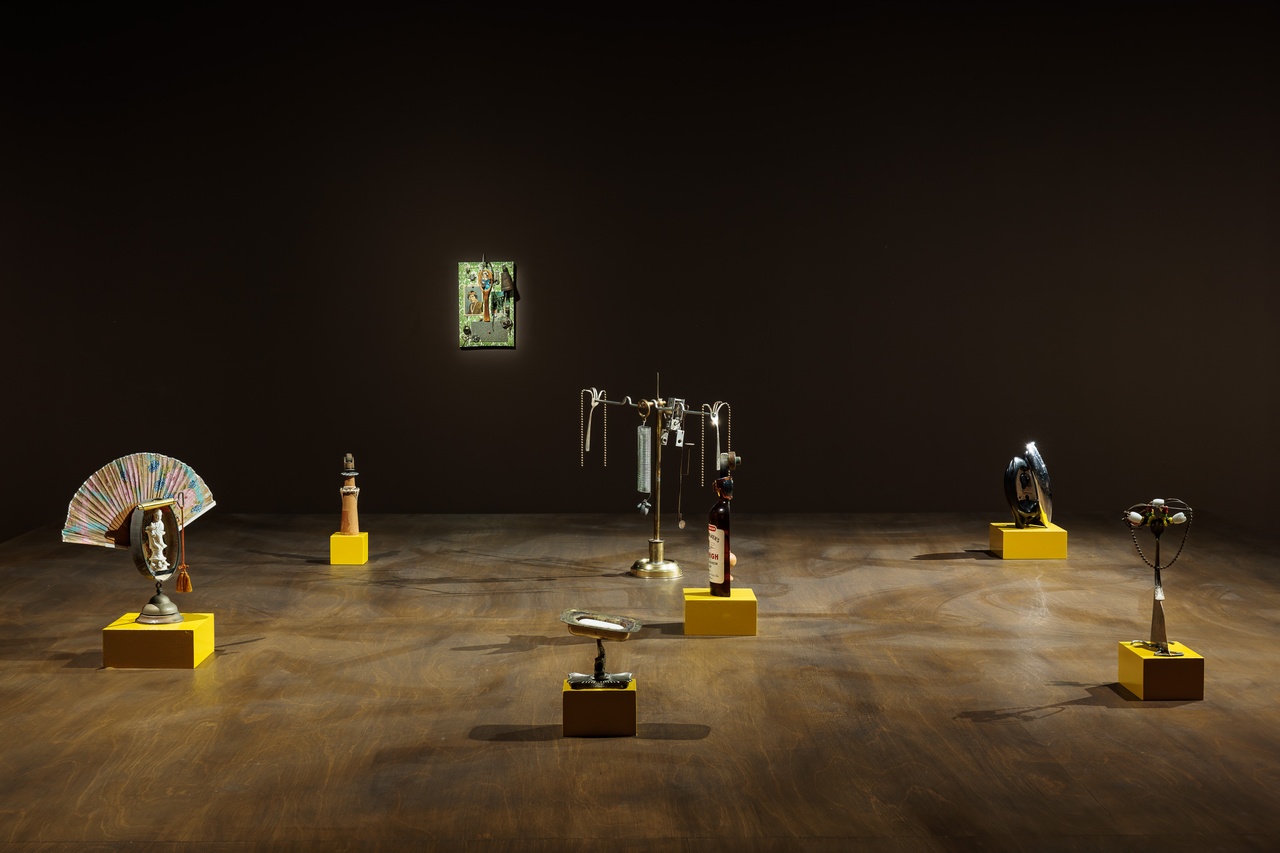
“Terminal Piece,” mumok, Vienna, 2026-2027
Whereas Act 1 sits in the white cube, Act 2, one level down, stages a dim domestic environment with a mustard-yellow carpet, dark purple walls, and Louis Goodman’s assemblages of household objects, presented on an altar-like wooden table at the room’s center. Within this homely atmosphere, the image of the cage, figured both as home-like shelter and hellhole, subtly returns in artistic reflections of the female psyche. A case history from R. D. Laing’s Divided Self is quoted in Anna Oppermann’s colored photo canvas Einzelleinwand (1977), a fragment of one of her Ensembles, spatial installations resembling altars, cluttered desks, or untidy children’s rooms and consisting of various assembled objects. Laing describes a case of schizophrenia in a young woman who experiences life as if living inside an encapsulated, bottle-like vacuum – a shelter from the outside world that curdles into a prison. On the other side of the room is Elisabeth Subrin’s 1995 video Swallow, about teenage girls in the 1970s caught between the promises of women’s liberation and, in Millett’s words, “the nightmare of adolescence” [4] – depression, anxiety, anorexia – rendered in images moving between DIY video and diagnostic objectivity. Here the cage of the self turns porous, as different women’s biographies collide and social history – footage of feminist marches, the averted gaze from televised images of the Vietnam War – slides into the narration of depression.
Act 3 turns from the spaces of interiority to the effects of war and destruction on nature and the human form. Sculptures by Magdalena Abakanowicz, Bruce Conner, Dieter Roth, Wolf Vostell, Franz West, and others, as well as Véréna Paravel and Lucien Castaing-Taylor’s cinematic epic Leviathan (2012) about the modern fishing industry, form a wrecked landscape, backdropping what reads as the act’s central position: Jean Fautrier’s early 1940s haute pâte paintings of heads or skulls, devoid of individual physiognomy and each almost sculptural in its fusion of paper, gesso, paint, ink, and canvas. These works from the Otages series are commonly read as Fautrier’s response to the horror of fascist violence, their “sculptural plasticity” registering, in Benjamin Buchloh’s words, “the experience of the subject’s fundamental dislodgement and literal disembodiment in painterly terms.” [5] The paintings hang across two small rooms, one with a window-like aperture cut into a wall, framing one of Cora Pongracz’s 1977 photographs of Ernst Jandl. The series of ten black-and-white images shows the poet seated either in a chair or on a table, photographed from multiple angles while he himself is photographing in different directions. In the image seen through the aperture he turns his camera on the photographer herself, his face vanishing behind the flash. The exhibition display thus positions the viewer between Fautrier’s paintings and the poet’s lens, as the object of the other’s gaze while looking at what are “not portraits but [...] pictures of the dead,” [6] images that cannot look back. Through this spatial trick, Fautrier’s Otages are drawn into the exhibition’s central question: What does it mean to look at images of violence and be confronted with our own spectatorship as a non-innocent act? Yet, an exhibition that frames the experience of looking as spatial rather than temporal (historical) can only pose that question as another mise-en-scène, where the viewing subject – cast, like Millett’s doll, as witness and actor – is staged in a theater of the gaze placed outside of history.
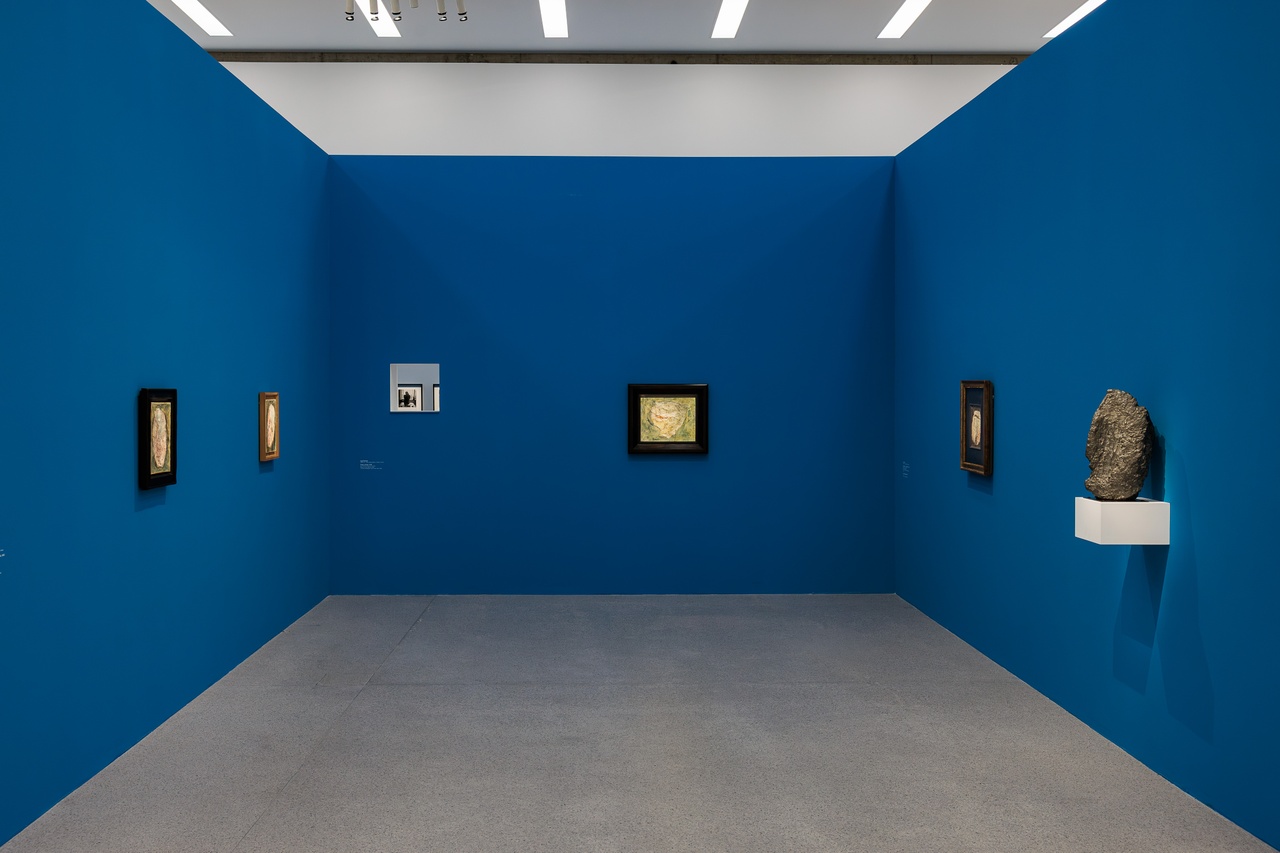
“Terminal Piece,” mumok, Vienna, 2026-2027
History seems to be just another prop, staged in the fourth and final act where, in the museum’s former children’s workshop – its concrete walls still marked with colorful drawings – Nina Porter’s modular steel structures on soapbox wheels carry other artists’ works, turning the space into an archive or storage room. One wagon holds material documenting the production of Millett’s Terminal Piece – photographs and invoices, including the price of the doll: $48.15. Paired with Porter’s long-exposure photographs, taken with a pinhole camera, each indexing the apparatus that produced it, the exhibition’s final act ends with a look behind the scenes and inside the infrastructure of image-making. From here, the exhibition segues into Astakhishvili’s “Figure of the Child” (itself housing small cages with works from the collection), where before entering, visitors encounter 20 Hantarex box-monitors distributed across the floor, each looping footage of the museum’s own substructure of pipes and ducts. This infrastructural prologue to Astakhishvili’s exhibition leads into an uncanny scene, where rather than simply revealing what lies beneath, something repressed seems to return in disfigured form. “Terminal Piece”’s final act, by contrast, seems to settle into an infrastructural aesthetic of exposure, trading the exhibition’s aim to destabilize the act of looking for the well-rehearsed gesture of “making visible.” The exhibition’s closing scene thus risks eliding the very problem inherited from Millett’s cage and rearticulated, for example, by Fautrier’s skulls: how to represent an unspeakable violence not by rendering it visible, but by picturing the very impossibility of its representation.
“Terminal Piece,” mumok – Museum moderner Kunst Stiftung Ludwig Wien, Vienna, June 20, 2026–February 2, 2027.
Sophia Rohwetter is an art historian based in Vienna.
Image credit: 1., 3., 4., 5. photo kunst-dokumentation.com / Manuel Carreon Lopez; 2. photo Hans Dekeyser
Notes
| [1] | Kate Millett, Sexual Politics (Equinox Books, 1971), 22. |
| [2] | Ibid., 20. |
| [3] | Kate Millett, The Basement: Mediations on a Human Sacrifice (Simon and Schuster, 1979), 12. |
| [4] | Ibid., 11. |
| [5] | Benjamin Buchloh, “Fautrier’s Natures mortes,” in Jean Fautrier, 1898–1964, ed. Curtis L. Carter and Karen K. Butler (Yale University Press, 2002), 63–69, at 68. |
| [6] | Ibid., 69. |