
FUELED BY A PASSION FOR A UNITY THAT CAN NEVER COME INTO BEING Steph Holl-Trieu and Nikhil Vettukattil on “The Defeated: The Aesthetics of Resistance 2026” at Bonniers Konsthall, Stockholm
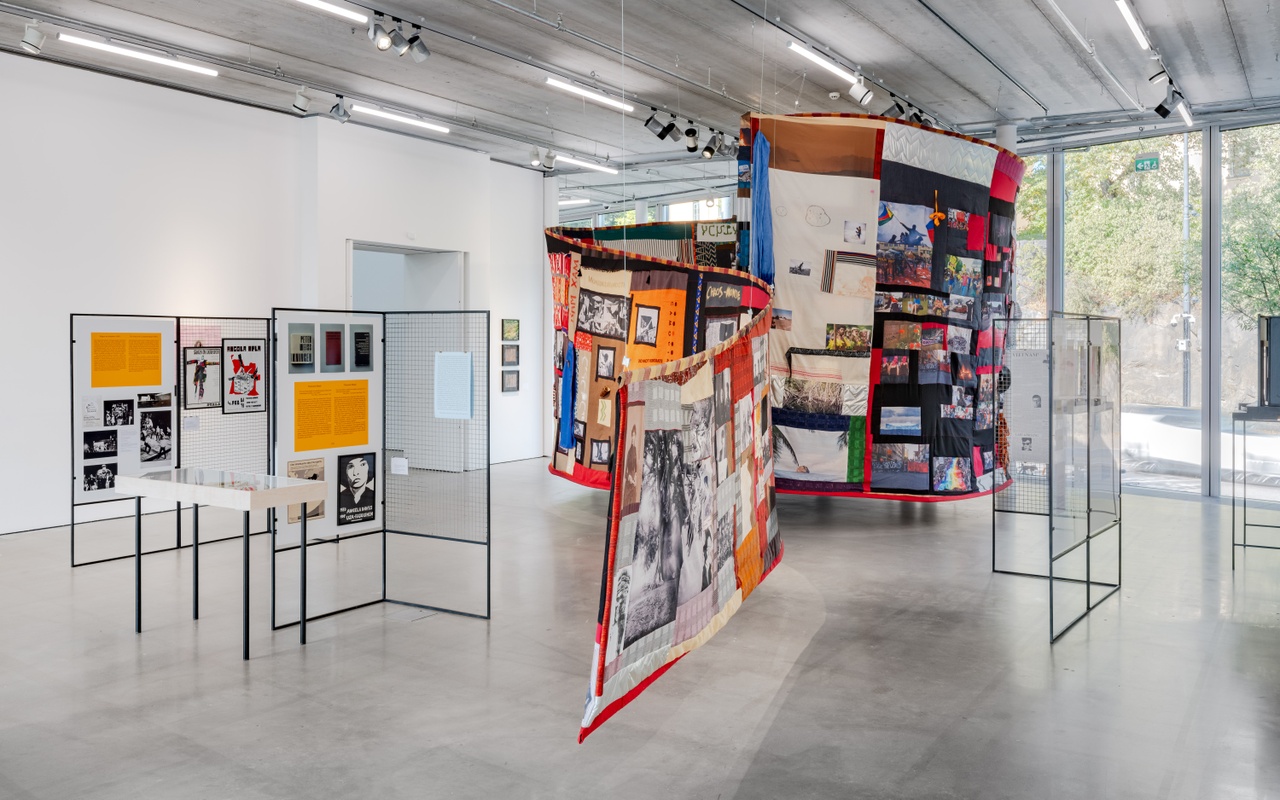
“The Defeated: The Aesthetics of Resistance 2026,” Bonniers Konsthall, Stockholm, 2026
In a recently published essay in Radical Philosophy, Danny Hayward proposes to understand Peter Weiss’s The Aesthetics of Resistance as an extended treatment of Pronomendenken: “the problem of solidarity as it appears at the level of speech, in the ability to use and transform the words ‘I,’ ‘us’ and ‘we’.” [1] The novel’s unnamed protagonist, identified only through the abstract first-person pronoun, allows Weiss to assimilate particular experiences of historical figures either through citation or conversation, while conceptualizing universally shared contradictions and antagonisms of anti-fascist resistance across vast stretches of time – from the construction of the Pergamon Altar in the 2nd century BC to the narrator’s final reflections in 1945. Frederic Jameson, in his foreword to the English translation, calls this depersonalized collective voice a “dialogical agon” [2] to describe Weiss’s pursuit of narrative resolution for what the novel’s characters sought in art and politics: unity, that is, unified agency aiming at action and praxis.
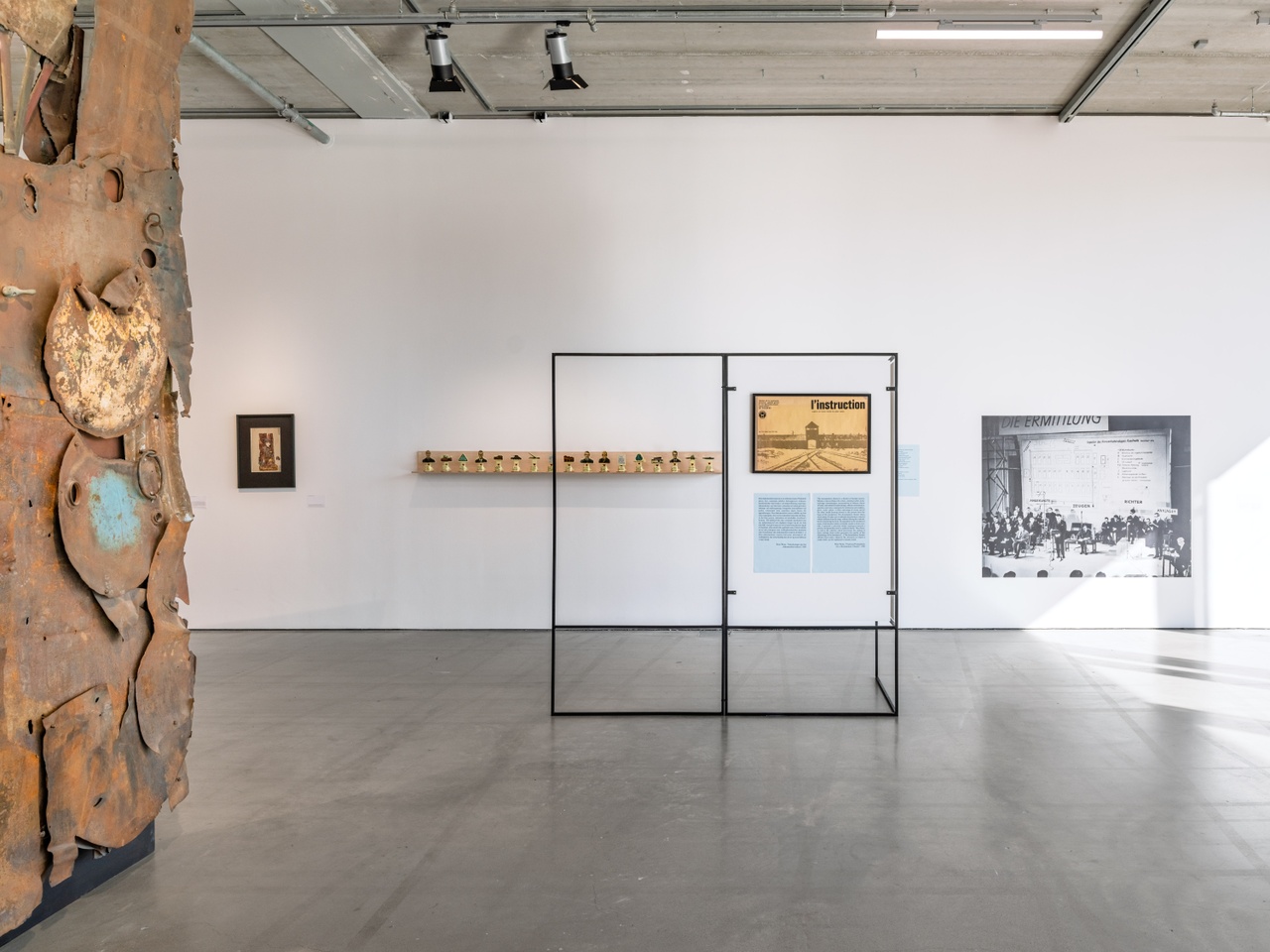
“The Defeated: The Aesthetics of Resistance 2026,” Bonniers Konsthall, Stockholm, 2026
Beyond the literary form, an exhibition project can serve as an invitation for such a collective voice to emerge, or so it can be inferred from the curatorial text introducing the project “The Defeated: Aesthetics of Resistance 2026,” spanning a group exhibition and a public discourse program at Bonniers Konsthall, as well as an accompanying publication. Departing from a framing of the novel’s premise, “that it is by ‘taking on’ art and culture that an effective resistance against the forces of fascism – and against the forces that create fascism – can be formed, that a new we can be created, one able to construct a future beyond fascism’s devastations,” the exhibition makers ask what this might look like today. Part retrospective of Peter Weiss and Gunilla Palmstierna-Weiss’s work, part gathering of works by their contemporaries as well as artists working today, the exhibition ambitiously sets out to both reconstruct Weiss’s work from the urgencies of the present and to instantiate what an aesthetics of resistance would look like today, where “a new far right and new fascisms are gathering force.” [3]
Structurally, the former takes precedence, as demonstrated by the composite title, which traces the show’s chronological axis, beginning with Weiss’s second novel, The Defeated (De besegrade), published by Bonniers Förlag in 1948, and ending with The Aesthetics of Resistance, published by Suhrkamp in three volumes between 1975 and 1981. Between these bookends, the exhibition periodizes three approximate phases of Weiss’s work, from his reclusive engagement with surrealism to his turn to political documentary theater, both of which coalesce in The Aesthetics of Resistance, where every encounter with a work of art is made to confront the demands of anti-fascist struggle. Trained as a painter, Weiss later moved away from visual images and film, turning instead to documentary theater and novels made of large ekphrastic block formations. Visual productions, set, and costume design for his pieces were largely entrusted to the artistic acuity of Palmstierna-Weiss, whose writing, scenographic elements, collages, and sketches claim space equal to other artworks, forming the sculptural dramaturgy that traverses the exhibition.
Adjacent to three screens showing excerpts from Weiss’s feature film Fata Morgana (Hägringen, 1958), a film portrait of his friend Öyvind Fahlström, and a trailer by Jean-Luc Godard, the wall text points to “montage as a form that thinks” – an understanding of technique that is carried throughout the exhibition. A number of works respond to the notion of montage directly. In Sightseeing (1968) by Peter Nestler, for example, a filmic boat tour through a placid Stockholm in ’68 turns into a reconnaissance flight with a voice-over reading from Weiss and Palmstierna-Weiss’s reportage on US Air Force bombardments of Vietnam. The video triptych Binding the Dream (2026) by Lina Selander and Oscar Mangione presents a productive media archaeology of digital and analogue techniques, layering clips of bulldozers demolishing homes in Gaza, Godard’s Ici et ailleurs (1976), Straub-Huillet’s Fortini/Cani (1976), Jorge Giannoni and Jorge Denti’s Palestina, Otro Vietnam (1972), the studio of Carl Eldh, and the Palmstierna-Weiss archive. In Samuel Richter’s The Imperial Commissioner’s Journey (2026), the diary of Hermann Göring’s father on his 1886 colonial mission to Namibia is refracted through the logbook of an assistant to one of the painters tasked with the panorama for the Pergamon Altar, unveiled that same year. Gaps in the historical record between both events are ventriloquized to connect the concomitance of the genocide of the Herero and Nama people and the looting of cultural artefacts rooted in colonial conquest of the German Empire in modern-day Turkey. The question that Richter poses in his work, “What in our present comes to light in the images we make of the past?,” converts from critique to constructive principle in Hamedine Kane and Valérie Osouf’s monumental textile work Where the Seams Hold Against the Fixed Narrative (2026), installed to mimic a boat sail in homage to Théodore Géricault’s The Raft of the Medusa (1818–19), to which Weiss devotes countless pages in the Aesthetics, admiring how the painter forces the viewer into a fearful dream “laying a path for others” despite “himself [Géricault] dying a defeated man.” [4] An image archive of social liberation movements, personages, and artworks from across the world is sewn onto the sail, with one face dedicated to the struggles and movements Weiss’s own writing had overlooked.
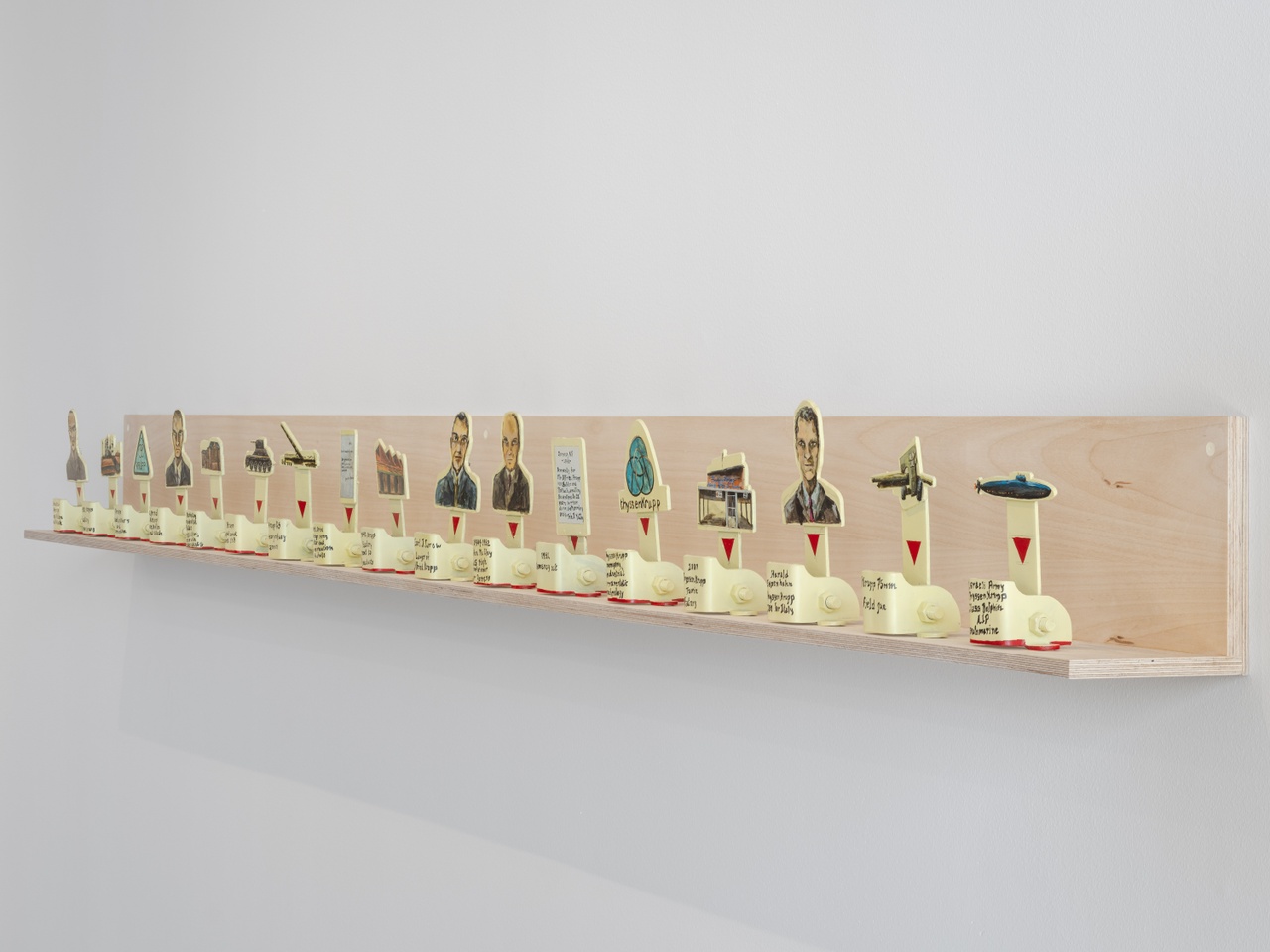
Daniela Ortiz, “Krupp,” 2025
Beyond individual artworks, montage is employed as a curatorial technique: as one perambulates from collage to video, assemblages, and documentary and archival material, there is hardly a vantage point from which one views an artwork in isolation. A dialogical tension can, for example, be read across Daniela Ortiz’s sculptural series Krupp (2025), Weiss’s play The Investigation (1965), and Oracles/Protocols (2023–25) by Zbyněk Baladrán. For Krupp, Ortiz aggregates the history of the eponymous German steel and weapons manufacturing corporation into a row of miniature pop-up shooting targets. Charting its support of the Nazi regime, exploitation of forced laborers in Auschwitz, and, in the most recent target, complicity in genocide through the manufacture and sale of submarines to the Israeli military, each event is labeled and represented by painted illustrations of respective personages, documents, or military equipment. Next to this work, a documentary station of The Investigation, Weiss’s play about the Auschwitz trials in Frankfurt two years prior, cites the script:
We all knew the society which had produced the regime that could bring about such a camp we were familiar with this order from its very beginnings [...].
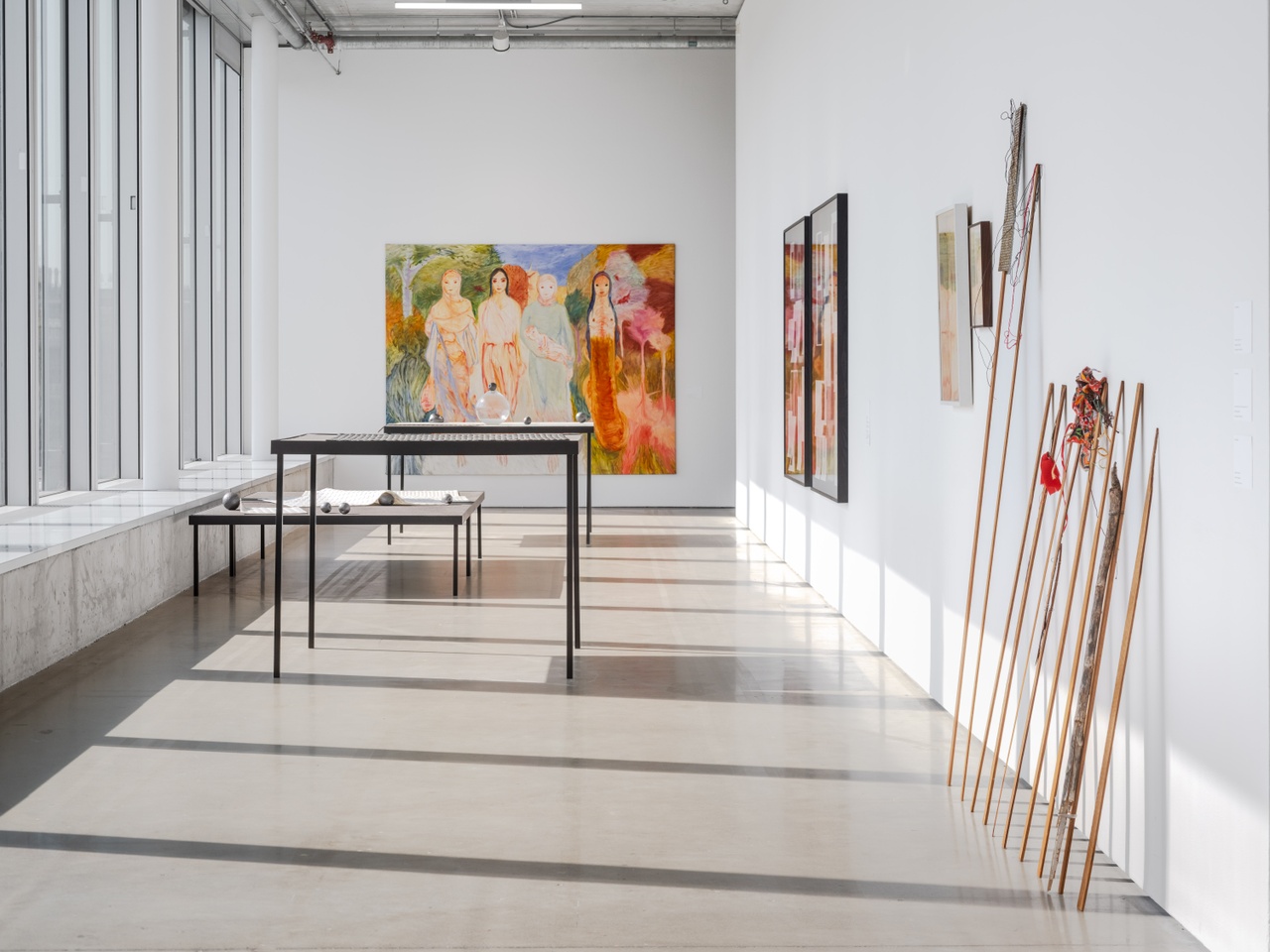
As W.G. Sebald noted in 2003, the significance of The Investigation in relation to other works on the Nazi Holocaust lies in how it demonstrates “that even now the economic conditions, considerations and forms of organization making genocide possible continue to operate.” [5] Taking up this argument, Baladrán’s extensive serial work Oracles/Protocols fuses Weiss’s early surrealism and his later turn to political documentary in a non-rational inversion of Forensic Architecture’s investigative aesthetics. Materializing across close to 50 canvases set on the floor and leaning unceremoniously, sometimes on top of each other, against the wall, and in a row of framed wall works hung in a straight line above them, the work turns a muddied language of abstract expressionism – murky blooms of reacting paint outlined with black marker – into unsettling proxies for aerial bombardment. Painting is turned into an augural device with which the next bombing of the Gaza Strip might be predicted, hoping helplessly to be capable of preventing lethal consequences. Above the canvases, a detailed chart indexes the logos of firms invested in the war industry beside their absurd corporate slogans, for instance, Lockheed Martin – “Ensuring those we serve stay ahead of ready.” In one of the last wall works, “the geomatic sum of Truth,” the number 441, is determined by the equation “I=f(P,M,E)” (explicated as ideological influence being a function of the intensity of propaganda, media, and exposure). Here, the work counters its own incapacity, not by presenting forensic evidence but by pointing out the unreasonable through illogical means.
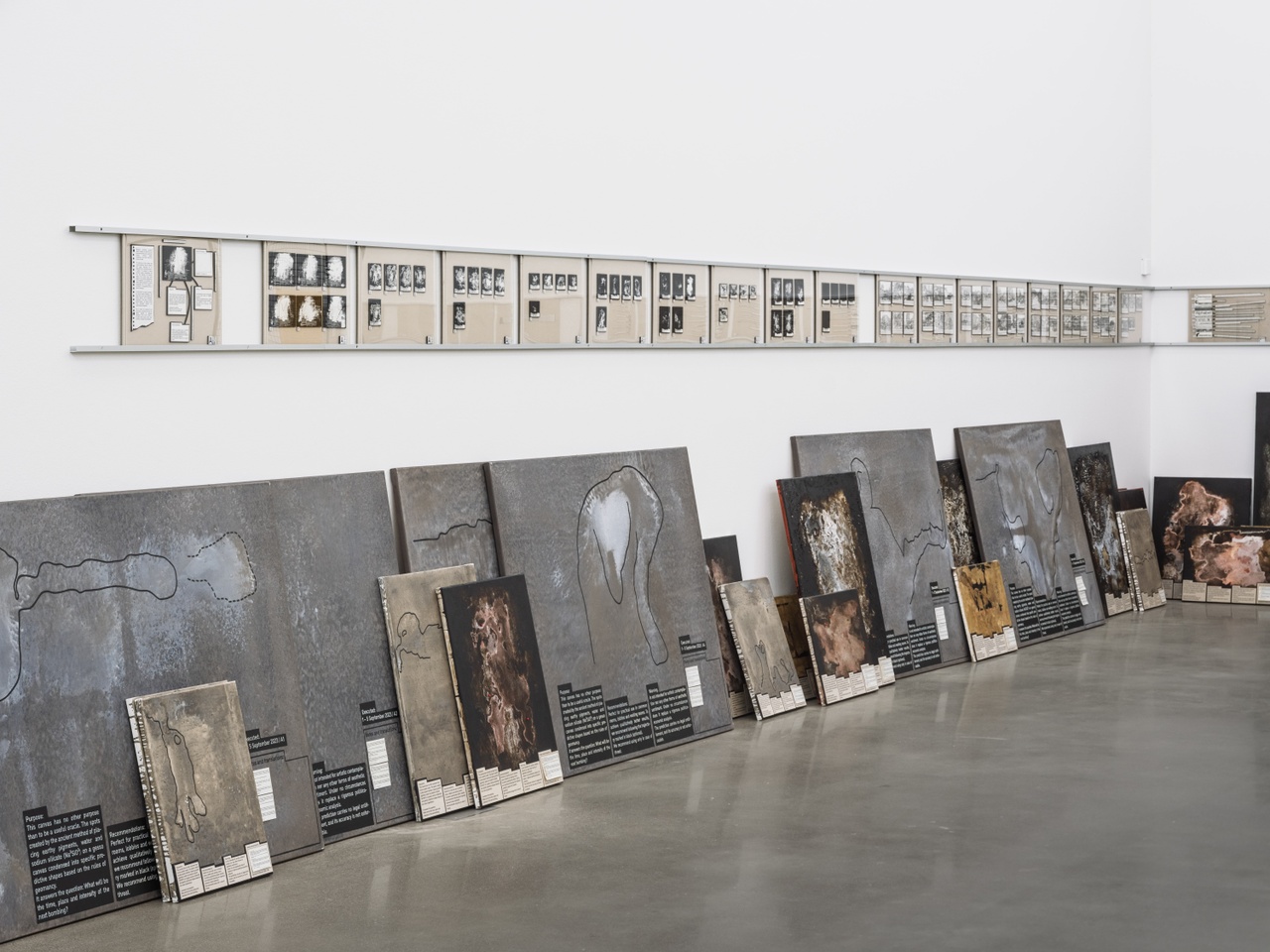
Zbyněk Baladrán, “Oracles / Protocols,” 2023–25
Against the optical and informatic density of most artworks in the exhibition, Asier Mendizabal’s pair of sculptures, Hiru’s covers I and II (2026), offer a much-needed counterpoint. Made to resemble open book covers, the works’ sail-like canvases are stretched over wooden beams. Their distinctive color-field compositions cite the idiosyncratic designs of the independent publishing house Hiru, founded by friends of Weiss and Palmstierna-Weiss, the feminist anti-Francoist activist Eva Forest, and the playwright, theorist, and translator of Weiss’s plays into Spanish, Alfonso Sastre. Mendizabal’s minimalist sculptures condense the traditions of Basque abstraction, of Eduardo Chillida and Jorge Oteiza, and the stakes of political publishing (Forest and Sastre were subjected to imprisonment, censorship, and ostracization from the intellectual scene for their militancy), drawing a line from the exhibition to its accompanying publication (where Hiru’s covers I is printed on the reverse side of the book cover).
The publication, coedited by Kim West and Gustav Strandberg, assembles previously inaccessible texts by Weiss and Palmstierna-Weiss, as well as newly commissioned essays by authors Claudia Firth, Esther Leslie, Sven Lütticken, Jacques Rancière, and Alberto Toscano, among others. Its claim of being an “additional element of the exhibition’s montage” is evident in cases such as Firth’s survey of collective study groups brought forth by the Aesthetics, which extends the documentary station in the exhibition dedicated to the reading group as social form. The display includes a reproduction of a drawing by Hans Tombrock, himself a figure in the novel, which depicts a discussion about the Spanish Civil War in Brecht’s atelier. In the conclusion to her essay, Firth writes, “the fact that there will always be something of an excess that escapes capture is part of the militant potential of collective learning and doing.” [6]
There are moments in which the exhibition fails to deliver upon its premise, such as in the very first “frame” of the show, in which a dense line of sight leads from the Swedish publications of Weiss’s novels and plays, Ali Cherri’s composite relic The Summoner (Grafting) (2026), Lenke Rothman’s sculptural totem The Family (1984), Chiara Bugatti’s installation Poses and Postures (2026) and Kateryna Lysovenko’s painted composition To be in Vienna, seeing people from other wars (2025). From Weiss’s writings to sculptural translations of montage, family histories extinguished by German fascism, autobiographical excavations of Italian anti-fascist partisanship, and figurations of people devastated by war, the exhibition’s thematic and retrospective threads already begin to fray and feel arbitrary. Neither relating satisfyingly to Weiss’s work (just using montage or thematically addressing fascism is insufficient) or the envisioned “aesthetics of resistance today” (the works are largely silent on the “new far right and new fascisms [that] are gathering force” in Europe), the optical density of artistic positions does not itself form an argument, and it is hard to locate contradictions or nuances that would constitute the dialogical agon or an actionable unity. This perhaps speaks less to an overall defeat of the exhibition than the impossible standard it set for itself in the first place. As theorist Bojana Cvejić noted recently, “antifascism will not be curated.” [7] Its subject has to be reconstituted elsewhere.
“The Defeated: The Aesthetics of Resistance 2026,” Bonniers Konsthall, Stockholm, 2026
An exhibition can be exceeded by social forms it cannot display; take for example the lecture series that ran from April to June, which took on the subject of anti-fascism in art, education, and cultural organization, the very fields threatened continually by right-wing policy; or actions taken by artists outside of their work, such as Ali Cherri filing a civil complaint before France’s War Crimes Unit together with the International Federation for Human Rights (FIDH) over the Israeli bombing of a civilian building in Beirut that killed seven civilians, including his parents. [8] As an exhibition, The Defeated is most effective in opening Weiss’s work for engagement through its visual framework, as Weiss says to Harun Farocki, “[which] surrounds the processes and gives them a particular weight.” [9] This is achieved historically rather than thematically. The strength of the exhibition’s montage is found where it does not seek to fill or crowd the absence of a unified voice of anti-fascism: the lack of a preconceived we, its inconclusiveness, which forces us to work and make meaningful inferences. Citing Nicos Poulantzas, Toscano writes in a newly commissioned essay: “it was not fascism that undid the communist revolutions; its devastating surge and consolidation was based on their prior defeat.” [10] What is to be done with this framework is for each I, us, or we to ground in its own social contradictions and material contexts. In his essay in the publication, one of the show’s three curators, Kim West, asks who the unnamed I would be if it still existed today, and what forms of we would gather around it. This question lingers, unanswered by the exhibition. Some pages earlier, West cites Jameson in characterizing the dialogical agon as being motivated by “a passion for a unity that can never come into being”. [11] Art does not deliver on that unity, but it can refuse to let its passion lapse.
“The Defeated: The Aesthetics of Resistance 2026,” Bonniers Konsthall, August 26–November 8, 2026.
Steph Holl-Trieu is an artist and writer. Working across text, installation, sound, performance and role-play, she develops her work iteratively, often in collaboration with others. In 2026, she was awarded the AICA Prize for Young Art Critics.
Nikhil Vettukattil is an artist and writer. Using a range of media such as sound, installation, performance, text, sculpture, and video, his practice questions modes of representation and image-making processes in their relation to lived experiences.
Together with Stefa Govaart and Andrea Rodrigo, they organize the annual Spring Meeting at the Performing Arts Forum in St. Erme, an artist-initiated and self-organized space for artistic (knowledge) production.
Image Credits: © The artists and Bonniers Konsthall, photos Bonniers Konsthall (Jean-Baptiste Béranger)
Notes
| [1] | Danny Hayward, “After We Achieved Political Understanding: On the Poetics of Peter Weiss’s Aesthetics of Resistance,” Radical Philosophy, no. 2.21 (Summer 2026): 3–11. |
| [2] | Fredric Jameson, “Foreword: A Monument to Radical Instants,” in The Aesthetics of Resistance, Volume I: A Novel, by Peter Weiss, trans. Joachim Neugroschel (Duke University Press, 2005), xxiv. |
| [3] | The Defeated: The Aesthetics of Resistance 2026, exhibition leaflet, curated by Kim West, François Piron, and Joanna Nordin Arp (Bonniers Konsthall, Stockholm, 2026). |
| [4] | Weiss, Aesthetics of Resistance, vol. 2, 28. |
| [5] | W.G. Sebald, On the Natural History of Destruction, trans. Anthea Bell (Penguin, 2003), 191–92. |
| [6] | Claudia Firth, “The Aesthetics of Resistance and the Necessity of Reading Groups,” in TheDefeated: The Aesthetics of Resistance 2026, ed. Kim West and Gustav Strandberg (Bokförlaget Faethon in collaboration with Bonniers Konsthall, 2026), 302. |
| [7] | Kaaitheater, Figures of Fascism and Antifascist Solidarity, study days, Kaaistudios, Brussels, January 27–29, 2026. |
| [8] | Joanna Nordin Asp, “Fate: It Is the Past,” in West and Strandberg, The Defeated, 171. |
| [9] | Harun Farocki, On Display: Peter Weiss, 1979, video, 44 minutes. |
| [10] | Alberto Toscano, “The Tradition of the Defeated,” in West and Strandberg, The Defeated, 240. |
| [11] | Kim West, “Exhibiting The Aesthetics of Resistance,” in West and Strandberg, The Defeated, 148. |