
LOST AND FOUND HISTORIES Talia Kwartler on Marlow Moss (with Leonor Antunes, Tacita Dean, Florette Dijkstra, and Ro Robertson) at the Georg Kolbe Museum, Berlin
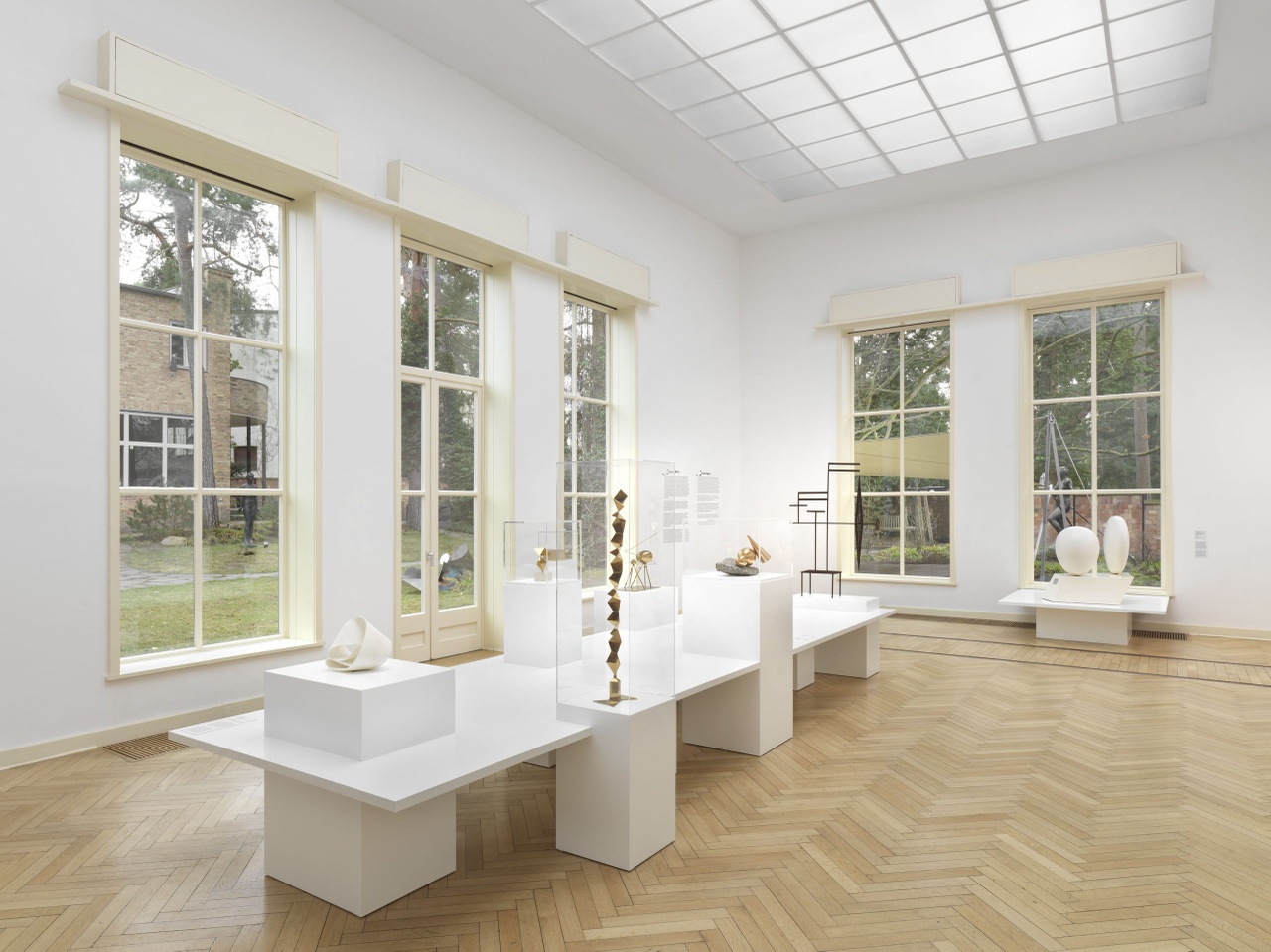
“Räume schaffen. Die Konstruktivistin Marlow Moss,” Georg Kolbe Museum, 2026
How can we restore the history of an artist when much of their work has been lost? “Creating Space: The Constructivist Marlow Moss” answers this question by suggesting that contemporary artists can help us to better understand and contextualize a modern artist’s life and work when we are presented with only a fragmentary record of it, as is the case with Moss, whose legacy has been shaped by dislocation and absence. The exhibition is organized by Elisa Tamaschke, curator and head of exhibitions, research, and publications at the Georg Kolbe Museum, and Lucy Howarth, a scholar and leading expert on Moss. At the heart of the show are the artist’s Constructivist sculptures, works Moss explicitly referred to as “constructions,” which are placed in relationship to artworks by four contemporary artists: Leonor Antunes, Tacita Dean, Florette Dijkstra, and Ro Robertson. The exhibition gives the sense that the space created through the juxtaposition of artworks by Moss and those of four contemporary artists can refer to the restorative work done on Moss and her legacy, to the Constructivist sculptures that she made, and to the contemporary artists whose voices are elevated through a dialogue with Moss.
Born in London in 1889, Marlow Moss followed an international path that took her from art school at the Slade in London to Paris in the 1920s, where she became a founding member of the avant-garde group Abstraction-Création in the 1930s. Around that time, Moss met Piet Mondrian through the writer Antoinette Hendrika (Netty) Nijhoff and the poet Martinus Nijhoff. Netty would become Moss’s lifelong partner, and Mondrian would prove a key reference point for Moss, both during her lifetime and in the historicization of her art and legacy. Moss and Mondrian both experimented with abstract compositions made purely of color, lines, and geometric elements. During the 1930s, they also both began working with the concept of the double line, and, apparently, it was Moss who first defined it as a new pictorial structure that offered, in her words, “a continuity of related rhythms in the space.” [1] However, in histories of the avant-garde, Moss has often been minimized or ignored vis-à-vis Mondrian, a far too common situation when women and men have developed related subjects contemporaneously. This exhibition effectively reframes this narrative without dwelling on conceptual primogeniture.
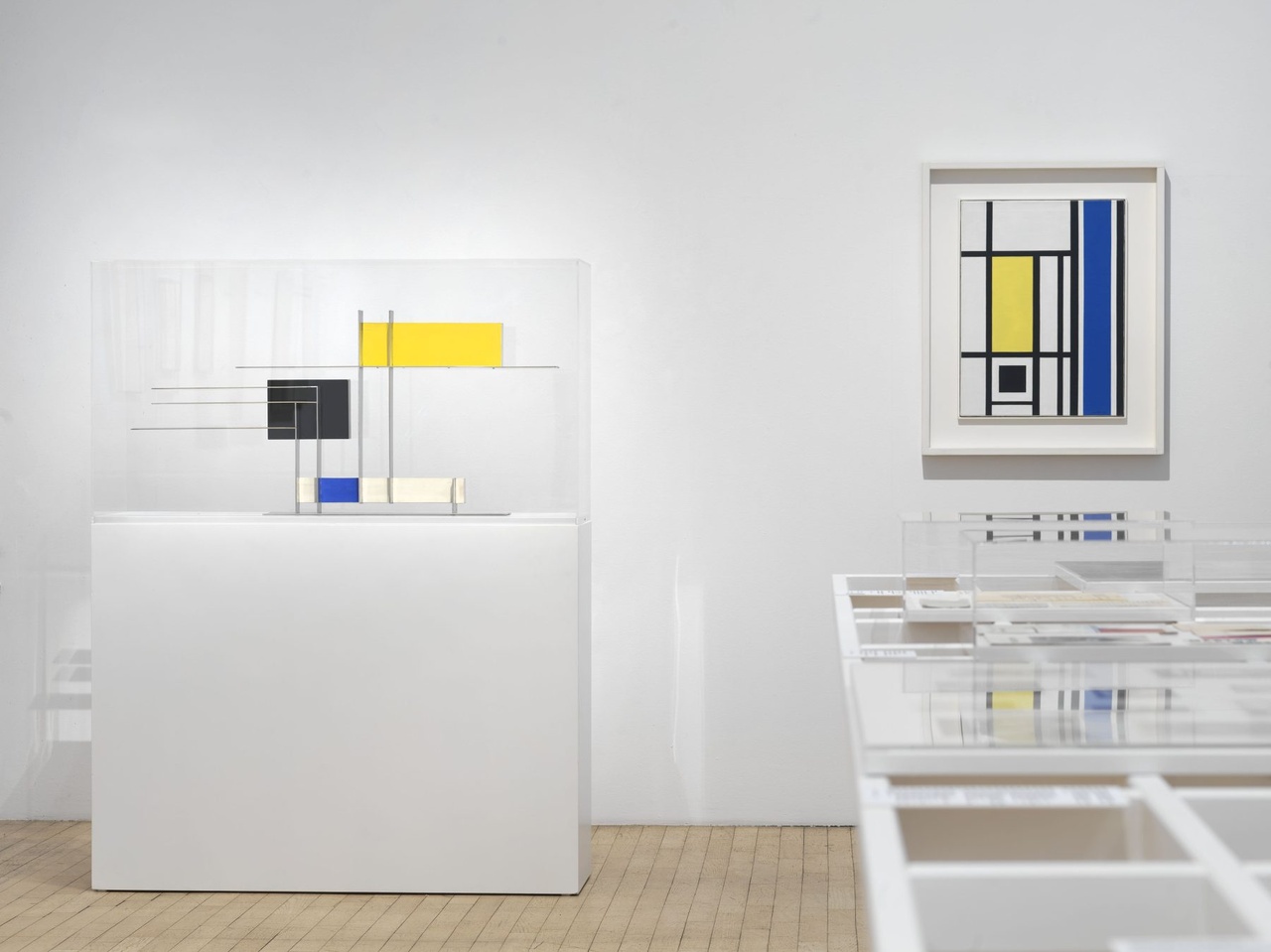
“Räume schaffen. Die Konstruktivistin Marlow Moss,” Georg Kolbe Museum, 2026
The main gallery of the exhibition is set in the principal room of the former atelier of sculptor Georg Kolbe – a space with grand windows opening onto a sculpture garden. It centers on Moss’s extant sculptures that were made in the 1940s and 1950s in Cornwall, nine of which are reunited in the exhibition. The museum is dedicated to presenting expanded narratives about modern and contemporary sculpture, so it makes sense that it has chosen to place emphasis on this understudied aspect of Moss’s career. When viewers first encounter the works on a joint plinth with jutting pedestals, Moss’s material and formal explorations of lines, angles, circles, cones, and curvatures seem to merge as if part of a broader geometric language. The artist’s approach to form ranged across media, from traditional sculptural materials of cast bronze and carved marble to salvaged pieces of granite and found brass objects. When viewing one sculpture, one often sees parts of others, too, which makes it harder to focus on individual works but easier to see the resonances between them.
Another gallery emphasizes Moss’s paintings and drawings, mainly from the 1940s and 1950s (with a few exceptions), in relation to two of her Constructivist sculptures, shown alongside archival materials. Much of Moss’s work was destroyed when she and Nijhoff fled their home in Normandy during World War II due to their queer partnership and Moss’s Jewish heritage. These archives, especially the photographs, represent an important attempt to give life to artworks that will never be recovered. [2] A documentary by Fifi Visser and André van der Hout, De verdwenen lijnen van Marlow Moss (The Vanished Lines of Marlow Moss) (2022), screened beyond this gallery, tells the history of another loss, when a substantial part of Moss’s surviving body of work that had been in a storage unit in Zurich was exhibited in the Dutch city of Arnhem in 1994 and was then suspiciously never seen again, neither on the art market nor anywhere else: a true art historical mystery. [3]
The question circulating throughout the exhibition, about how to adequately exhibit fragmentary histories, is also answered by the contemporary artists included in the presentation, whose works appear throughout the galleries alongside Moss’s. In the first gallery, the significance of this connection comes across powerfully when Moss is paired with Florette Dijkstra, an artist who was instrumental in reviving Moss’s legacy in the 1990s through her research project Marlow Moss Reconstruction Project (1994). A work from this series, a box of 58 reproductions of paintings by Moss, is exhibited alongside Moss’s sculptures. So too are a new series of drawings that Dijkstra made for the exhibition that meditate on Moss’s sculptures, both those that are extant and exhibited here and those that are lost. In Marlow Moss Sculpture Garden (2026), which greets visitors at the entrance to the exhibition, Dijkstra places Moss’s sculpture in the Georg Kolbe Museum’s garden, creating an imaginary landscape for Moss’s work that turns the garden into an expansive, almost Palladian, space for chance encounters across time.
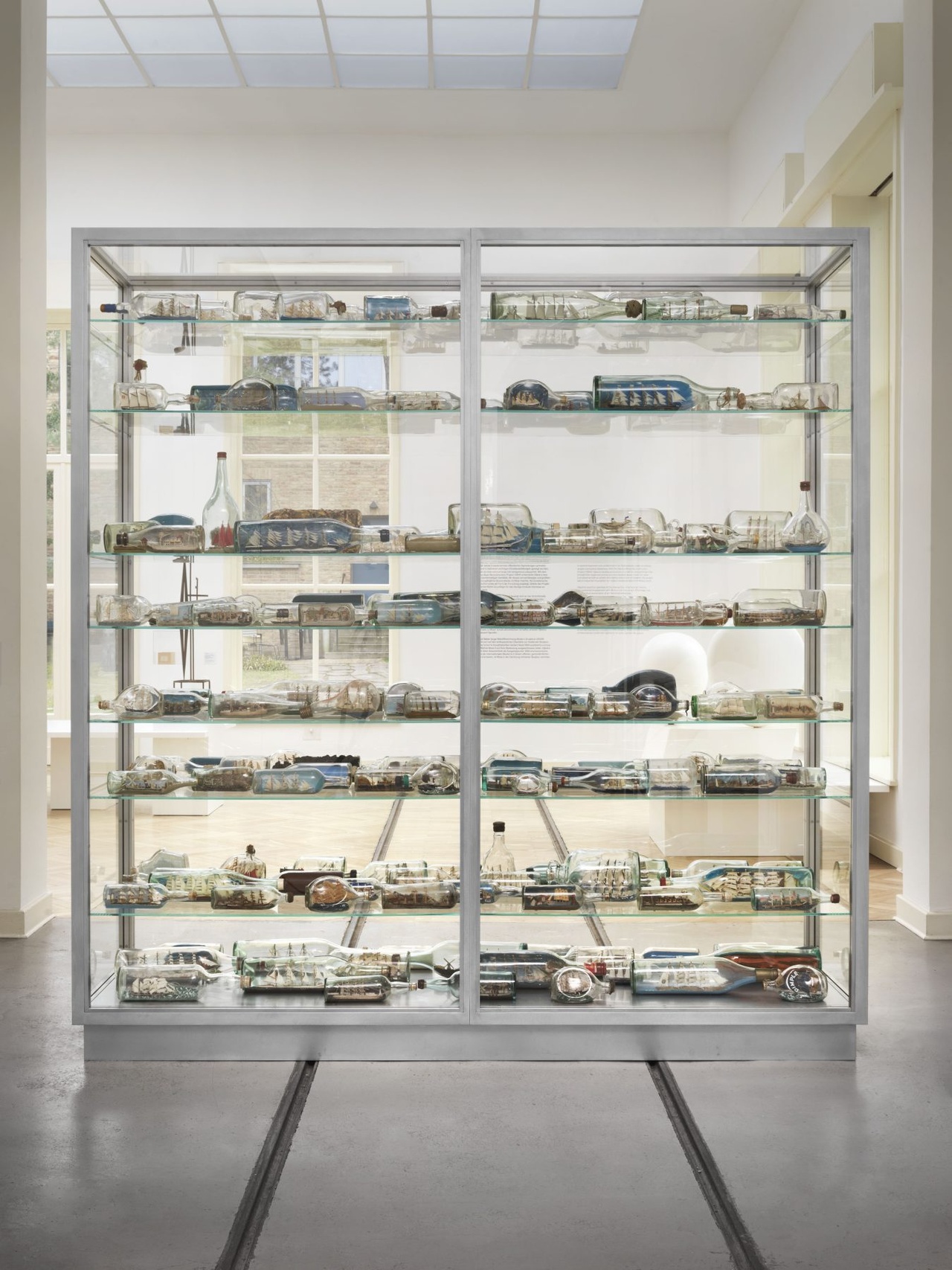
Tacita Dean “Boat in a Bottle Collection,” (1995–ongoing)
The other three contemporary artists are drawn into dialogue with Moss from various angles, whether through biography or subject matter or material approach. Beyond the main gallery populated with Moss’s sculptures, in the passageway leading to the annex of the building, stands Tacita Dean’s Boat in a Bottle Collection (1995–ongoing), a glass case filled with boats in bottles. Here, the point of reference is the location of Cornwall, where Moss settled in Lamorna after fleeing continental Europe during World War II, and where Dean studied at the Falmouth School of Art in the 1980s, where she then worked for an extended period. (A film of Dean being taught how to put boats into bottles also appears in a separate room, on the lower level of the exhibition.) The relationship between Dean and Moss could have been developed further, especially in terms of the role Cornwall played in shaping Moss’s art, rather than just being the place where it was made.
The Cornwall connection is, however, expanded with the work of the non-binary artist Ro Robertson, with the biographical dialogue enhanced through a material one. Two of Robertson’s sculptures are included in the exhibition, one directly at the outset so that you can see it when looking into the main gallery containing Moss’s sculptures, and a second in the garden, visible through the main gallery’s windows, along with a video filmed in Cornwall and screened in the exhibition. Robertson’s sculptures invoke the forms of Moss’s earlier works, and the artist even bathed them in the sea of Lamorna to weather the materials, as if baptizing them. The inclusion of Robertson, as a queer and non-binary artist, also points toward Moss’s own gender orientation and sexuality. Moss was born Marjorie Jewel but changed her name to Marlow in 1919 and thereafter always kept her hair cropped and dressed in masculine fashions. Even though Moss has been referred to as a woman, including by herself and her partner Nijhoff, there has recently been speculation, including by Robertson, that if Moss had lived in our own time, she might have considered herself non-binary. [4] Robertson’s works resonate formally with Moss’s sculptures, but their placement, at some remove from the galleries, separates these questions of identity from the exhibition’s arguments about reframing fragmentary histories of art. This is mirrored by the curators’ use of female pronouns for Moss throughout the exhibition and the accompanying catalogue.
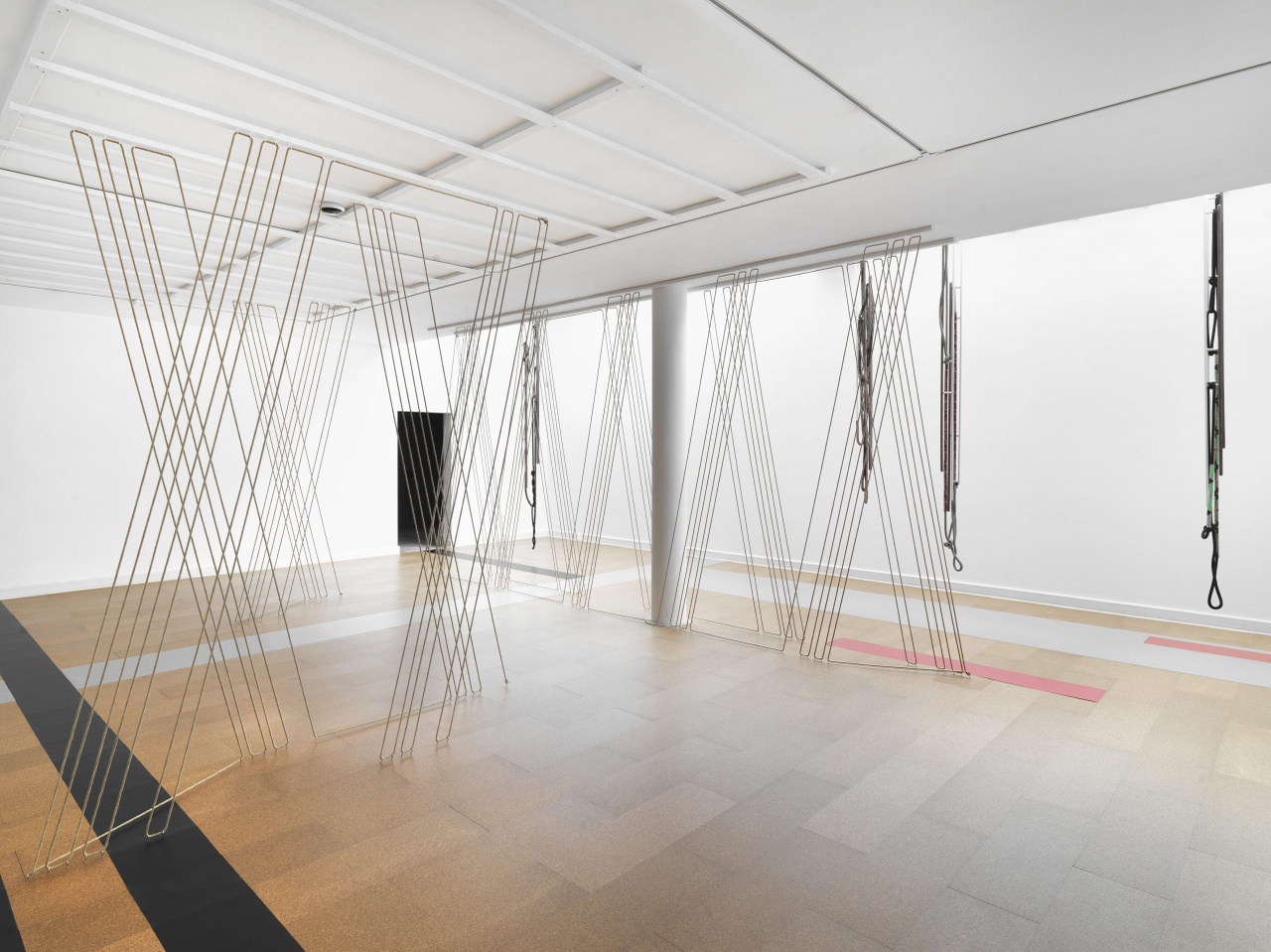
Leonor Antunes “discrepancies with MM,” 2026 and “Marlow and Lygia #1–#6,” 2026
An underlying conundrum of the exhibition is finding a balance between the history of Moss, as told through her own art and archives, and the legacy of Moss, as meditated on by contemporary artists. This question continues in the final gallery of the exhibition, which features a large-scale and site-specific installation by Leonor Antunes. The installation is made of two works: discrepancies with MM (2026), made of hanging X-shaped forms created from hemp rope, echoing Moss’s earlier sculptures, and a cork floor with a striped abstract pattern made of linoleum, shown alongside Marlow and Lygia #1–#6 (2026), a row of hanging beaded sculptures. Antunes’s work draws Moss into an expanded narrative that also includes Lygia Clark, a pioneer of abstract painting and sculpture in Brazil in the 1950s and 1960s who Antunes suggests is conceptually connected to Moss. [5] The dialogue with Moss feels compelling here because of the way that Antunes invokes specific formal aspects of Moss’s art in her own sculptures, especially her use of the double line, but it might have been made even richer had this gallery made a direct juxtaposition with works by Moss, especially her paintings and drawings.
In the end, what “Creating Space” offers is not only a concise history of Moss as a Constructivist sculptor, but also a thoughtful means to consider how we can best approach the work of modern artists through a contemporary lens. The exhibition reveals new insights into Moss’s art and life while it also reflects on how to reconstruct the fragmentary history of an artist when aspects of their art can never be recovered. By opening this dialogue up to contemporary artists, the curators broaden the lenses through which visitors can engage with Moss’s work and the questions that it asks about forms, materials, gender, and queerness. Even though some of the parallels with contemporary artists come across more strongly than others, the range of artistic voices that the curators bring into the discussion on Moss make her come alive. What we are left with then is a hybrid and open history of a modern artist that continues to resonate today.
“Marlow Moss: Creating Space” at the Georg Kolbe Museum, Berlin, April 2–July 26, 2026.
Talia Kwartler is a curator and art historian based in Berlin.
Image Credit: Courtesy of Georg Kolbe Museum and the artists, photos Jens Ziehe
Notes
| [1] | Marlow Moss quoted in Elisa Tamaschke, “‘To help the inexperienced spectator a little, I recommend looking at my work without prejudice.’, The Constructivist Marlow Moss,” in Creating Space: The Constructivist Marlow Moss; With Leonor Antunes, Tacita Dean, Florette Dijkstra, and Ro Robertson, ed. Elisa Tamaschke and Lucy Howarth, exh. cat. (Hirmer; Georg Kolbe Museum, 2026), 18. |
| [2] | Marlow Moss did not have any children, so she bequeathed her estate to Netty Nijhoff’s son, Wouter Stefan Nijhoff, who then bequeathed it to his partner, Andreas Oosthoek. See Charles Darwent, “Marlow Moss: Forgotten Art Maverick,” The Guardian, August 25, 2014. A substantial part of Moss’s archives were recently donated to the Literatuurmuseum Den Haag. |
| [3] | See the film presented in the exhibition Die werdwenen lijnen van Marlow Moss (The Vanished Lines of Marlow Moss) (2022) by Fifi Visser and André van der Hout, online here . |
| [4] | See Ro Robertson’s discussion of their works in “The Bird and the Wind,” in Tamaschke and Howarth, Creating Space, 112–114. The colophon for the catalogue explains that even though Robertson used gender neutral pronouns for Moss, the exhibition used female pronouns to reflect the terms Moss employed (127). |
| [5] | See Leonor Antunes’s discussion on the connection between Lygia Clark and Marlow Moss in “surface, edge and voids,” in Tamaschke and Howarth, Creating Space, 98. |