
MAKING SCENES Valerie Mindlin on Nairy Baghramian at WIELS, Brussels
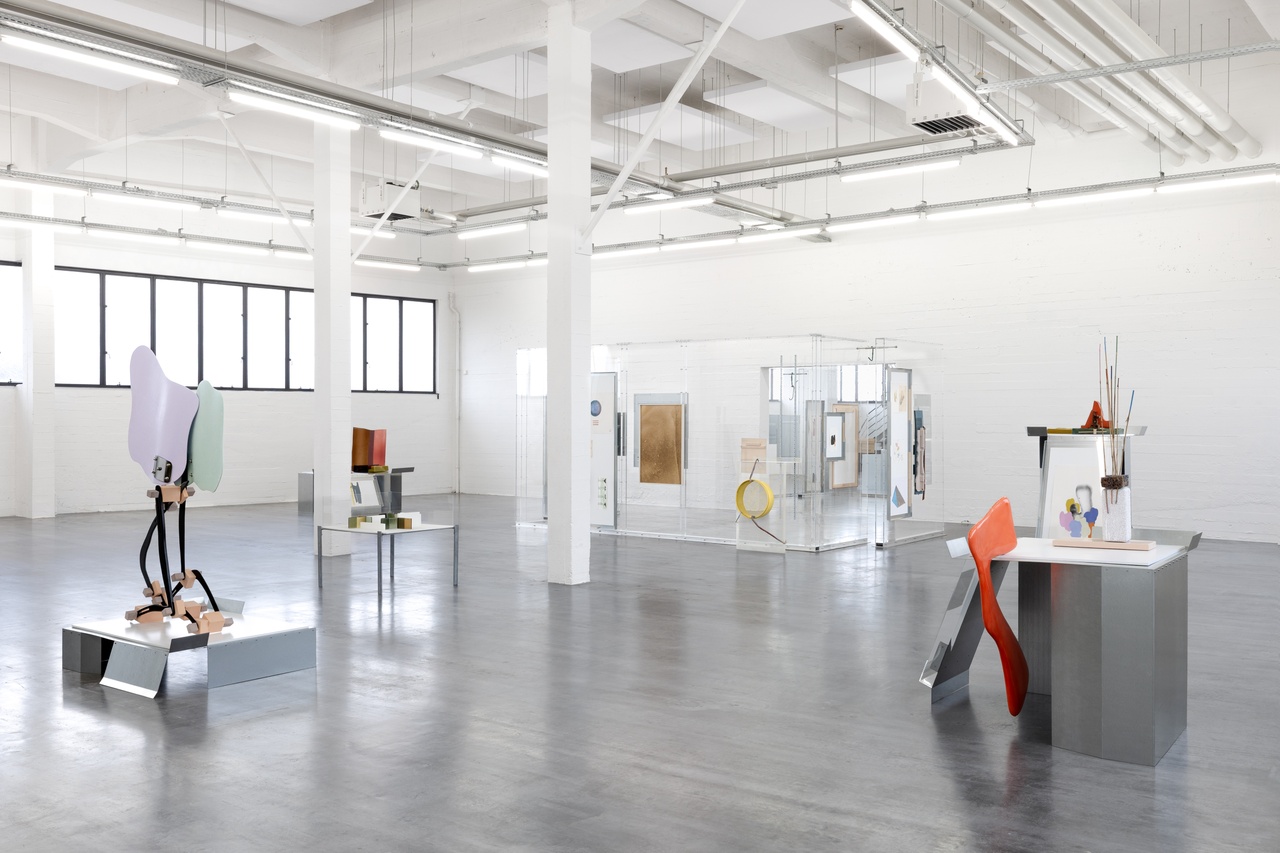
“Nairy Baghramian: nameless,” WIELS, Brussels, 2026
The one concept you can’t escape anywhere in Nairy Baghramian’s work is that of scenography. She would be the first to admit the influence on her work from the likes of theater directors Ruth Berghaus, Einar Schleef, Heiner Müller, and Frank Castorf. The way she approaches sculpture is by choreographing its presence in space and, in so doing, choreographing the space itself and its relationship with and stance toward the spectator.
Seen in this light, Baghramian’s scenographic approach to sculptural work is closely linked to the concept of theatricality as famously defined by Michael Fried. For Fried (who, we can recall, employed the concept as a sobriquet for his misgivings about Minimalism and its, in his view, codependent relationship with its viewer), theatricality was based on the “concern with the actual circumstances in which the beholder encounters the work … [to the effect that] the experience of [art defined as such] is of an object in a situation – one that, virtually by definition, includes the beholder.” [1] What is especially fruitful about theatricality and its relationship to Baghramian’s practice is to think through that definition in tandem with Fried’s friend Stanley Cavell’s interpellation of theatricality, theater, and contemporary art’s ontological prerequisites, as the condition of explicit complicity between creator and audience in the collaborative unfolding of a work of art through mutual awareness. [2] Spread over two floors in a seemingly unsystematized manner, Baghramian’s solo show at WIELS made the centrality of such a complicity for the artist’s project especially evident.
Presented on the upper floor of the WIELS Blomme building were Baghramian’s Side Leaps – an ongoing series of spatial compositions assembled from a patchwork of sketches, drawings, maquettes, acrylic slats, aluminum tables, and cabinets (plus, as the saying goes, other “diverse materials”). Resembling decorative arrangements of interior design objects, they are cognizant of all modern sculpture’s complicity in an order wherein the prerequisite or proof-of-life that certifies a given object’s or assemblage’s status as sculpture proper is the easy recognizability of its decorative unity. With that in mind, Baghramian very knowingly calls up the referents of domestic decor and “lifestyle” orchestration. One object from the Side Leaps series incorporates an assemblage of stone and straw that resembles both an upscale reed diffuser and a vase of artificial plants; another features a red boxy form topped by a globule of white styrofoam, distinctly redolent of a box of tissues. Many of the pieces pantomime a vaguely Memphis Group-esque look, but with the extravagance of postmodern design updated toward the minimal shallowness of millennial platform aesthetics.
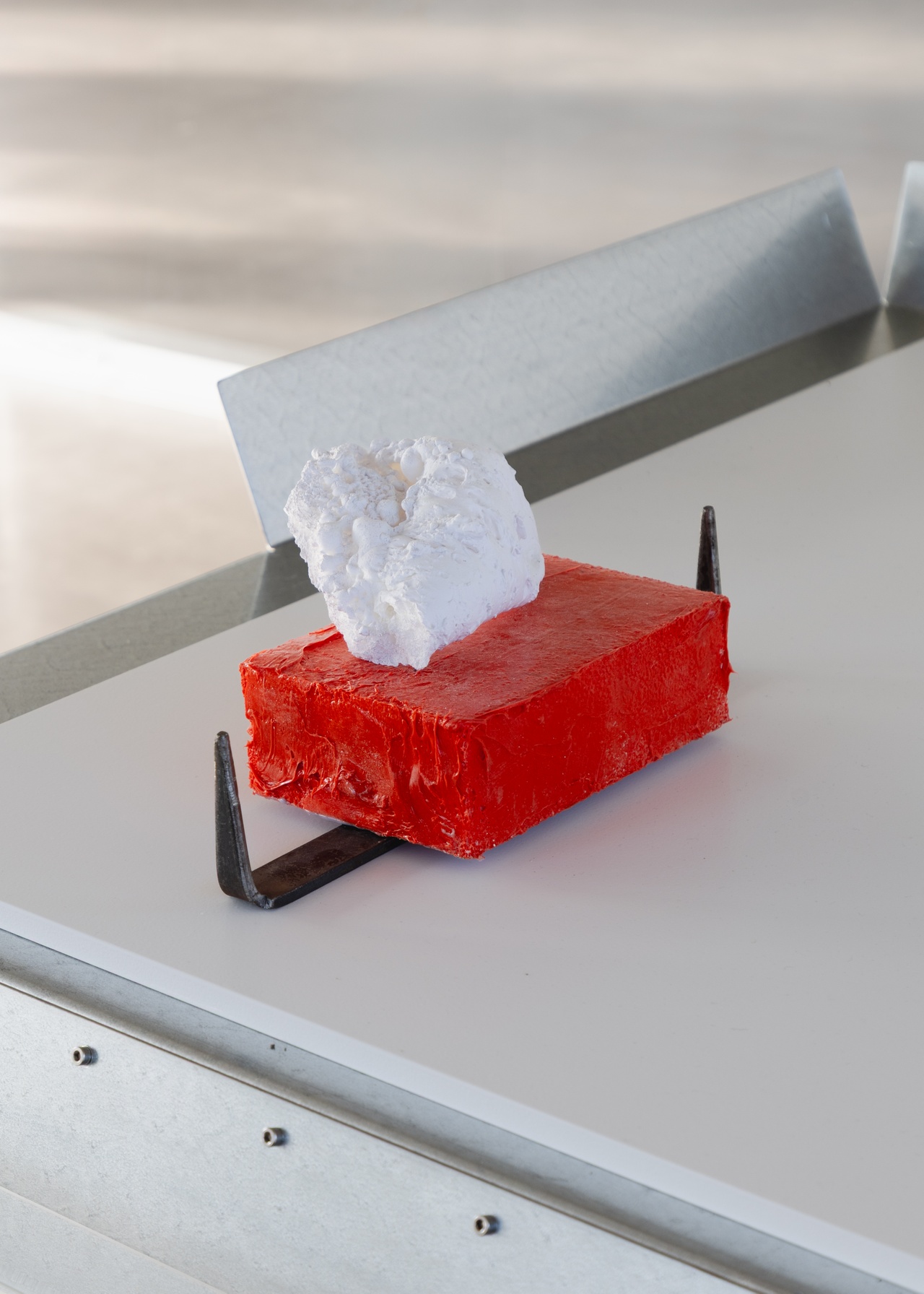
Nairy Baghramian, “Side Leaps” (detail), undated
Elfriede Jelinek’s essay on theater is called “Ich möchte seicht sein” (I want to be shallow). “The meaning of theater,” she writes, “is to be without sense, but also to demonstrate the power of the directors to keep the machinery going […]. On the stage the ornament becomes the essential thing. And what’s essential – Hold it! Step back! – becomes decoration, mere effect.” [3] Or to quote Max Ernst: Fiat modes pereat ars (Let there be fashion, down with art). This is sculpture as image: Even if the whole doesn’t make sense at first, one recognizes the decorative coherence of an overall impression and accepts the work’s original premise as an invitation to engage with it on the terms of “art.” In this way, the work demands its spectator’s attention and participation, since its disparate elements only coexist for the purpose of soliciting that attention. “As a sculptor,” Baghramian once told Artforum, “my exhibited drawings dwell in ideation. They ask me to leave them alone, to release them from their usual servile purpose by not letting them become objects. We need objects that only fit in our head.” [4] These words are instructive in their firsthand knowledge of how any object that cannot easily be reduced to an absorptive condition of an image only acquires meaning through interaction, direction, mise-en-scène, and the cooperation of the viewer – the very processes that define Baghramian’s work.
Spread along several walls of WIELS’s lower floor, nameless (2025), the work that gave this exhibition its name, consists of varying amalgamations of winding, dangling, and looping tubes – neon, mouth-blown glass, and silicone – each attached to the wall by lustrously polished aluminum brackets. The tubes evince different shades, levels of tinting, and complexity of construction; some project in long, straight lines of opaque blue or white, others undulate in twists and turns interrupted by flourishes of medicinal silicone, giving them a vague pharmaceutical lab vibe, while one droops down in a tangle of shaggy tentacles. Taken together, they bring to mind both an aestheticized vision of exposed intestines and a jumble of crawling earthworms. The pieces’ tactile surfaces are irresistibly smooth and glossy, captivating in the viscerality of their presence. The work’s positioning against, along, and around the walls, in places extending to the spots not fully accessible to the visitor, brings to the fore the spatial situation of both the piece and, more emphatically, the observer, in a real-time interaction with the room’s architecture and the physical properties of one’s immediate situation. To that effect, nameless’s resemblance to and association with commercial neon signage is not incidental. Where such signage draws one’s attention to the message it spells out, nameless disposes of the linguistic in order to emphasize the spatial emplacedness of the constructions themselves, as well as of the person confronted with them.
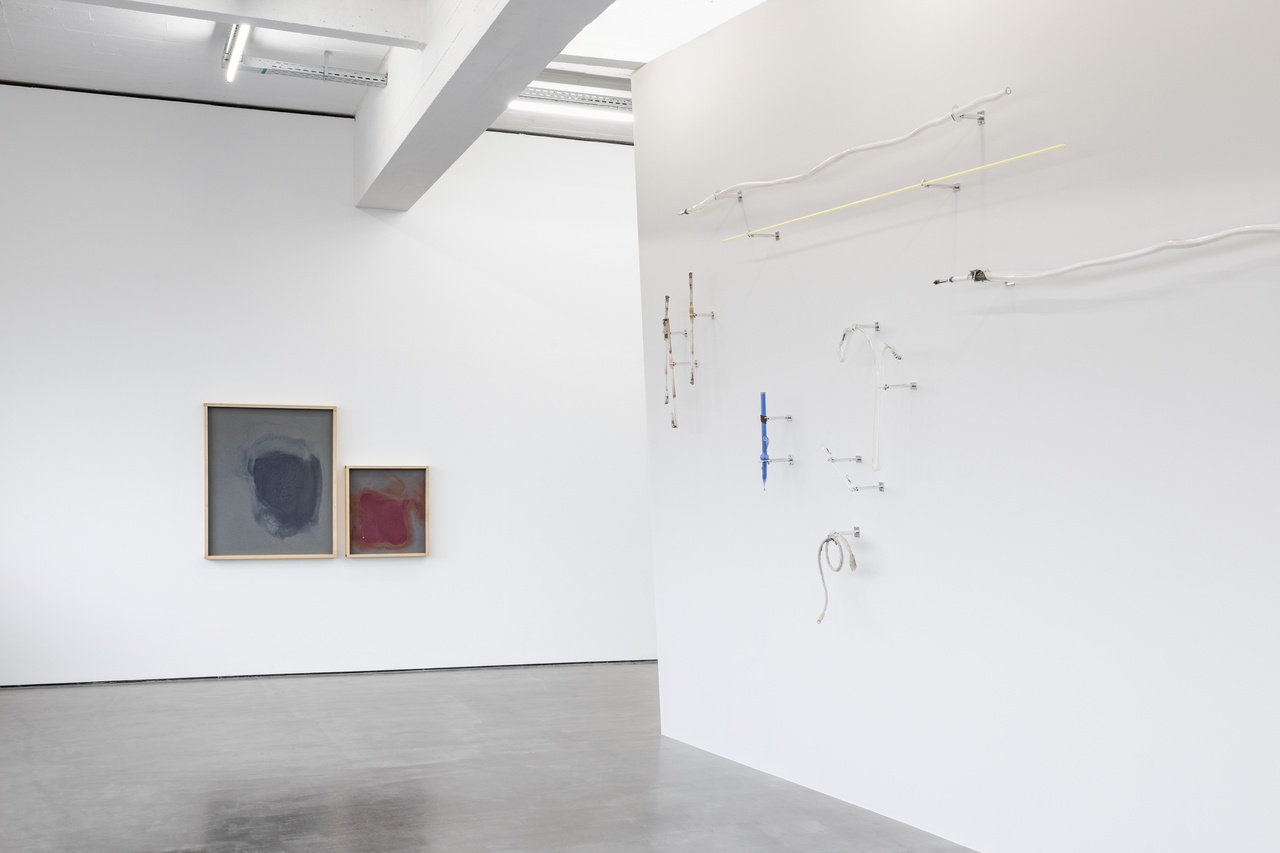
“Nairy Baghramian: nameless,” WIELS, Brussels, 2026
Returning to Fried’s notion of theatricality, it behooves one to remember that this idea is neither simply ahistorical nor amorphously theoretical but inextricably tied to the specific moment of Minimalism. Minimalism’s attention to and focalization – not to say fetishization – of surface and industrial materials is one of the movement’s banner features, and as an heir to the era’s sculptural idiom, Baghramian acknowledges and extends that legacy into her own progression of the medium. Surfaces are tremendously important to Baghramian, invariably carefully worked and never incidental – but they are so in the service of the overall hapticity of experience that the work delivers as a result of the combination of the tactile and the visceral qualities it corrals and arranges.
selves (2025), scattered around the show’s lower floor, is the series that represents surface-as-subject in its most distilled form – as framed rectangular planes of glutinous wax on oiled maple, thickly applied and pigmented in greyish pastel hues toward an impression of perpetual coalescence of latent potential images. Elsewhere, surface is focalized in other ways throughout Baghramian’s work. If there is a distinct image one carries away from the WIELS show, it’s that of plexiglass’s subtle gloss, which pervades throughout as a smoothing unifier. It brings polish and surface-level refinement to the drawings and sculptural mock-ups on paper displayed as part of the Side Leaps constructions, buffs out the edges of the wooly tubular strings integrated into one of the assemblages, and reinforces the theatrical shallowness of the scenographic arrangement when it appears as a partitioned see-through enclosure scaffolding a miscellany of elements in the middle of the gallery. Otherwise, surface is underscored by means of the aluminum panels’ burnished sleekness and the reflective shininess of glazed ceramics. Among the wide panoply of objects displayed atop, inside, and underneath the metal tables, a couple bear a distinct resemblance to Marcel Duchamp’s Wedge of Chastity (1954) – magnified, reduplicated, and rendered extra-ornamental with glossy panes of tinted glass in place of the original bronze (or was it only me who saw them as such?). To that end, hardware has always played a leading part in Baghramian’s sculptures, drawing one’s attention to normally overlooked or concealed construction elements by means of glossily polished finishes, oversized dimensions, and prominent placement, all of which serve to stress the work’s tireless refusal to coalesce into a simple two-dimensional image that can be abstracted from its localized spatiality, entrenched as this is in the dialogue with a viewer’s physical presence.
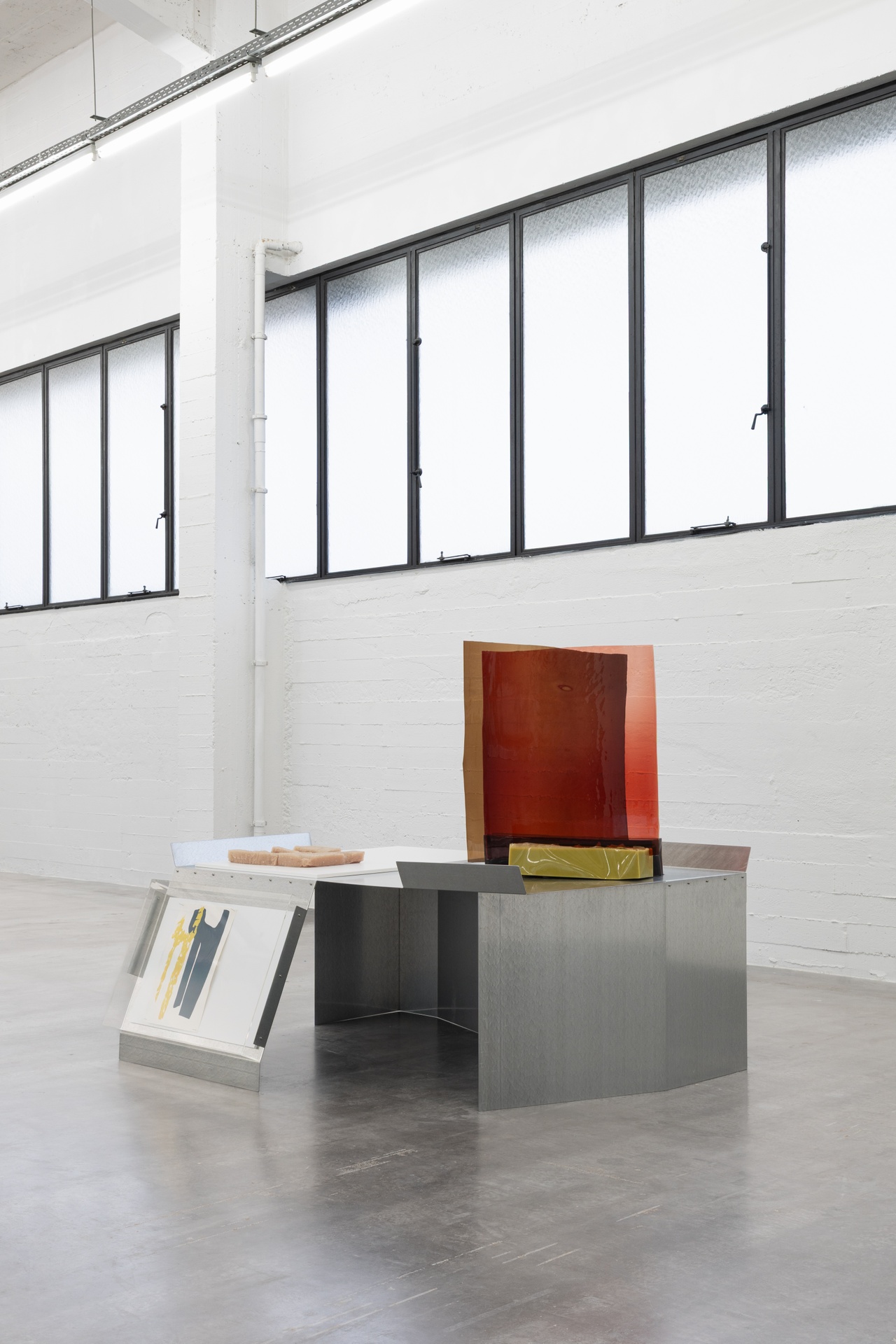
Nairy Baghramian, “Side Leaps” (detail), undated
To a similar effect, the oreiller (2025) pieces concretize the notion of weight. Amorphously shaped in curvy slabs of epoxy resin held together by solder wire, they recall both clouds and stone boulders, and perhaps blobs of AI goo, due to the vaguely jellylike, translucent aspect of their material basis. It is this combination of transparency and heft, of outward floating-ness and unavoidable physicality, that brings one into direct confrontation with the very idea of weight and its relationship to one’s own gravity-beholden situation more specifically.
There is an ethical dimension to all these operations of space creation as well. All the way back in 1976, Cavell was already observing how the modern subject, immersed in the unending stream of incoming information and constantly redirected elsewhere by a ceaseless flow of screen and news media, comes to experience reality as where “everything happening [appears] as overwhelmingly present,” and thus, “because we are actors in what is happening, nothing can be present to us to which we are not present. Of course we can still know, more than ever, what is going on. […] What we do not now know is what there is to acknowledge, what it is I am to make present, what I am to make myself present to.” [5] Needless to say, half a century onward into technology’s march of progress, that condition has become a thousandfold more acute – now compounded by the disappearance of space, or rather of enspacedness, within the parameters of the modern subject’s self-situation, endlessly diverted toward a screen-based elsewhere by an incoming stream of images. What is perhaps most valuable about the critical acuteness of Baghramian’s work, then, is its ability and interest in both emancipating the presence, imbrication, and emplacedness of the beholder while also presenting an exacerbated distillation of the present condition – a condition the artist’s work lays bare in the theatricality of its scenographic presentation.
“Nairy Baghramian: nameless,” WIELS, Brussels, October 25, 2025–March 1, 2026.
Valerie Mindlin is an art historian, critic, and curator currently based in Madrid.
Image credits: all images courtesy of WIELS, Brussels, photos Eline Willaert
Notes
| [1] | Michael Fried, Art and Objecthood: Essays and Reviews (University of Chicago Press, 1998), 153. |
| [2] | Stanley Cavell, The World Viewed: Reflections on the Ontology of Film (Harvard University Press, 1979), 111. |
| [3] | Elfriede Jelinek, “I want to be shallow” [1983], trans. Jorn Bramann. Originally published as “Ich möchte seicht sein” in Theater Heute: Jahrbuch 1983 (Friedrich Verlag, 1983), 102. |
| [4] | Amelia Stein, “Nairy Baghramian on Janette Laverrière and the Politics of Space,” Artforum, November 26, 2019. |
| [5] | Stanley Cavell, Must We Mean What We Say? (Cambridge University Press, 1976), 346–47. |