

AGENTIAL CONFIGURATIONS Beatrice von Bismarck on Bruce Nauman at Konrad Fischer, Berlin
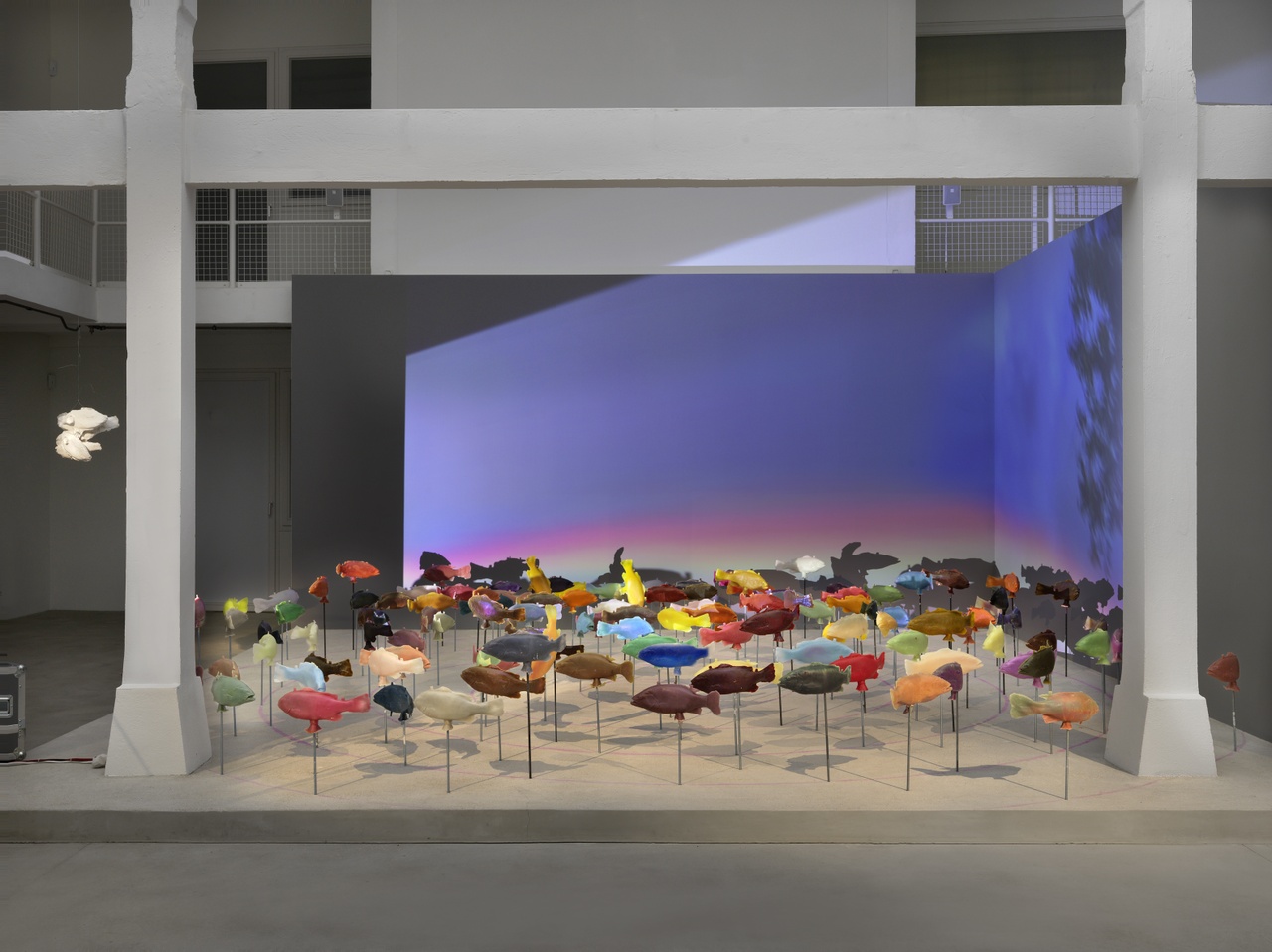
Bruce Nauman, „Fish/rainbow“, 2025
Anyone who has followed Bruce Nauman’s more than 60-year career over an extended period and visited Konrad Fischer’s Berlin branch in the fall of 2025 felt surrounded by old friends. Even though only recent works produced between 2023 and 2025 were on view, references to earlier works were readily apparent: hanging forms of human heads, animal bodies or parts thereof, and videos of the artist performing circular movements in an empty space permeate his entire oeuvre. Spread throughout the multistory gallery building were sculptures made of bronze, wax, and plaster – configured into fish, fish heads gnawed by rats, and human heads – many hanging from the ceiling. These found a thematic echo in the drawings installed on the surrounding exterior walls, all of which were grouped around two central, large-format works: the installation Fish/rainbow (2025) on one floor, consisting of 120 colorful wax fish casts arranged in a spiral, backed by a rainbow projection, and Beckett’s Chair Portrait Rotated (2025), a 3D video work filling the entire wall surface, on another. The latter’s title references an early work, Slow Angle Walk (Beckett Walk) from 1968, which is part of a group of videos created in the late 1960s in which Nauman documented actions reduced to a few sequential movements in his studio. Similarly, the fish motif appears for the first time in a 2′44″ 16mm film from 1966, Fishing for an Asian Carp, which shows Naumans friend William Allan fishing, from the preparations to the actual catch. This theme is continued in a series of works that present water-spouting fish casts as elements of larger installations, thereby revisiting another early motif that alludes to Nauman’s questioning of the artist’s role: the artist as a wondrous source of creation. With works such as Self Portrait as a Fountain (1966–67/70) and The True Artist Is an Amazing Luminous Fountain (1966), Nauman examines the possible social roles of artists as well as the ideas projected onto them. While he has increasingly replaced his own body as a waterspout with the heads of other people, taxidermy animal bodies – dogs, cats, coyotes – or with fish casts – such as One Hundred Fish Fountain (2005) – the association with a continuously flowing force of artistic creativity nonetheless remains attached to these works.
The long arcs that Nauman has been able to draw between his groups of works over several decades have become particularly apparent in his exhibitions over the last 20 years. Nauman’s revisiting of certain motifs took up questions he had explored through other themes, only to be further developed through shifts in media or technologies, introducing new twists, connections, or expansions. If the presentation at Konrad Fischer was not exhausted by such retrospective moments, this was primarily due to the topicality with which Nauman re-examined the relationship between bodily experience, being an artist, and the public sphere under technological conditions.
Testing the limits of his own body is a common theme that runs throughout Nauman’s work: the body as a manipulable tool, as the embodiment of being an artist, as the arena for physical and psychological use of force. Existence as an artist and violence; creative productivity and monotonous repetition; the seeming levity of the wordplay he uses to address the viewer and the nerve-wracking demands he places on his audience – life and death are always closely intertwined.
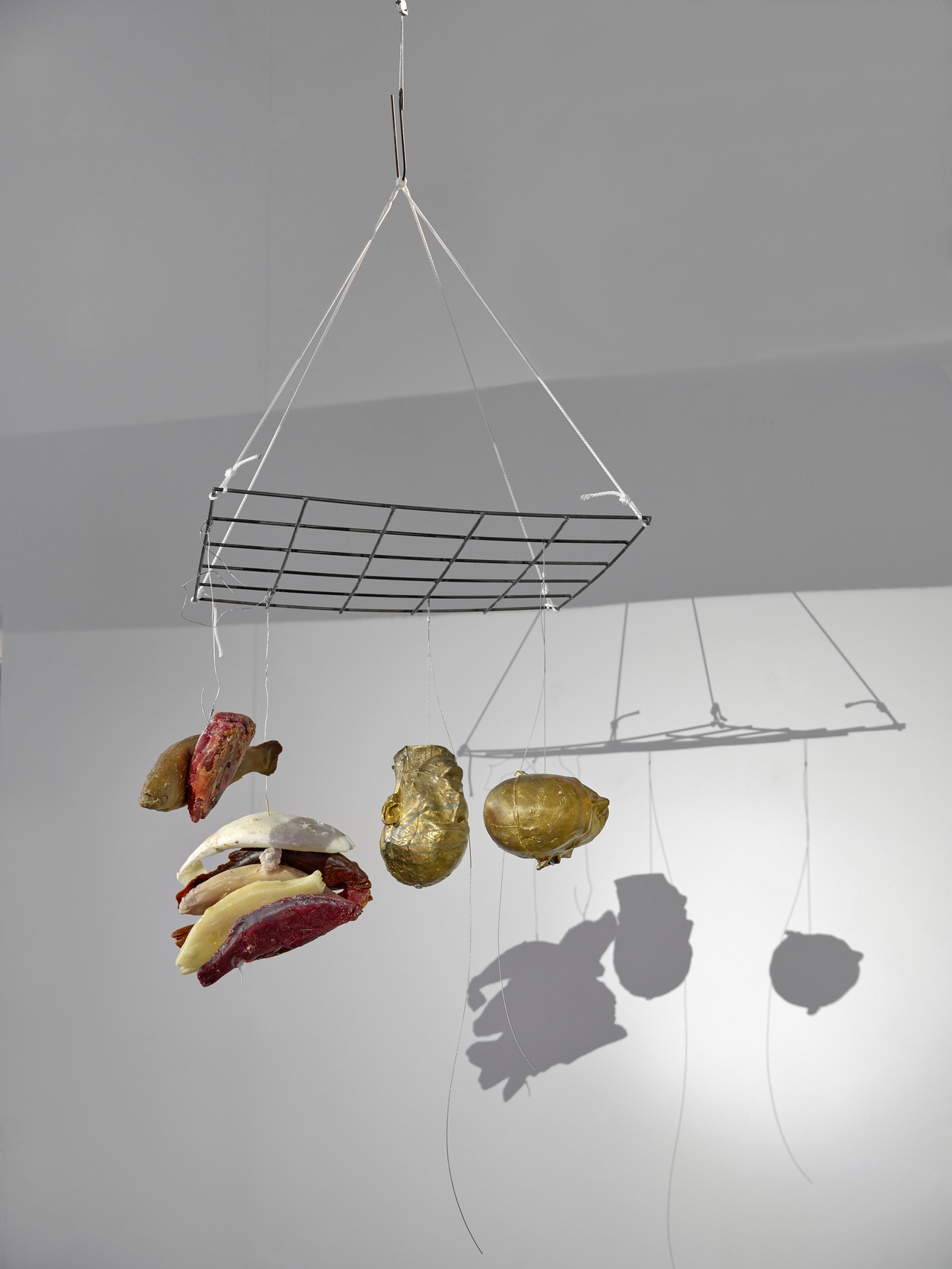
Bruce Nauman, „2 bronze heads hung with bundled damaged or packrat chewn wax fish“, 2025
In Beckett’s Chair Portrait Rotated, the conditions to which Nauman had previously subjected bodies acquire an additional dimension, one that might be described as agential. He does not manipulate the object, as he did in his early videos with a T-beam or a neon light, but rather the chair stands in a reciprocal relationship to the artist’s body: It presses into his hands, supports him, and is set in motion in ways both lingering and circular, performing almost like a dance in tandem with Nauman, who in turn can only execute these movements by relying on its support. Beyond its function as a tool, the chair takes on the characteristics of a counterpart for Nauman, which – in a form of mutual interdependent togetherness – makes it possible for him to carry out the movements he used to be able to execute on his own with ease. This new dependence on assistive forces has become an integral part of his working method. It is also revealed in the video documentation of the production process, which he presented in a public conversation with Eric Fischl. [1] In it, Nauman’s assistant is seen holding one of Nauman’s legs suspended behind him while the artist turns on the other leg. An “assisted walk,” as he called the movement in conversation, further intensifies the absurdity of the opposing forces to which Samuel Beckett subjects his character Watt: In an attempt to walk eastward, Beckett has his figure lean his upper body as far northward as possible, while his leg swings emphatically backward toward the south. That Watt gets nowhere this way, Nauman suggests, is fitting for Beckett’s work as well as for his own.
With this continuous rotation of body and chair, Beckett’s Chair Portrait Rotated set the dynamic mode for the entire presentation at Konrad Fischer. All the works seemed to be set in a circular motion that knew no end, no beginning, only closed circuits around themselves and the central works. Even though the fish bodies of Fish/rainbow pointed in opposite directions and were firmly anchored to the floor with rods, the spiral arrangement and shimmering, colored light of the rainbow – appearing and disappearing in the continuous pan of the camera from right to left – also set them in a circular motion. The galleries surrounding the two large central spaces appeared to absorb these rotations, bordered by the building’s outer walls. The space, in a sense, assumed the function of a casing, continuing and reorienting Nauman’s inquiries into the function of the studio.
The artist’s studio has always played a dual role: It is a place of retreat where work can develop away from public view and where artists can claim interpretive authority; it also functions as a motif that puts this very privacy on display, grants insight, and thus conceives the private as public. Since his early video works documenting activities in the studio, Nauman has revealed the discrepancy between control and loss of control inherent in the friction between retreating from public view and being exposed to it. Through image cropping, temporal progression, or the immersive quality of the presentation, he tests the possibilities of determining the degree of exposure, or experiments at times with relinquishing control over his image as an artist to various media technologies, or, as in Mapping the Studio I (Fat Chance John Cage) (2001), even to mice, moths, and cats.
For his current work, Beckett’s Chair Portrait Rotated, Nauman creates two arenas for the interplay between control and loss of control: On the one hand, fatigue, exhaustion, and age-related loss of strength become all the more pronounced against the backdrop of his early studio videos. His own body can no longer perform the tasks that once allowed him to determine the course of action and access to his studio. The heightened interplay between people and things is both the subject and the prerequisite of the video.
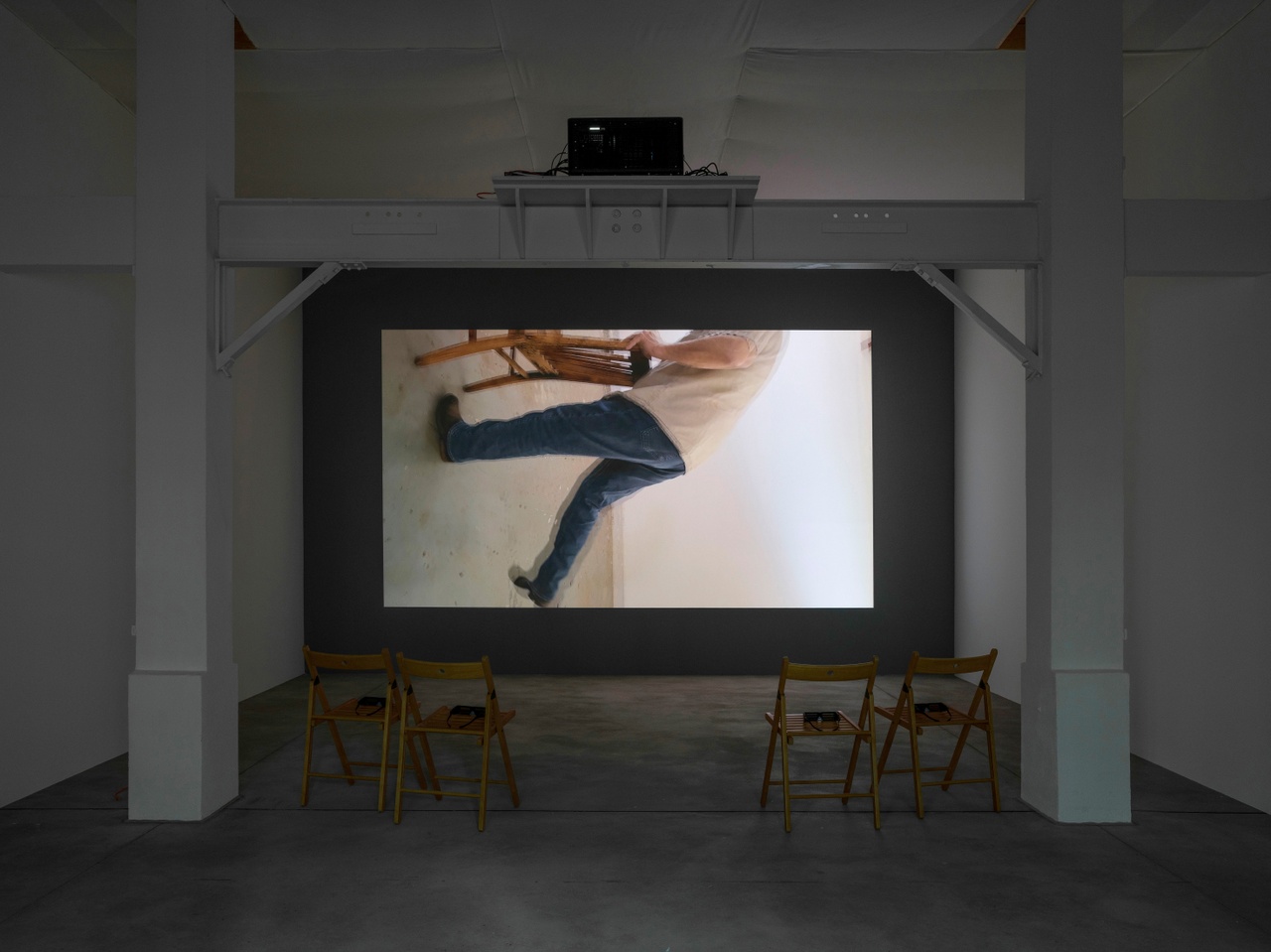
Bruce Nauman, „Beckett’s Chair Portrait Rotated“, 2025
On the other hand, Nauman opens up a further field of tension with the 3D technology he employs. This gives him a new power to regulate how viewers are included or excluded: While they can become part of his studio in a similarly immersive way, as Mapping the Studio suggests, the extreme slowing down of the image into slow motion and forcefully rotating it 90° confines the viewer to a space in front of the projection screen. The experience of being excluded from the studio intensifies for viewers when they realize that, without 3D glasses, they primarily perceive the disruption of synchronicity created by the stereoscopically filmed footage shot with two iPhone cameras from two offset perspectives. Generated is an unsettling sense of asynchrony across multiple levels, resulting from the gap between perspectives, the elongated temporality of individual movements, and, finally, the historical distance to the earlier works being referenced. Nauman exposes the distance between the viewer and the studio despite a temporary illusion of proximity, while simultaneously distancing himself from his early studio works. In contrast to those, he presents the sequence of actions only in part by omitting one participant, the assistant. Only the documentation that he later presents to an audience makes the conditions of its genesis visible. Revealing this information ultimately also means pointing to the labor involved in producing the image he is prepared to show the public. Against the backdrop of social media, this performative component cannot be completely ignored when viewing the re-staged Beckett Walk today.
This return to his earlier practice – one evidently crucial for Nauman – opens up an agential perspective on the exhibition, which assumes the participation of all human and non-human participants. The gallery thus appeared as a framing vehicle through which the work entered the public sphere. In this capacity, the building absorbed the duality of the studio, combining the function of a presentation space with that of protective enclosure. Artistic installation and site were inextricably linked as vehicles for the circular motif of movement. In this way, the building assumed the function of Nauman’s earlier corridor and room installations as a negative mold. If Stefan Neuner and Wolfram Pichler drew a parallel between these works and Nauman’s body casts, insofar that he used them to make impressions not of individual body parts but of entire sequences of actions, [2] then the function of the gallery building can be understood in an even broader sense as a cast that, as an integral part of the installation, also incorporated its historical dimension. It absorbed the various relationships that Nauman continues to examine today – from bodily, spatial, social, and economic relations, to mutual gazes and power dynamics, to visibility and disappearance – as if configured as a proper fit for his practice. Nauman thus expanded the function of casting, which initially enveloped the body, for example, with the shoulder impression, and later – in the form of corridors – the actions. What this reciprocal, interdependent form-giving signifies with regard to a living, potentially mutable cast, as in The Negative Shape of the Right Half of My Body Carved into a Living Tree (1966–67), or an empty spatial structure, as in Room with My Soul Left Out/Room That Does Not Care (1984), may remain for now an open question.
Translation: Erik Smith
“Bruce Nauman,” Galerie Konrad Fischer, Berlin, September 12–December 20, 2025.
Beatrice von Bismarck is an art historian, cultural theorist, and curator. From 1989 to 1993, she worked at the Städelsches Kunstinstitut and Städtische Galerie in Frankfurt am Main as curator of the 20th century department, and from 1993 to 1999, she was cofounder and codirector of the Kunstraum at Leuphana University of Lüneburg. From 1999 to 2025, she taught at the Academy of Fine Arts Leipzig (HGB), where she initiated the “Cultures of the Curatorial” MA program in 2009. From 2017 to 2018, she codirected the TRANScuratorial Academy, which traveled from Berlin to Mumbai and Phnom Penh. For her research project on the curatorial, she received an Opus Magnum grant from the Volkswagen Foundation. Her most recent publications include the collected volume Archives on Show: Revoicing, Shapeshifting, Displacing – A Curatorial Glossary (Archive Books, 2022; editor), the conference proceedings Broken Relations: Infrastructure, Aesthetics, and Critique (Spector Books, 2022; coeditor) and the monograph The Curatorial Condition (Sternberg Press, 2022).
Image Credit: © Bruce Nauman / VG Bild-Kunst, Bonn, courtesy Konrad Fischer Galerie, photos Bernd Borchardt
Notes
| [1] | Bruce Nauman in conversation with Eric Fischl, July 6, 2025, posted September 30, 2025 by The Church Sag Harbour, YouTube, 59:31. |
| [2] | Stefan Neuner and Wolfram Pichler, “Das umgestülpte Spiegelbild: Zur plastischen Form von Bruce Naumans Live-Taped Video Corridor,” in Bruce Nauman: A Contemporary, ed. Eva Ehninger and Martina Venanzoni (Laurenz-Stiftung; Schaulager, 2018), 59–92, at 78. |