

TRANSFORMATIVE ARENAS Daniel Birnbaum on Kerry James Marshall at the Royal Academy of Arts, London, and Gerhard Richter at the Fondation Louis Vuitton, Paris
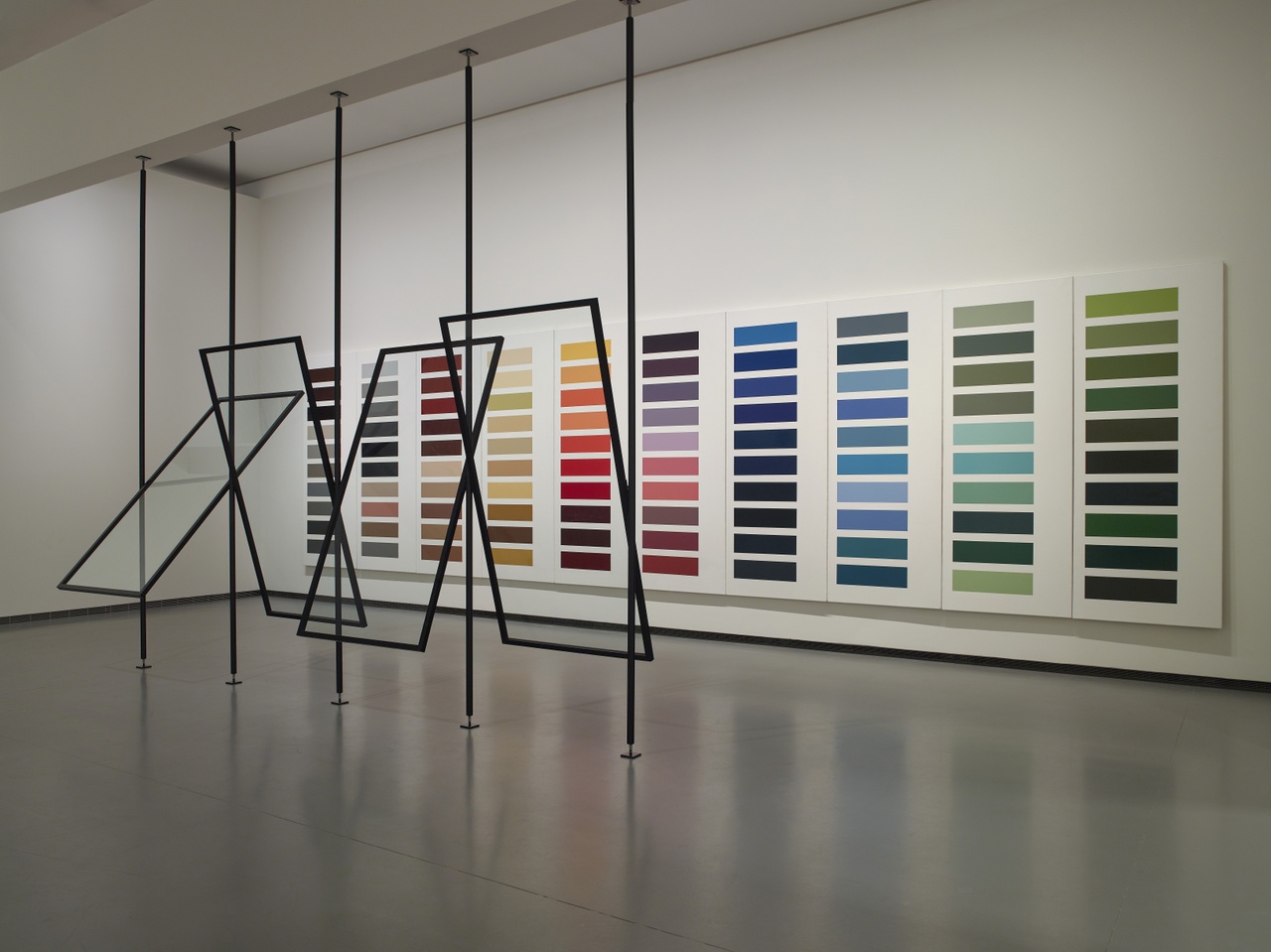
“Gerhard Richter,” Fondation Louis Vuitton, Paris, 2025–26
Two ambitious surveys of significant contemporary painters – Gerhard Richter at the Fondation Louis Vuitton in Paris and Kerry James Marshall at London’s Royal Academy of Arts – raise fundamental questions about history painting and about the theoretical frameworks within which works of art are received today. A comparison – or should I call it a confrontation? – seems fruitful.
No other painter’s work has, to my knowledge, been so meticulously examined through the lenses of critical theory and notions such as commodification and the culture industry as Richter’s. The blur, one of his signature strategies, destabilizes photographic certainty. It interrupts, so we have been told by Benjamin H. D. Buchloh, the smooth consumption of images and acts as a formal resistance to commodification and spectacle culture. Richter’s works thus supposedly reject the culture industry’s demands, and yet, simultaneously, they have become high-value commodities within it. This tension – critique entwined with complicity – is not a flaw but, I would argue, essential to how his practice should be understood. Richter does not stand outside the system, diagnosing its ailments. Rather, he works within the compromised field of contemporary visuality, generating works that dramatize their own impossibility. That Richter’s largest retrospective to date is staged at an institution deeply embedded in luxury branding seems worth taking into consideration when trying to assess the significance of his work today. Perhaps it’s the ideal location, one that amplifies the contradictions his art performs.
The institutional context of Marshall’s exhibition is, it seems to me, also of relevance. No other contemporary painter has so powerfully and consistently confronted the aftereffects of slavery, making its enduring legacies visible in visually mesmerizing ways. What does it tell us that Marshall’s large European survey is staged at an institution deeply entwined with the continent’s colonial history – its founding members and patrons sometimes directly connected to trade networks, including those enriched by slavery? Perhaps it’s the perfect stage for his ambitious history paintings that explore what Mark Godfrey, the exhibition’s curator, refers to as the traumatic impact of the transatlantic slave trade. [1]
The vast Richter retrospective in Paris, curated by Dieter Schwarz and Nicholas Serota, offers a unique chance to see the most significant works from all periods gathered in a way that I doubt will ever happen again. Yes, they are all on display: the early photographic Uncle Rudi (1965) and Aunt Marianne (1965); his precious portraits of wives and children; the dead-serious Baader-Meinhof suite (1988); stubbornly monotonous studies of the color gray; increasingly explosive and colorful abstract pictures; still lifes and landscapes flirting with the sublime; works using mirrors and glass – consciously or unconsciously late reactions to Marcel Duchamp’s legendary delay in glass.
Are there any flaws in the selection? Anything missing? Well, personally, I would gladly have exchanged the selection of late drawings for parts of the Atlas project, Richter’s expansive visual archive that documents his sources. But repeatedly, the exhibition offers views and juxtapositions that will remain in my memory: Ten Large Colour Panels (1966) seen through 4 Panes of Glass (1967) presents a Duchampian end and a continuation in spite of everything. To repeatedly come across intensely colorful abstractions first as reflections in mirrors and then as physical canvases is an unusual experience that I enjoyed without really knowing why.
And then there are those individual works that are so captivating that no curatorial mediation trick would be welcome. I am thinking first and foremost of Ema (Nude on a Staircase) (1966), the first painting after a color photograph taken by the artist himself. The motif, of course, alludes to Duchamp’s mechanistic Nude Descending a Staircase (No. 2) (1912), but Richter does not dissolve the body into machinic segments. He makes the movement soft, intimate. Ema is not a mechanical body but a loved one.
Is this painting simply too visually appealing, too auratic in ways we can no longer accept? That is the dilemma Buchloh confronts in “A Nude in the Neo-Avant-Garde,” one of the most sophisticated readings of a single work of art I am aware of from recent years. [2] Fragments from that essay’s many meandering arguments drift around in my mind as I continue walking through the exhibition. It is striking to what extent Buchloh’s writings have influenced the reception of Richter’s oeuvre – defining his art as one that refuses redemption, stages contradiction, and resists both political instrumentalization and aesthetic consolation.
Someone will, I hope, write a comparably sophisticated essay on one of Marshall’s most complex works – De Style (1993), perhaps, or School of Beauty, School of Culture (2012). Both paintings display the joys of everyday Black life: five stylish men in a barber shop; a lively scene in a beauty parlor. They are maze-like and multilayered. The attentive viewer recognizes a multiplicity of spectacular visual effects borrowed from the greatest painters in the Western tradition, from Diego Velázquez and Hans Holbein the Younger to Édouard Manet.
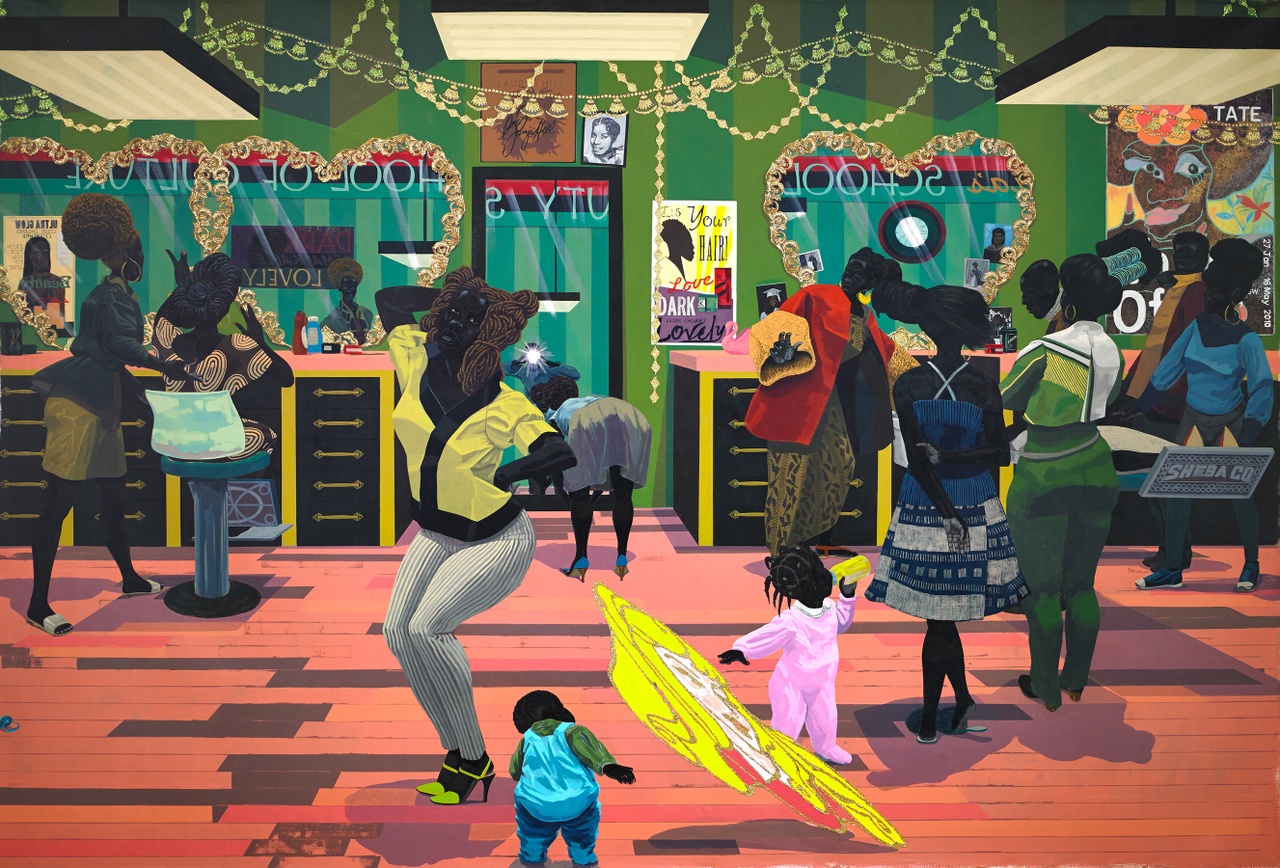
Kerry James Marshall, “School of Beauty, School of Culture,” 2012
In School of Beauty, School of Culture, references to Las Meninas (1656) and A Bar at the Folies-Bergère (1882) exist side by side with citations from contemporary visual sources: a poster for Chris Ofili at the Tate Britain, and another showing Lauryn Hill. Hovering at the center of the picture is an anamorphic shape positioned in a way that is an obvious reference to Holbein’s The Ambassadors (1553). Two toddlers playing on the floor seem to be exploring the mysterious contour. Seen from the correct angle, Walt Disney’s Sleeping Beauty emerges. Thus, as a secret reminder, a small symbol of the dominant white beauty ideal hovers in the middle of the Black women’s beauty salon.
In works like De Style and this, Black subjects are given the attention they have been denied in the art on display at major museums across the world. Marshall renders them visible in his hugely ambitious paintings. He has never made it a secret that his main objective is to achieve exactly that. The critical reception of his art in recent years and the influence he exerts today, also on theoretical discourse, point to a shift in attitude toward painterly and institutional devices previously routinely viewed with skepticism. Even the postmodern museum, home to the abhorrent blockbuster exhibition, appears in a new light. Perhaps these despised amplifiers should not be dismissed but utilized as “transformative arenas,” sites where history can be rewritten and the future redirected. [3]
“The importance of the impossibility and refusal in the Frankfurt School-tinged discourse on history painting seemed irrelevant in front of a painting of such care and ambition,” [4] writes Godfrey about his first encounter with School of Beauty, School of Culture. Is it time for the critical theorist to “exit” – to quote the title of Buchloh’s most recent publication, in which he spells out his own sense of obsolescence? [5]
Another approach, one that entails an enormous theoretical effort, would be to acknowledge the structural limitations of those influential texts of the Frankfurt School in which the plantation, the slave ship, and the colonial frontier appear only as distant shadows, if they appear at all. One would need to acknowledge that without colonial extraction, the commodity form would not have achieved its world-historical reach. One would need to admit that a genealogy of modern art that treats these histories as marginal reproduces the very blind spots that Euro-modernity itself depends on.
What better place to begin this work than Marshall’s Middle Passage series? Take a close look at Terra Incognita (1991) with its list of main “commodities” extracted from the African continent: “GOLD”, “IVORY”, “NEGROES”.
Clearly, Godfrey is not quite willing to let go entirely of “Frankfurt School-tinged discourse,” since he invites one of its most influential representatives – yes, Buchloh again – to contribute to the exhibition’s catalogue in the form of a conversation with Marshall. It is placed at the front of the publication, symbolically setting the stage. [6]
This exchange, full of attempts to understand differences and not shying away from confrontation, is another possible place to begin the demanding task of developing a transfigured critical theory. No doubt, Marshall exposes limitations in the kind of discourse that has dominated critical theory in the art world. He insists on themes both more general – “I don’t write in Chinese” – and seemingly more specific: “There is no real difference between writing your name and making a painting. When we do more than is necessary, we call that artistry.” Yes, names no doubt can be critical arenas, too. [7]
It becomes obvious that concepts such as abstraction, the index, or the readymade – of key importance to the reception of Richter – prove of limited use for grasping what is at stake in Marshall’s work: the ethical, historical, and aesthetic afterlives of slavery and the global structures of domination that they continue to organize.
“Gerhard Richter,” Fondation Louis Vuitton, Paris, October 17, 2025–March 2, 2026.
“Kerry James Marshall: The Histories,” Royal Academy of Arts, London, September 20, 2025–January 18, 2026.
Daniel Birnbaum is a writer and curator based in Paris. He is a professor of philosophy at the Hochschule für Bildende Künste – Städelschule in Frankfurt am Main and the cofounder of the Institute for Art Criticism there.
Image credits: 1. © Fondation Louis Vuitton, Collection Herbert Foundation, Collection NRW-Forum, photo Marc Domage; 2. © Kerry James Marshall, Courtesy of the artist and Jack Shainman Gallery, Collection of the Birmingham Museum of Art, photo Sean Pathasema
Notes
| [1] | Mark Godfrey, “Kerry James Marshall: The Histories,” in Kerry James Marshall: The Histories, ed. Mark Godfrey (Royal Academy of Arts, 2025), 39. |
| [2] | Benjamin H. D. Buchloh, “A Nude in the Neo-Avant-Garde: Ema (Nude on a Staircase), 1966,” in Painting Beyond Itself: The Medium in the Post-Medium Condition, ed. Isabelle Graw and Ewa Lajer-Burcharth (Sternberg Press, 2016), 229–68. |
| [3] | The museum as a “transformative arena” was discussed in Elena Filipovic’s laudation to the artist on the occasion of Marshall being awarded the 2014 Wolfgang Hahn Prize by the Gesellschaft für Moderne Kunst at the Museum Ludwig (Cologne, April 12, 2014). |
| [4] | Godfrey, “Kerry James Marshall: The Histories,” 120. |
| [5] | Benjamin H. D. Buchloh and Hal Foster, Exit Interview (No Place Press, 2024). |
| [6] | “Radical Pragmatism: Kerry James Marshall in Conversation with Benjamin H. D. Buchloh,” in Godfrey, Kerry James Marshall, 10–17. |
| [7] | As is well-known, the name functioned as a critical arena of power, violence, and resistance within the transatlantic slave trade. Enslaved Africans were routinely stripped of their original names – names that carried lineage, cosmology, ethnic identity, and social belonging – and were assigned new ones by enslavers as a means of asserting ownership and erasing personhood. Yet the arena of naming also became a site of agency: Many enslaved people preserved African naming practices in secret, adapted them creatively, or reclaimed them after emancipation, using names to assert self-definition. The Nazi naming regulation of 1938 used bureaucratic means to enforce racial categorization by restricting Old Testament names to Jews and prohibiting “Aryans” from choosing them. Implemented through amendments to the law on family and given names, the policy required Jewish individuals to adopt names from an official list while ensuring these same names were barred to non-Jews. A kind of “artistry” is thus obviously involved in the name of Benjamin H. D. Buchloh. It seems unlikely that Buchloh’s father, described in Exit Interview as a small-time Nazi, in 1941 would have added the name Benjamin to the bureaucratically acceptable Heinz-Dieter (H. D.). If instead the young Buchloh himself created this nom de plume – not exactly a neutral one in the critical landscape of postwar Germany – it would seem to represent a strong investment in a historically specific critical paradigm and should perhaps be understood in the context of Jürgen Habermas naming his daughters Rebekka and Judith. I am surprised that Foster shows no interest in this topic in his otherwise so informative conversation with Buchloh in Exit Interview. |