

FASHION AT THE END OF THE WORLD Joel Danilewitz on Women’s History Museum at Amant, New York
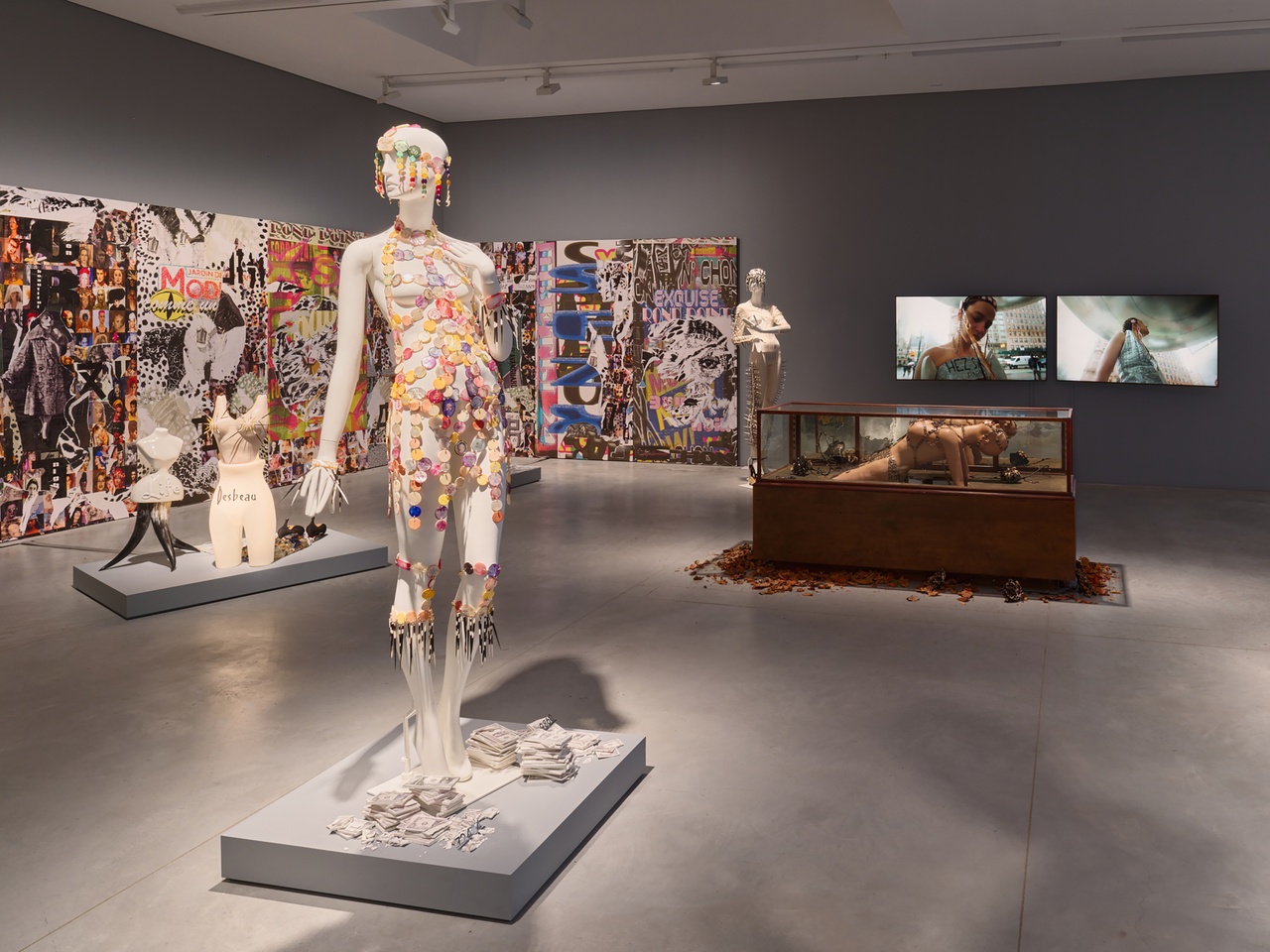
“Women’s History Museum: Grisette à l’enfer,” Amant, New York, 2025–26
The eschatology of fashion is prophesized in its past: a history choked in grime and broken glass, set ablaze in burning factories without emergency exits. Exploitation of feminized labor recurs like a biblical premonition, just as Dinah’s abduction in Genesis presages David’s abuse of Bathsheba, or how the lineage of Noah’s Ark plays out in contemporary Armageddons. We can’t say we didn’t see this coming – history is just a filthy cycle of apocalyptic brutality.
For Women’s History Museum, a label and vintage store led by Mattie Barringer and Amanda McGowan, the annals of fashion are covered in shit and glistening rhinestones. In this doomerist modality, the friction between labor, femininity, and style engenders the grisette, Barringer and McGowan’s muse for their first institutional exhibition, “Grisette l’enfer” (Grisette in Hell). As a French 17th-century paradigm that metonymizes the various roles women took on in the fashion industry at the time, the grisette typically worked multiple jobs at once, serving as seamstress and model, shopgirl and it-girl. She also experienced the brunt of fashion’s underhanded capitalistic origins, as a factory worker and sexualized ideal of womanhood.
In “Grisette l’enfer,” glamour is a means to an end, a sorcerous diversion from an industry whose primary currency is irreconcilable illusion generated through exploitative labor malpractice. Fashion’s cruel mendaciousness is what we pay for, and as Natasha Stagg points out, “fashion is elitist, and therefore will always necessarily be ugly and hypocritical. But this inability to resolve into some moral right or wrong is what makes it so irresistible.” [1]
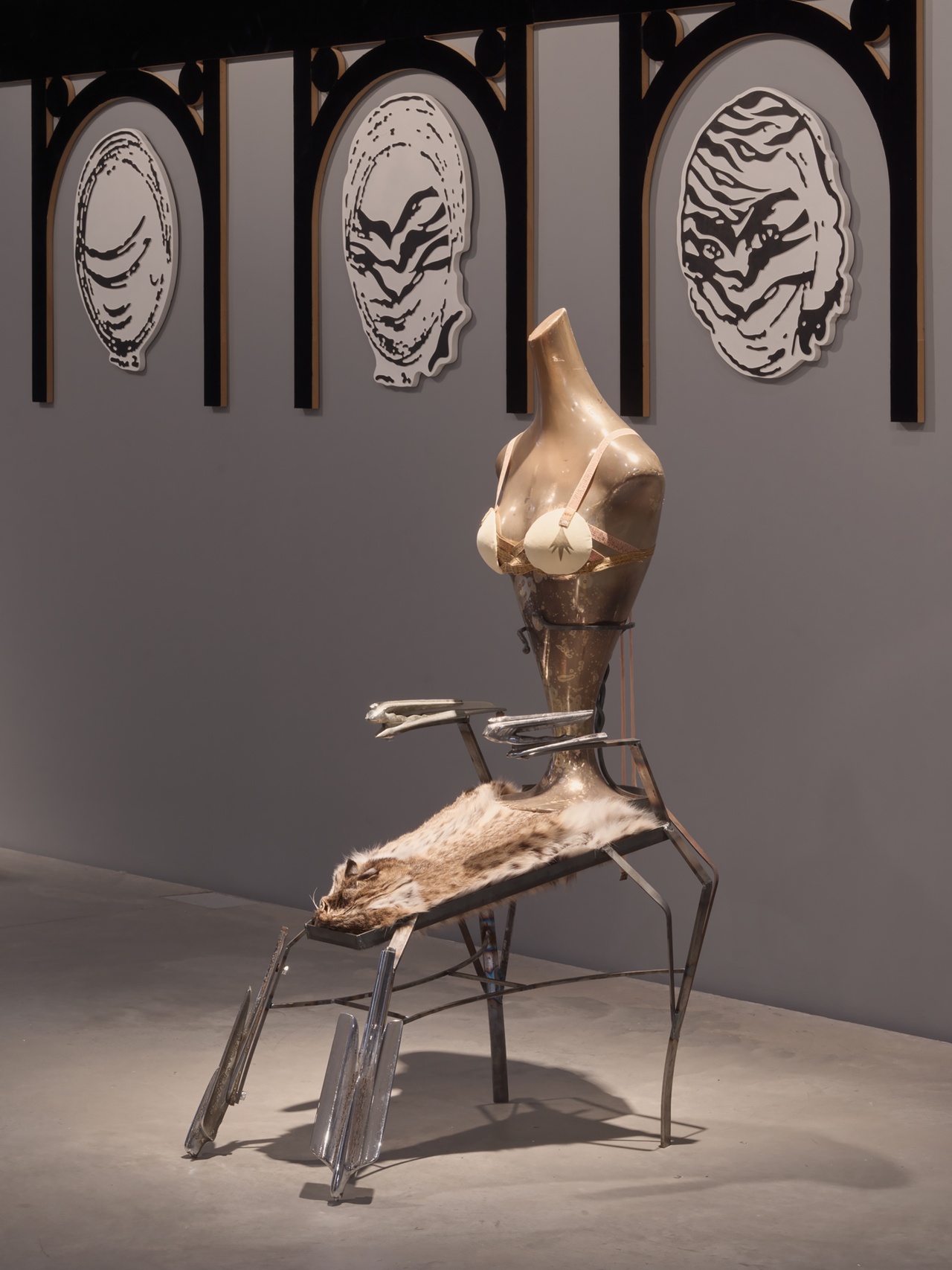
Barringer and McGowan’s designs are recombinant forms of grit and glitz, demonstrating the recursive nature of the grisette in garments that indicate her transcendent temporality. The exhibition pulls viewers into a sepia-tinted diorama interspersed with uncanny mannequin-like figures. One with amber leopard-print skin stands vaulted from the floor on high heels with vertiginous platform extensions, wearing a bra of pigeons while more birds float around her, long strips of silk threaded with damask patterns clutched in their beaks. Some models have more naturalized facial features, while others remain faceless. One has thin metal poles for appendages, another’s torso is a jewelry box, and nearly all have bobcat-clawed high heels. Shopping bags tossed aside appropriate famous logo typefaces; one sees Women’s History Museum’s initials styled like those of Walter Van Beirendonck’s ’90s label Wild & Lethal Trash (W.&L.T.), whose Day-Glo red “KISS THE FUTURE” slogan has been replaced by one reading “KISS THE RAPTURE.” Fashion incites lapsarian decay. “People only want things they’ve already seen,” decries the nameless vintage consigner in WHM’s short film The Massive Disposal of Experience (2022), which plays near the back of the exhibition; “they don’t want something new.” And yet, it’s WHM’s chimerical take on the ghosts of fashion past that make the gowns and dresses feel if not “new,” then enlivened by an oblique perspective on fashion’s historical recklessness.
Resisting outright fetishism, Lit reliquaire de Mary Magdalene (2025) postulates voyeurism as a means of exchange. Holding herself with her forearms in a supplicant pose is a mannequin in a Victorian antique box – a figure with large breasts and a narrow waist who emulates both contemporary sex-store mannequins and ancient Venus figurines. Wearing a body cage made of US pennies, she bends backward on her knees as scorpions crawl along her legs and cheetah-print florals and crushes of dead leaves snake around her on a metal vine. The penny, the lowest form of US currency and one that is now on the brink of extinction, becomes a chain-mail enclosure, suggesting the grisette is imprisoned within a concurrence of undervaluation and overexposure. [2] The work’s title refers to a reliquary for Mary Magdalene’s alleged remains in southern France. Magdalene, a sex worker who was considered Jesus’s closest follower, invokes the historical intricacies of piety, sexuality, and commerce that have been projected onto women throughout time.
“Women’s History Museum: Grisette à l’enfer,” Amant, New York, 2025–26
The mannequins transform from fashion vessels into rusted bionic women, hybrid figures that, unlike a typical mannequin, reject the stylist’s projection and instead take on their own personas. Several of the mannequins are unaltered loaners from the Costume Institute of the Metropolitan Museum of Art, underscoring an interest in the history of fashion as avant-garde art. Given fashion’s overreliance on supply chains and consumer appetites, starkly opposed by the antiestablishment ethos of the avant-garde, WHM never really settles into either movement. But it’s the designers’ refusal to iron out any tensions that makes the grisette a paragon of mutable desire. One wears a white skirt suit with pagoda shoulders and panels of broken glass that have been fused back together, crowned with a dripping headpiece of crystal-blue shards. At once a businesswoman and a fashion plate, her legs crossed into a somewhat impossible pose, she also becomes a fluid symbol of feminine signification.
Walking into the tableau vivant of “Grisette l’enfer,” spectators encounter a wide range of fashion’s defunct physical and commercial manifestations, from Walter Benjamin’s arcades to the 1945–46 “Théâtre de la Mode,” a touring exhibit of dressed mannequins that sought to revive couture in postwar France. A vignette near the space’s entrance depicts a burning wooden shack, the ground in front of it strewn with crushed ceramic dollar bills and other debris. Here, WHM depicts the fashion industry’s brittle promises with a gauntleted heavy-handedness that risks ossifying into rigid agitprop, while the burning shed almost too readily transports audiences to garment manufacturing’s most calamitous and grotesque episodes, from the Triangle Shirtwaist Factory fire of 1911 to the Dhaka garment factory fire of 2012. As explicit as these props and set pieces appear, the imagery also gestures more subtly to fashion as a form of regulatory capture; one recalls John Galliano’s Spring/Summer 2000 Dior collection and its aestheticization of poverty or Vivienne Westwood’s upcycled punk archetypes, implicating everyone who participates in fashion (wittingly or not) as regimenting popular and communal behaviors.
On the opposite wall, the words “FOR A MOMENT I HAVE NO PAIN” are written in glossy art deco letters as a veil slowly lifts across six faces. Can a woman avail herself of pleasure while participating in this hypocritical economy? WHM seems to think she can, though this may come at the expense of genuine dignity for herself and for others. The grisette was not as alienated from her labor as those working at the bottom of fashion’s production chain today; her close proximity to her industry was actually the tinderbox that generated enough friction to spark her existence. The original sin of fashion lies in this contradictory entanglement of exploitation and glamour, and though the bulk of today’s fashion items are made by distant garment makers whose working conditions cannot be romanticized, fashion still carries a trace of this genesis in its symbolic output. The grisettes exist behind the show’s diaphanous rectangular curtains, illusory yet forthcoming, approximating with louche charm our violent expectations of feminine labor.
“Women’s History Museum: Grisette à l’enfer,” Amant, New York, September 18, 2025–February 15, 2026.
Joel Danilewitz is an art writer who lives in New York.
Image credits: Courtesy of the artists and Amant, Brooklyn, NY, photos New Document
Notes
| [1] | Natasha Stagg, Sleeveless: Fashion, Image, Media, New York 2011–2019 (Semiotext(e)/Native Agents, 2019), 93. Originally published as “Access Coding,” Texte zur Kunst, no. 102 (2016): 98. |
| [2] | Maryclaire Dale, “US Mint Presses Final Pennies as Production Ends After More than 230 Years,” AP News, November 18, 2025. |