

BREADMAKERS/BREADWINNERS A Roundtable on the Tradwife Phenomenon with Petra Cortright, Birgit Sauer, and Friederike Sigler, moderated by TZK
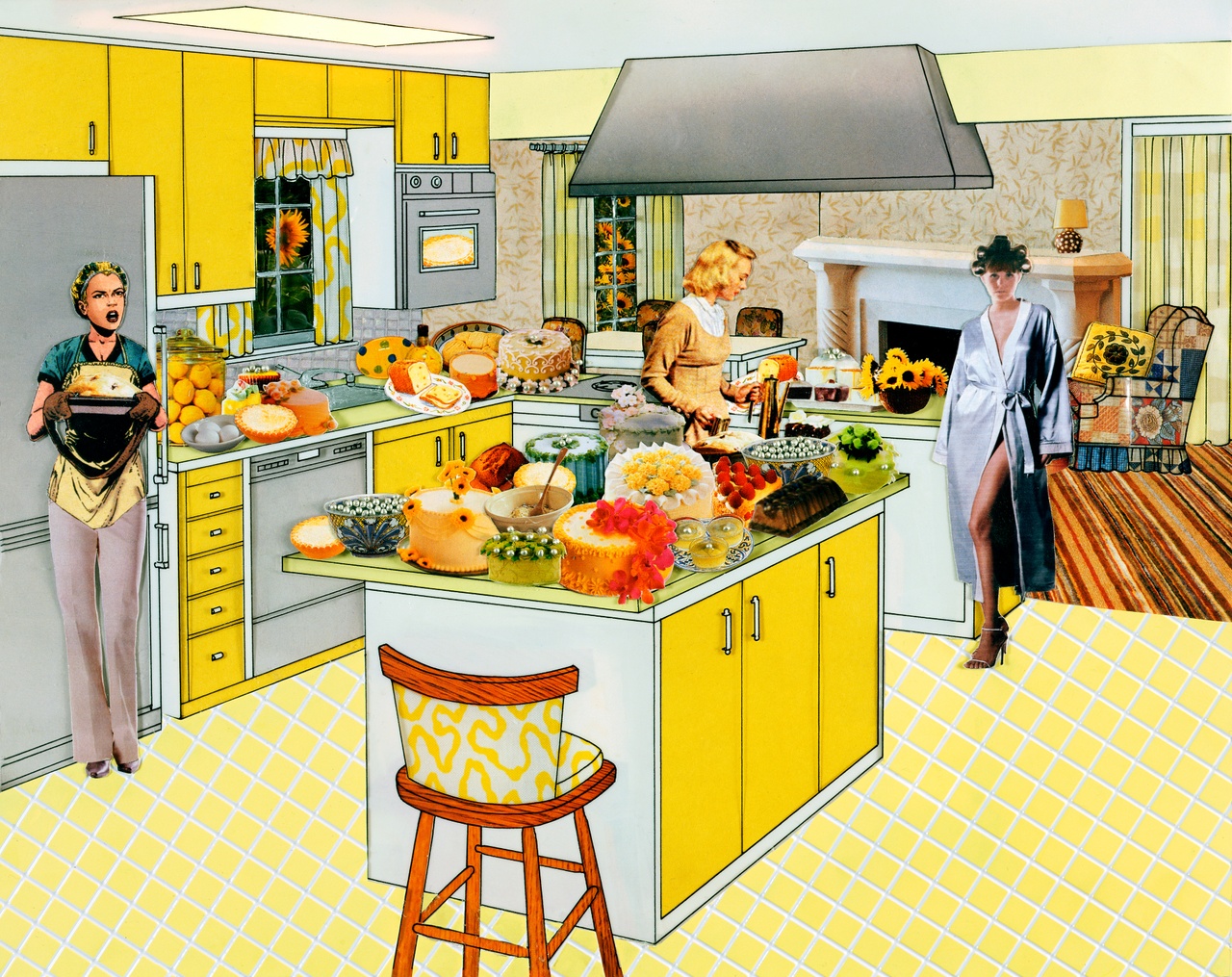
Laurie Simmons, “The Instant Decorator (Yellow Kitchen),” 2003
TZK: On closer inspection, the phenomenon of the tradwife, with its anti-feminist return to conservative values, is not only astoundingly heterogeneous but also contradictory. To what extent do you consider it part of a current misogynistic backlash?
PETRA CORTRIGHT: For me, it’s important to first draw a distinction between tradwives as an internet phenomenon and motherhood at large. Because there’s the assumption recently that every mother with a penchant for homemaking is also a tradwife, while in fact these are two very separate things. I understand the idea of the tradwife as a backlash to feminism, but I also perceive it as a response to certain failures of feminism. And as a working mother of two, I must say that I also understand the appeal. Making digital art allows me to work from home. But in my experience, the art world is very anti-natal, and it blurs the private and professional realms to an extent that can be pretty brutal if you have children. A few years ago, a very well-known blue-chip gallerist in Los Angeles disclosed to my art dealer that it was a bad look for me to be married, that I should better look available for the art world. Especially in the United States, it’s very difficult to be a working mother in any line of work, because childcare is incredibly expensive. But of course, people are out of their minds if they believe that they could simply return to a 1950s lifestyle to solve their problems. They’re being nostalgic about a time that was very miserable for women.
BIRGIT SAUER: Tradwives are anti-feminist because they believe heteronormativity is the best way to live a relationship. Because they don’t believe that women should be treated as equal to men and think that they should not participate in the labor market. They also have an essentially anti-modern position, while at the same time they indeed respond to the contradictions of capitalism that negate care work. I don’t think it’s feminism creating these contradictions for mothers on the labor market, Petra; it’s the carelessness of capitalism. Being in the labor market as a mother is exhausting, and staying at home as a mother is presented as an alternative to competitive and exploitative neoliberal work environments. However contradictory and ambivalent the phenomenon is, the mere fact that many tradwives blame feminism for these contradictions instead of addressing the real cause, which is the capitalist organization of life, makes them anti-feminist to me.
FRIEDERIKE SIGLER: First, I’d like to stress that women who identify as tradwives on the internet can only make that choice because they act within a post-feminist society. It’s not the state, a societal order, or someone else who decides for them: They could take wage labor, but they choose not to – as an active anti-feminist stance. Second, as Birgit mentioned, these women operate in and reproduce a biologically determined, heteronormative, and heterosexual matrix that only works when there’s a moneymaking man as a counterpart. What they represent is fundamentally at odds with the concept of gender equality – both within a family and in the broader sense.
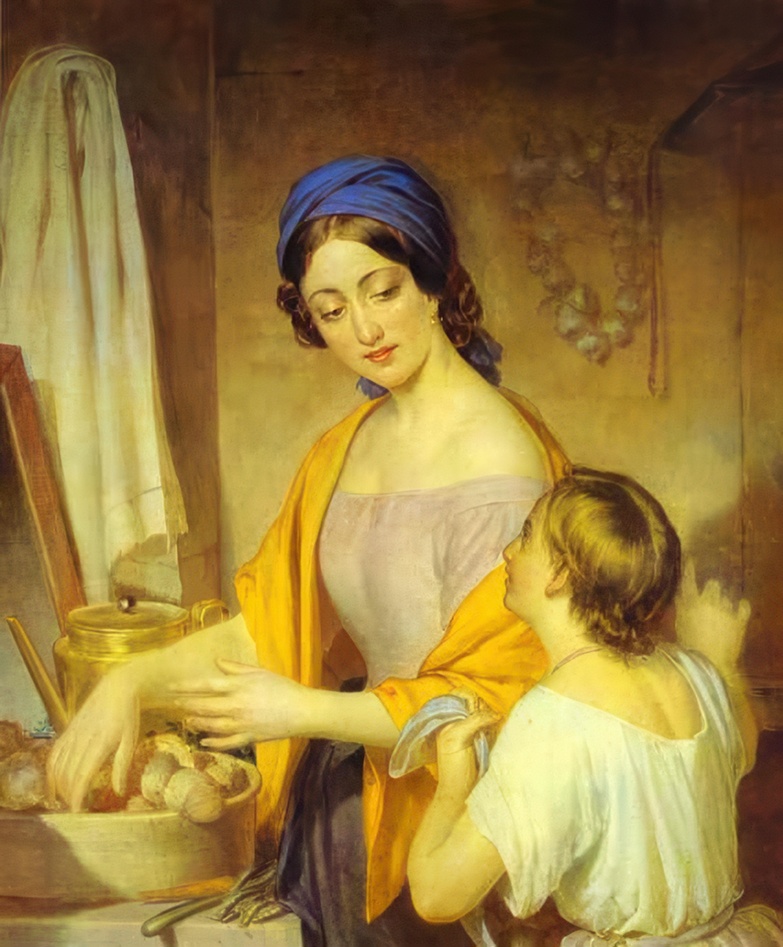
Alexeï Tyranov, “Young Housewife,” 1840s
TZK: One of the core paradoxes of the tradwife is that she, on the one hand, promotes leaving paid work, but on the other hand, she partakes in it as she earns money being an influencer performing housework. And while there’s a certain visibility of reproductive work that is characteristic for tradwives, the actual housework or care work oftentimes isn’t depicted in the videos or pictures. You would see a woman baking a cake but not cleaning the kitchen afterward, or only cleaning it in an aestheticized way. How do you conceive of this representation of housework and care work?
SIGLER: For me, the tradwife is primarily a political phenomenon. The objective of her public appearance on social media is not to document how care work is executed in the home. Rather it’s a representation of a woman according to a New Right or neoconservative worldview. It’s a very specific, ideologically charged notion of womanhood. That’s why it’s not important if the tradwife really executes care work in the videos. It’s more important how affective or how convincing she is for other social media users who live and strive for this image of how a woman should be. This is a very old strategy of political propaganda to show ideal versions of, for example, what women doing care work are supposed to look like, even though it is clear that daily work looks different in practice.
TZK: Friederike, together with Kathrin Rottmann, you recently explored forms of right-wing and neo-right-wing art in an issue of the journal kritische berichte. In it, art historian Dennis Brzek argues that art and art history currently face a challenge similar to that declared by Theodor W. Adorno at the beginning of his Aesthetic Theory: If these fields want to help disarm the New Right, they must abandon their own assumptions – thus we must continually question our definition of art. Against this backdrop, and also in view of the current fragmentation of the art field and the fact that, for example, so-called red-chip art is opening up segments of the art market that follow their own sets of rules, would it be too far-fetched to view certain tradwife accounts as a form of artistic expression from the Right? Some accounts and approaches are so overly performative that this question imposes itself.
SIGLER: I think one central strategy of the tradwife is hyper-aestheticization, which is very common in the context of the New Right as well. Aestheticizing political discourse may have a very long tradition. For the New Right, however, it has become the crucial strategy to claim cultural hegemony in order to distribute their political agenda. The tradwife is the ideal figure for this phenomenon, even though, or perhaps precisely because, tradwives do not typically align with any particular political movement.

Andy Kassier, “My Homegrown Foods,” 2023
TZK: The concept of hyper-aestheticization brings to mind artists like Andy Kassier, for example, who, in a completely different political context, with an ironic Instagram “performance,” plays on the logic of the platform economy from which his project itself benefits. There are parodistic takes on tradwives’ hyper-aestheticized renditions of housework, too, but to our knowledge, none from artists. We were wondering whether applying artistic methods could be productive as a form of critique. What do you make of the idea of a counter-tradwifery from the Left, following the tradition of feminist artists’ representations of care work and housework, for example?
SAUER: What is completely absent from the imagery of the tradwives I’ve looked at is any sort of irony or parody. Both would be strategies to make visible the contradictions that tradwives refer to of being a woman in late capitalism, and to engage with these contradictions in an emancipatory way. I’m not an art historian, but, for example, Martha Rosler’s work is full of irony. Especially because, as you mentioned earlier, tradwives make a lot of money out of and feed into the capitalist platform economy – they don’t have distance from it. A critical take would need to address the economic system behind caregiving, which, for example, the feminist mobilization around wages for housework in the 1970s did by attacking the capitalist logic of doing care work for free.
SIGLER: I’d like to jump back to the first part of the question and rephrase it slightly: How can methods from art history or art critique contribute to a better understanding of the tradwife as subject of a political agenda? I do believe that right-wing art exists and needs to be examined. However, it is important to ensure that the interpretation put forward employed by right-wing groups, who frequently refer to their practices as “art,” is used with caution. This was the case with the Identitarian movement, for example, which described its own actions as avant-garde performance art – and this was then simply adopted by art critics. Along these lines, it may be helpful to compare the tradwives’ output with that of feminist artists who worked on care work in the 1970s and demanded representation for it. When they were documenting the actual care work, they addressed the question of what a woman had to be in a political context. Another artist who comes to mind in this context is Margaret Raspé with her camera-helmet videos. Although Raspé did not consider herself a feminist artist, her videos contributed to making the dirty reality of chores in the household visible.
CORTRIGHT: What hasn’t been brought up yet is that the tradwife phenomenon is strongly linked with pornography. Especially on the internet, all roads seem to lead back to porn. We all know that the tradwife is not real; it’s a fantasy, a daydream. You can call it that, or you can call it pornography.
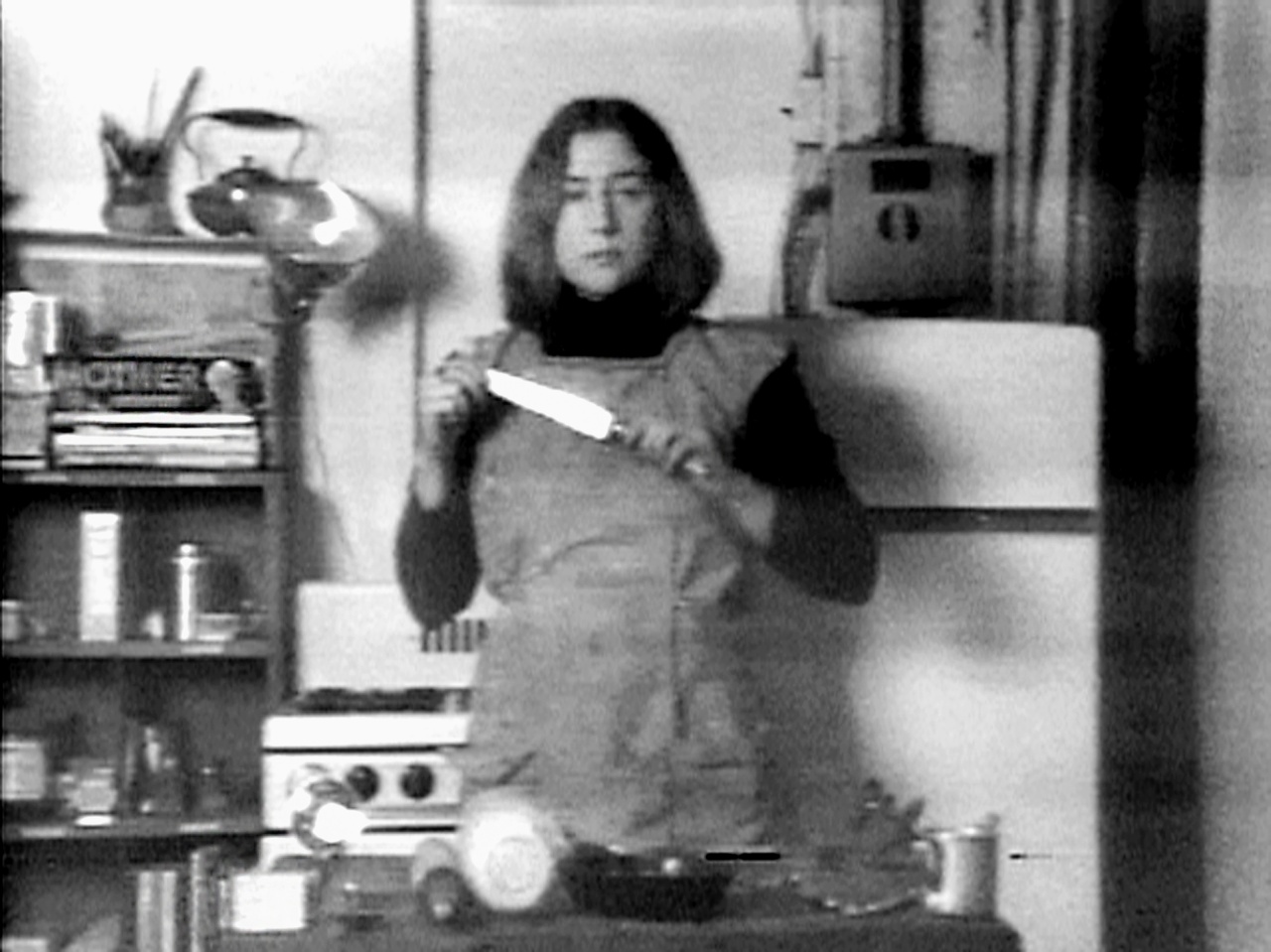
Martha Rosler, “Semiotics of the Kitchen,” 1975
TZK: According to some commentators, the tradwife is also closely related to the so-called girlboss, which in itself is a reaction to the 2008 financial crisis and the deregulation of labor that followed. How would you, Birgit, describe the connection between the tradwife phenomenon and the current structural changes in the world of work? How can we understand the gender roles people are “reviving” from a class-sensitive perspective?
SAUER: All these representations of traditional womanhood are part of an ongoing struggle over gender relations since the reinforcement of the gender binary and the heterosexual matrix in Western societies in the 19th century. The transformations of neoliberalism, especially in European countries with rather conservative gender regimes, are different from those in the United States, where women and mothers are pushed to be in the labor market, as paid maternity leave is virtually nonexistent. In West Germany and Austria, for example, there has historically been a reluctance to integrate women in the labor market. In the neoliberal era, women should be economically active and financially independent and not rely on the state, especially on social welfare. Of course, this ideology is flawed because women earn less, and mothers in particular aren’t as mobile in the labor market as fathers and often work part-time. Tradwives perform the image of a well-off family where the man is the breadwinner and able to support a woman and several children. But workers usually don’t earn that much money; their position in the labor market is increasingly precarious, and they can’t afford to have a stay-at-home wife. While for women it isn’t new to work under precarious conditions, the labor market situation for men worsened in the last decades, and their previous position within the family is now eroding. Against that backdrop, it makes perfect sense that the trend of the tradwife went viral after the crisis of neoliberalism. It has to be considered not only in the context of a struggle over gender relations; it also reflects a struggle over class relations. In a new form of capitalist accumulation, these tradwives also appeal to a specific group of women. They say, “I need a man who can afford my house and care work.”
TZK: A growing number of Black female influencers promote ideas similar to those of white tradwives on social media, but they reject the label and instead frame their presentation as a liberation from exploitative structures. Looking at the phenomenon through an intersectional lens, it becomes even more complex and contradictory than it already is …
SAUER: The position of the Black women’s movement since the 1960s was always that women being confined to the private space of the family and the criticism of that ideal were related to the white middle class. Historically, most Black women did not have this sort of privacy, Black feminists always argued. The private home of white women was a place of wage labor for them. It’s important to include a race perspective to understand how family care work is reshaped today. Some Black tradwife-influencers might understand their content as emancipatory from this classist and racist confinement into white families’ spaces – or it might also be a way of ridiculing white privacy.
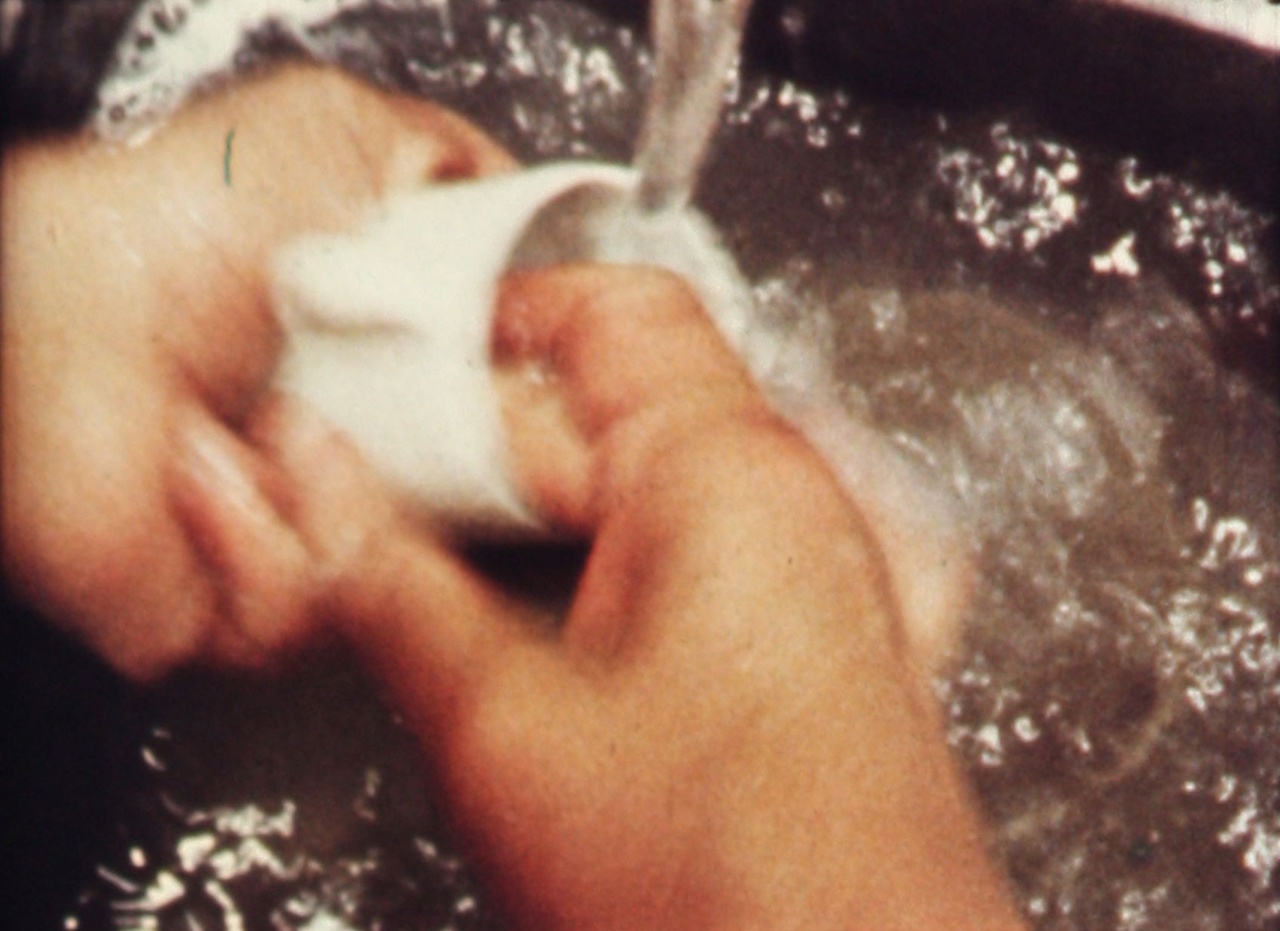
Margaret Raspé, “Alle Tage wieder – let them swing!,” 1974
TZK: Some Black influencers emphasize that they reject the label “trad” because the respective tradition has never existed for them and neither have representations of it; for example, there were no magazines for Black women in the 1950s promoting a similar ideology. Perhaps it’s worth taking a step back: What tradition does the “trad” in tradwife actually refer to?
SIGLER: With the term trad, women suggest that they want to revitalize a traditional image of women from a past era and, simultaneously, “better” times before feminism, wokeness, and so on. This return to a supposedly superior past is also a characteristic feature of the New Right. In this respect, tradwives are reminiscent of Nazi politics and, to some extent, Nazi imagery, although women in that case were not always depicted as looking happy at home but were in domestic spaces often shown working – or exhausted from work. With their openly reactionary politics, tradwives are also reproducing a false view of history. Women were not always housewives. Rather, the housewife is an invention of the 19th century and based on capitalism’s model of the nuclear family.
SAUER: The clothes and aprons of many of today’s tradwives look like they’re from the 1950s – a time of growing wealth and state interventionism, of postwar Fordism in the United States and the “economic miracle” in West Germany. These policies were, on the one hand, class-specific because they tried to raise the consumption of working-class people; on the other hand, they were gender-specific, since women were constrained to the household. It is the image of this time of a national economy where a male breadwinner was able to support a family and the wife did not have to contribute to the family income that tradwives today are selling. It’s important to note that this is ideologically aligned with Donald Trump’s idea to renationalize the US economy – that is, imposing tariffs in order to support the US economy. This, of course, is the end of the neoliberal globalization project.
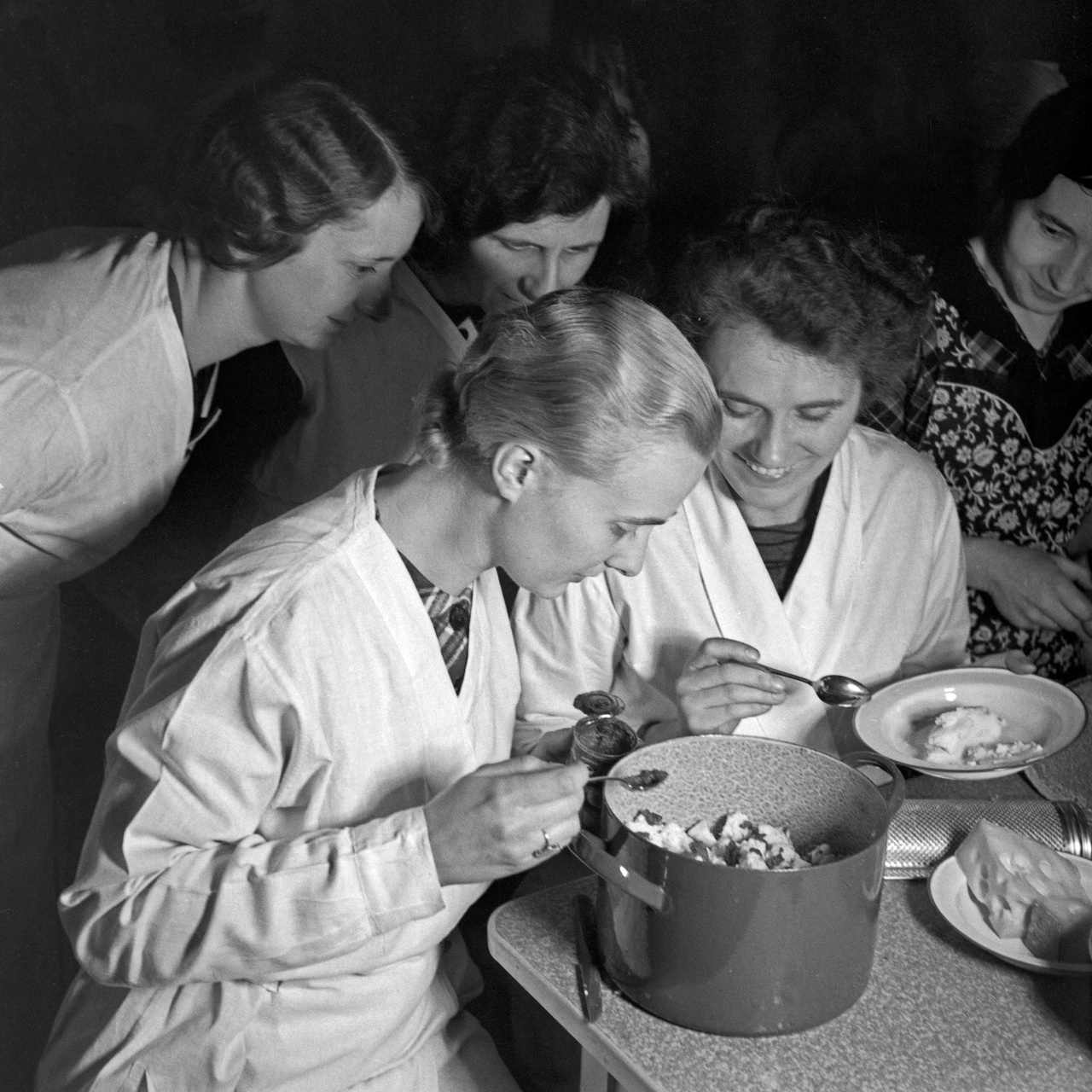
Training school for mothers (Reichsmütterdienst) during the NS regime, Essen, 1930s
SIGLER: It may be obvious, but I would like to emphasize how important the tradwife is for today’s conservative. Although they don’t point to the picture of a tradwife in public, when someone like the German culture minister Wolfram Weimer dismisses gender language, the conservatives’ reactionary gender politics totally align with the idea of the tradwife.
TZK: Sometimes you hear arguments from the Left that gender policies offered an easy target for right-wing parties – as if we were responsible for their success. The tradwife phenomenon plays a major role in normalizing this sort of genderist ideology – especially because it offers a variety of types to identify with. What’s also interesting about tradwives is that they seem relatively withdrawn, as far as social life is concerned. The only people we see on their accounts are family members. Most tradwives are religious, but they don’t practice their faith in a community. Could we connect the dismantling of the welfare state under neoliberalism with this antisocial dimension? Can that which is now often referred to as the crisis of Western democracies be understood in relation to this ideal of the nuclear family?
SAUER: In the neoliberal tradition, the position was always to argue for a retreat of state institutions and claim that the market and the family should regulate people’s lives. It’s not the political Right that invented the idea that the family is the nucleus of the state and the public sphere. This has been a stock figure since the 19th century, when the nation-state developed in and outside of Europe. The New Right now uses these ideas of privatization, of pushing back the res publica. The demolition of the state, especially the welfare state, includes the demolition of the rule of law and, in consequence, feeds into de-democratization. Right-wingers don’t want democratic decisions that might defend institutions of the welfare state, but they want self-sufficient people, and that’s why they need these traditional ideas of the family. Of course it’s an ideology – but yeah, they want families to be self-sufficient, and that’s what the tradwife represents. In this way, this image is a little piece of a larger puzzle that could amount to the demolition of state and democracy.
SIGLER: This is another interesting paradox of the tradwife: She stands for reinstalling that private space as a female space, but at the same time, she’s doing it in and for a public. A housewife from the 1950s was not supposed to be part of public discourse. By contrast, it’s the main objective of the tradwives to communicate, maybe not with other families next door but with their followers.
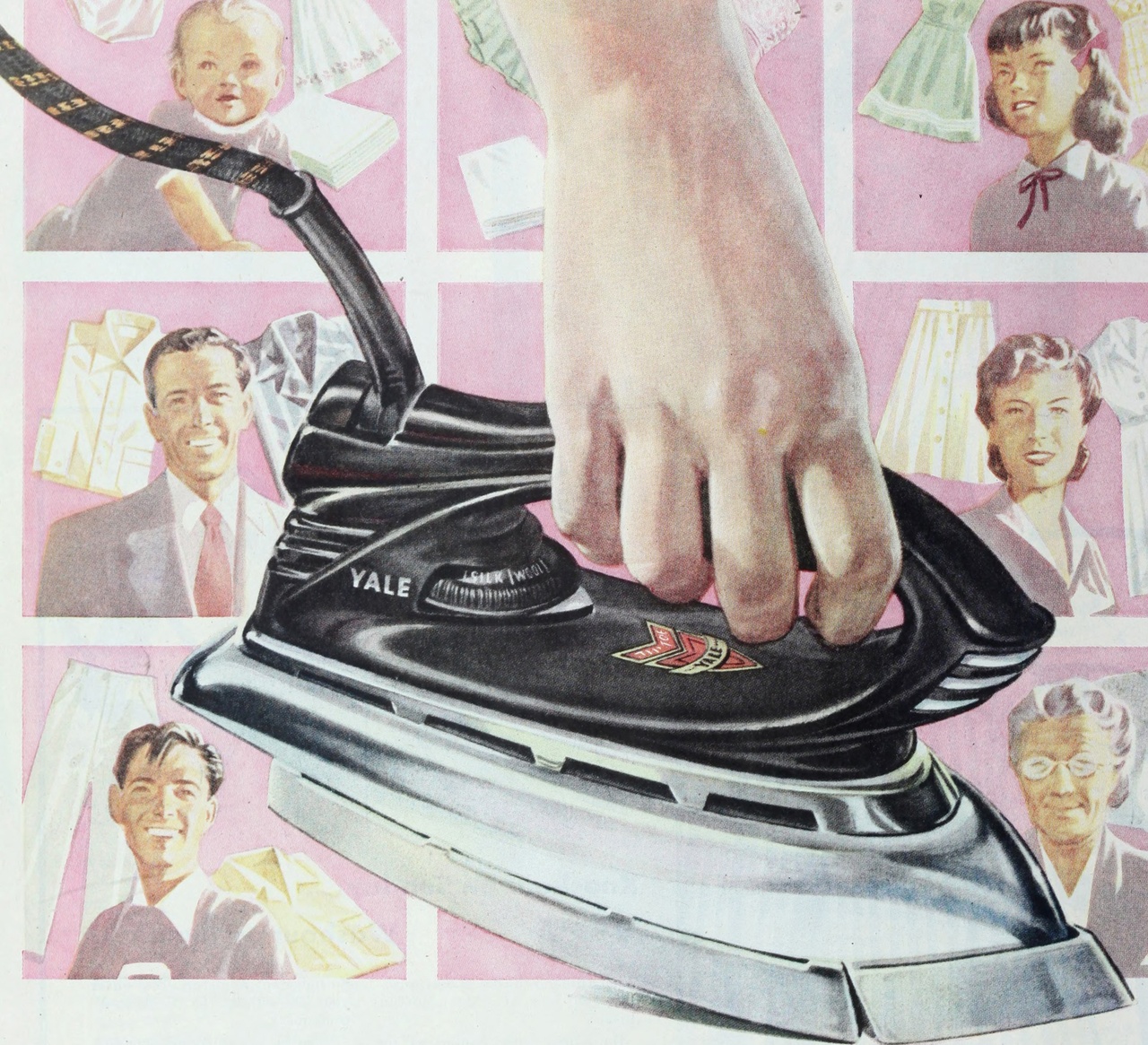
Illustration from “Ladies Home Journal,” 1948
CORTRIGHT: The word that comes to mind in this context is isolation – which is the way that a lot of people feel in the United States, regardless of gender and across the political spectrum. That’s the system in the US: There’s simply no one coming to save you. Tradwives are grifters. But they are also totally symptomatic of the gig economy and ways of making money that weren’t available 10 years ago. This shift happened during the Covid lockdowns when everybody became used to living a life online. Working as an internet artist for the past decades, I was already used to this. To be frank, I’m not sure if I would have participated in the “trad” art world if the NFT and crypto sphere had been an option earlier.
TZK: Since you bring up recent shifts in the art economy, Petra, do you feel that the increase of hyper-aestheticized imagery as it is seen on so many tradwives’ accounts affects the market? For instance, is there a growing demand for traditional yet strangely ahistorical tropes? Your recent work is replete with references to the US-American West; it is digital but includes well-tried, somewhat old-fashioned elements, such as floral patterns or prairie landscapes. One may assume that this combination attracts a new generation of neo-Republican collectors from the tech field. Have you noticed a change in the perception and demand for your work in this political moment? Is this something you think about at all?
CORTRIGHT: As I’ve said many times in the past, my work is rather apolitical. I actively try not to think about any of these things when I’m making art because it is an escape from the world for me. So, if I’m bringing in all these tiresome thoughts, it’s not an escape, it’s just a chore. My work does leave open space for people to put ideas on it, and that’s okay with me. I try to keep a healthy distance to the art world as a social space for wealthy people. This, the art market, and the art itself are three separate things for me.

Petra Cortright, “BURNT UMBER BROKEN SILVER AMERICAN SPIRIT,” 2024
TZK: This view strikes me as rather idealistic. I mean, you’re working in this social space and are part of the gallery system as well. So, how can you draw the line that clearly?
CORTRIGHT: I work with seven different galleries, and I engage with the NFT world on the side. This isn’t the norm; usually an artist might try to sign with one blue-chip gallery. But I work with a central art dealer studio in LA, and we consign to all the different galleries. I’m a prolific maker and work digitally, so I simply produce more work that the galleries can show, and I also make a different kind of work so that everyone feels like they get something for their audience. I consider the NFTs grocery money. But then recently, I had an NFT project that was so successful that I bought a second home, a log cabin in Montana – which is extremely tradwife of me, except for the fact that I bought it with NFTs, which is more of a girlboss move. I guess I’m a very strange example of many things happening at once.
TZK: Which also seems very symptomatic of this political and socioeconomic moment.
SIGLER: The pointed emphasis on the contrasting aesthetics of a log cabin and those of the NFT space that Petra conjures here reflects an increasing fragmentation of experience and an imperative of economic opportunism, which makes me wonder about the notion of the backlash we started our discussion with. Newer research in the field of masculinity studies suggests not to refer to a “crisis of masculinity,” because this reproduces the idea of the strong man who was suppressed and is now coming back. Instead, scholars propose talking about the coexistence of different masculinities. This could also be interesting for the analysis of the tradwife. Then she is not only a backlash but also a figure who was never gone and who is gaining new resonance and new significance through social media, as well as right-wing politics, within the framework of today’s neoliberal conditions.
Sabeth Buchmann is an art historian and art critic based in Berlin and Vienna. She is a professor of modern and postmodern art at the Academy of Fine Arts in Vienna and coeditor of PoLYpeN, a series on art criticism and political theory (b_books, Berlin), and a board member of TEXTE ZUR KUNST, the European Kunsthalle, and the documenta Institute. Her most recent publications include Kunst als Infrastruktur (Verlag der Buchhandlung Walther König, 2023), Broken Relations: Infrastructure, Aesthetic, and Critique (Spector Books, 2022; coeditor), and Putting Rehearsals to the Test: Practices of Rehearsal in Fine Arts, Film, Theater, Theory, and Politics (Sternberg Press, 2016; coeditor).
Petra Cortright became renowned for making self-portrait videos that use her computer’s webcam and default effects tools, which she would then upload to YouTube and caption with spam text. Her core practice is the creation and distribution of digital and physical images using consumer or corporate software. Her works are in the permanent collections of MoMA (New York), the Péréz Art Museum (Miami), the Bass Museum (Miami), LACMA (Los Angeles), the Hammer Museum (Los Angeles), Moderna Museet (Stockholm), MOTI (Breda), the Stedelijk Museum (Amsterdam), MCA Chicago, the Kadist Foundation (San Francisco), BAMPFA (Berkeley), the San José Museum of Art, and MOCA (Los Angeles).
Leonie Huber is an art critic and editor at TEXTE ZUR KUNST.
Birgit Sauer was a professor of political science at the University of Vienna until her retirement in 2022. Her main areas of research are politics and gender, politics and affect, and right-wing authoritarianism and gender.
Friederike Sigler is an art historian. She is currently a professor of contemporary art history at the University of Vienna and researches care work, the reception of fascism, and the New Right in art.
Anna Sinofzik is a writer and Senior Editor at TEXTE ZUR KUNST.
Image credits: 1. © Laurie Simmons; 2. The Russian Museum, St. Petersburg, public domain; 3. © Andy Kassier; 4. © Martha Rosler, courtesy of the artist and Galerie Nagel Draxler; 5. Courtesy of the estate of Margaret Raspé, Galerie Molitor, and Deutsche Kinemathek; 6. Alamy (Mauritius images/United Archive), public domain; 7. Yale Iron Ad, public domain; 8. © Petra Cortright