
THE POETICS OF UNSETTLED TIME Roland Betancourt on the Temporal Vertigo of the Theme Park
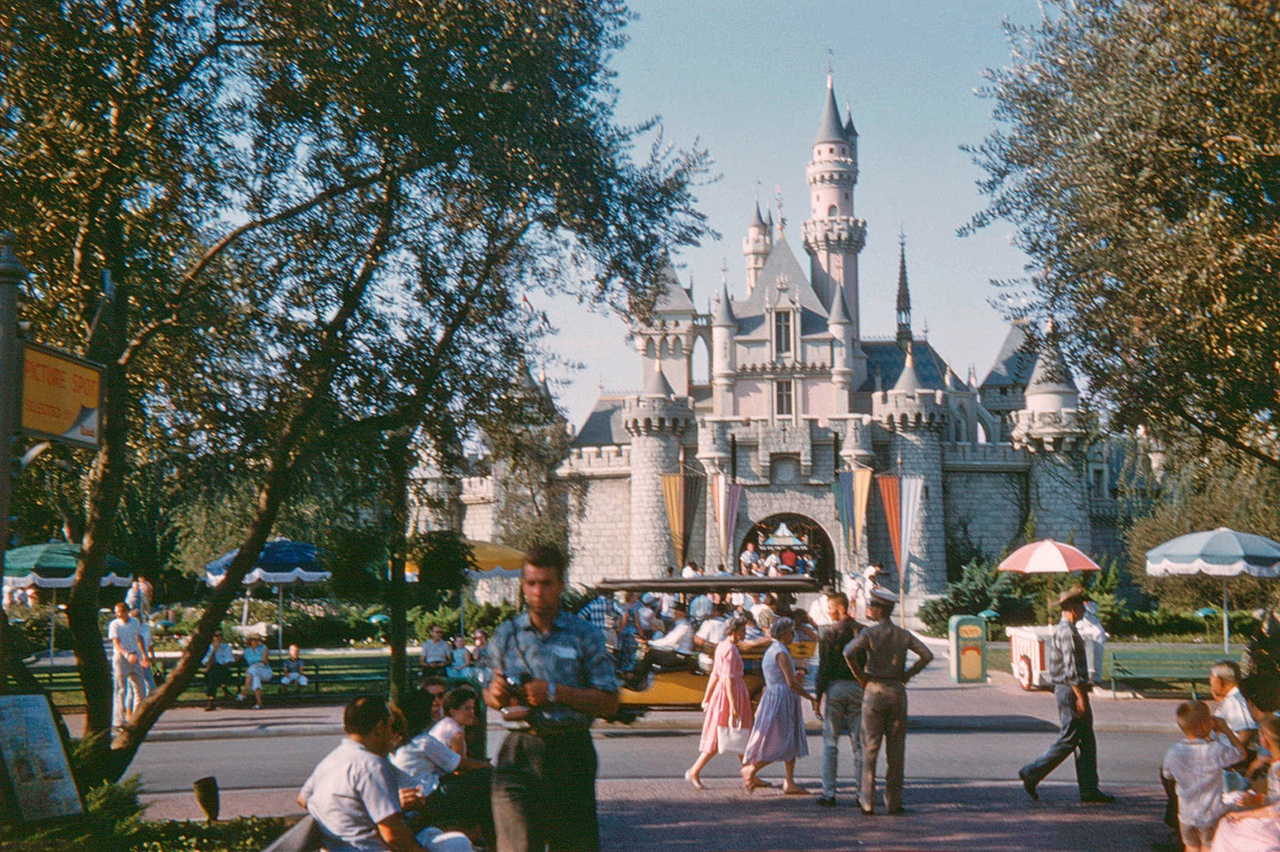
Sleeping Beauty Castle at Disneyland, Anaheim, 1968
In 1955, when Walt Disney constructed Disneyland in California, a medieval-style castle anchored the central axis of the park and served as the landmark for its Fantasyland section. Today, the Middle Ages stand at the conceptual center of the fantasy genre in contemporary popular culture. [1] It has become nearly impossible to imagine the realm of fantasy, from books to television, without a European medieval imaginary glossing its surface. What role do the Middle Ages play in constructing our counterfactual imaginations of the past at Disneyland? And how do medieval references subvert the temporality of this landscape, rather than just citing a lost then and there?
In an early drawing of the park from 1953 by Herb Ryman, an art director at the Walt Disney Studio, the castle was shown as a near-perfect replica of the 19th-century neo-medieval Neuschwanstein Castle. The castle that would eventually be built, however, was a highly pared down version of this, inflected by distinctly American visions of late-medieval French architecture, often referred to as château style. [2] The “châteauesque,” as it is also called, applies fanciful Gothic elements (particularly turrets, high-pitched roofs, and faux masonry) onto an otherwise nondescript building. The châteauesque emerged alongside other so-called “storybook” styles in the imagination of the Hollywood studio industry. This style can be seen across Los Angeles, especially at sites such as the Hollywood Tower (1929) and Le Trianon Apartments (1928), as well as more mundane exemplars from the 1930s. In this context, Disneyland’s castle, suggestive of the medieval past, was less of an aberration in the urban fabric than it was a local styling.
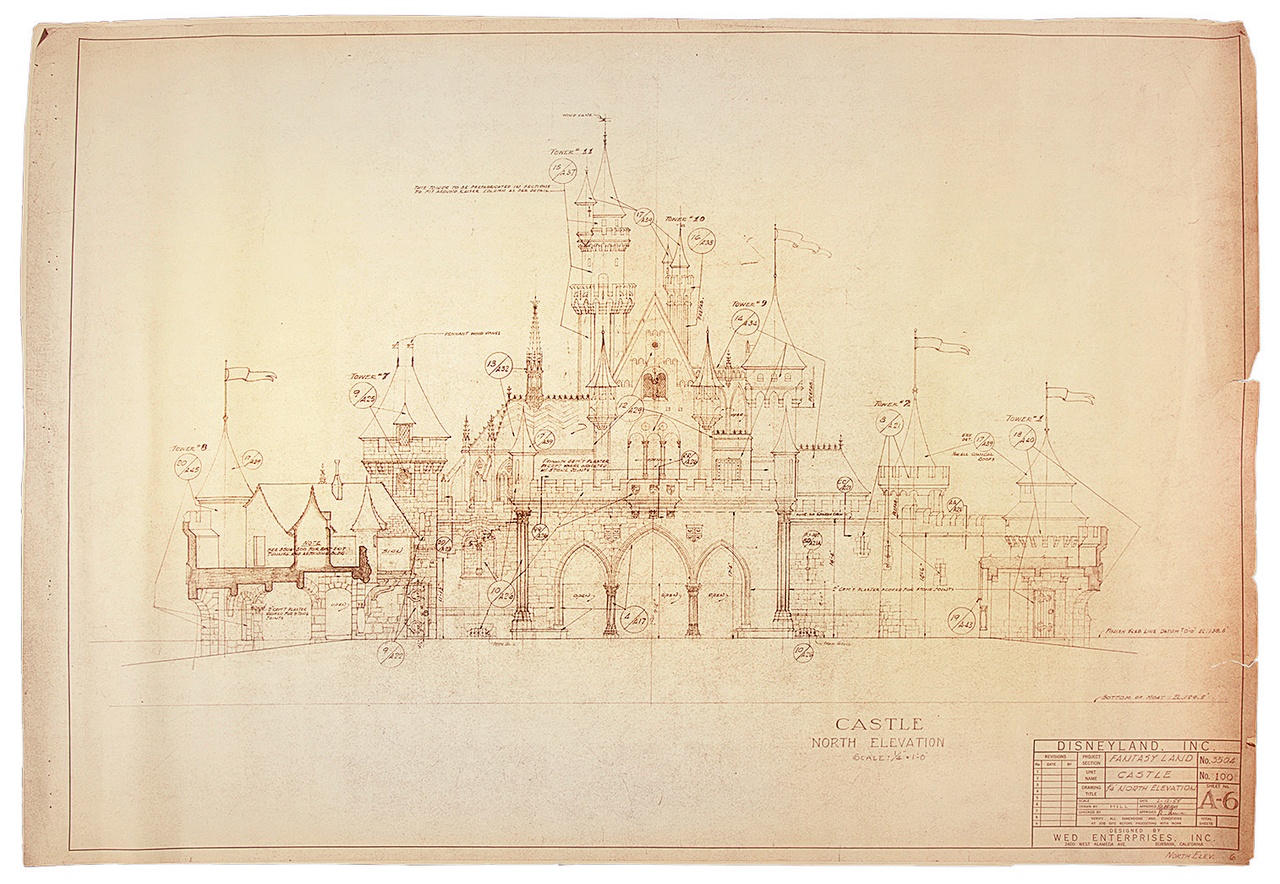
Blueprint for Disneyland’s Sleeping Beauty Castle, ca. 1954–55
Disneyland’s original Fantasyland fused this popular medieval vision with a streamlined mid-century modern aesthetic that had become synonymous with the style of Disney artist and illustrator Eyvind Earle. [3] During the park’s construction, Earle was working on Walt Disney’s Sleeping Beauty, which embodied Fantasyland’s look and offered the namesake for Disneyland’s castle. Heraldry, tournament tents, and royal standards made of colorful sheet metal enlivened the medieval fantasy that Disneyland Park sought to convey. Since then, Walt Disney’s vision of the Middle Ages has been exported across the world through the global Disney theme parks. Yet when Disney turned to the construction of the Euro Disney Resort (opened 1992, now renamed Disneyland Paris), for the first time the company had to build its Fantasyland near actual medieval sites that were central to the country’s patrimony.
Disneyland Paris’s castle features an overextended central turret with an oval rose window. This serves as the castle’s vertical axis from which all other elements cascade down, grounded by the faux-masonry fortification walls at the base. For those familiar with Gothic architecture and even its fanciful 19th-century reconstructions, such as the nearby Château de Chantilly, the vocabulary of Disneyland Paris’s castle is one of hyper-accumulation that even exceeds its 19th-century predecessors: While we can witness the clustering of architectural elements in the illuminations of the Très Riches Heures du Duc de Berry (ca. 1412–16), for example, these features remain on the horizontal plane of the roofline in the manuscript’s image, set upon a squat building. Disneyland Paris’s castle expands these forms upward in a counterfactual manner that seeks to produce a castle that could have never existed structurally – the skyscraper version of a late-medieval French fortification.
In the outskirts of Paris, the medieval-style castle had to sidestep any claims to authenticity or citationality. Instead, it had to declare itself as fantasy through its campy, overwrought aesthetics. The Walt Disney Company’s design patent for the “ornamental design for an amusement castle,” corresponding with Disneyland Paris’s castle, took a hyperbolic approach to the mid-century medieval-style aesthetic that Disneyland had cultivated decades earlier. [4] In the references cited in the patent application, the castle’s designers did not mention medieval sites or illustrations but instead turned to an internal corpus of photographs of Disney theme-park castles and to mid-century design patents for toy castles. Fortification walls, turrets, and arches are presented in those patents not as documentary reality but as an aestheticization of the medieval past as a plaything for a mass-produced children’s toy.
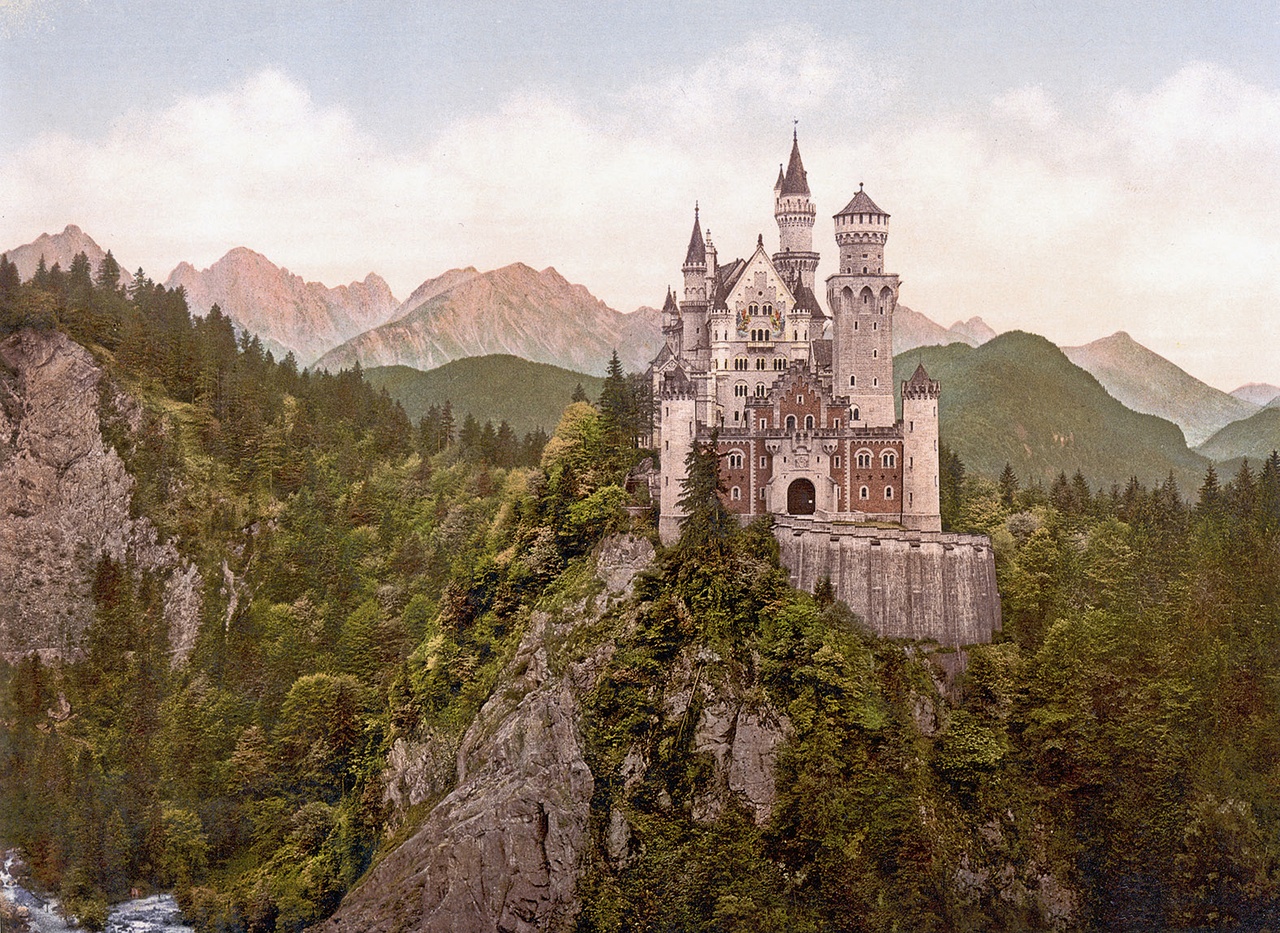
Neuschwanstein Castle, ca. 1890–1905
A theme park is as much a site of highly regulated commercial amusement as it is a space of play – a nonproductive, at times creative, activity of absorption and imagination. To play in the park, however, requires nothing more than spending time within its bounds, inhabiting its architectures. It takes no additional performative investment, as one might associate with role-playing games or cosplay. In the Disney theme parks’ Fantasyland, the vision of the medieval serves as an architecture of and for play, literalizing the associations between the castle as a toy and the activities occurring therein: going on rides, taking pictures, dressing up as a character, and so on.
When the original Disneyland opened in Anaheim, for instance, none of the attractions in Fantasyland featured any of the main characters from the films that the attractions were based on. That is to say that taking a trip on Peter Pan’s Flight meant that you never saw Peter Pan himself. Instead, you rode a flying galleon through the scenes of the story with the conceit being that you (as the rider) were Peter Pan. This led to complaints, however. At Snow White and Her Adventures, this approach reached its conceptual breaking point. There, the rider would be stalked by the Evil Witch at every turn, while Snow White was nowhere to be seen. The ride terrified children and confused adults who were left looking for Snow White. [5]
Throughout Disneyland’s other themed sections, guests inhabited the subjectivity of the tourist. Across Tomorrowland, Frontierland, and Adventureland, they were passengers on a riverboat touring the world’s jungles, travelers on a commercial space flight, and drivers on the new interstate highway system. Nowhere else were visitors meant to “play” a Disney character but in Fantasyland, whose ethos cultivated this role-play. There, the Middle Ages served as the backdrop, the plaything, that motivated the imaginative fantasy. What is perhaps most surprising is that the stories contained within Fantasyland’s medieval-style buildings were never medieval stories: a flight through turn-of-the-century London, a mad dash on an automobile through the English countryside, and an adventure through 16th-century Germany.
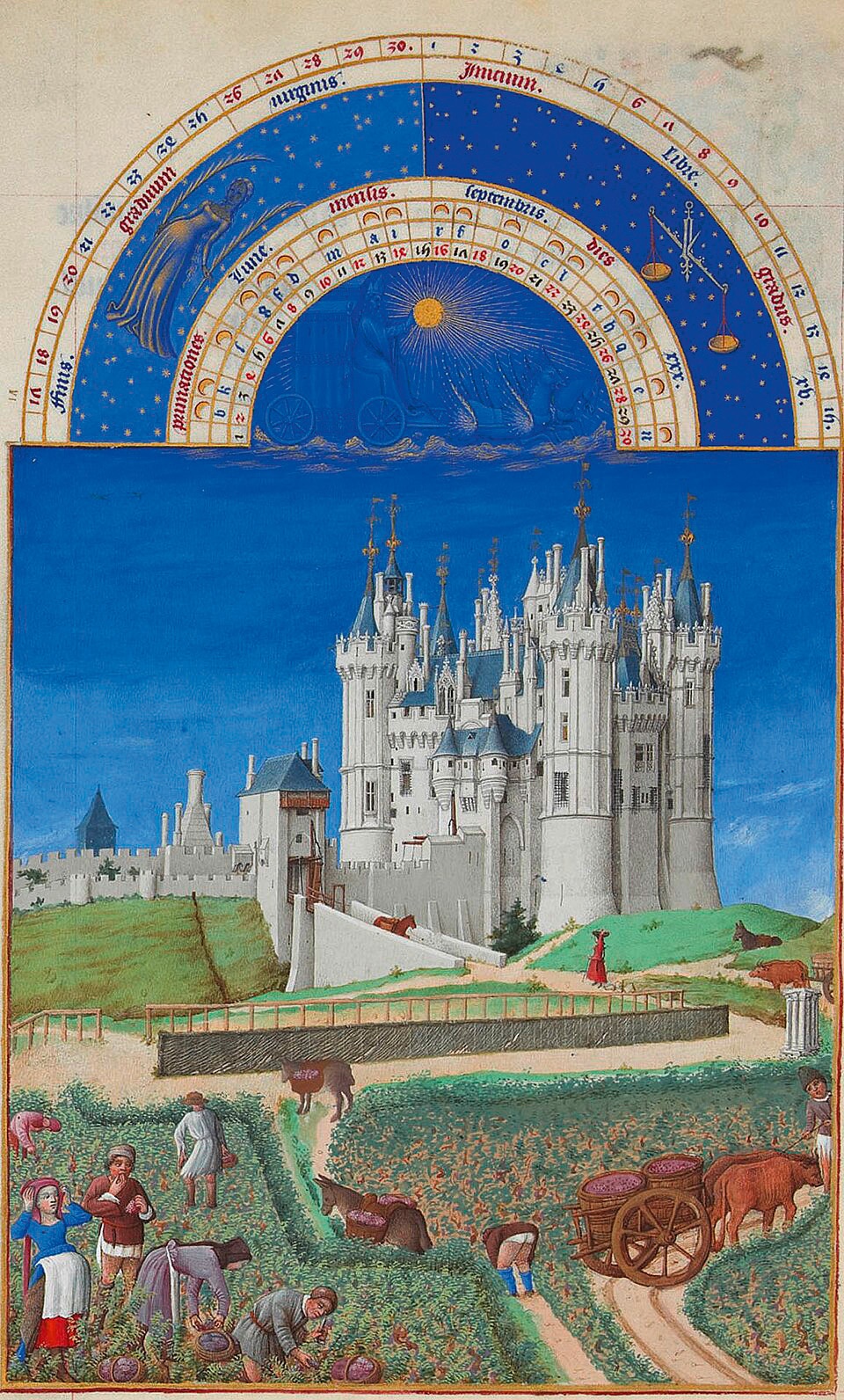
Jean de Berry, “Les Très Riches Heures”, September scene, Chatêau de Saumur, ca. 1412–16
In all these cases, the Middle Ages do not serve as a historical locale for the stories unfolding there. Instead, the medieval deracinates the visitor from chronology, serving as a portal to many different times and places. Fantasyland works as play precisely by creating the illusion of being removed from the conditions of capital, labor, and progress. By building this sense of play into its conceptual center, Disneyland embraces postwar ideals surrounding the necessity of imaginative play for the creative child and, reinscribing the liberatory nature of play into the corporate, the commercial amusement industry. [6] Its temporal fissuring is certainly unique in the conceptualization of the theme park where guests are urged to “leave today” and enter the worlds of “tomorrow” in Tomorrowland, of the Old West in Frontierland, of early 20th-century exploration in Adventureland, and of the 1900s America on Main Street. While each of Disney’s other lands are chronologically specific, making clear nods and citations to a historically distinct then and there, Fantasyland’s medievalism is a temporal subterfuge.
In placing the Middle Ages outside of time, Disney’s mid-century medieval aesthetic proposes a promiscuous temporality that is both historically distant yet proximate in the imaginary. Here, the iconographies of the medieval past are presented with what is an undeniably modern aesthetic of streamlined color and line, particularly as seen in the decorations around Fantasyland. It is difficult to think that a Southern Californian visiting Disneyland in 1955 would miss the familiarity of Disneyland’s castle, composed of so many elements that defined Los Angeles’s landscape. If the medieval architecture of Fantasyland was in any way allusive to a historical past, it is a past that must have also felt proximate and futuristic. Let us not forget that Earle’s Sleeping Beauty would not make it into theaters until 1959. In other words, his mid-century medieval aesthetic foreshadowed the aesthetics of a film four years after Disneyland opened.
But is there something medieval in the temporal incursions for which the Middle Ages serve as a backdrop at Disneyland? When I first expressed my interest in the theme park, Disney Imagineer Joe M. Rohde – upon hearing I was a medievalist – remarked, “If you like themed spaces, there is always La Sainte-Chapelle.” [7] Rohde’s words captured the work of Gothic architecture in unsettling temporal and spatial locality. In its manifestation of the Heavenly Jerusalem, in its Passion relics looted from Constantinople, Sainte-Chapelle in Paris does indeed operate as a themed space: one that seeks to take visitors away from the earthly and mundane realities of life outside its bounds to a loftier world – divine and spiritual – but also rooted in imperial power, war, and conquest.
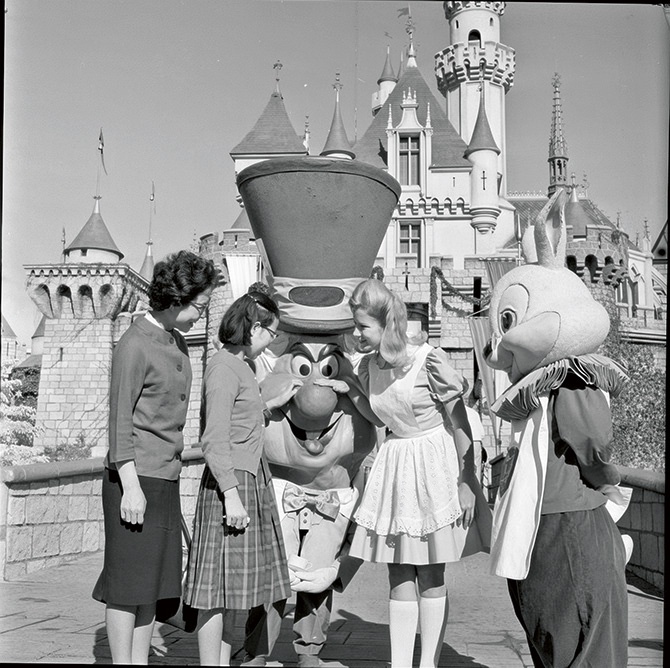
Visitors and cast members at Disneyland, Anaheim, 1964
Across modern theme parks, the Middle Ages play a role either as a distinct historical referent or, more interestingly, as a temporal cipher that delaminates time from historical chronicity. While “accurate” or “historical” re-creations of the Middle Ages may be a fascinating curiosity, it is the use of the Middle Ages to signal temporal vertigo that I find the most compelling. The latter deploys medieval art and architecture in the way it had been designed to be used: to transport its pilgrims into the realms of contemplation and the imaginative faculties, to transcend the present. From liturgical chalices for the blood of Christ to the space of a church, objects and architectures were meant to make unseen realities visible in the here and now, as when Russian envoys who had entered the church of Hagia Sophia in Constantinople in the 10th century exclaimed, “We knew not whether we were in heaven or on earth.” [8] Details and conflations that might seem careless or garish to the historian, like Disneyland Paris’s castle, index the conceptual force of the medieval as the poetics of unsettled time.
Roland Betancourt is a Chancellor’s Professor in the Department of Art History at the University of California, Irvine, and a 2023 Guggenheim Fellow. He is the 2024–26 Andrew W. Mellon Professor at the Center for Advanced Study in the Visual Arts at the National Gallery of Art in Washington, DC. Betancourt is an expert on the art and culture of the Byzantine Empire, and his work also looks at the uses of the medieval past in the modern world. His books include Disneyland and the Rise of Automation (Princeton University Press, 2026) and the award-winning Byzantine Intersectionality: Sexuality, Gender, and Race in the Middle Ages (Princeton University Press, 2020).
Image Credit: 1. GLC Pix/Alamy; 3. Library of Congress collection; 4. Musée Condé; 5. UCLA Library Special Collections, 2.-5. public domain
Notes
| [1] | Larisa Grollemond and Bryan C. Keene, The Fantasy of the Middle Ages: An Epic Journey Through Imaginary Medieval Worlds (Getty, 2022). See also Helen Young and Kavita Mudan Finn, Global Medievalism: An Introduction (Cambridge University Press, 2022). |
| [2] | Erika Doss, “Making Imagination Safe in the 1950s: Disneyland’s Fantasy Art and Architecture,” in *Designing Disney’s Theme Parks: The Architecture of Reassurance*, ed. Karal Ann Marling (Flammarion, 1997), 179–89. |
| [3] | Ioan Szasz with Michael Labrie, Awaking Beauty: The Art of Eyvind Earle (Weldon Owen, 2017). |
| [4] | Anthony Baxter, Thomas K. Morris, and Mark A. Lescault, “Amusement Castle,” US Patent No. D350995S, filed March 20, 1992, issued September 27, 1994. |
| [5] | Suzanne Rahn, “The Dark Ride of Snow White: Narrative Strategies at Disneyland,” in Disneyland and Culture: Essays on the Parks and Their Influence, ed. Kathy Merlock Jackson and Mark I. West (McFarland and Company, 2011), 87–100, at 92. |
| [6] | See Amy F. Ogata, Designing the Creative Child: Playthings and Places in Midcentury America (University of Minnesota Press, 2013). |
| [7] | Joe M. Rohde, in discussion with the author, March 21, 2021. |
| [8] | The Russian Primary Chronicle: Laurentian Text, ed. and trans. Samuel Hazzard Cross and Olgerd P. Sherbowitz-Wetzor (Mediaeval Academy of America, 1953), 111. |