
“OURSELF, BEHIND OURSELF, CONCEALED”* Isabelle Bucklow on “The Persistence of Masks” by Joyce Suechun Cheng
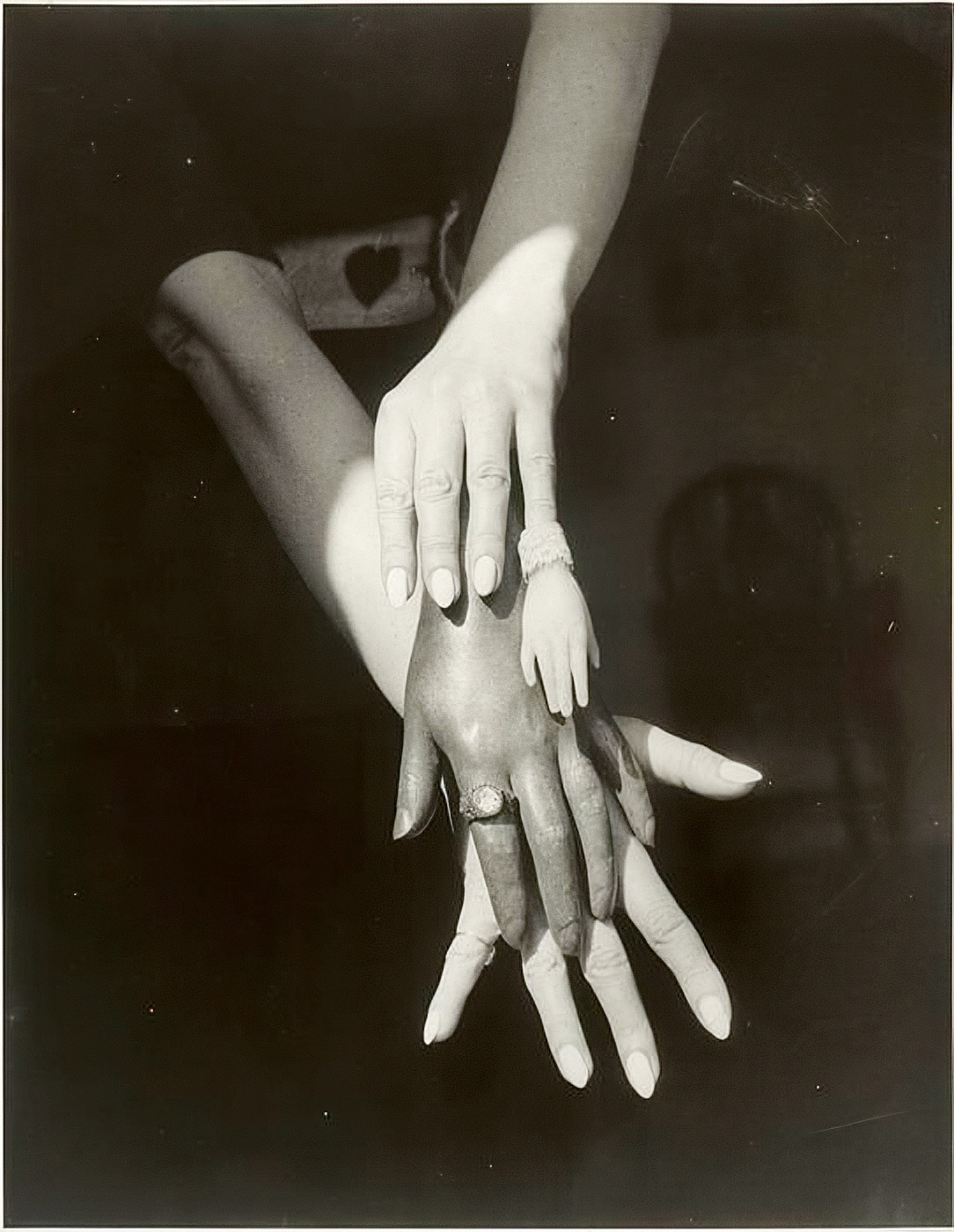
Claude Cahun, untitled (“Mains”), 1936/39
One of Surrealism’s most famous exports, André Breton’s Nadja (1928), opens with the line “Who am I?” It’s the kind of existentially troubling question that draws one to the analyst’s couch. The question of the self, what truly constitutes it, has long nagged at poets and logicians, only to be appropriated for a neoliberal agenda to both tame and blame the individual. Polonius’s guidance to his son Laertes, “To thine own self be true,” from William Shakespeare’s Hamlet (1623), manifests today as “living your truth,” a helpfully ambiguous mantra favored by wellness gurus, advertising execs, and TikTok influencers for whom your “truth” requires you to subscribe to a club or part with money (or both). But a “true” self presupposes a “false” self. In the parlance of psychologists, that “false” self is our mask, a defensive carapace applied to perform and reinforce social expectations. And although that mask is necessary for upholding social cohesion, popular (Western) narratives – through Antiquity, Renaissance, Enlightenment, and Romanticism to the present day – vilify the mask for obscuring the naked, ergo “true,” face revelatory of the “soul.” But while dichotomies pathologize the mask for obscuring the uninhibited self, it’s the very existence of a sovereign self that should be interrogated.
In Joyce Suechun Cheng’s genre-bending book The Persistence of Masks, the insistence on a stable self is rejected as, at best, overrated and, at worst, foundational to totalitarianism. Cheng inverts what Jacques Lacan identified as the “bourgeois philosophical concept of man endowed with moral liberty and responsibility appropriate to the individual” (Cheng quoting Lacan, p. 2) to posit the phenomenal subject as “more akin to masks than selves” (p. 8). In short, the opposite of the mask is not authenticity but the fantasy that there is a pure, pre-social self underneath.
An associate professor of art history at the University of Oregon, Cheng has written widely on Dada, Surrealism, and so-called Primitivism. This book situates itself in the interwar moment of “mature automatism” to analyze the cultural motif of the mask. For context (not provided in the publication): By 1926, masks had reached peak zeitgeist, epitomized by an image in Vogue by Man Ray – Kiki de Montparnasse’s pale face beside an ebony Baule mask. The widespread penchant for masks during the Années folles collapsed cultural differences into one endless parade of aesthetic masquerade. The focus of The Persistence of Masks on the mature Surrealist mask stands apart from these ornamental playthings by nature of its philosophical seriousness and reappraisal of the “primitive” as synonymous with poetic reason.
Cheng’s definition of the mask is broad, constituting adornments like hats and veils, decorative motifs like art nouveau tendrils, and appendages like hands and ears. The book swiftly plunges into the Surrealist imagination, absorbing the well-documented ideological conflict between Georges Bataille and Breton to build its thesis – that of the subject as mask – by way of detours (and perhaps too many). Arguments are richly illustrated, from René Crevel’s anthropomorphized curtain drapes and Tristan Tzara’s analysis of female hats as analogous to genitalia to Salvador Dali’s Le phénomène de l’extase (1933) – a photomontage of cropped female faces juxtaposed with ears – and Claude Cahun’s untitled work (“Mains”) from 1936/39, picturing her own hands spawning numerous others by way of a miniature hand worn on her pinkie finger and a prosthetic laid between. While hats can be put on and taken off to (symbolically) perform different functions, the proposition of masks as bodily appendages is generative. Cheng demonstrates how hands can be separated and repossessed. For example, when virtuosic craftspeople outsource their work, “the hands appear no longer to be their own but under the sway of some external force” (Sōetsu Yanagi quoted in Cheng, p. 83). The hand, our original autonomous agent, is also an Other.
Alongside physical masks, Surrealists engaged in textual masquerade, which Cheng locates in “Subject” (1916), a text written by Breton when an intern at a psychiatric ward. Breton refused the medicalization of subjects as “types,” instead adopting the patient’s perspective, which, in this case, was that of an ex-soldier who believed war to be but illusory theater. Writing as “the Other,” he inhabited alternate qualia (a complex layering of masks upon masks, for the madman persona adopted by Breton believes himself to only be playing the role of a soldier). Cheng reads Breton’s approach as para-ethnographic, approaching the urban and institutional environments as a “set of fields” (p. 4) – thus establishing her book’s methodological agenda.
Departing from pure art history, Cheng draws on other methodologies, notably ethnography, to flesh out the vicissitudes of subjecthood beyond the white-masculine bias of European Surrealism – unfortunately, aside from Suzanne Césaire, who enters in the conclusion, many of Cheng’s informants are white Europeans (albeit taking us to Rio de Janeiro and Northern Ethiopia). The Surrealist quest to “uncover and valorize unconscious, overlooked and socially marginalized forms of subjectivity” (p. 133) expands Claude Lévi-Strauss’s definition of ethnography as “the observation and analysis of […] the respective modes of life of various groups” (Levi-Strauss quoted in Cheng, p. 5). In France, anthropology was maturing alongside Surrealism, with many anthropologist-ethnographers contributing to Bataille’s Documents. [1] This intersection provoked anthropologist James Clifford to coin the term surrealist ethnography to classify hybrid poetic-and-positivist works. [2] Cheng finds the ethnographic impulse, originally applied to Surrealist writer Michel Leiris’s autoethnography, L’Afrique fantôme (1934), as constitutive of Surrealism from its beginnings. Correspondingly, ethnography contained within it a literary dimension. Cheng cites Vincent Debaene, who noticed that anthropologists often paired their scientific monographs with a “literary supplement” (p. 8) – these, too, it must be understood, are masks – a recognition of the ethnographer’s subjective position in a supposedly objective study.
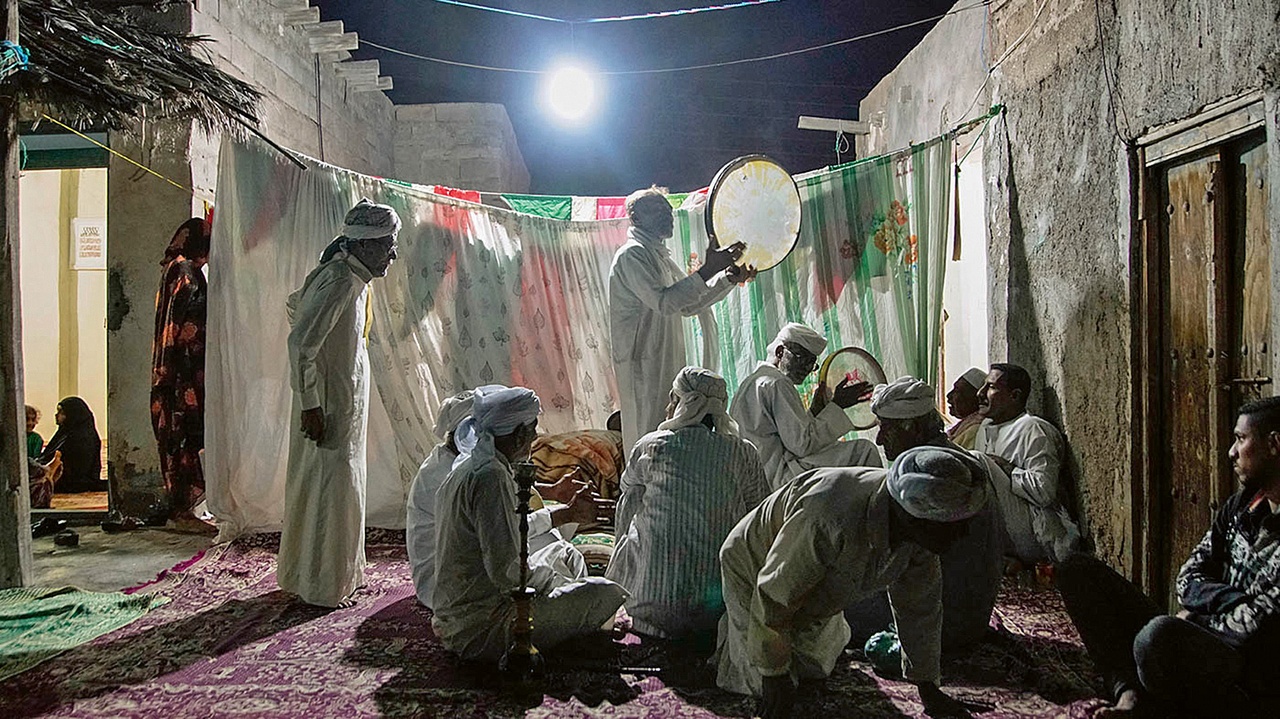
Zār ceremony on Hormuz Island
It’s Leiris’s lesser-known fieldwork across sub-Saharan Africa that provides Cheng’s book with its conceptual hook. For five months, Leiris studied a syncretic religion of spirit possession, observing Ethiopian healer Malkam Ayyahou and her zārs. Though his work is a scientific study, the subject matter is quintessentially Surrealist, the possessing spirit analogous to the Surrealist mask. Leiris saw Ayyahou as far from being at the mercy of the spirits but as strategically incarnating them: “Her zārs constitute […] a kind of wardrobe of personalities that she could put on according to the various needs and hazards of her daily existence” (Leiris quoted in Cheng, p. 140). He deemed the elderly priestess a “virtuosic actress” whose hundreds of zārs, “as much symbolic hats as hands in actions” (Leiris quoted in Cheng, p. 147), enabled her to perform duties (and excuse bad behaviors). In the context of Cheng’s wider ambition to cast the Surrealist mask as identified with the “universal-feminine,” “empowering individuals from politically and economically disenfranchised groups” (p. 15), zārs are invisible masks that the women repossess to take ownership of the zārs’ actions. (Re)possession thus extends the book’s earlier analysis of hysteria, which – although medically discredited – was admired by Surrealists as “a supreme means of expression” (p. 102) and intentionally performed as a mode of subjecthood. Likewise, for Ayyahou to incarnate different identities, she had to manifest a self that was culturally known to gain recognition and acceptance in the public sphere (equivalent to Hannah Arendt’s “vita activa” and her “space of appearance,” the latter term later developed by Judith Butler). [3]
While disciplinarily vast, Cheng’s book does not extend to contemporary manifestations of masks. Her analysis of zārs as “wardrobes of personalities” would be further enlightened if read alongside digital avatars and the online “space of appearance” that has unleashed innumerable deceptive maskings, to facilitate catfishing, identity theft, and the like. Today we build social media personas or train autonomous agents to write or even attend meetings on our behalf, siphoning off our “self” to everywhere all at once. But as the Tiqqun collective prophesized in 1999, the cyberneticians – who laid the foundations for today’s AI – reconstructed “social bonds by depriving subjects of substance. Each person […] a fleshless envelope, the best possible conductor of social communication”. [4] If Cheng pursued textual masquerade in the present, it would be hard not to invoke the fleshless envelope of AI-generated text: LLMs constitute a generic median that, while formed of many, resounds with none. The smoothness of this vampiric textual masquerade feigns humanity while sucking it dry. Rather than enabling the subject to be more than one, such masks constitute a parasitic hollowing out.
When our words and faces can be tracked and hijacked for ulterior motives, anonymity becomes increasingly desirable. Cheng knowingly warns how appeals to selflessness and anonymity feed totalitarian ends to both pacify and mobilize masses. Surrealists instead “aspired less to anonymity […] than the condition of the [good] mask” (p. 161); Cheng finds the political and ethical significance of this good mask articulated in Arendt’s On Revolution (1963): In trying to advance egalitarian ideals, French revolutionaries failed to distinguish the “bad mask” from the “good mask” of legal persona. “By the unending hunt for hypocrites they had unknowingly torn away the mask of the persona as well [and] left all without the protecting mask of a legal personality,” Arendt cautions. [5] Ultimately, subjects are left without the interfaces through which they can be recognized and are thus unable to organize for themselves. It’s chillingly resonant.
In Cheng’s concluding chapter, Cahun and Marcel Moore’s self-qualified “militant Surrealist acts” (p. 162) embody the good mask of resistance. Following the Nazi takeover of Jersey in 1940, they began a textual masquerade – producing and distributing 5,000 anti-Nazi documents – under the pseudonym “the soldier with no name,” adopting the persona of a soldier who had revolted and urged others to follow. Cheng assures that Cahun and Moore’s nameless soldier, although “reflecting the condition of anonymity imposed by Totalitarian regimes” (p. 162), only thematizes anonymity, remaining an identity better understood as the soldier with a hundred names (a pun on Max Ernst’s 1929 La Femme 100 têtes). When the couple was eventually caught, the Gestapo couldn’t believe only two people were behind the thousands of seemingly autobiographical voices. Recalling countless zārs, the nameless soldier was multiple subjects in disguise.
Cheng shows that masks, far from self-effacing, enable the deployment of multiple subjects and contradictory facets. That one can have a hundred names is not a villainous offence but rather is fundamental to upholding our ethical obligations to our “selves” and the Other. Alētheia, Greek for “truth,” stems from “what was previously concealed or covered up,” but as Cheng, via Leiris et al., shows, we are but masks begetting masks. We’d do better, then, to observe Walter Benjamin’s conception of truth as not “a process of exposure which destroys the secret, but a revelation which does justice to it.” [6] And revelation, just like resistance, has many faces.
The Persistence of Masks is a densely researched, occasionally unwieldy, but significant reorientation of Surrealist studies, surfacing minor histories and adjacent fields to foreground the movement as para-ethnographic. Regarding methodology, Cheng admits to “practical challenges of navigating the methods of different disciplines […] complexified by the multiple positionalities and identities we assume in our daily life” (p. xi). Reading over my own text, I realize that only now do I announce myself in the first person. But the contradictory and fraught conditions of my professional, academic, and personal personas are present, speaking through the characters I’ve chosen to cite. Cheng is an encouraging guide, reassuring us that “this multiplicity is not madness […] madness is forcing the subject to be one” (p. xi).
- The title of this text references Emily Dickinson’s poem “One need not be a Chamber – to be Haunted” (1862).
Joyce Suechun Cheng, The Persistence of Masks: Surrealism and the Ethnography of the Subject, University of Minnesota Press, 2025, 256 pages.
Isabelle Bucklow is a cultural critic. She is founding editor of motor dance journal and lives in London.
Image credit: 1. Centre Pompidou, public domain, 2. public domain
Notes
| [1] | A Surrealist magazine and self-proclaimed “Journal of Ethnology” that ran between 1929 and 1930. |
| [2] | See James Clifford, “On Ethnographic Surrealism,” in The Predicament of Culture: Twentieth-Century Ethnography, Literature, and Art (Harvard University Press, 1988). |
| [3] | As in Joan Riviere’s “Womanliness as Masquerade,” *International Journal of Psychoanalysis* 10 (1929): “Whether radical or superficial, they [womanliness and the masquerade] are the same thing”, 38. |
| [4] | Tiqqun, The Cybernetic Hypothesis, trans. Robert Hurley (Semiotext(e), 2020 [1999]), 14. |
| [5] | Hannah Arendt, On Revolution (Viking, 1965 [1963]), 104. |
| [6] | Walter Benjamin, The Origin of German Tragic Drama, trans. John Osborne (Verso, 1998), 31. |