
SOCIOCULTURAL CIPHERS A Conversation Between Gabriella Coleman and Simon Denny
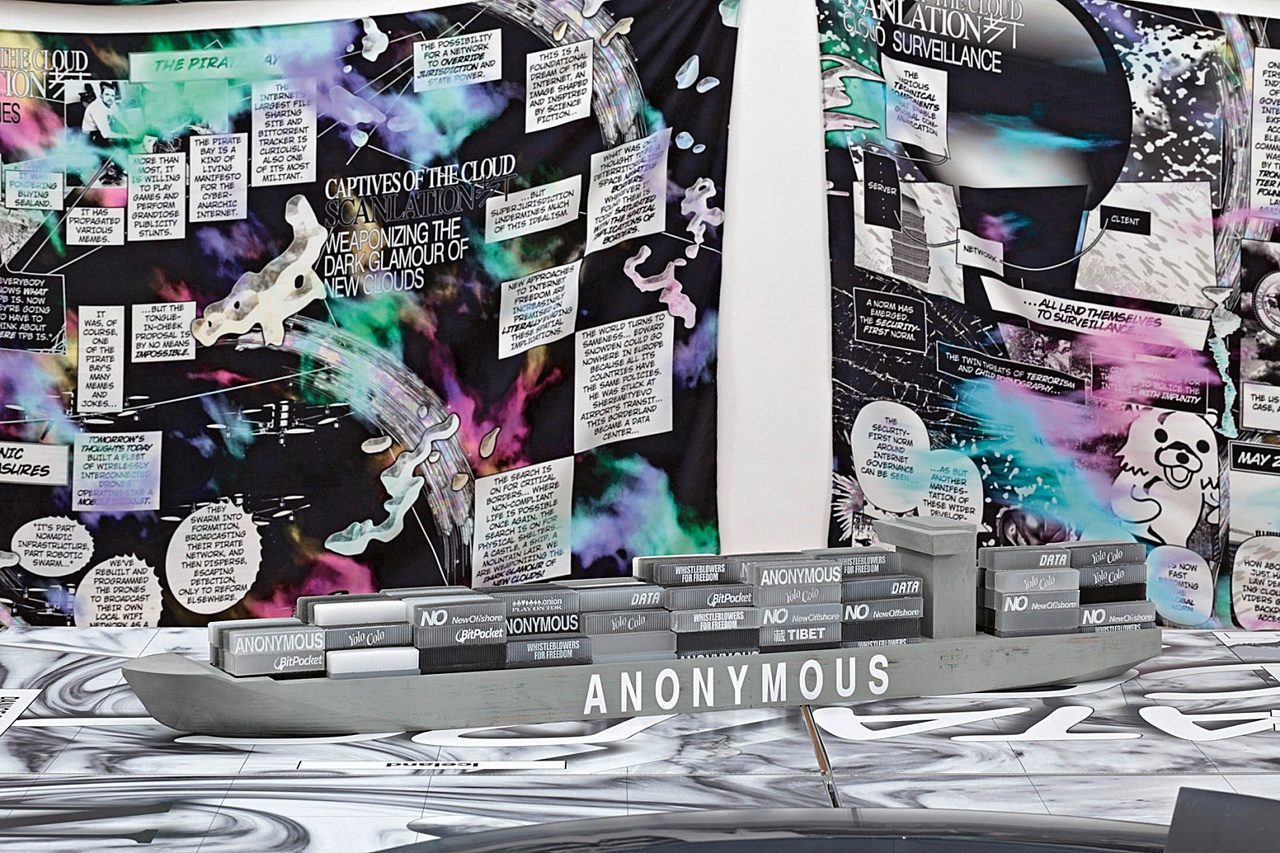
“Metahaven: Black Transparency,” Future Gallery, Berlin, 2014
SIMON DENNY: I got to know your work when I was working on my pavilion for the 2015 Venice Biennale interpreting government documents leaked by Edward Snowden. Your writing on the Anonymous collective was crucial for understanding the context. Imageboards like 4chan and 8chan – often breeding grounds for Anonymous – became a fascination. How has that group affected public perceptions around anonymizing personas online?
GABRIELLA COLEMAN: Anonymous emerged from the trollish culture of imageboards. Until 2008, the name, which is derived from the default “Anonymous” tag that comes with every 4chan post, was used almost exclusively for often quite cruel pranking and harassment. So it was a huge pivot – a historical aberration, even – when the collective landed on hacktivism and developed an anti-celebrity ethic where the community valued shared authorship over personal reputation. Witnessing that transformation is what pulled me in. What started in 2008 as small-scale protest against the Church of Scientology morphed into something far bigger. By 2011, when Anonymous got involved in the Tunisian uprising, nodes started to pop up around the world, and the group seemed to be everywhere, which is a bit of a paradox: an anonymous formation that is global, multitudinous, and constantly present on social media. The public reception was wildly mixed. Some people, especially leftists, admired Anonymous’s cooperative activism. Others were skeptical due to its roots in the offensive world of trolling and its ostensible lack of accountability – in reality, a flimsy shield, given that plenty of Anonymous activists and hackers took real risks and were arrested. Some critics went so far as to claim that the group’s tactics and aesthetics reminded them of fascists. But what especially troubled me was when, starting around 2016, at a time when Anonymous activity waned, some journalists and filmmakers claimed that the anonymous far right, such as QAnon, evolved from Anonymous. [1] In fact, they shared a similar birthplace but not a lineage. By the time the anonymous far right and QAnon took shape on the boards, Anonymous had left them and clamored for worthy political causes, from fighting rape culture to supporting social justice movements. [2] The very conditions of anonymity and ephemerality that mark these collectives make them easy to misrepresent. So it’s understandable why outsiders lump one anonymous formation in with another. But the resemblance is only skin-deep. Anonymous, for all its lawbreaking and transgression, worked in a mode compatible with investigative journalism: leaking documents to reporters, hoping they’d dig through them and expose wrongdoing. Trolls and anonymous formations from the far right conceal identities to dupe people, spread disinformation, and dodge accountability. Anonymous’s secrecy was motivated by an anti-celebrity ethic, and since hacking is illegal, anonymity was, above all, necessary for self-protection. Of course, Anonymous launched fake campaigns, too. But unlike the far right, the group never really aimed at deception. When an Anonymous offshoot, LulzSec, hacked PBS to implant a bogus story about 2Pac and Biggie Smalls, it was meant to be revealed as fake, for example.
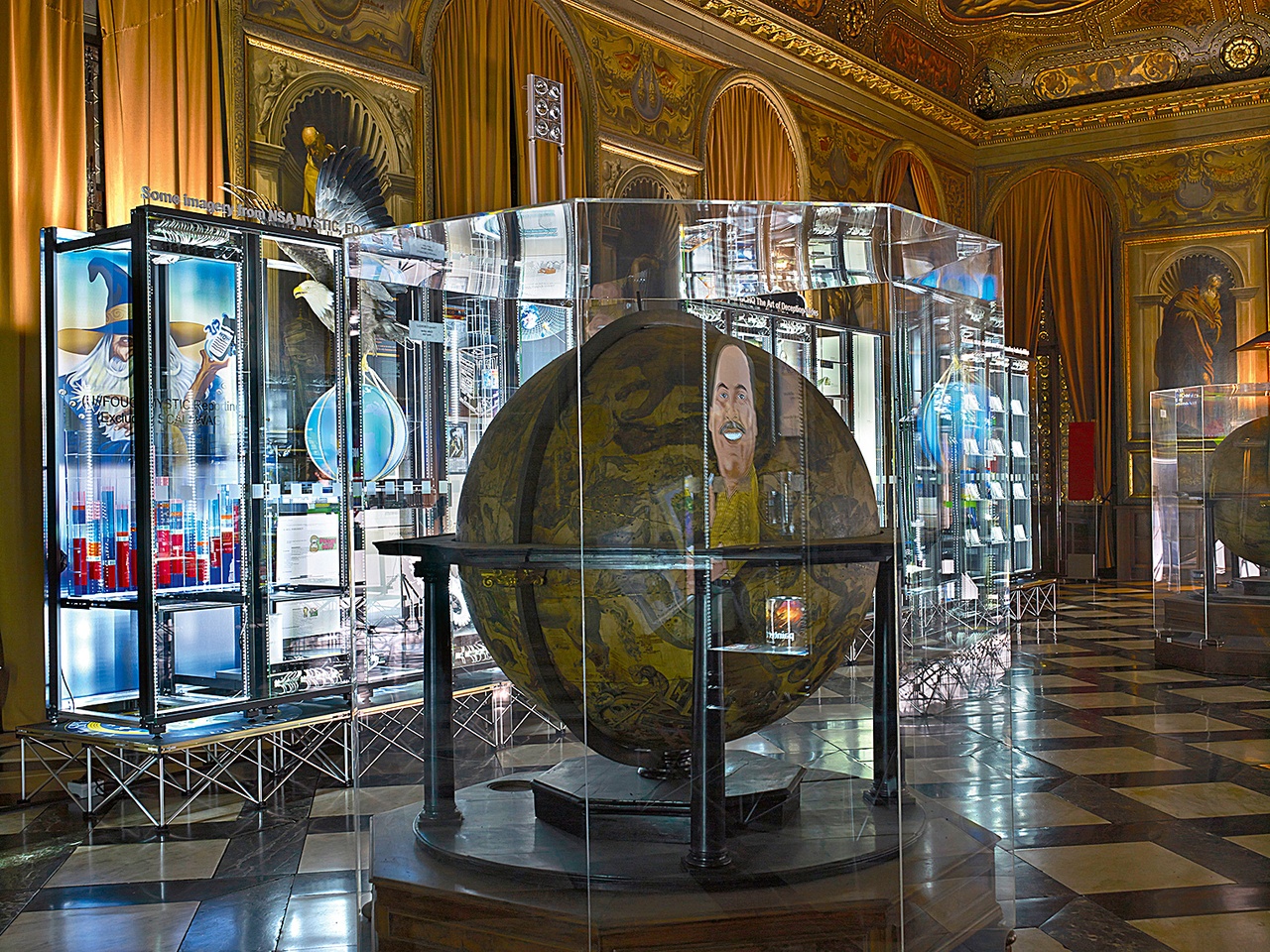
“Simon Denny: Secret Power,” Biblioteca Nazionale Marciana, Venice, 2015
DENNY: As a 2Pac fan from New Zealand, that story about 2Pac being alive and in New Zealand is one of my favorites, of course.
COLEMAN: But everyone knew it was fake, right? We were all in on the joke, whereas the anonymous far right, in 2014, pushed a fake campaign on Twitter claiming that feminists want to get rid of Father’s Day, using it to entrap and red-pill people into reactionary thinking.
DENNY: One could argue that the Anonymous group’s tactics were co-opted by more powerful actors. It’s still unclear who really benefited from the power that was unleashed by the development of online trolling, right? It feels like the Donald Trump and Vladimir Putin universes have been most successful in implementing these tactics.
COLEMAN: That’s right. One theory is that both the trolls and the hacktivists embraced tactics that emerged from the affordances of the internet. Others suggest that Peter Thiel, Steve Bannon, and others co-opted the Anonymous toolkit and directed it deliberately. Bannon’s fanning the flames of the Gamergate controversy through Breitbart and Milo Yiannopoulos is the clearest example. Thiel’s role is currently murkier, though some researchers are trying to pin that down. Whatever they find, Anonymous’s tactics fed into a zeitgeist, and they became available to others. Especially in the aughts, when Anonymous came up, there were these rich online domains that developed cultures of anonymity and pseudonymity, which was very powerful because the internet was otherwise marching in the opposite direction.
DENNY: Like Facebook, right from its founding in 2004. In aligning accounts with real identities, social media platforms are substantially different from anonymous or pseudonymous chat forums.
COLEMAN: Exactly. And now there’s AI, which is built on hoovering data from the internet in ways so different from what Anonymous did, which was to steal specific caches of documents at great legal risk. AI companies scoop up the entire web, but when we prompt AI, what comes out the other end obscures the original sources, as if the machine were offering the material. Every time we use these tools, we’re feeding them new, often intimate data too, without fully registering it. ChatGPT and Claude are surveilling you in a micro sense, extending the infrastructure of hardware-led devices, like cameras on the streets, license-plate readers, or cell phones that track our movements. We’re at the apex of the surveillance state to date.
Sakrowski, “Anonymous: A Shared Identity in The Era of a Global Networked Society,” 2011/14
DENNY: Today’s actors such as OpenAI perform a corporate appropriation of anonymized contributions to build unprecedented proprietary models on. Also, when you actively use an LLM like ChatGPT, you provide such detailed data that platforms can produce astoundingly granular user profiles. User disclosure goes far beyond what one publishes on social media platforms because what you’re contributing to social media is self-consciously public-facing. With LLMs, you’re often contributing very private things, like email drafts or bureaucratic data, with details one would never publish on socials. For the user, AI feels very private – but it’s not. It’s this incredible sleight of hand – AI companies leverage the affordances and assumptions around anonymity in their favor. Given this new terrain, where do you feel the power and the leverage are compared to yesterday’s internet regarding personal user anonymity?
COLEMAN: For one thing, AI systems are quite opaque. And while the hacktivists of Anonymous were enacting opacity from the ground up, these AI companies do so from top-down fortresses. There are a lot of forms of opacity on the system side, but not for the users. In the past two or three decades, technologies for tracking and surveillance really improved, but so did privacy tools such as Tor and Signal. It was a coevolution where the balance of power didn’t really shift. But the AI systems we’re dealing with today are more powerful, and they develop faster. Today, privacy tools like Tor and Signal are robust and so much better to use than their predecessors like Pretty Good Privacy (PGP), a tool for email encryption released in 1991. But despite improvements, these tools feel like toys compared to what companies like Palantir, OpenAI, Flock Safety, and Clearview AI can produce with their enormous capabilities and capacities. It will take a lot of work to create AI with built-in privacy protections, which are direly needed now.
DENNY: What are the costs of being pro-anonymity today? And why is advocating for it still important?
COLEMAN: When I was doing my research on Anonymous – which I didn’t do anonymously but under my own name – there was a recurring touchstone of people viewing anonymity itself as a reason not to trust people or their motives, to dismiss them as shady. And that is a problem. Of course, there was and still is a lot of anonymous or pseudonymous trolling that is very mean-spirited and harmful. But it’s worth troubling the long-standing assumption that anonymity by default leads to bad behavior – an assumption that is, by the way, steeped in tradition. I was reading this book called Anonymous: The Performance of Hidden Identities (2023) by Thomas DeGloma last night, who writes about how Christians tried to stamp out pagan rituals of masking and cast them as sinful. In the case of anonymity, and of its public perception, there’s a very long history and a more proximate history at work together, which makes people forget about its social and emancipatory potential. Take Anonymous: Its activities arose at a moment when a lot of people turned to social media to build up a reputation, a brand, to push their own individual projects and personas, which does get in the way of solidarity at times. There is something powerful about doing good without seeking credit for it, especially in a society that idolizes individualism. So much social and financial value stems from cultivating your identity, and this has only intensified in recent times. Anonymous’s hacktivists weren’t simply anonymous because they were breaking the law; they shared this bedrock ethic that you don’t convert the credit you might be accruing in the group for your own personal fame.
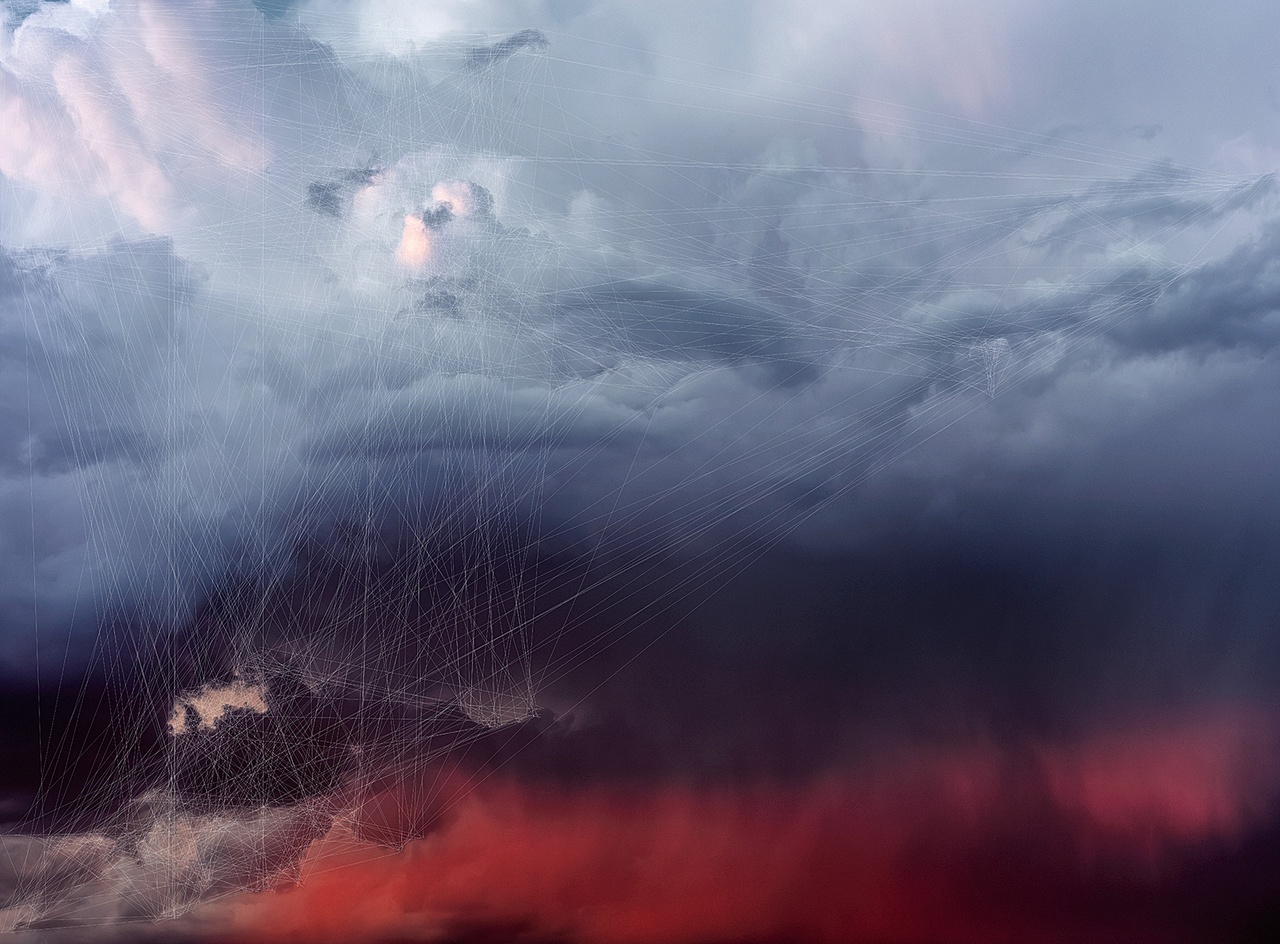
Trevor Paglen, “CLOUD #135 Hough Lines,” 2019
DENNY: I learned from your analysis that this ethic was socially enforced in those contexts as well. Once individual pseudonyms or the occasional actors who used their own names accrued too much value, they faced consequences.
COLEMAN: Yes, they were warned, then kicked out. It was based on the living ethic on the early imageboards, where people posted anonymously and couldn’t accrue a reputation or build a persona. But in the hacktivist world, individual pseudonyms could, so they established these mechanisms, as if to say, Hey, your ego is getting too big – bring it down a notch. I wish we had more such mechanisms in society at large, especially in the United States, where the spirit of individualism crowds out solidarity. Anonymous was remarkable in that respect, because the group really worked collectively. There was a palpable sense of solidarity, which is still present on platforms like Reddit, where people often give advice under a pseudonym, just giving for the sake of giving to the community, to help advance the topic at hand. The anonymous far right, which obviously has its own trajectory when it comes to collectivity, embraced this anti-celebrity ethic from the boards at first. But it soon turned out that it was still willing to put up with what it calls e-celebrities, like Tucker Carlson, if it was going to further their causes. The hacktivists booted all big egos out. It may seem as if I’m making a mountain out of a molehill to differentiate them. But I think it’s an important difference.
DENNY: The crypto world, which has its own relationship to the accruing of value, uses pseudonyms very often – perhaps to combine some of the privacy- or accountability-related affordances that anonymity provides with the value-accruing function associated with using a real name. For example, the pseudonymity of Satoshi, the name behind Bitcoin, still plays an important role in networks around crypto. Could you unpack the most crucial differences between pseudonymity and anonymity as positions to act from?
COLEMAN: They are very distinct at some level. Unlike an anonymous persona, a pseudonymous one develops a consistent reputation, so it can run afoul with the anti-celebrity ethic I’ve just described. In the face of a pseudonym, we tend to create (often incorrect) pictures in our head about who is behind it – like we do with anyone we meet online or offline before we really get to know them. As Walter Lippmann theorized a good century ago, stereotyping is necessary to some degree, to pre-assess people and social situations. What’s distinct about pseudonymity is that it can afford the opportunity to make the problems and process of stereotyping more visible to us: Many of the usual cues we use for initial judgements (a name, a face, an accent, a résumé, clothing) are absent, so the picture you paint is created almost entirely from what people say and do. Given our propensity to filter the world through stereotypes, it’s important to have places where we interrogate them.
Let me tell a story about t-flow – a core Anonymous and LulzSec participant – to clarify what I mean. I knew he was British through his language and spelling. He was brilliant, and I knew he was young. I assumed he came from a wealthy family and went to an elite school. I imagined that he was shipped off to boarding school by his extremely wealthy parents and was as white as white could be. When he was arrested because of his hacking activities, I learned he was Mustafa Al-Bassam, who came from a working-class community; his profile looked nothing like the one I had built up in my head. What I’m getting at is that there is something liberating about interacting with people pseudonymously. Not because such interactions enact a pure ideal of meritocracy, which may well be impossible. We can’t ever fully shed our tendency to judge others on the basis of our biases, nor can one fully shed markers of social status, class, gender, etc., which bear on how people treat you. But both anonymous and pseudonymous spaces let words and actions carry more of the weight than usual. And with pseudonyms, there is enough consistency to maintain this focus on words and actions, even though a kind of relationship is being built.
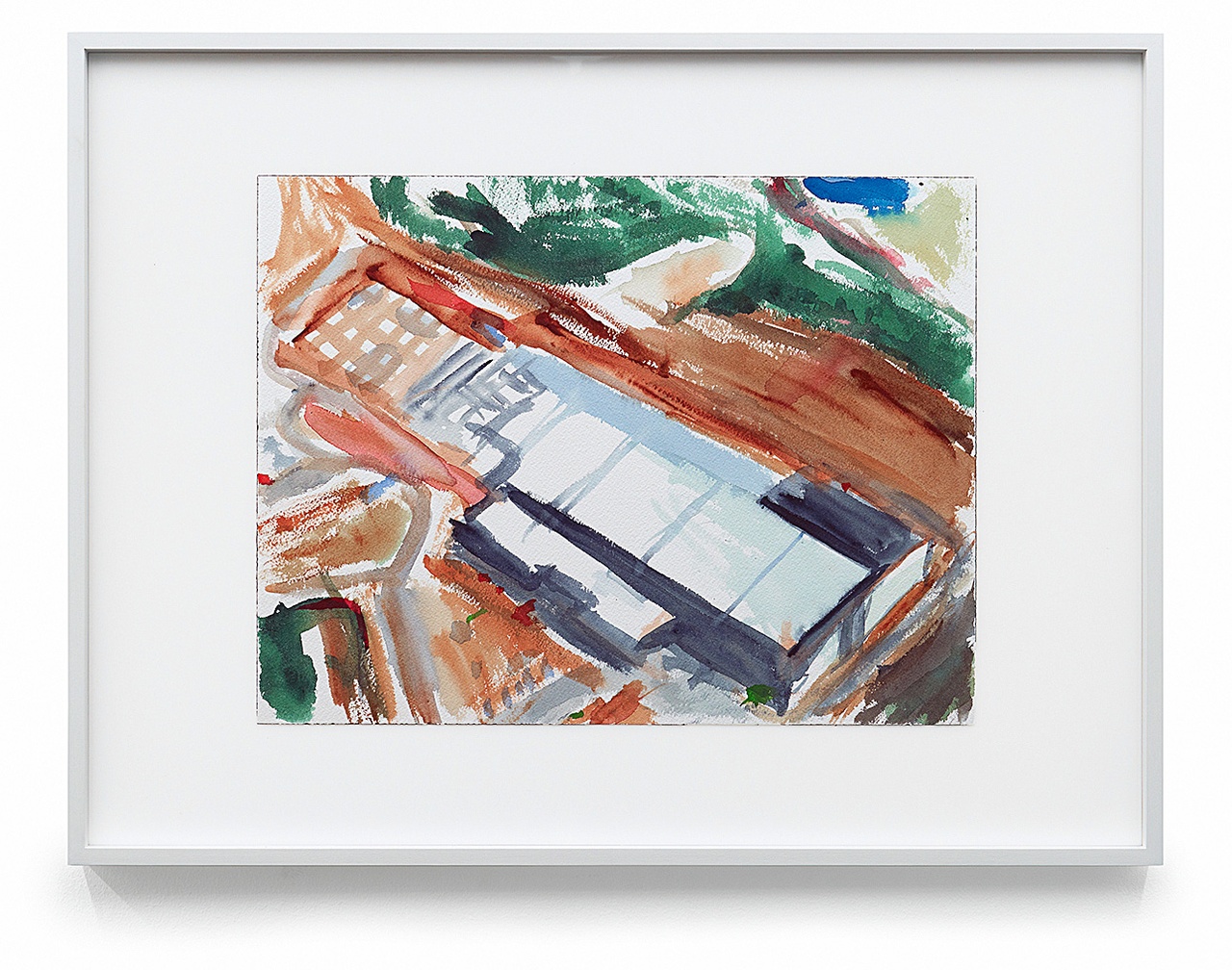
John Kelsey, “Facebook Data Center, Rutherford County, NC IV.,” 2013
DENNY: I love this quote from your more recent writing: “To be online […] is also an occasion to develop and experiment with new selves, socialities, and ethical relations.” [3] It’s an older idea, but it’s beautiful. When one acts as an artist, one becomes a persona, too: You’re working with your own likeness, but you take on another character. I’ve often played with different rhetorical roles, even taken on positions I don’t agree with and done things where I used my own face as a mask, in a way.
COLEMAN: There is something very theatrical and ethnographic about it at the same time. Theatrical insofar as that’s precisely what people do when they take on a persona. And ethnographic because you’re not in a lab setting up an experiment. Taking on a different role and position as an artist, you create the experiential conditions for it.
DENNY: You’re a Harvard professor, which is a very specific position. In that role, you must also experience culture wars from a very particular perspective.
COLEMAN: You’re right. That is the current backdrop; we can’t ignore it. And if you look historically at Anonymous, the hacktivists, it’s interesting that they really started to congeal around 2011 and 2012, when a certain style of left “woke” politics started to consolidate, too. And by 2014, reactionary types started to go after “wokeness,” with Gamergate being one notable example. It goes without saying that certain aspects of what I’ll gloss as identity politics are very important and valuable. Race, class, gender, disability, sexuality, etc. inform our sensibilities and alliances, as they should. But we aren’t determined or imprisoned by them. Our capacity to make art, to organize, to seek change reflects a human desire to exceed the given, identity included. Leaving politics entirely to questions of identity can come at a cost. At its worst, it can make solidarity harder. Anonymous was anti–identity politics, but crucially it was still committed to social leveling or social justice. The new right has also embraced an anti-identity posture, casting itself as above these markers and committed to meritocracy. But without examining power, structural forces, and things like bias, you risk naturalizing hierarchy. Forging solidarity across difference is vital, and it need not come at the expense of fighting for particular isms. It’s important to have domains where we can get out of the culture-wars loop. And spaces of anonymity and pseudonymity, especially when they are committed to social leveling and justice, can potentially help with that.
DENNY: I had the fortune of having a few back-and-forths with David Graeber before he died. I think his way of doing politics was very interesting. He’d do all this work on Occupy Wall Street yet also debate Thiel. I found this inspiring.
COLEMAN: I’ve long respected Graeber for refusing to fall back on the usual culture-war script of us versus them and, especially, the purity tests that treat things like debating the other side as a capitulation or, worse, a moral failure. Yes, sometimes you need to draw stark lines in the sand, and debate is not some political silver bullet. But it can be a worthwhile exercise, and Graeber knew this well. We also need to recognize that not every issue fractures along political lines and that there are situations in which short-term alliances are necessary. Take issues like the regulation of data centers or the fight for privacy, which are supported from the left and the right. This question of anonymity and opacity is another domain where …
DENNY: … it is not necessarily clear where the cookie crumbles politically.
COLEMAN: No, not at all.
DENNY: And sometimes, in hindsight, you want to refine your own position. Working on my Venice pavilion, unpacking the visuals from the Snowden releases, we found this artist figure who was a creative director at the NSA, and I partly gave up my authorial position to foreground his. It was a pretty deceptive, trollish move in its own way – to use somebody else’s work, unauthorized, and to frame it speculatively within a partly diplomatic project, as a national pavilion at the Venice Biennale is. I now see the whole issue as much more ambiguous than I did at the time, when I thought all this disclosure of state secrets was definitely in the interest of the left, that Julian Assange and his collaborators helped to critique and inform the liberal state and nudge policymakers in a more progressive and accountable direction. Looking back, I think that it also clearly fueled mistrust and helped spread misinformation, which in turn could be seen as sowing the seeds of the kind of intrigue that gives positions like QAnon their power. You were and are in touch with many more actors from the hacktivist context surrounding Wikileaks than I’ve been. How has the politics changed, from your perspective, also with a view toward more progressive hacktivism, or versions that were self-styled as progressive?
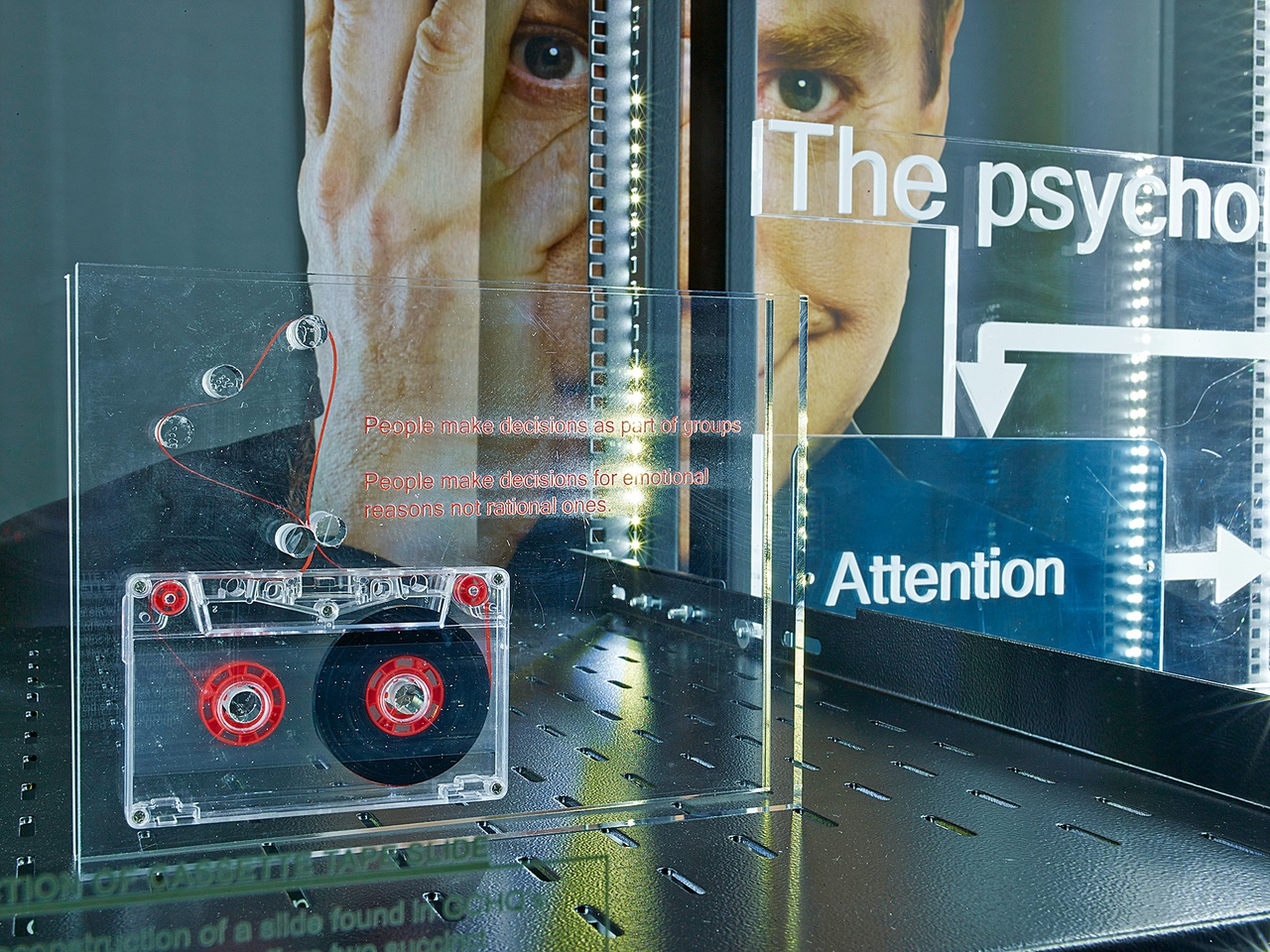
Simon Denny: Secret Power,” Biblioteca Nazionale Marciana, Venice, 2015
COLEMAN: You just enacted a method I’m currently using and theorizing in my new book: recursive return. It involves reassessing our positions to see things that couldn’t be seen clearly in the thick of things. Anthropologists often toggle between the past and present in this manner. I’m applying it to the history of hacking and leaking, for example. It was through this exercise that I came to see how important Jeremy Hammond – a prolific leftist hacker who joined Anonymous – was to ensuring the stabilization of hacking and leaking in the public interest. To make his role visible, I’m piecing together a micro-history of the hack-and-leak and can say now with more confidence that Anonymous’s trajectory – moving from trolling to activism – is a laudable one. Assessing their actions in the moment was tough. It’s only with the distance of time that this arc really comes into focus, and so does the value of their strategy for political change. But of course we shouldn’t naively idolize their hacks and leaks as if simply placing information into the light will magically fix the world.
DENNY: That’s not a given. Especially now.
COLEMAN: It’s not a given, but that’s always been the case and no reason not to still …
DENNY: … keep these tactics in your toolkit.
COLEMAN: That’s it. And it’s crucial to nurture journalism. It’s in peril, and we should be doing everything to support especially investigative, adversarial types of journalism. At the time, many of us – myself included – believed WikiLeaks would engender more positive change than it did. But it was still a valuable project and experiment: It offered disclosures that mattered and provided a template that others, such as the activist platform Xnet and the whistleblower site DDoSecrets, have built on since. WikiLeaks as an institution and Assange as a figure made many mistakes. However, being able to step back and evaluate what worked and what failed is important – essential, even – especially if we can carry lessons learned into the future and into new projects. Whether it’s hacktivists, academics writing about them, or artists working with the material, it’s through this recursive process that the sharper edges come into view. Especially experimental formations require more than one reading – they deserve repeated analysis that brings their impact and stakes into relief.
Gabriella "Biella" Coleman is the Ernest E. Monrad Professor of the Social Sciences in the Department of Anthropology at Harvard University. Her work examines the politics, cultures, and ethics of hacking. She is the author of Coding Freedom (2012) and Hacker, Hoaxer, Whistleblower, Spy: The Many Faces of Anonymous (2014), the founder and editor of Hack_Curio, and the host of the BBC Radio 4 podcast series The Hackers.
Simon Denny is a Berlin-based artist working with painting, installation, sculpture, video, print, and web-based media. He has exhibited widely, including representing New Zealand at the 56th Venice Biennale, and has been included in many other major biennials. He has presented exhibitions at K21, Düsseldorf; MoMA PS1, New York; Serpentine Galleries, London; OCAT Shenzhen; and the Hammer Museum, Los Angeles, among many other museums and institutions. Denny serves as Professor for Time-Based Media at the HFBK Hamburg and cofounded the mentoring program BPA// Berlin program for artists.
Image credit: 1. © Metahaven and Future Gallery; 2. + 6. Courtesy of Simon Denny, photo Nick Ash; 3. Courtesy of Sakrowski, Kunst Halle St. Gallen and !Mediengruppe Bitnik, photo Gunnar Meier; 4. © Trevor Paglen, courtesy of Jessica Silverman, San Francisco and Pace Gallery; 5. Courtesy of Galerie Buchholz
Notes
| [1] | See, for example, Angela Nagle, Kill All Normies: Online Culture Wars from 4chan and Tumblr to Trump and the Alt-Right (Zero Books, 2017); or Cullen Hoback, Q: Into the Storm, HBO, 2021. |
| [2] | A more detailed account can be found in Gabriella Coleman, “From Busting Cults to Breeding Cults: Anonymous H/acktivism vs. the (A)nonymous Far Right and QAnon,” HAU: Journal of Ethnographic Theory 13, no. 2 (2023): 250–54. |
| [3] | Gabriella Coleman, “Reconsidering Anonymity and Anonymous in the Age of Narcissism,” in The Aesthetics and Politics of the Online Self: A Savage Journey into the Heart of Online Cultures, ed. Donatella Della Ratta, Geert Lovink, Teresa Numerico, and Peter Sarram (Palgrave Macmillan, 2021), 239–62, at 239. |