

IMAGES AND SOUNDS FROM ANOTHER AMERICA Arindam Sen on DOK Leipzig
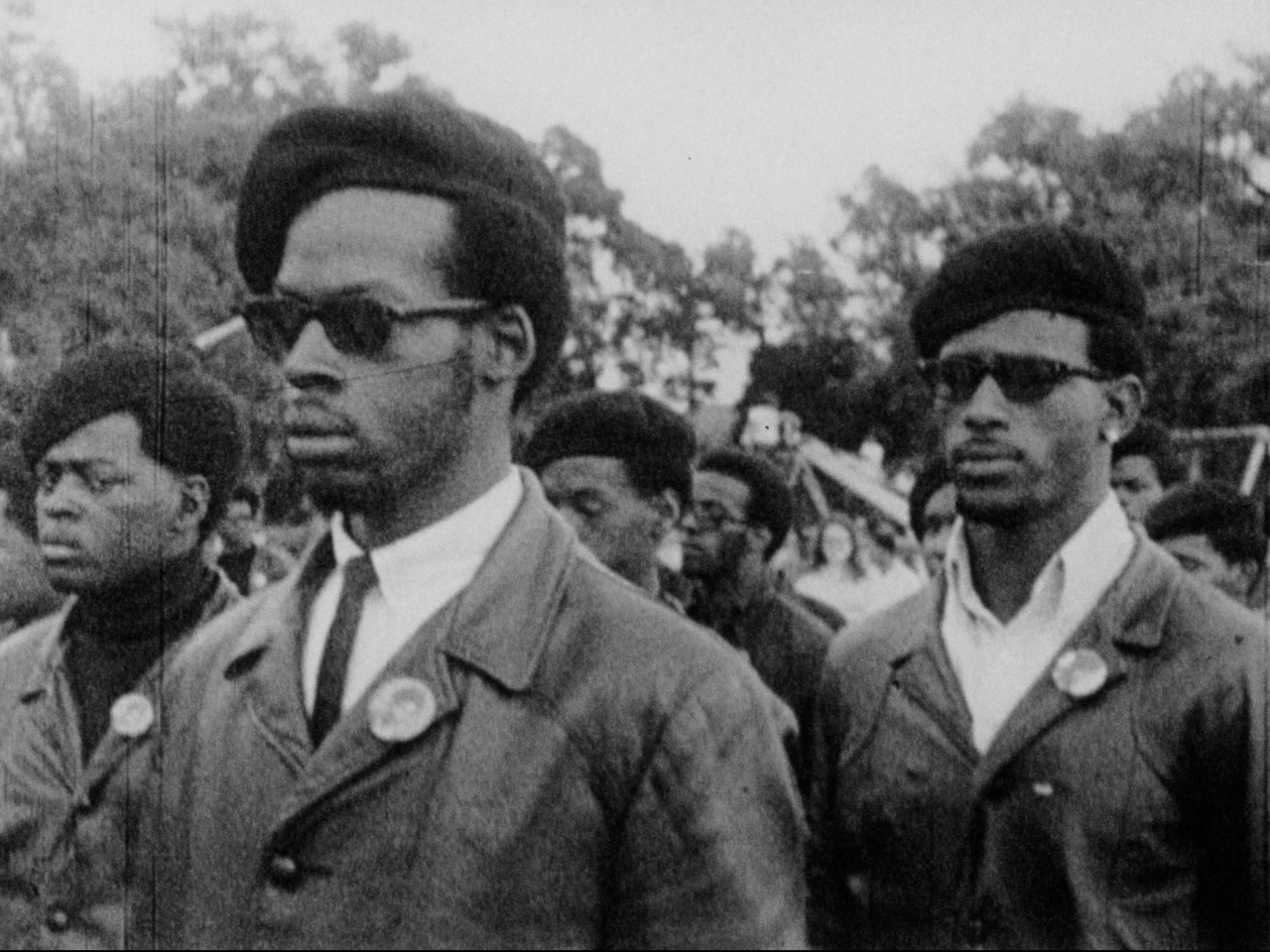
Newsreel, “Black Pather a.k.a. Off the Pig,” 1968
Sitting somewhere between genuine transnational solidarity and the vagaries of Cold War propaganda, the popularized idiom of the Other America subsisted in the German Democratic Republic (GDR). The term might have its roots in the eponymous book by the socialist author Michael Harrington from 1962, or in a speech delivered by Martin Luther King Jr. in 1968, but in the GDR, Other America took on a more expansive connotation throughout the long 1960s, running counter to the perceived synonymity of prosperity and freedom with the country’s bête noire, the USA. It brought together workers’ movements, Black and Native American resistance, prison uprisings, grassroots organizing, and internal opposition to the Vietnam War, standing for an image of a defiant people with whom solidarities might be forged. The Iron Curtain was porous enough for impressions of this other to seep through. Notable names from the civil rights movement frequently visited the GDR, Black music was popular in the erstwhile communist state, and American themes were common in state-sponsored productions – as were American films at the Leipzig Dokumentarfilmwoche, the predecessor of the present-day DOK Leipzig, and to an extent that might not have been apparent until now. Each year, a retrospective is the centerpiece of the festival, and this edition’s “Un-American Activities” program was no different. It used a careful selection of films from the festival’s history between 1962 and 1989 to unveil a strong affinity between militant documentary practices in the US and the current festival’s antecedent.
The retrospective borrows its title from the House Un-American Activities Committee (HUAC), an investigative body in the US House of Representatives that, from 1938 onward, led a purge of political dissenters under the guise of anti-communism; though Joseph McCarthy himself was never a member, the committee’s political witch-hunting was tantamount to McCarthyism. Robert Carl Cohen’s film Committee on Un-American Activities (1962), which appeared in the opening program of the retrospective, was a passionate indictment of the committee’s unaccountability and political overreach, delivered through a well-knit miscellany of archival footage, interviews, affective narration, and expressionistic close-ups. McCarthy’s fall from grace and the end of the Korean War were followed by the watershed event of the 1960s – the war in Vietnam. Not only would the conflict become the face of American imperialism, but the opposition it faced both on the domestic front and globally also generated the heartbeat of the countercultural moment; many filmmakers included in the retrospective wouldn’t have bothered to pick up a camera if not for Vietnam. Two films, both now slightly recherché, speak to the pulse of the era: Jerry Stoll’s Sons and Daughters, which won the DOK festival’s Golden Dove award in 1967, and Jack Ofield’s Different Sons (1971). Stoll, a Bay Area photographer best known for his portraits of the leading jazz artists of his time, filmed a two-day anti-war protest march from the UC Berkeley campus to an Oakland military port. Switching between shots of individuals and assemblies with effortless ease, Stoll’s camera wanders close to the crowd and mimics the dynamism in the sit-ins, banners, and fiery speeches, which cut across age, gender, class, and race. Punctuated by archival footage of the war, the context is made ubiquitous – this is what the fight is against, and there is no escaping it. Different Sons is of a similar tenor, with uniformed Vietnam veterans wielding plastic machine guns and marching from Morristown, New Jersey to Valley Forge, Pennsylvania, publicly staging and reenacting scenes of shocking brutality and war crimes committed in Vietnam, drawing both sympathy and ire from onlookers on different sides of the political divide. Amidst other films dealing with American war efforts abroad is Witness to War: Dr. Charlie Clements (Deborah Shaffer, 1985), a portrait of a fascinating figure: a Vietnam War veteran who later served as a medic to the guerillas in El Salvador. Clements had experienced the ultimate irony of fate, in the words of his fellow Vietnam veteran in the film, from flying bombers in Vietnam to getting bombed by the same destroyers in the jungles of El Salvador 15 years later.
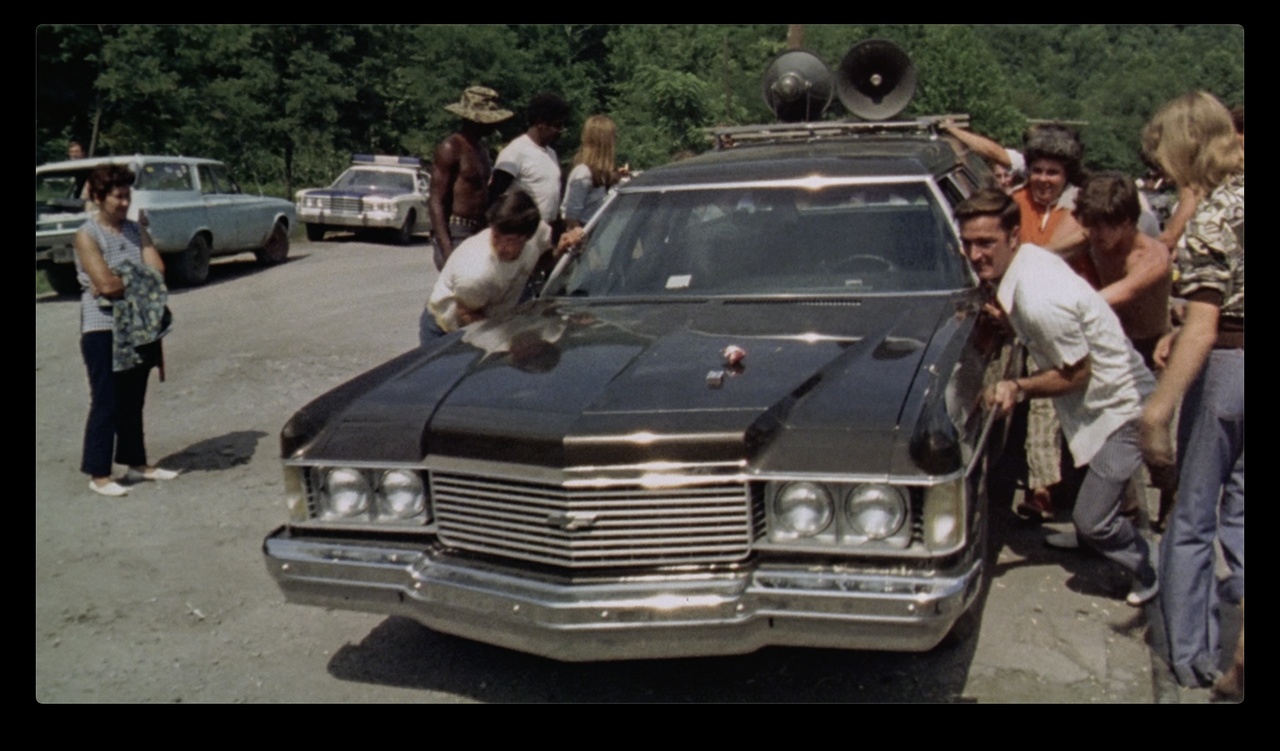
Barbara Kopple, “Harlan County, USA,” 1977
The most famous of the film selections is Barbara Kopple’s Oscar-winning Harlan County, USA (1977), an impactful example of political filmmaking that entangles its stake with political action. Documenting coal miners striking to assert their right to join the United Mine Workers Union in Harlan County, Kentucky, Kopple successfully archived not only the flashpoints of the movement – the several confrontations between the miners and the mine owners – but also the mundane precarity of the miners’ lives, the defiant resolution of their wives to hold the picket line against armed hired thugs, and, unwittingly, the physical threat she herself and her small crew were subjected to during the course of filming. The film is a fine specimen of participatory filmmaking, in contrast to the typical get-in, shoot, get-out, and edit-to-purpose sort.
Documentaries about strikes and unions were unsurprisingly popular in Leipzig, as attested to by other films in the retrospective. In the talking-heads-style Union Maids (1976), by Jim Klein, Miles Mogulescu, and Julia Reichert, three women present an oral history of the union movement in the US and the complex relational dynamic of gender, race, and class there during the Great Depression. The significance of such historic organizing efforts is vindicated, and their achievements rendered exiguous, by the economic hardships of Joan Williams, a 70-year-old nighttime cleaner in Chicago clubs and the protagonist of Loretta Smith’s Where Did You Get That Woman? (1982), which was presented on a drop-dead-gorgeous 16mm print. The retrospective was divided into three parts, with the program held during the festival days prefaced by a focus on the filmmaker Emile de Antonio and postscripted by a few screenings dedicated to two film collectives, Newsreel and Kartemquin.
De Antonio, or “De” to his friends, was among America’s most significant Cold War filmmakers, a master of making compilation films from archival footage. He was a regular fixture at Leipzig, and the retrospective re-presented his landmark films from the festival’s history. These include Point of Order! (1964), a tour de force of editing that turns 188 hours of footage from the McCarthy hearings into 90 minutes of what Susan Sontag, in 1964, referred to as “the real comédie noire of the season, as well as the best political drama”; [1] the essayistic In the Year of the Pig (1968), on the history of the American presence in Vietnam; and Millhouse (1972), a documentary comedy that lampooned Richard Milhous Nixon flush in the middle of his presidency.
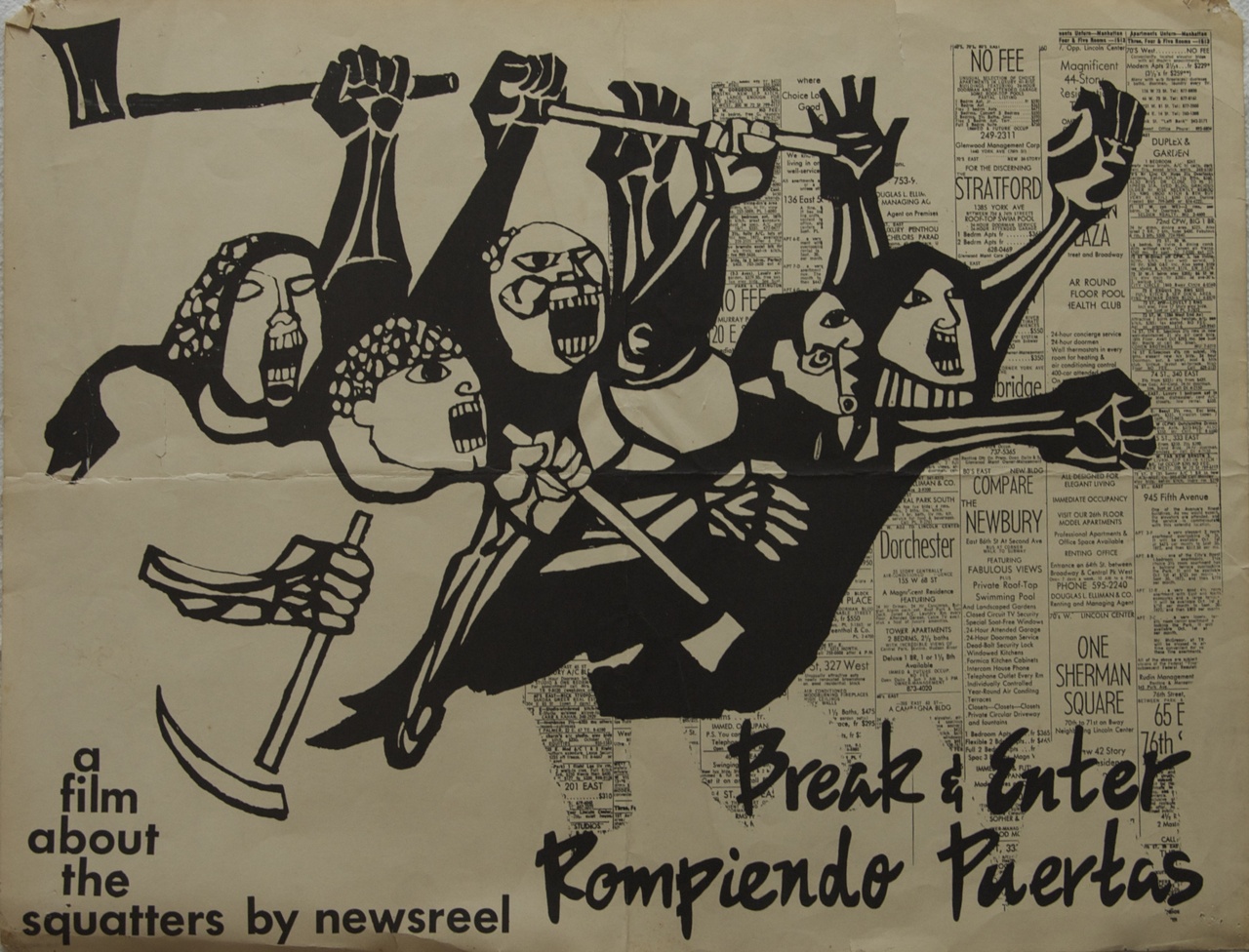
Poster for “Break and Enter a.k.a. Squatters,” Newsreel, 1971
On the other end were the film collectives. Newsreel was the cinematic front of the New Left, originating in New York before branching out into other parts of the country and later being succeeded by the Third World Newsreel. The lesser known Kartemquin Films was (and still is) based out of Chicago. In the lineage of Dziga Vertov’s Kino-Pravda and covering a range of styles, the films were counterinformational, empiricist, and opposed to the propaganda of dominant ideology. Army a.k.a. Army Film (Newsreel #36) chronicles the discontent among Vietnam War draftees and is assaultive in the spirit of the collective’s flickering title, which is synced to the sound of a machine gun and so harks back to the “films as bullets” ethos of the Workers Film and Photo League in the 1930s. In contrast, Break & Enter a.k.a. Squatters (Newsreel #62) (1971), People’s Firehouse No. 1 (Paul Schneider, 1979), and the deeply moving The Chicago Maternity Center Story (1976) by Kartemquin solemnly detail collective organizing against urban gentrification, the planned shrinkage of poor neighborhoods, and the commercialization of health care, in a manner that recalls Allan Sekula when he said that “the rhetorical strength of documentary is imagined to reside in the unequivocal character of the camera’s evidence, in an essential realism.” [2]
Rhetorics were at a premium in the 26-film expanded retrospective, as was the amalgamation of archival footage and recorded conversations. Owing to their indifference to the valued ideals of detachment and self-reflection, these mostly obscure films do not feature within avant-garde historicizations or the project of 1960s political modernism. Their hit-the-nail-on-the-head-hard style of radical non-objectivity meant that questions of form remained on the back burner, save for the occasional sequence. One such instance appears in Black Panther a.k.a. Off the Pig (Newsreel #19) (1968), where Bobby Seale’s speech is effectively intercut with, rather than images of police brutality, a series of tracking shots of Black neighborhoods – the real site of the daily liberation struggle. But Black filmmakers themselves were missing from the retrospective, whose scale enticed one to ruminate on the absences as much as the presences. It was certainly not an oversight on the part of the curators Tobias Hering and Tilman Schumacher, who looked closely at the festival’s archives, but is nonetheless a curious case given the long history of camaraderie between the GDR and the Black Power movement, which went all the way to solidarity campaigns with the incarcerated members of the Wilmington 10 and their family members facing persecution in the US. The reasons are hard to ascertain, but discussions with the curators suggest it could be either a case of bad bookkeeping or simply a limitation on the part of the festival’s curatorial reach.
Un-American Activities was a veritable index of the 1960s musical nerve – blues, jazz, country, folk, and even concertos made of helicopter sounds all populate the films’ soundtracks. It also pointed to a broader critical tendency within legacy film festival curation in recent years – such as the re-selected section in Kurzfilmtage Oberhausen (2018–24) or the Forum 50 retrospective at the Berlinale in 2021 – which, through reenactment, confers a relationship to the past and the gesture, not restorative but reconstructive, activating often unexpected resonances with the present while also rendering film and festival history dynamic.
“Retrospective: Un-American Activities,” 68th International Leipzig Festival for Documentary and Animated Film, Leipzig, October 27–November 1, 2025.
Arindam Sen curates and writes on experimental, artists’, and documentary film. He is the cofounder of the Brussels-based experimental film platform Cinema Parenthèse and the author of Distant Voices (Stereo Editions, 2024).
Image credits: 1 + 3: Courtesy of Third World Newsreel; 2: Courtesy of Cabin Creek Films