
SHARKS IN THE POOL Christoph Gurk on the “Volksbad” at Volksbühne on Rosa-Luxemburgplatz, Berlin
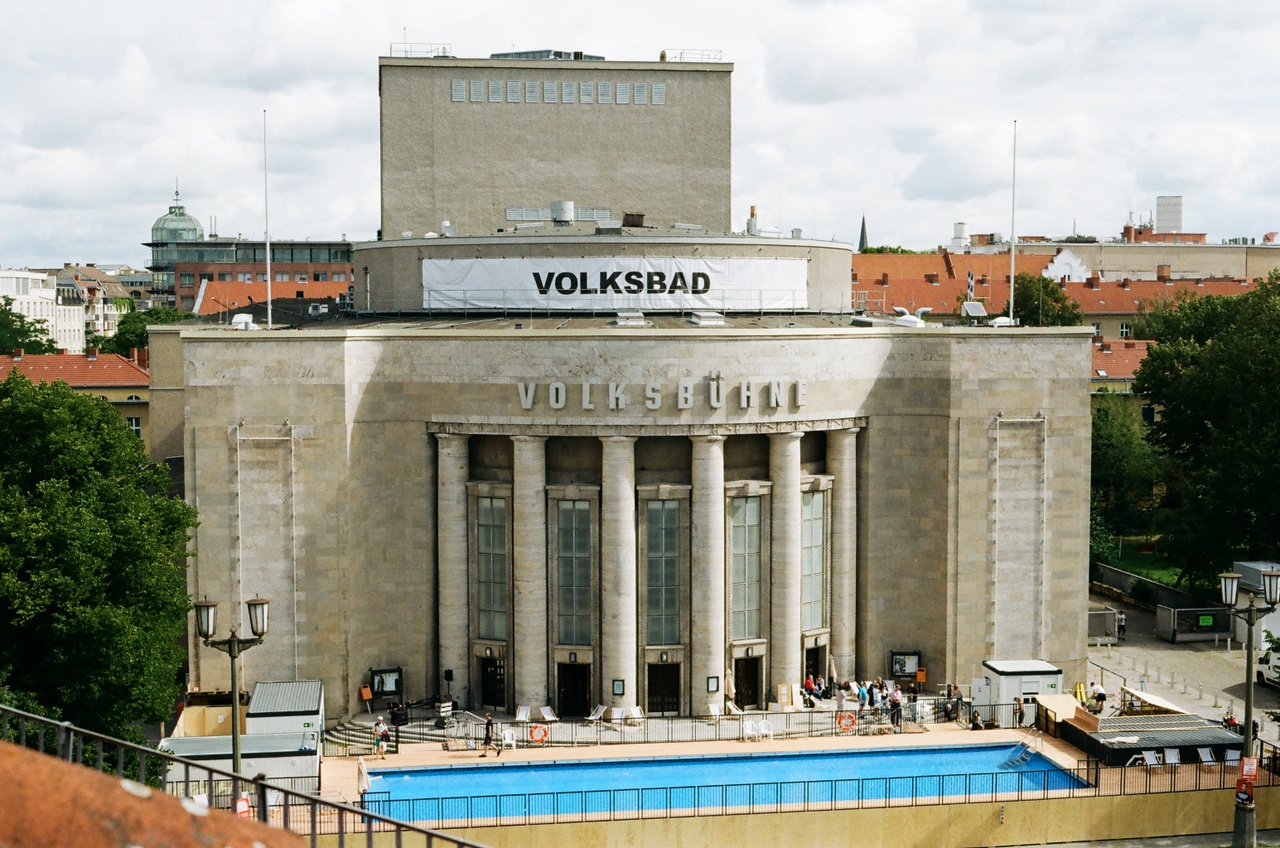
Volksbad an der Volksbühne am Rosa-Luxemburg-Platz, Berlin, 2026
Within the single month of August, the cultural scene in Germany has seen three projects – spanning theater, dance, and performance – focus on the swimming pool as a site of social struggles. With the work Pool People, director Christiane Huber celebrated the Michaelibad – located in Munich’s “problem neighborhood” of Neuperlach – as a space for nonviolent processes of negotiation and understanding. At the Oderberger Bad, in the heart of Berlin’s Prenzlauer Berg, Dana Michel’s work You Cannot Can explored the diverse fears that arise when people come into contact with water. As if the Montreal-based choreographer and performer had already anticipated the debates surrounding the Volksbad, her work addressed the unequal access to public pools and bodies of water for people of different skin colors, and the history of water – anchored in traumatic Afro-diasporic memory – as a medium of deportation and enslavement.
A reasonably functioning public discourse would have welcomed the diversity of these projects and situated the Volksbad precisely at the intersection of these two positions – one hopeful, the other skeptical. Perhaps it would also have been acknowledged that, after ten years of brutal infighting over the theater’s future direction, the Volksbühne’s new artistic leadership had extended a generous invitation – above all to the neighborhood in the now completely gentrified Scheunenviertel. With the Volksbad, a “third space” was created: a place of encounter free from the pressure to consume, where people can simultaneously chat with other visitors and find relief from seemingly endless heat waves.
The steps at the main entrance of the Volksbühne have always been used by local residents as a meeting place, even outside of performance times. By setting up a temporary swimming pool, the theater is, by its own account, symbolically protesting the miserable state of public infrastructure, the lack of summer swimming pools in the whole district, and likely also the rising entrance fees at existing swimming facilities – prices that are unaffordable for low-income residents if used on a regular basis. Even the pool’s placement right in front of the theater makes it clear that a fundamental question is being addressed here – one that also shapes the legitimacy of theaters as such. It concerns low-threshold forms and formats, and the accessibility of cultural institutions.
Even before the pool had been opened to the public, debate heated up over accusations leveled by right-wing media, as well as some more reputable publications, of “wasting taxpayer money.” As if someone had turned the debate calendar back decades, the public found itself in a discussion about what still qualifies as theater, as an artistic act, and therefore as worthy of funding.
Even veteran and experienced critics – now in questionable company – have apparently forgotten that the Volksbühne, even back in the early 1990s when it was reestablished by artistic director Frank Castorf and by its then-chief dramaturge, a certain Matthias Lilienthal, had already championed an expanded concept of what theater could be through high-profile actions by artists like Christoph Schlingensief, or through formats based in culturally underserved outlying areas, such as chief set designer Bert Neumann’s “Rollende Roadshow.” In this way, the theater – not to mention Matthias Lilienthal’s subsequent pioneering work as founder and artistic director of the Hebbel am Ufer (HAU) – has contributed significantly to the development of a new understanding of outreach: understood not merely as an explanatory accompaniment to theatrical productions, but as an artistic work in its own right.
It is precisely in line with this approach to outreach, now established in many cultural institutions, that the Volksbad also allocates a number of time slots to civil society organizations and initiatives that require a reasonably safe environment for visits by disadvantaged and stigmatized population groups. The wave of outrage, hatred, and threats of overt violence – which the term “shitstorm” can only barely describe – descended upon the Volksbühne only when it became known that a six-hour time slot had been allocated to the organization Each One Teach One. The aim behind that arrangement was to provide a carefree afternoon for children and young adults who face daily racist hostility in a predominantly white society.
Matthias Lilienthal quite rightly points out that such measures are a part of the guidelines provided by the city of Berlin and have long been a matter of course in everyday life – not only for cultural institutions in the city. The current debate completely overlooks the fact that the dramaturgical and curatorial decisions at the theater are made not by a sole ruler to be demonized as attention-seeking and paternalistic, but rather in close cooperation with a (now) diverse artistic leadership team.
Hindsight is 20/20, especially for the almost exclusively white commentators who, of course, would have foreseen the disaster had they only been asked. Sure, one can always argue whether a reasonably safe space can even be created in such an overdetermined and media-scrutinized performative setting, with the Volksbad serving as a temporary stage. Perhaps one could also have anticipated that this task would be even more difficult to manage in the run-up to the Berlin House of Representatives elections on September 20 – that much is clear.
Even if everyone had had the time and space to weigh the uncertainties and risks more thoroughly beforehand, perhaps even in an effort to please everyone – what difference would that have made? It has become abundantly clear how right-wingers, who present themselves as the “political center” and as spokespeople for common sense, just like the fascists who are appearing ever more brazenly even in the Mitte district, will leave no opportunity unused to destroy just about everything that the Volksbühne has stood for throughout its history – and, hopefully, in the future – and replace it with an entirely different concept of culture. An example is currently being made of this theater. The boundaries of what is still possible in a metropolis like Berlin are being redrawn in ways that were unimaginable not too long ago.
Not only has it been the case – at least since the attack on Berlin’s Christopher Street Day this July – that structurally disadvantaged population groups face risks to their lives and health when they appear in public and make themselves visible. The very framework within which these alarming developments can be discussed is on the verge of being destroyed.
Difficult and protracted processes will be needed to clarify how the right to visibility in public spaces, on the one hand, and the right to safety, on the other, can be reconciled in the future. We must hope that the Volksbühne and all other cultural institutions in this country can be – and will remain – one thing above all else: institutions that are committed to learning.
Christoph Gurk is a dramaturge, curator, and author living in Berlin.
Transparency statement: Christoph Gurk is currently engaged as a dramaturge for another project at the Volksbühne and was involved in the “Pool People” project in Munich.
Image credit: Courtesy of Volksbühne am Rosa-Luxemburg-Platz, photo Bahar Kaygusuz