
ZURICH DOESN’T MEAN ANYTHING Leonie Huber on Tereza Glazova and Sveta Mordovskaya at Autokomanda, Belgrade
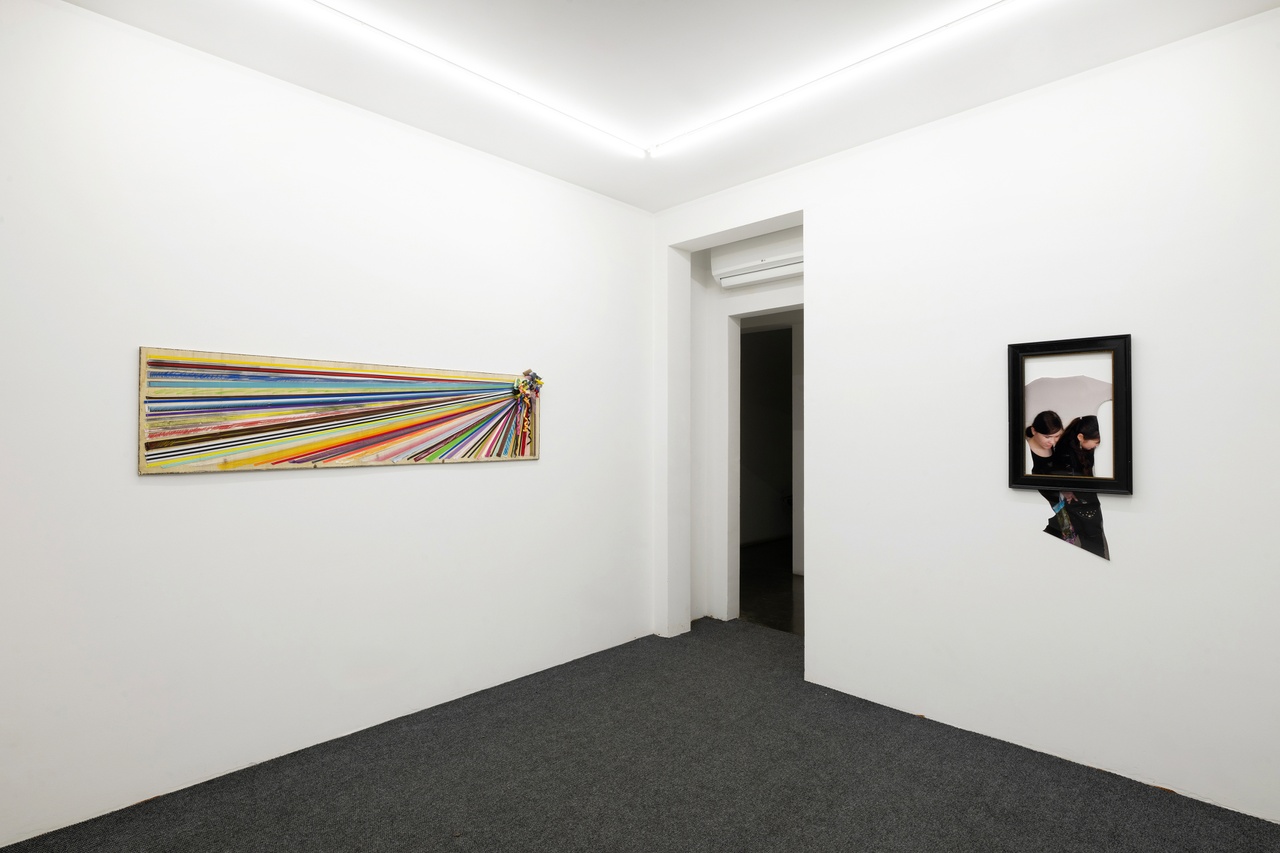
“UNTITLEД: Sveta Mordovskaya, Tereza Glazova,” Autokomanda, Belgrade, 2026
The many images of young women in this exhibition all attest to a desire to be seen, while, at the same time, demonstrate different ways of escaping the picture frame. Photographs of teenage girls posing in groups of two or three or taking a mirror selfie, with the bright flash testifying to their origin in the aughts, make up Sveta Mordovskaya’s group of works Interior, interior, space, … (2026). Mordovskaya, who often employs material from her personal collections, uses images from her teenage years in South-East Russia in the post-Soviet period – two of them even show the artist herself. Some are blown up, cut into silhouettes, or ripped to pieces, then presented within or adjacent to found picture frames. Another is displayed behind a wooden frame but exceeding beyond it. Placed across from that work is Girl with a bouquet, without face (2026) by Tereza Glazova, a sculpture made of plastic straws and everyday objects, provisionally painted red, and arranged in the form of a bunch of flowers. The motif cited in the work’s title is a social media trend in the artist’s home country of Latvia and across Eastern Europe: A girl covers her face with a bouquet, most often red roses, hiding her individual features and instead displaying either the adoration and wealth of the person who has presumably gifted her the flowers or a representation of her own expectations of a partner. Exemplary of the exhibition’s overall theme, Mordovskaya’s group of works and Glazova’s sculpture reference gestures of young women’s self-fashioning across different geographic locations broadly labeled “East.” Inscribed in the source material, the photographs, and the social media trope is a duality between authenticity and artificiality that relates to any idea of womanhood yet is particularly prominent in the perception of Eastern European women. In their duo show at Autokomanda in Belgrade, Glazova and Mordovskaya focus on private and popular image economies, superimposing these with the desires and politics of deploying them in the contemporary art field.
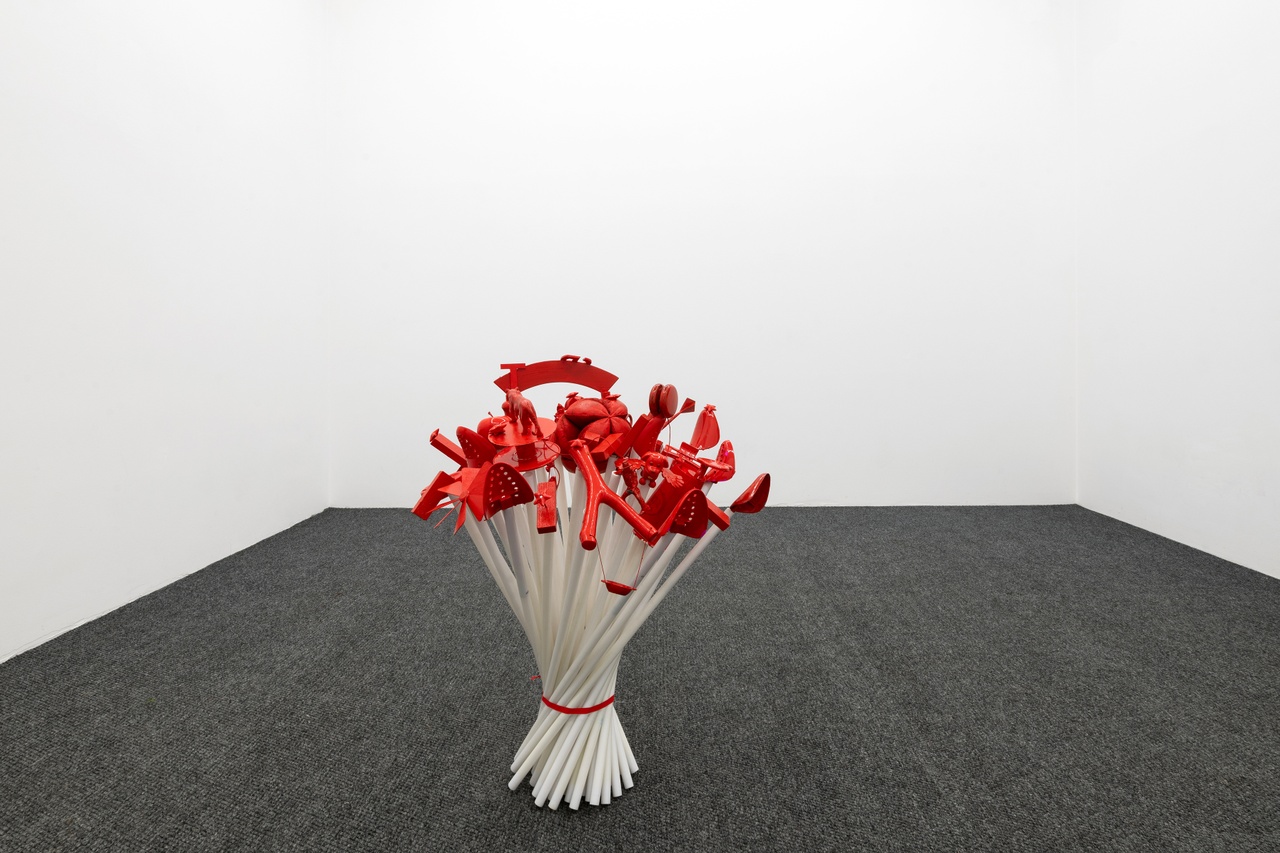
Tereza Glazova, “Bouquet,” 2026
Autokomanda’s three rooms, modest in size, are largely empty, underlining the conceptual positing of the artworks more than their formal qualities. This look has become the lingua franca of a cohort of artists, curators, and critics involved in exhibition spaces such as Autokomanda, which flourish from Vienna to Berlin to Brussels and position themselves between the institutional and commercial spheres. Despite the reduced visuality, it commonly signals an unmediated presence of artistic expression that disavows the influence of art history or the market.
Aside from the aforementioned group of works, Mordovskaya presents her Make-up marks (2026), a site-specific intervention for which the artist has smeared make-up around a light switch, onto the wall, or in the corner of the room, for example. Easy to overlook at first, these gestural marks in subdued yet artificial colors alter the atmosphere of the gallery rooms: Traces of human touch reminiscent of stains on interior walls or of children’s scrawl, they allude to domestic spaces. This connects Mordovskaya’s intervention to Interior, interior, space, …, where even when the teenagers aren’t depicted at home, we imagine a girl sitting at her bedroom desk, cutting and collaging the photos and arranging them in the found frames. Both works invoke creative processes untethered by the academic or professional norms of art making. While they, at first glance, affirm the language of contemporary art in their gestural quality and use of quotidian objects, they subtly point to ways of making that lie outside of the art field system and are not guided by a need to affirm or oppose its symbolic or material conventions.
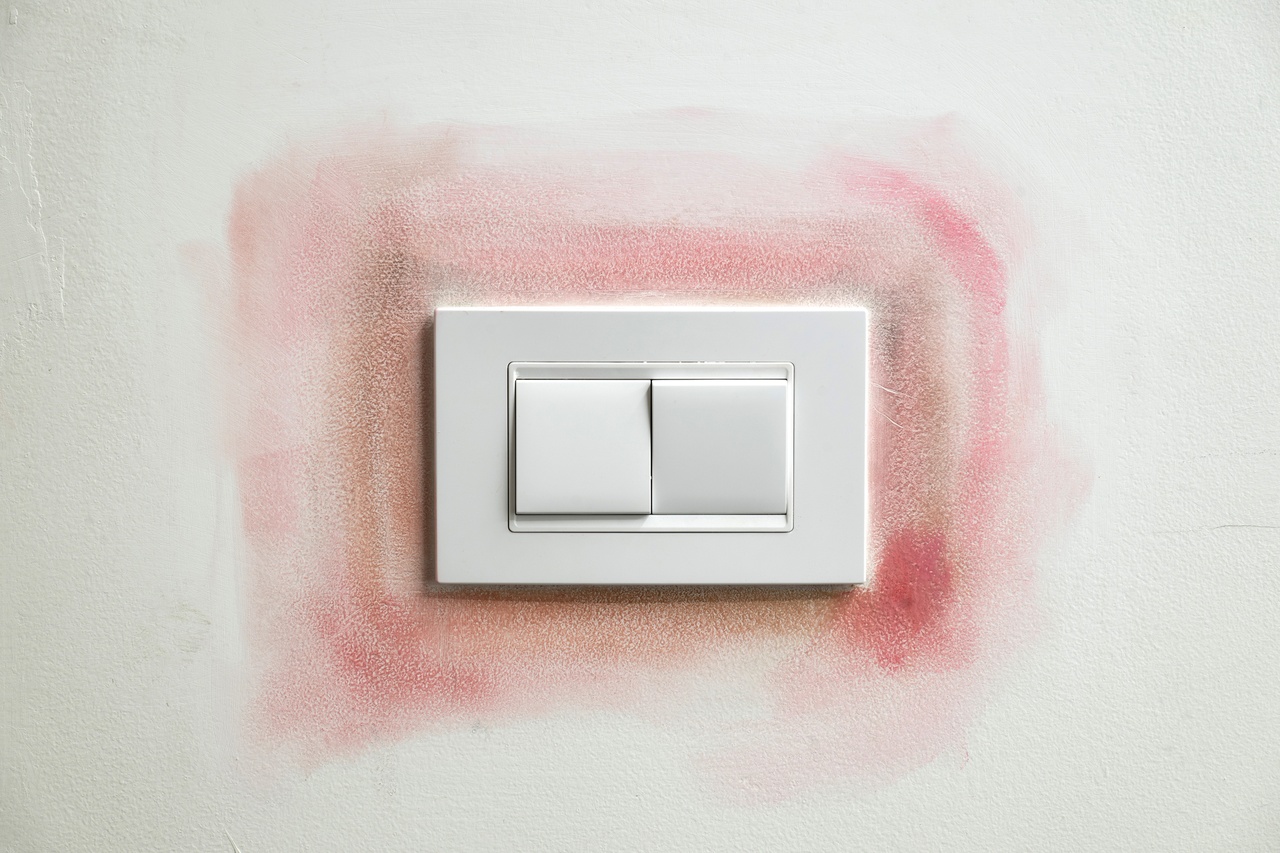
Sveta Mordovskaya, “Make-up marks,” 2026
For Rainbow over the country road after the rain, tied with antimonumental intent and decorative bows (2026), Glazova has stapled ribbons in different colors onto a wooden panel, all conjoining in the upper right corner in a bundle of decorative bows. In Mordovskaya’s works, the artist’s presence is apparent: We see her in the pictures, we presume the make-up to be hers. (She has previously used make-up to write her name and the show’s title on the walls of an exhibition space.) With Glazova, the personal dimension of the material is less manifest and needs to be mediated: Speaking about the work, the artist discloses that she had first bought similar ribbons at a clearance sale in Latvia and that the board is from Belgrade. Like the objects representing the rosebuds in her bouquet – including a pack of Parisienne cigarettes, a coffee to-go cup, shoe trees – the materiality of bow and board is secondary to the work’s concept (and frankly, it’s not much to look at, really). Still, because of its indexical connection to the artist’s life, the material acquires a certain significance.
On the surface, Mordovskaya’s and Glazova’s works are aligned with the base vocabulary of their peers – veneer of conceptual coolness, base of formal pragmatism (using whatever is immediately available of course also speaks to precarious means of production), bound together by a (somewhat contradictory) affirmation of artistic subjectivity – but they don’t plead immediacy or realism behind it. The bows are decorative, after all. Both artists are conscious of the fact that references to their biographies and lives aren’t merely read as traces of artistic subjectivity but often serve as projection surfaces for an image of alterity. Consequently, they keep their source material at arm’s length: As images are cut and rearranged, objects colored over or smeared on, what comes to the fore are the varying degrees of staging and concealing. The artificiality rather than the artistry of those processes is underlined by the makeshift quality of the works. This could be easily mistaken for the aforementioned nonchalance but takes on a different character in combination with Autokomanda’s carpeted floor. (In this setting, minimal gestures don’t simply look cool – which has the pleasant side effect that one doesn’t have them at hand to cover up a lack of ideas.) What comes into view in this exhibition is the dependency of an idea of authenticity on the act of masking or invoking it.
In a different room than the object itself, a picture of Glazova posing with the make-believe bouquet in the exhibition space is printed on a pair of plastic glasses, which are attached to the wall at eye level. The artist here ironically aligns herself with the social media trope while the specific presentation underlines that the viewer only encounters this image through the lenses she’s provided for them. As she is presenting herself as the girl without a face and one signifier is exchanged for another, the viewer’s position changes, becoming who Glazova is posing for and prompted to ask themselves what her bouquet signifies and who hides behind it. All self-fashioning, be it in accordance or distinction with other’s expectations, is contextual.
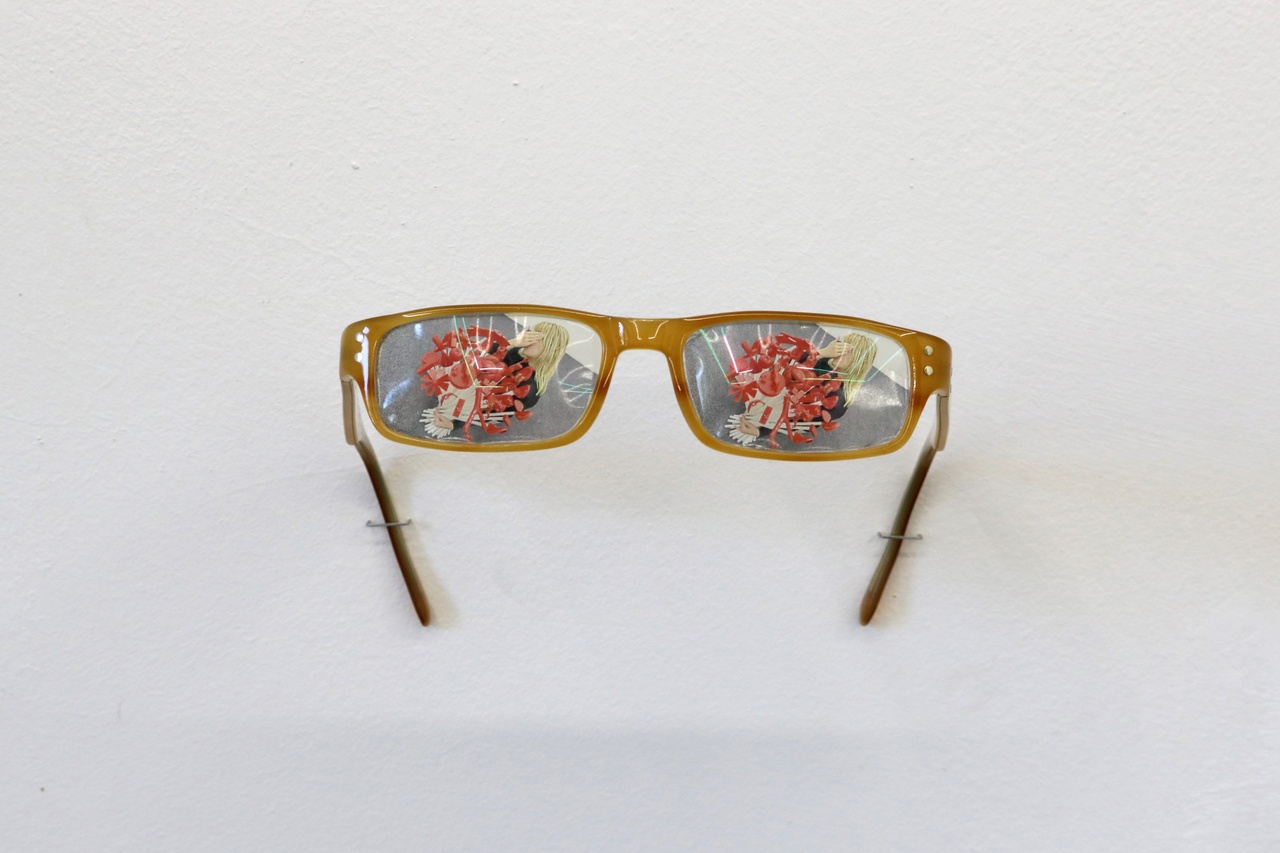
Tereza Glazova, “Girl with a bouquet without face,” 2026
As for context, the site specificity of this show can’t be denied, yet it amounts to more than the fact that the majority of the works were produced on-site, and that this site is, in fact, in Eastern Europe. Located in the Belgrade neighborhood of the same name, Autokomanda also shares its moniker with a major crossroad in the area, where the main Serbian highway merges with the European route E75, which runs from Norway to Greece. This demarcation line might be as useful as any to separate Western form Eastern Europe or, as Autokomanda’s Natalija Paunić states in the text accompanying the exhibition: “thinking about Eastern Europe is hard when you are, in fact, from Eastern Europe – a place that has never been east to the point from which you are standing.” The show is reflective of its location and context in that there’s a parallel between the space and the works on view: They evoke and play into the aesthetics, mode of production, and discourse while at the same time reflecting on the desire to conform as well as on the possibility of diverging from internalized protocols.
Paunić runs Autokomanda with the intention to bring more progressive artistic positions to Belgrade, while the program also, by way of digital distribution and personal connections, registers outside of its local context. Partly financed through the Swiss Cultural Fund of Serbia, the show is, like previous exhibitions at Autokomanda, dependent on the exhibiting artists’ connection to Western European cultural funding (both artists are based in Zurich). The interchange as a site of transit and transition, referenced in the space’s name, echoes not only in its geographic location in the Balkans but also in its material conditions. According to the website, Autokomanda has the additional meaning of an “auto- (self), command (order): Kunstverein.” In informatics, an auto command describes a code to automatically run a command whenever a specific event happens. Calling it such to facilitate this kind of space in Belgrade is reflective of Paunić’s awareness of the degree to which the imperative to professionalize and to appropriate institutional formats and their means is already internalized. Its model is less the member-funded Kunstverein with its origin in postwar West Germany and more the exhibition politics this same label represents today: a loose network of spaces operating across Europe, mostly financed by public funding and occasionally mimicking the sale of artworks as Jahresgaben, which has become the norm for emerging curators.
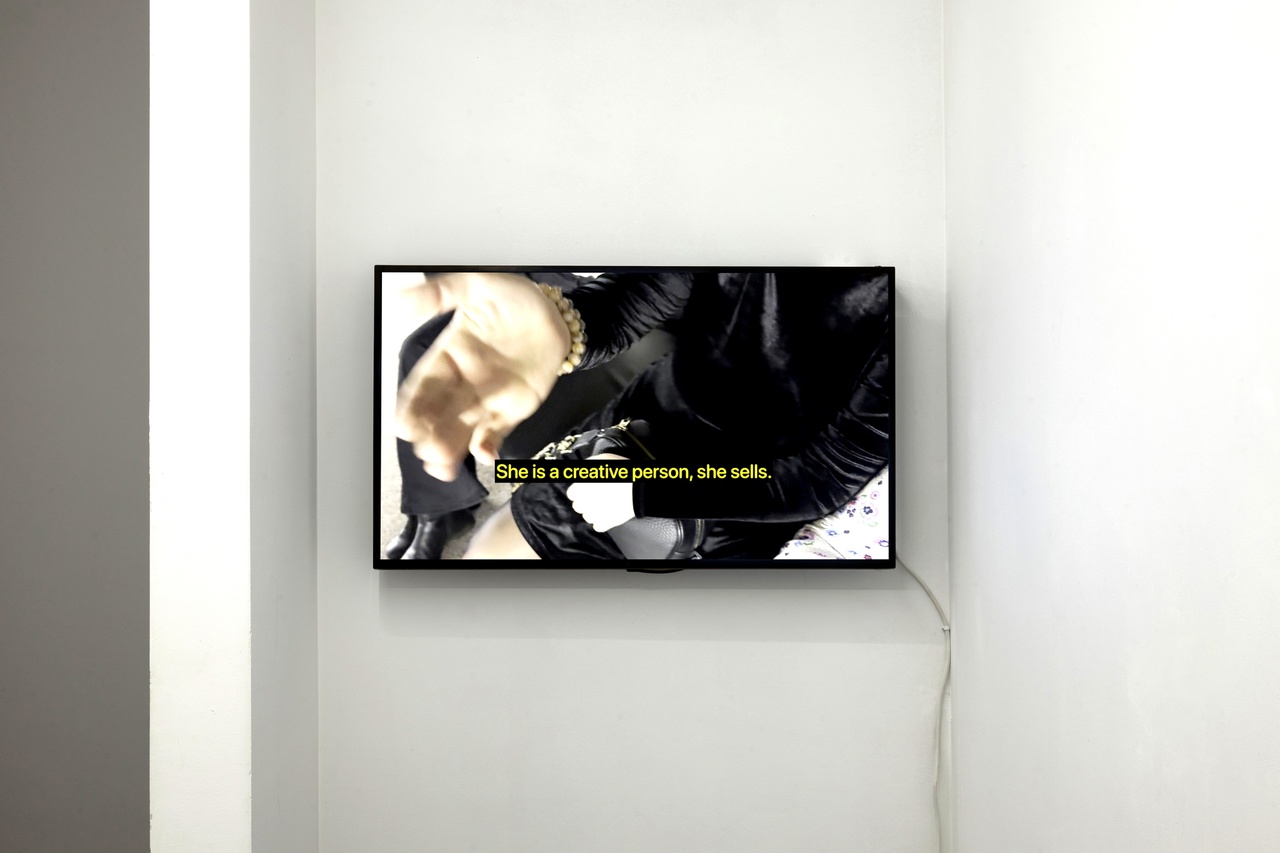
Tereza Glazova, “Dad’s birthday at the billard bar,” 2026
The self-command to fit into the frame of contemporary art and exhibition making on the one hand, and to question such conventions on the other, is the junction where this exhibition is located. Glazova’s video work Dad’s birthday at the billiard bar (2026), tucked away in the corner of one of the rooms, is a reminder that to position oneself at this threshold where both the inside and outside of the system are hard to delineate runs the risk of rendering one’s actions unintelligible to either side. In the five-minute clip, three women – the artist’s mother, cousin, and sister (whose eyes are glued to her smartphone screen throughout most of the conversation) – sit on a couch, bringing forward multiple arguments to convince the man standing in front of them, reportedly the father’s best friend, that Glazova is, in fact, an artist. In the background, billiard tables and the gallery of the postmodern building shift in and out of view. The initial line of reasoning, what kind of art she makes, is exhausted by his repeated question of whether she paints. Commenting on the fact that she works with metal, he states, drink in hand, that scrap metal is a lucrative business. Neither reaction is ironic or derogatory per se but brought forward with late-night sincerity and the desire to understand what attracts Glazova to this line of work. Still, even her claims of institutional recognition and commercial success are brushed aside. When the women mention that the city of Zurich bought a work of Glazova’s for 15,000 CHF last year, the man replies “Zurich doesn’t mean anything.” Instead, he advises her to become a content creator. Glazova, recording the spontaneous and unscripted scene on her phone, remains invisible and mute. The work is brilliantly funny and relatable to anyone who has ever had to legitimize that they are, in fact, pursuing a career in contemporary art. More importantly, it is indicative of different, often contradictory, understandings of artistic production and the evaluation criteria derived from them. Painting as a classical medium has value, metal as a material does too, and digital content is what creates today’s currency of visibility. Yet, unless that value is monetized, its assessment depends on a consensus which, in the end, is social: Just as the artist’s father’s friend struggles to understand what an art career in Switzerland constitutes, it will not be obvious to a Zurich-based art critic why the Girl with a bouquet, without face presents herself in this way. Not having set this task for themselves, Glazova, Mordovskaya, and Paunić succeed in mediating between different contexts while being mindful of what can get lost in translation.
“UNTITLEД: Sveta Mordovskaya, Tereza Glazova,” Autokomanda, Belgrade, January 24–March 21, 2026.
Leonie Huber is an art critic and editor at TEXTE ZUR KUNST.
Image credits: Courtesy of Autokomanda and the artists, photos Bojana Janjic