

“NEO-CHINA ARRIVES FROM THE FUTURE” Nikolay Smirnov on “The China Moment” at the Kasseler Kunstverein
“The China Moment,” Kasseler Kunstverein, 2026
The documenta Institut is still often confused with the documenta archiv or documenta gGmbH. When I worked there, I saw how its name functions externally as a brand – almost automatically associated with the famous exhibition. I often had to explain that the Institut has no role in producing documenta itself (as that is the work of documenta gGmbH), and that it is a separate research institution, even though it has operated as a subsidiary alongside the documenta archive. [1] Now, finally independent, the Institut enters the field of exhibition making with its first research exhibition, “The China Moment.”
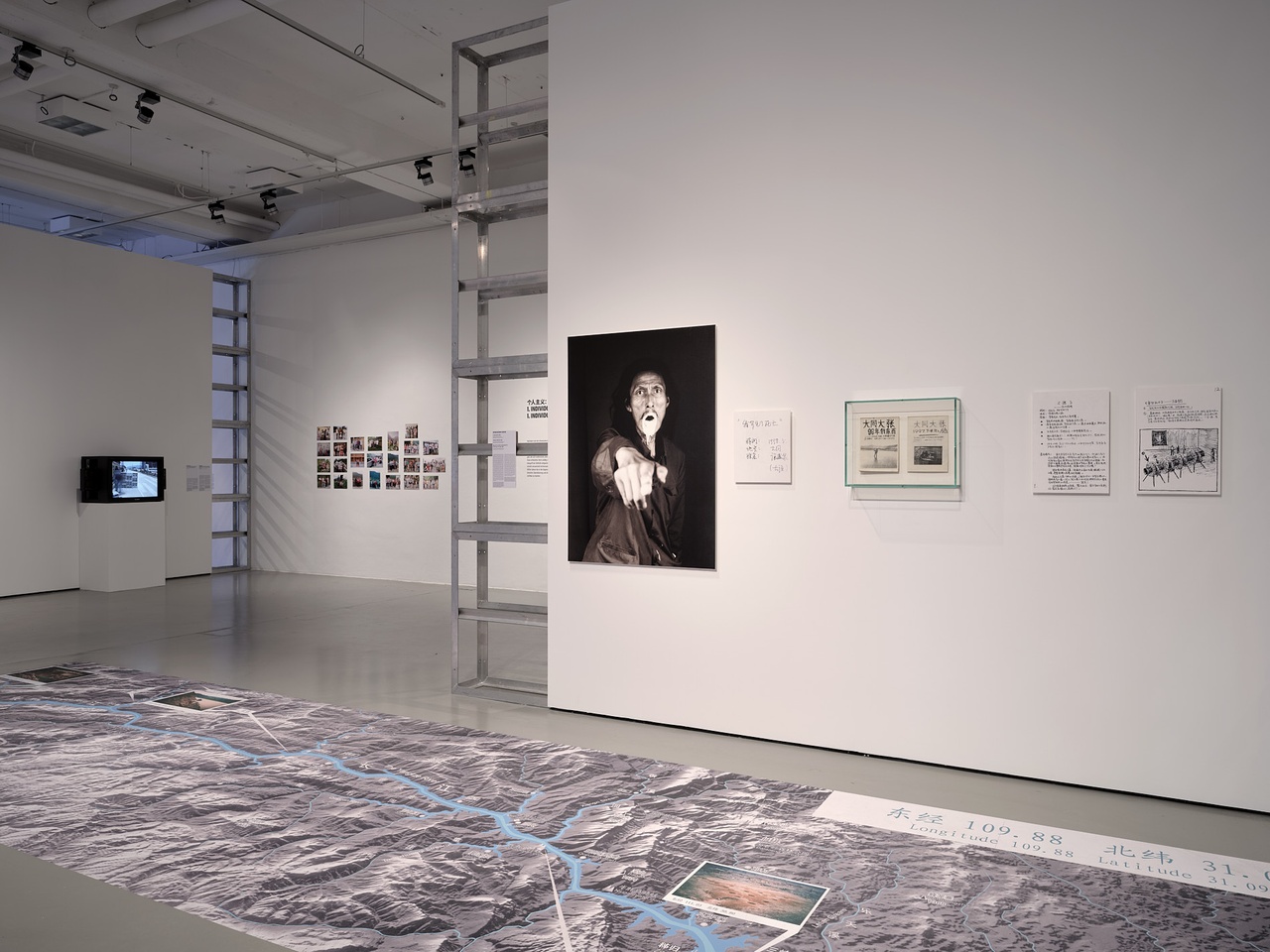
Entering the Kasseler Kunstverein on the Fridericianum’s ground floor, visitors are met by an expressive black-and-white photograph of a kind of mad prophet: Long-haired, eyes and mouth flung wide open, foam-white lather on lips, he points his index finger straight at the viewer – like the figure in an avant-garde propaganda poster. It is Datong Dazhang’s self-portrait I Saw Death (1998), made two years before the artist’s suicide. This gesture of directly calling out the viewer – a kind of Althusserian interpellation of an individual by the Subject, eye to eye – can be read as an appeal to agency, self‑consciousness, and individuality. Yet the message delivered by the performer concerns an imminent death, signaling the coming – or already ongoing – erasure of that very individuality. This resonant work can be read as an image of the exhibition’s ambition: to unpack Chinese contemporary art from the late 1980s to 2000s – when it entered the international scene, using global languages while reflecting on its own geocultural individuality – through the lens of individualism and its decline, and to prophesy a change of eras. [2]
The exhibition unfolds like a Tetris puzzle through a long L-shaped space – comprising the high‑ceilinged hall and adjacent rooms – laid out by permanent walls and display elements into uneven zones that flow into one another and are packed with diverse materials: photographs, objects, video screens, monitors, vitrines of archival documents, paintings, and extensive wall texts for most works. One might ask whether this is not an already dated form – akin to the essay exhibition, whose research-rich versions were epitomized by Berlin’s HKW under Bernd Scherer and Anselm Franke between 2013 and 2022, and whose golden age has somewhat waned since then. [3] Yet the Kassel show is to a large extent a historical research exhibition, and in that sense its mode of display suits both its material and its method. However, the project’s relation to history is more complicated. The period it conceptualizes lies in the past, and part of what is shown has already been canonized in various histories of art; yet the lives and international careers of almost all the artists continue to unfold, and the exhibition also looks ahead – to what it presents as the detritus of the global art world, as one of the show’s three curators, Mi You, professor at the documenta Institut and Kassel University, calls it, “art in a multipolar world.” [4] This attempt to grasp and name phenomena suspended between past, present, and future also reveals an ambition to influence the course of events: by tying the flowering of individualism in Chinese art to the golden age of globalization and stitching it to the recent past, the exhibition declares it outdated and positions itself as both diagnostician and facilitator of historical change – somewhat in the manner of Dazhang’s prophet, delivering its truth to the viewer.
The research behind the exhibition is extensive, and many visitors may find themselves, as I did, in the position of an outsider to the material. Alongside Mi You’s long engagement with Chinese art and its intellectual context, the project draws on Beijing-based curator Su Wei’s years-long research, which takes the “post-1949” as key to understanding both the legitimacy and ruptures of contemporary Chinese art history and current artistic production in a global context. Together with Anna-Lisa Scherfose, a researcher at Kunsthochschule Kassel and managing director of the Berlin program for artists (BPA//), Mi You and Su Wei form the curatorial team. The exhibition is accompanied by a substantial reader, which includes, among other texts, historian Yang Guoqiang’s (b. 1948) reflections on modes of individualism in China – an edited excerpt from a 2016 essay of his. [5] A professor at East China Normal University in Shanghai, Yang traces the roots of Chinese individualism to the New Culture Movement of the 1910s and 1920s, and links three of its key figures – Chen Duxiu, Hu Shih, and Lu Xun – to three understandings of individualism, defined by what the individual distinguishes herself from: “the individual and the country” (in the meaning of the state), “the individual and society,” and “the individual and the masses.”
“The China Moment,” Kasseler Kunstverein, 2026
The curators adopt this heuristic typology to structure the show, naming the chapters after the individual’s dominant mode of agency: “Individualism as Reaction” (against the state), “Individualism as Participation” (in society), “Individualism as Re‑animation of Humanism,” and “Individualism as Interrogation of the Mass.” The last two are derived from Yang’s third type – a humanistic‑existential stance that confronts the masses. The rationale for this split is not entirely clear, especially in the publication, where only one work is assigned to the final type, making it feel less like a full chapter than an epilogue with an opaque curatorial intent. In the display, however, the scheme works better: The chapter titles are dispersed across the exhibition and function not as rigid boxes but as shifting angles, an analytical framework the curators use to unpack individual works. And although some pieces clearly fit one type or another, most can be analyzed along several facets of individualism, and Yang’s model of multifaceted individualism proves quite effective here – both in the curators’ usage and as a conceptual toolkit offered to the viewer.
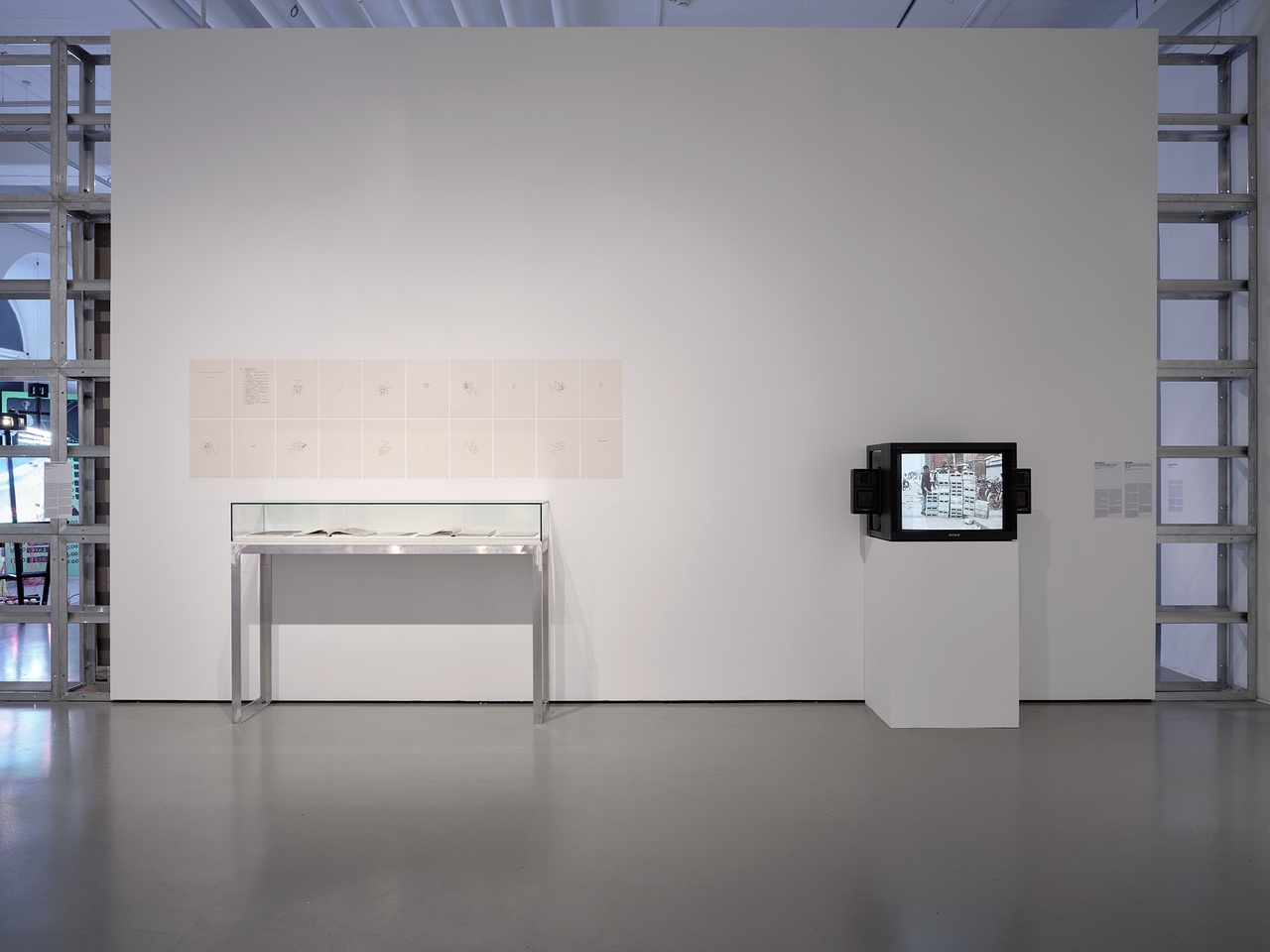
Through this model, the reading of Wang Guangyi’s installation sketches, for example, shows that his famous series Great Criticism (1990–2007) is part of a broader lifelong project: tracing how individuality is produced within political and visual regimes of control and propaganda, across geocultural differences. Less well known are Xin Kedu (New Measurement Group)’s series The Analysis (1990–95), graph-like abstract diagrams that might have been lifted from a systems-theory textbook. The curators read this impersonal idiom, paradoxically, as a statement of individualism, pushing against the art system’s demand for stable artistic identities, personal visibility, and authorship. The logical conclusion was the group’s self-erasure in 1995, along with the destruction of most of their works – though these drawings and the three members’ names remain. It raises the question of whether their gesture truly challenged the identity logic of the art world or merely reinforced it by constructing yet another collective individuality. In any case, this reading shifts the work beyond its surface: It appears less as a belated reception of conceptual art than as an early post-conceptual appropriation.
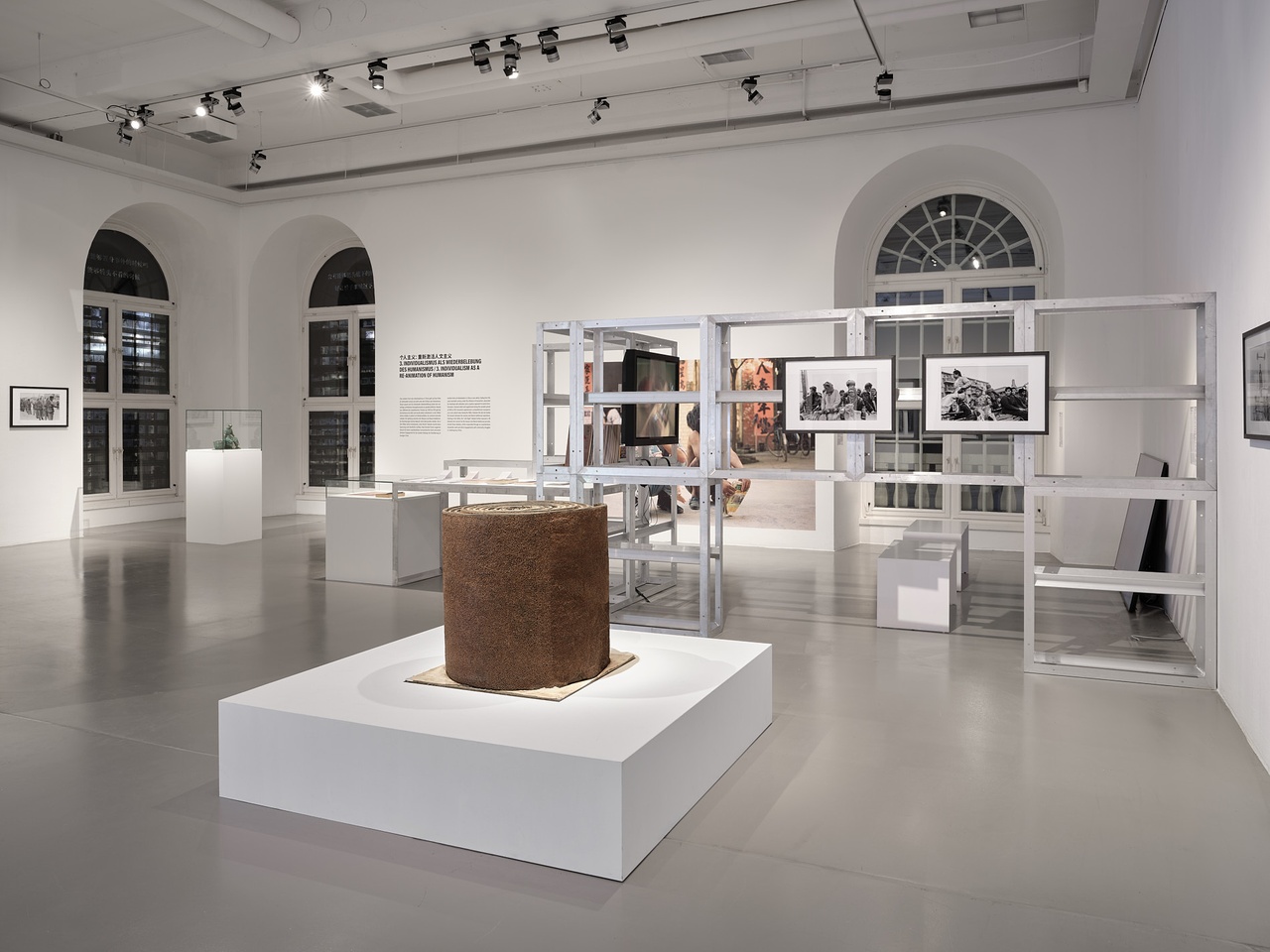
Sui Jianguo’s Kill (1996) is among the exhibition’s most formally powerful works. It is a thick roll of rubber, 65 x 65 x 65 cm, standing on the plinth, one side densely studded with rusty nails that pierce through and erupt on the other like the bristles of a grotesque porcupine. The outer surface reads as a protective armor of nail heads, while the interior becomes a dark, mysterious void between the nail tips. Extremely heavy – and, like many works here, shipped directly from the artist’s studio – it appears almost as a living creature: an image of individuality, a strange assemblage of parts that nonetheless coheres into a single body, performatively producing a distinction between inner and outer space.
“The China Moment,” Kasseler Kunstverein, 2026
The video Lu Xun 2008 (2008), a collaboration between four independent theaters, is among the exhibition’s most intellectually resonant works, though its installation is somewhat flat. [6] The piece documents a theatrical reworking of Lu Xun’s short story A Madman’s Diary (1918). In this classic of Chinese modernism – written by a passionate reader of Dostoevsky – Lu Xun offers a bleak critique of social alienation as “cannibal culture”: The narrator becomes convinced that those around him are cannibals. Developed through a series of collective improvisations in different cities, this work in particular asks how collective creativity and individual expression can be negotiated today. Precisely as a continual bargaining between the individual and the collective – always in danger of tipping into “the masses” – Lu Xun 2008 aligns closely with the exhibition’s conceptual frame, and with Lu Xun’s story itself. On a book table in an adjacent room, one finds a recent German translation of A Madman’s Diary, a slim volume produced collaboratively by an entire team of translators. This table, together with a glass vitrine of archival materials and modular aluminum shelving for books and photographs, forms a kind of exhibitionary dispositif that combines the functions of library, archive, and exhibition architecture – a participatory spatial construction that recurs, in varying configurations and appearances, at a few other points in the show.
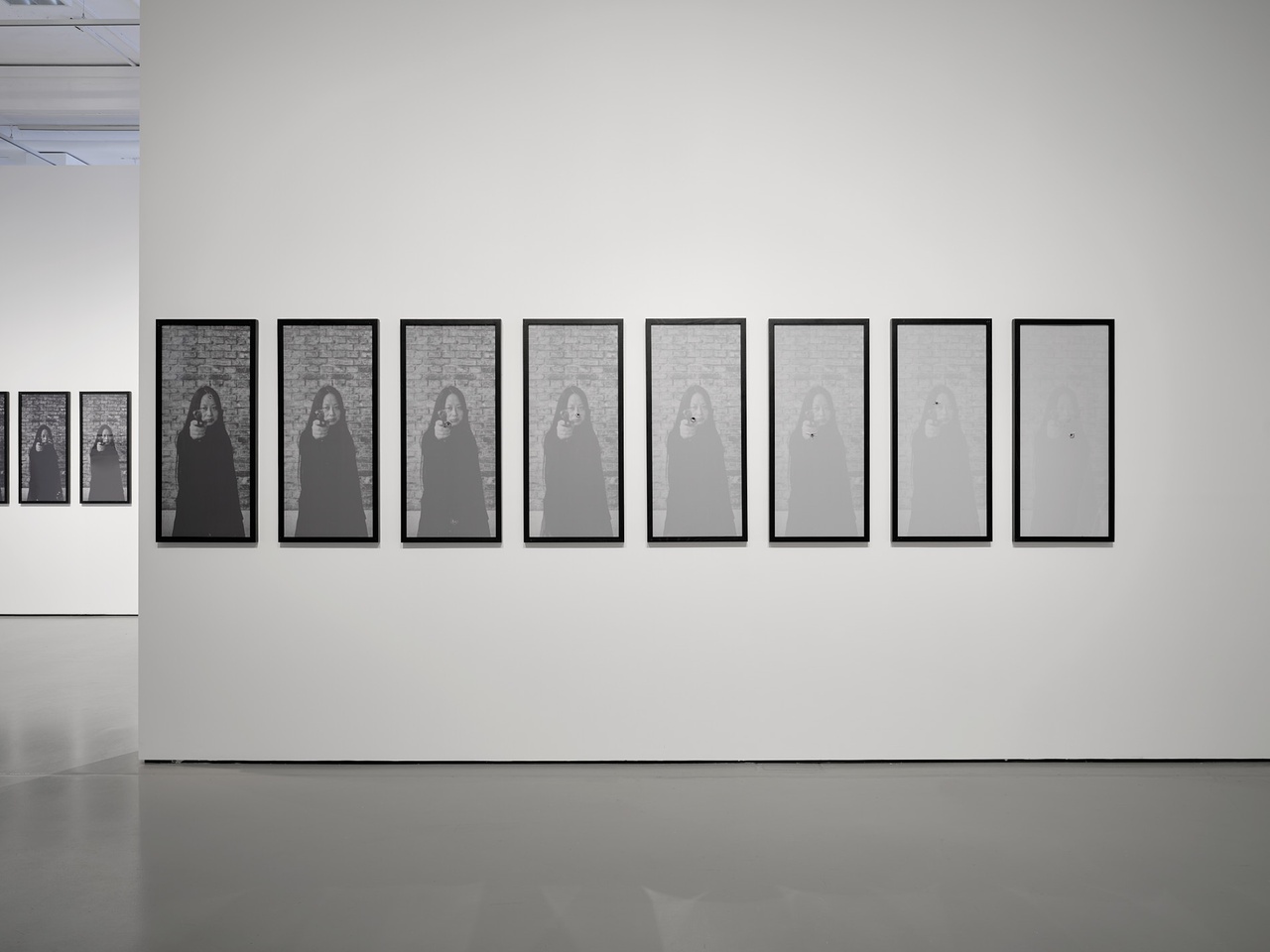
In front of this construction, Xiao Lu’s 15 Gunshots … from 1989 to 2003 (2003) revisits her notorious action at the 1989 “China/Avant-Garde” exhibition in Beijing, where she fired a gun into the glass component of her own installation Dialogue (1989) – depicting a man and a woman talking to each other in phone booths – prompting the exhibition’s closure. Later she reworked the event through a series of iconic self-images: gun aimed at the viewer, a bullet hole in glass. Her 1989 intervention was a feminist gesture, probing the fraught space between art, private life, and socio-political circumstance, yet it wasn’t perceived as such in its original context, being read instead in the light of the Tiananmen Square massacre that followed four months later. She therefore had to repeat and rethink the act for years before its feminist meaning became legible – even to herself. [7] Also compelling is the documentation series Fen-Ma Liuming (1993), which records Ma Liuming’s actions while dressed as a woman, including a walk along the Great Wall. The proper analysis of this art could unsettle the discursive boundaries of established feminist and queer discourses, as well as illuminate the gaps and continuities in their production across contexts.
Xiao Lu, “15 Gunshots … from 1989 to 2003,” 2003
Instead, one is more likely to note that the show includes remarkably few non-male positions: Out of some thirty artists, only six or so – unsurprising, perhaps, given that its focus lies largely elsewhere. The underlying theoretical model is this: The world experienced peak globalization from the late 1980s to the 2010s, when neoliberal markets and a global art world triumphed across contexts, and even collectivist settings like China were swept up in a surge of accompanying individualism. It was a “China moment” in the sense that Chinese artists entered the global art market as national representatives, leveraging their geocultural identity for this purpose. The curators contend that this moment has now passed: China is moving away from liberal individualism, and its art is no longer of much interest to a global art market that, in their view, no longer exists in the form it had during the golden age of globalization – as the wider world moves in the same direction of deglobalizing multipolarity, something we can grasp by “seeing through China.” [8] The world has entered a new condition in which, as Mi You suggests, we should attend to plural geocultural models of art – or, as Su Wei argues, rediscover a non-repressive leftist collectivity.
This framework is certainly worth considering, but at times it feels overly general – at odds with the very notion of individuality, at least in its existential mode in Yang Guoqiang’s triad. Perhaps the issue is that the latter is captured far more precisely by the artworks than by the conceptual theoretical framing. One of the few truly recent pieces, Wang Tuo’s The Second Interrogation (2022–23), for which the curators extracted from the existential mode the chapter “Individualism as Interrogation of the Mass,” extends the line found in Lu Xun 2008 and 15 Gunshots, probing the mutual determination of personal existence, the collective, and the masses. In Wang Tuo’s video, a prolonged exchange between censor and artist turns art into an interrogation of depth – almost a psychoanalytic form of censorship – while censorship itself begins to grasp the inner motives of art. All boundaries between the personal, the collective, and the masses are shifted: Collective determination appears embedded in psychic depth, while the ostensibly faceless representative of the masses discovers the depths of personal judgement. It seems that placing greater emphasis on the search for a new, complex balance between all facets of individualism in relation to state, society, and the masses – as seen in Wang Tuo’s work or Man Yu’s project Individual as Society (since 2017), shown alongside it – would have provided a more compelling conceptual ending than extracting a new facet of individualism from the original triad.
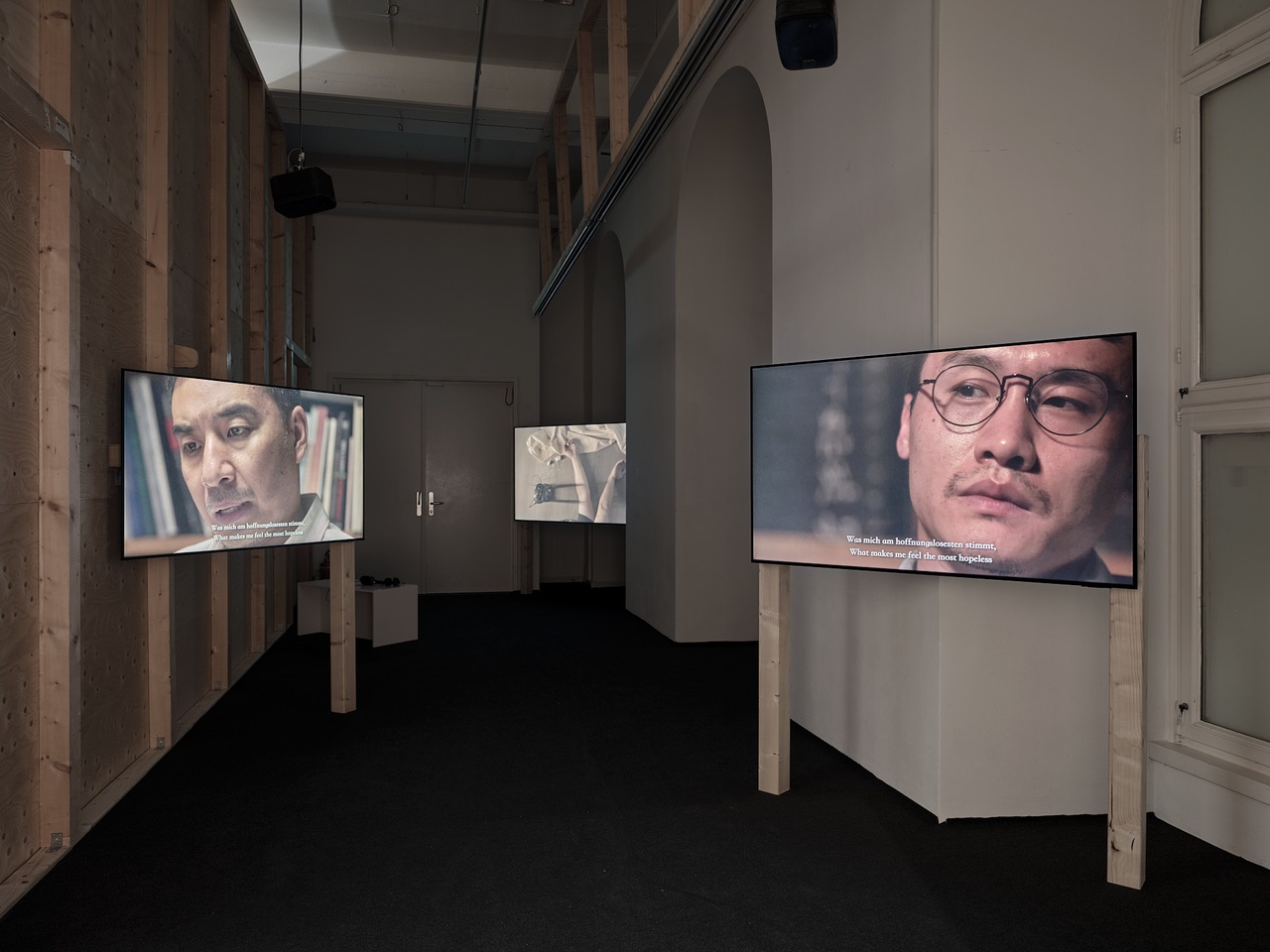
Wang Tuo, “The Second Interrogation,” 2023
The actual artistic process – largely absent from the show, apart from the works by Wang Tuo and Man Yu – can offer the freshest perspectives on the ongoing rebalancing of individualism’s facets and unsettle overly general models. In one of the parallel-program events, curated by Scherfose and held at the arthouse cinema BALi-Kinos, Berlin-based artist Tang Han put together a screening that not only supplemented but quietly challenged the exhibition’s main theoretical conclusion. She foregrounded younger artists of Chinese heritage important to her personally, with an emphasis on spirits, memory, intimacy, and geopoetics – quite unlike the predominantly historical presentation at the Kasseler Kunstverein. Leaving the screening, I kept thinking: Did the curators perhaps bury individualism in Chinese art too early? In works by a younger generation, it seems only to have sharpened, edging toward solipsism and a rupture with history. Has the nurtured narrative of global liberalism’s demise (and, by extension, individualism’s) obscured the continued intensification of individualism? And how does this solipsistic individualism relate to the emergence of a multipolar world? If private dream-worlds – both personal and geopolitical – replace a single, shared history, then individualism is not receding at all; it is on the rise, like China’s weight in the world, merely decoupled from the earlier model of globalization. This seems precisely what the philosopher of the “Dark Enlightenment,” Nick Land, exemplifies in his own shift – from universal accelerationism to a solipsistic, multipolar-aligned paleo-liberalism, and from the West to Shanghai in the early 2010s. In this sense, “The China Moment” is less about the past than about the future, which unfolds as a self‑fulfilling prophecy in line with Land’s own formula: “Neo-China arrives from the future.” In this post-liberal world – be it “Neo-China,” “Neo-Russia,” “Neo-USA,” “Neo-Germany,” or another label of your choice – the distinctions between state, society, and masses dissolve, giving rise to a homogenized solipsistic individualism and competing projections of individuality onto geopolitical terrains, which redefine and thereby increasingly encroach upon existing individual liberties, social participation, and humanistic existence. Perhaps this is not so far from what Datong Dazhang and the curators finally want to tell us.
“The China Moment,” Kasseler Kunstverein, January 24–March 22, 2026.
Nikolay Smirnov is a geographer, curator, and art researcher focusing on geographical imaginations in art, architecture, and intellectual history.
Image credits: Courtesy of documenta Institut, photos Nicolas Wefers
Notes
| [1] | A gGmbH (gemeinnützige Gesellschaft mit beschränkter Haftung) is a non‑profit limited liability company. “Non‑profit” here means that its activities must serve the public good rather than generate distributable profit. Typical gGmbH structures are used for hospitals, kindergartens, museums, and similar institutions. |
| [2] | Technically, the project begins in the early 1970s with archival material, and some works date from the 2020s, but its stated focus is the specific period from the late 1980s to the 2010s. |
| [3] | Haus der Kulturen der Welt (HKW) is an art institution in Berlin that, under the directorship of cultural philosopher Bernd M. Scherer (2006–2022), was conceptually reoriented toward “curating ideas in the making.” Between 2013 and 2022, curator Anselm Franke developed there a practice of essay exhibitions, curating a series of research‑intensive projects – such as Parapolitics: Cultural Freedom and the Cold War (2018) – that placed a multi‑media exhibition at the center and were accompanied by interdisciplinary publications and parallel programs. HKW’s projects from this period became emblematic of research‑based essay exhibitions, which flourished alongside other prominent examples such as The Potosí Principle (2010–11), and now seem to be waning—parallel to HKW’s recent shift toward less discursive, less narrative‑based modes of exhibition‑making. The overlapping methods of essay exhibitions and “exhibition‑as‑research” have been theorized by Franke and others; see, for instance, Jasper Delbecke, “Reimagining the Exhibition-as-Research for Artistic Research: Insights from the Essay Form,” COLLATERAL – Online Journal for Cross-Cultural Close Reading, no. 102 (September 2024). |
| [4] | Mi You, Art in a Multipolar World (Hatje Cantz Verlag, 2025). |
| [5] | Yang Guoqiang, “On Individualism in the New Culture Movement,” in The China Moment: Contextualizing Individualism in Chinese Contemporary Art, ed. Mi You, Su Wei, Anna-Lisa Scherfose (Hatje Cantz Verlag, 2026), 155–67. |
| [6] | The directors are Zhao Chuan (Shanghai), Tong Sze Hong (Hong Kong), Wang Molin (Taipei), and Hiroshi Ohashi (Tokyo). |
| [7] | See Joyce Hor-chung Lau, “Bringing a Woman’s Touch to Chinese Art Scene,” The New York Times, January 20, 2011, and Lu Xiao, Dialogue (Hong Kong University Press, 2010). |
| [8] | In another accompanying publication, Seeing Through China, founding director of the documenta Institut and sociologist Heinz Bude speaks with Mi You and Andreas Schmid – artist and cocurator of the exhibition China Avantgarde (HKW, Berlin, 1993) – about their personal experiences between German and Chinese contexts, tracing parallels between two societies seeking their place in a globalizing world after the “revolutions” of 1989 and before the recent turn toward deglobalization. See Heinz Bude, ed., Seeing Through China: Mi You und Andreas Schmid im Gespräch mit Heinz Bude (Hatje Cantz Verlag, 2026). |