

TRANSCENDENCE ON OFFER Rachel Haidu on Jeremy Shaw at Galerie Neu, Berlin
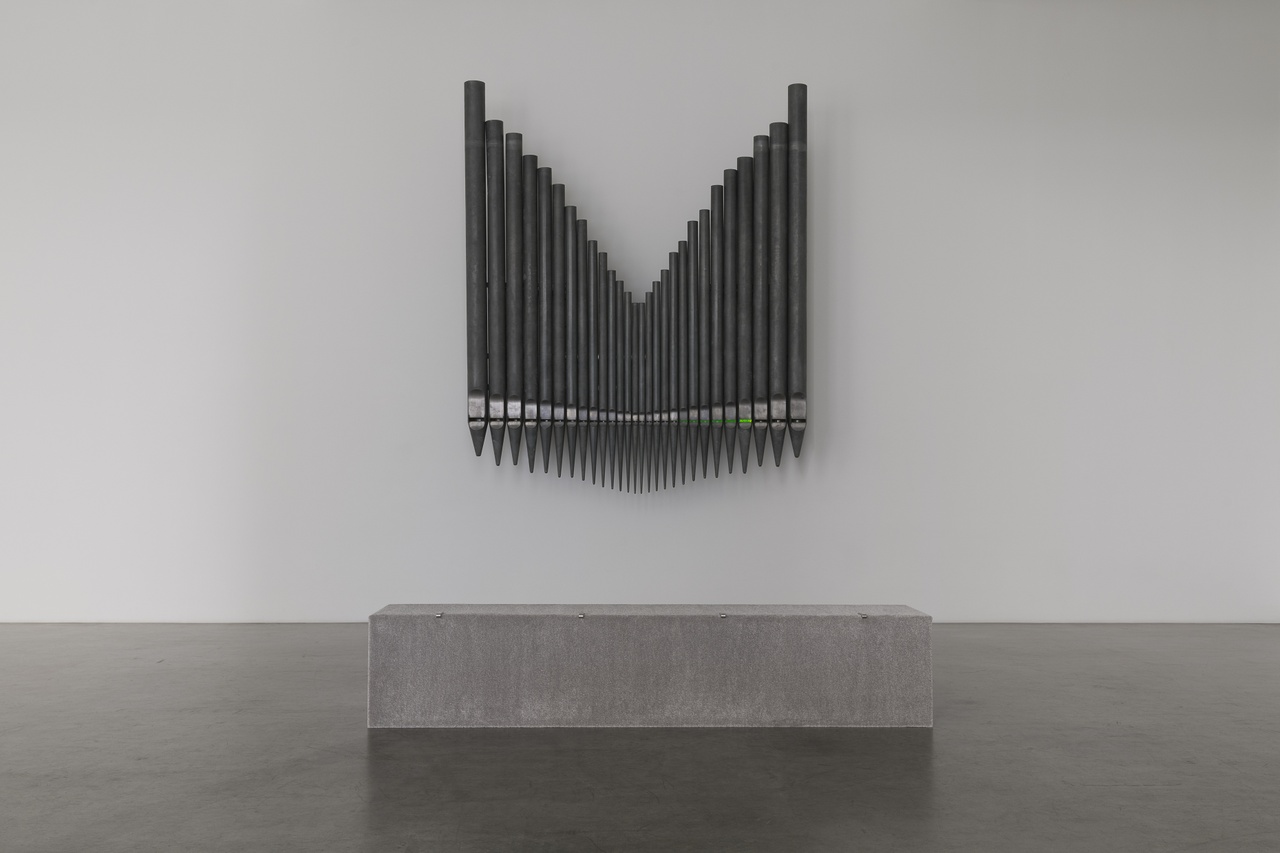
Jeremy Shaw, “Half-Life of Grace (1958),” 2026
If the psychedelic – from the English prefix psyche and the Greek root dēlos, to reveal or manifest – can mean anything to art, art will have to first transcend psychedelia. From Refik Anadol’s AI-directed pixelation of MoMA’s collection to Leidy Churchman’s occasionally Buddhist painterly questing, there is no shortage these days of art that adopts the countercultural stylings that have attached to various paths toward psychic revelation. Jeremy Shaw’s first gallery exhibition with Galerie Neu instead begins with questions of materiality and then leaves the possibility of transcendence up to each viewer’s actual experience. No swirling pixels or painted auras to reassure you that revelation or transcendence could save you from the day’s bad news: just an invitation to sit with your sensorium in a way that might get you outside yourself, momentarily. And with that, a reconsideration, perhaps, of the dynamics of escape. In a time in which the human itself is increasingly disposable, does the negativity of escape from one’s human limits – or even its positivity – finally deserve reconsideration?
The central work of the show is Half-Life of Grace (1958) (2026), which consists of a row of 28 metal organ pipes, lined up and projected outward on a stainless-steel strut so that it confronts visitors quite intensely as they enter Galerie Neu’s main space. Not an organ, not not The lengths of the pipes descend dramatically from the array’s two ends in a manner that amplifies their slightly concave composition; it almost looks as if they were fitted into an apse, not ranged along a straight wall. As a UV light travels across the array, showing through the pipes’ mouths, a stretchy, metallic, breathy audio track pulses alongside it, its hum swelling each time the light reaches each end. Shaw has used a so-called exciter, a tiny audio signal processor that turns any object into a transducer speaker, to simultaneously send sound through the resonant organ pipes and activate the lights. As your eyes chase this light, it is also tuning you to what you hear. If you sit long enough on the bench watching and listening, you might begin to wonder if a kind of EMDR therapy – or maybe ASMR – is working on you. You might reach another state. And then you might also venture up close to the pipes, peer into their mouths, and search for the backstory to this would-be aurora borealis that also evokes the green light of a financial services ticker. There, inside the mouths, you’d see green glass sleeves that, as described in the gallery’s press release, have been custom-made from uranium glass. There is something almost agonizing about that information; the glass’s tiny bubbles seem like proof of an artisanal process made noxious. A quick web search reassures that “handling solid uranium glass or melting it properly does not produce dangerous airborne uranium oxide fumes. The uranium is locked tightly inside the vitrified glass matrix.” Still, the toxin is there, somehow locked into these sleeves, lit up by UV light. Someone somewhere blew those glass sleeves; even if their radioactive compounds don’t seep outward, they’re “there.” But where, exactly, is “there”?
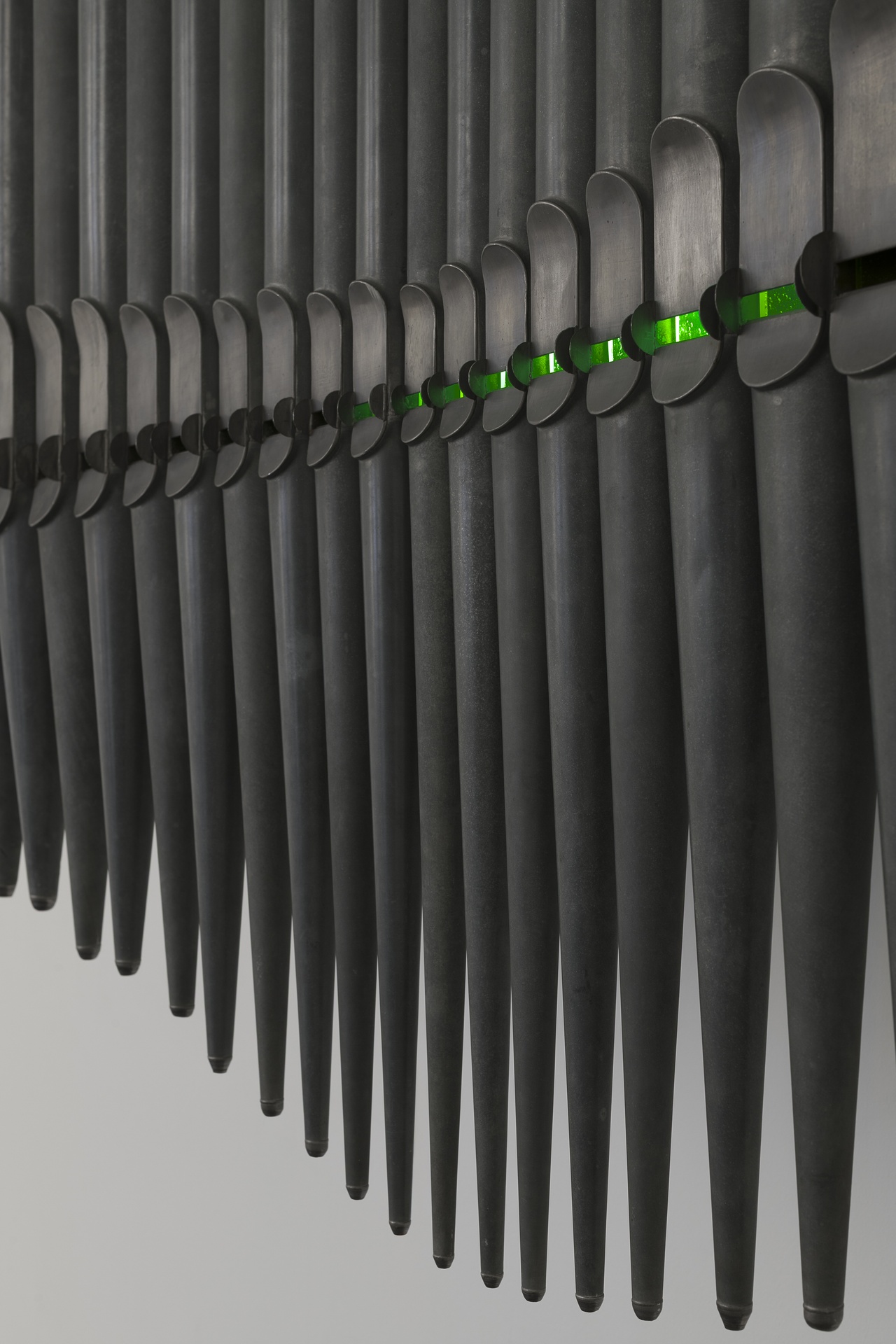
Jeremy Shaw, “Half-Life of Grace (1958),” 2026
In the gallery’s first room, which leads into the main exhibition space, one finds a wall-mounted trio of three connected Klein bottles. Klein bottles confound inside and outside, like Möbius strips made of glass, but here, “inside” each, sits the detritus of a large quantity of vaporized dimethyltryptamine (DMT), a naturally occurring psychedelic that produces predictably rapid and intense hallucinogenic experiences – including the kind of hyperbolic visualizations that a Klein bottle’s non-Euclidean geometries also invite. The dirty powder collected in the bowl of each bottle is visibly inside a container, but to sit upon that bottle’s apparently interior surface is to sit on an edge that also, eventually, faces “you.” And even if you can see that spatial paradox just as you can see the crusty deposit, it is hard to dispense with any distinction between inside and outside. Together, the bottles seem to contain enough residue to get the whole of Berlin-Mitte pretty high; meanwhile, the three works (all 2026) have titles that seem borrowed from new age aphorisms interpolating “you” in the second person (The Distance Between Infinite Folds Is Still You, Even the Most Ruinous Eventually Leads You Home, and Innumerable Thresholds Remain Available to You Without End), reminding us of the net-negative effects of populations reaching for transcendence. The hyper-individuated, privatized “you” is the bedrock of a contemporary political economy based on quantified risk, personal data, and universal fungibility. So, just as one might ask “Where ‘is’ inside, and what is its difference from outside,” one might also ask, “What is a ‘you’ under the present conditions?”
If Shaw’s interconnected Klein bottles point us toward the real fictiveness of those dichotomies (inside/outside, you/beyond you), they also ask us to question the distinction between an actual transcendent experience and its thingly proxy, a thing that either conjures or documents it. Or, alternatively, to consider how the phase shift that a vaporized substance has itself undergone invites the kind of ambiguity between event and document, experience and invocation. After all, these gorgeous sinuous shapes that refute what seems to be a basic physical truth (inside/outside) operate in tandem with the dis-confining discoveries of quantum physics. The strangely crass deposits inside these beautiful bottles tell of a “real” high – even if no one used the DMT, which is to be presumed given the quantities that have been vaporized. And their position inside/outside the Klein bottles requires us to push past the banal assumptions we constantly make about space and time. But so do math and physics. So: Which experience, which high, defines “transcendent”? The apparently irrational one indicated by the documentation of a high, a vaporized scum, or the glassy object blowing our minds once we reckon with it, cognitively? The one promised by a church organ, or the one skirted by a modernist artwork? And is an invitation to transcend our carefully, capitalistically crafted, individuated interiors an “escape” from reality or a means of rejoining the collective state we have so consistently abandoned?
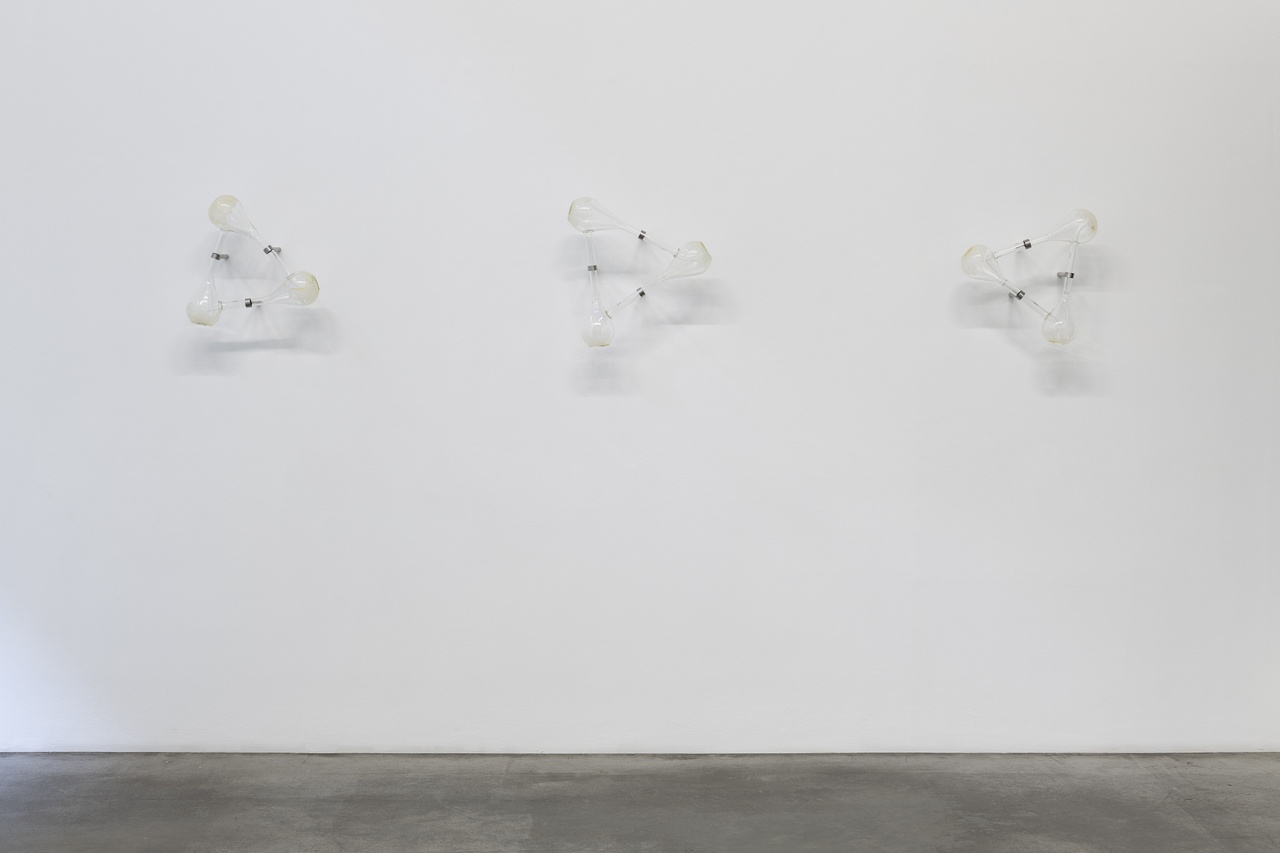
Jeremy Shaw, “Half-Life of Grace,” Galerie Neu, Berlin, 2026
The pipes that make up the work Half-Life of Grace (1958), we learn, come from a decommissioned church organ built, somewhat incongruously, in 1959. They are relics, and not only of the time when new organs were being built for every town. Their patina and nicked, ordinary surfaces tell of industrial fabrication’s heyday – a time whooshing into the past so fast right now that you are forgiven for the vertigo you feel when you consider it. But these works insist that we push harder on the question, What is the “time” we are in? If a three-dimensional object only makes sense when one considers traveling its surfaces – in other words, integrating time as their fourth dimension – then we are already understanding a fundamental complication to the spatiotemporal frameworks we live with in the day-to-day. You see the object not in the “now,” but across successive instants that it too, in its very forms, assumes. No now, as physicists have shown us, is nearly as durative or universal as we like to think it is. If the sounds you hear “from” the pipes both is and isn’t the sound of the pipes playing – for it is the exciter that is playing them, in a sense – then you are already in two places at once: hearing a pre-recorded sound and hearing the freshly minted sound of its resonance. The Klein bottles are an ouroboros, but so are the organ pipes, at least once your own experiences are in play.
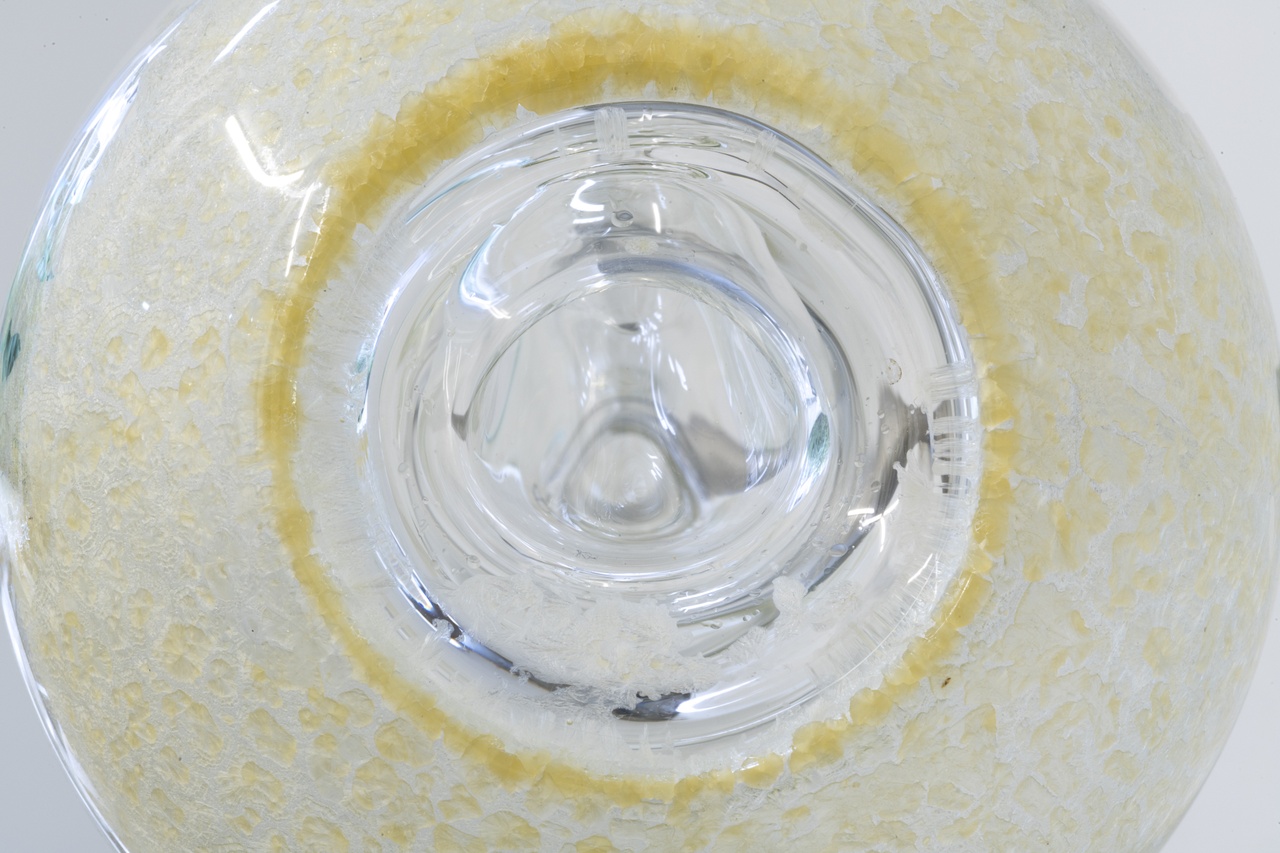
Jeremy Shaw, “The Distance Between Infinite Folds is Still You,” 2026
Shaw’s Phase Shifting Index (2020) – a massive multichannel work that was on display until recently at the Hamburger Bahnhof – is made up of seven different fictive “documents” of people trying, through dance and other forms of somatic experimentation, to overcome a made-up but perfectly credible historical caesura. All their movements and audio tracks synchronize in a cathartic, strobing, danced release that eventually, thanks to data-moshing, also diffuses into a liquescent color field and serene quiet. Phase Shifting Index used all kinds of media, from 16 mm film to VHS to Hi8, to generate its pseudo-documentary videos, just as its performers tried everything from modern dance to body-mind centering to hardcore skate-punk skanking, until their images were finally melded in the virtual, pixelated space of the screen. This show at Neu attends similarly to the human craving to push past the banalities of everyday existence, to reach other planes – but also to the historical materialities that both contain and frame those cravings. It investigates such desires and feeds them, giving a moment of “grace” to the one who sits long enough before it. In that way, “Half-Life of Grace” both looks absolutely modernist and is full of the contradictions that such aspirational states entail. Like its cousins in that realm (see Marcel Duchamp’s 1919 Air de Paris or, perhaps, any minimalist sculpture), it asks whether art can still reach for the transcendent or whether the contradictions that are so fully apparent these days constrain it, too. We are lucky that there are artists like Shaw who investigate the human and nonhuman capacities for extending our sense of the real instead of merely settling for the mimetic impulses that signal their resolution as design.
“Jeremy Shaw: Half-Life of Grace,” Galerie Neu, Berlin, September 11–November 14, 2026.
Rachel Haidu is a professor of art history and visual and cultural studies at the University of Rochester.
Image credit: Courtesy of the artist and Galerie Neu, Berlin, photos Stefan Korte