

CATHARTIC CHOREOGRAPHIES Sonja Teszler on Julia Heyward at Kunstverein Nürnberg
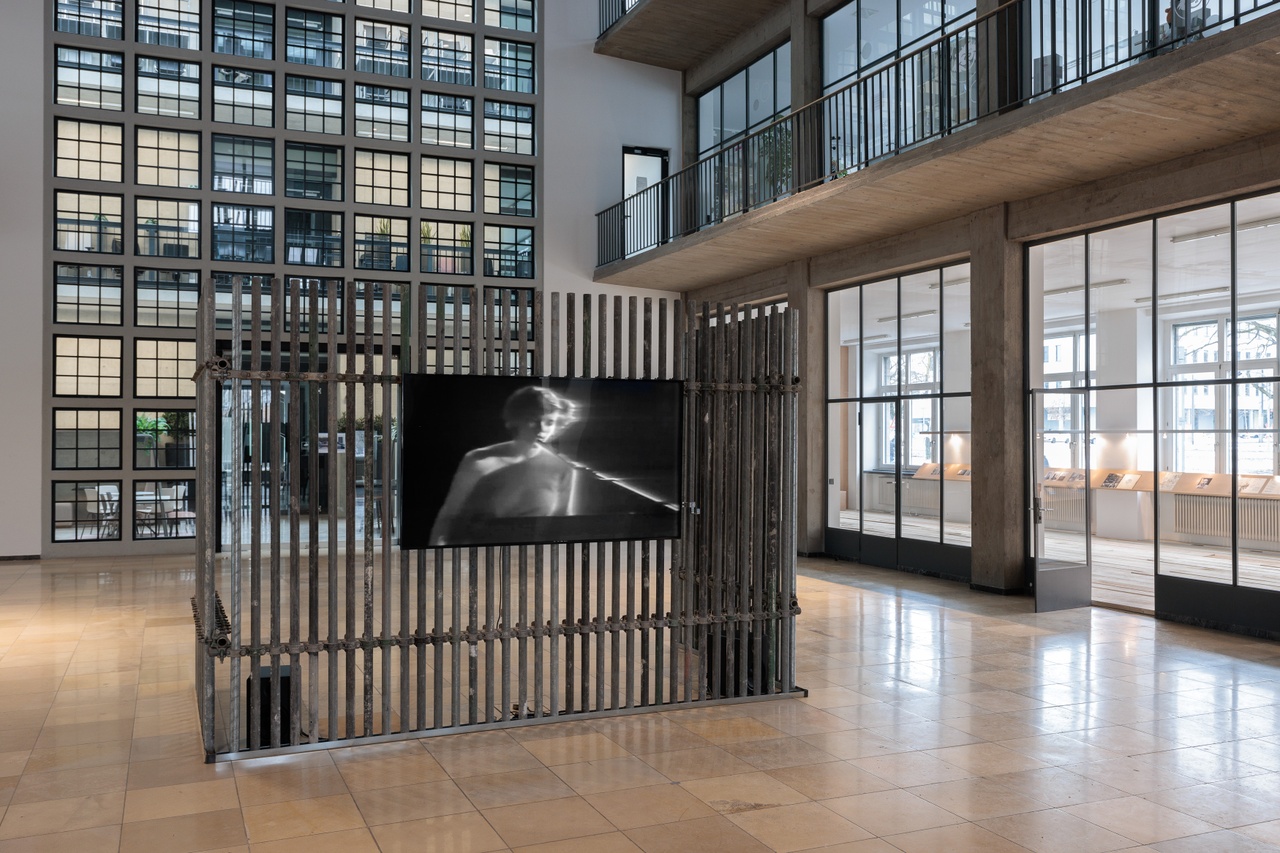
“Julia Hayward: Miracles in Reverse,” Kunstverein Nürnberg, 2026
During the opening-night performance of Julia Heyward’s current exhibition at Kunstverein Nürnberg, the artist guided the audience through the newest performative iteration of Miracles in Reverse, an interactive multimedia video game controlled by her in real time and musically accompanied by her collaborator and instrumentalist Perry Hoberman. In the background, a cleaning lady came in and out of view, languidly mopping the shared corridor of the institution’s sleek industrial building. The scene could almost have been pre-choreographed in its comic timing, exposing the arbitrary boundary between designated art and non-art spaces while rendering visible the gendered labor and class hierarchies underpinning the art system’s infrastructure. For an artistic practice that emerged in the lofts, basements, and DIY settings of New York’s 1970s and ’80s underground, this incidental glitch might have had an alienating effect, but in Heyward’s case, it could be absorbed into the humor and politics of her work, which remains persistently attentive to the choreographies of gender, labor, and class within popular media and visual culture – and to the blurred boundaries between them.
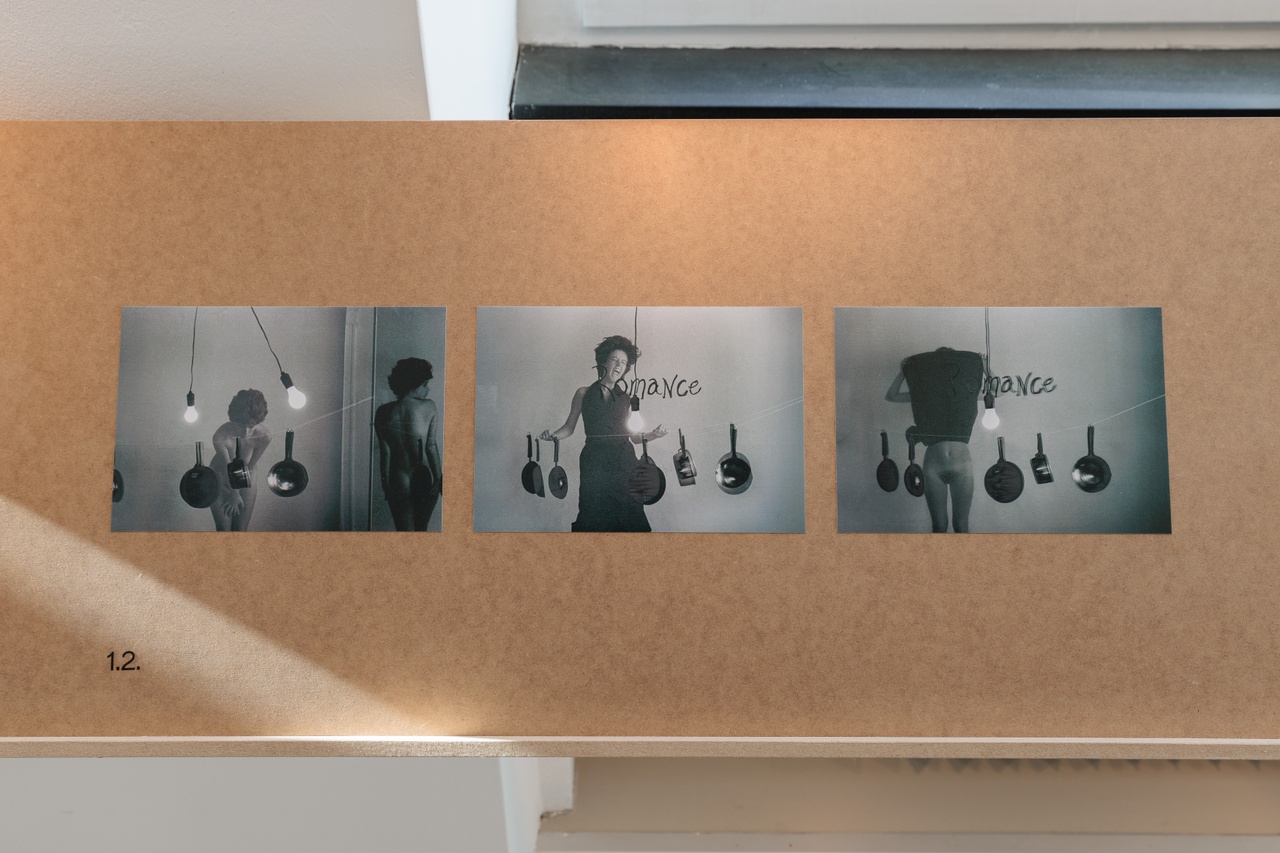
Julia Heyward, “Untitled (Self-Portrait),” 1971
Thinking in canonical art historical terms, Heyward might be described as an “overlooked” artist, particularly in solo contexts – despite her sustained inclusion in major group exhibitions. She has moved fluidly across performance, moving image, photography, and music (under her moniker Duka Delight, and as part of the band T-Venus), and, more recently, into interactive digital formats, while also being cited as an important influence on more widely recognized artists such as Mike Kelley and Ericka Beckman. Heyward’s first institutional solo exhibition since the Wattis Institute in 2015 and her first ever in Europe, with a sister exhibition running concurrently at the Westfälischer Kunstverein in Münster, “Miracles in Reverse” foregrounds a practice rooted in duration, improvisation, and ephemerality. Naturally resisting consolidation into market-friendly fixed-object form, it evolves instead through iterative reactivation across media and time, and by maintaining a mode of production that privileges process and ongoing transformation.
The exhibition opens with Shake Daddy Shake (1976), which loops on a screen fixed onto a cage-like metal structure, evoking the rough industrial character of 1970s SoHo. The black-and-white performance documentation establishes core themes of Heyward’s work: a feminist revolt against patriarchal authority – figured through religion, the Church, and the autobiographical presence of her pastor father – articulated through looping spoken word, song, and vocal strain. From an initial raised-arm salute, the artist’s body never settles: spinning, marching, swinging, and above all shaking – the gesture mirroring both her father’s tremor from the Parkinson’s disease he was diagnosed with later in life and his decades of ritualized handshaking with congregants. Her voice shifts from Southern whistle to shrill cry as she repeats, “Daddy, daddy, He’s got you on automatic.” Patriarchal and religious authority appear here as simultaneously intimate and structural, and as internalized in the individual body through repetitive, pathological movement. This approach is characteristic of Heyward’s broader practice, which fuses disarming vulnerability and diaristic storytelling with systemic critique, asserting that the personal is always political.
In the adjacent gallery, wooden shelving tracing the room’s perimeter displays performance documentation and staged self-portraits, situating Heyward within the subversive, punchy aesthetic of feminist performance art of the 1970s. Her storyboards are among the most compelling elements of the exhibition, appearing as quirky, unusual remnants of the analogue imaginary. The upper-left side of No Local Stops (1984), developed for a touring performance of 17 interconnected songs, shows a sketch of the artist in the costume later realized in performance; below it, a textbox provides stage directions, while the right-hand side of the page presents the song’s lyrics, with notes in the lower corner specifying musical structure. Lyrics, camera directions, narrative fragments, editing cues, and reference images – elements that today would be synchronized and rendered onto a screen through digital tools – are brought together within a single material surface, functioning at once as scripts, instructions, scores, and drawings. They also offer an insight into Heyward’s methodology of thinking simultaneously across multiple media and in terms of immersive narrative, an approach that becomes more fully realized in her later multimedia performances. A solo exhibition dedicated solely to the storyboards would feel entirely justified.
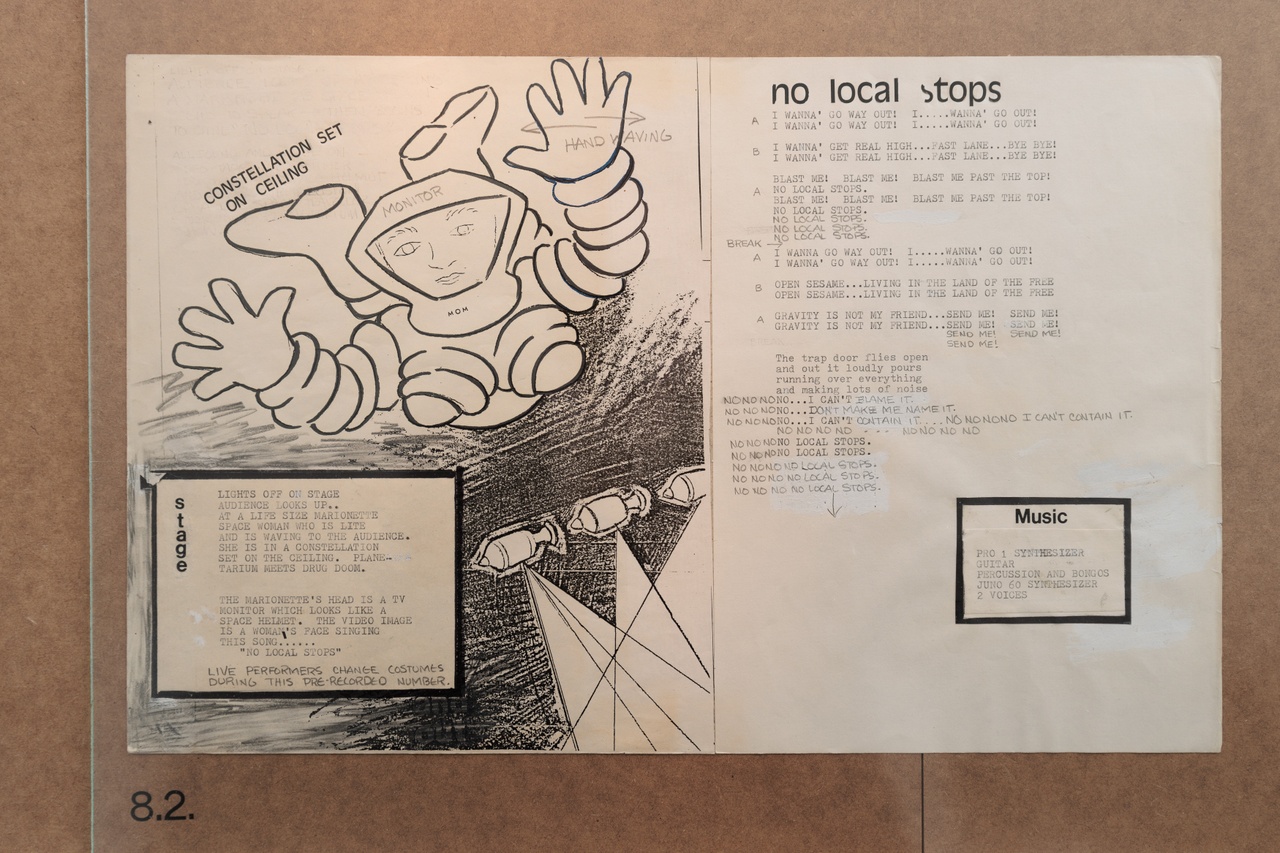
Julia Heyward, storyboard for “No Local Stops,” 1984
In the same gallery, This Is My Blue Period (1977) documents a performance at Artists Space, structured through a surreal poetic monologue. Filmed largely in close-up, the work foregrounds Heyward’s vocal experimentation: She exaggerates her voice’s articulation, using different registers ranging from high-pitched and childlike to croaked, strained, and mechanical. The color blue recalls various associations here. Some are explicitly referenced – such as the notion of “blue blood,” which points to the recurring critique of class hierarchies in Heyward’s work – and others more implicit and open to interpretation, ranging from simple sadness to the legacy of Yves Klein’s famous series of monochrome paintings from the 1960s, which serves as a stereotypical example of the male “genius” artist tradition that has instrumentalized the female body for spectacle and material gain.
This Is My Blue Period narrates a spreading virus inhabiting the body, mind, and heart of the waitress “Modern Mary,” who repeatedly insists that “I just work here” – and who thus finds her doppelganger in the cleaning lady who serendipitously appeared during Heyward’s opening performance. Comedic distortions – with the artist stretching her face into a grimace or pulling a hood over her head so her ears protrude – produce a slapstick choreography that refuses normative attractiveness in favor of awkward exposure and ridicule. Within this work, humor and uninhibited physical and vocal release emerge as coping mechanisms under capitalist conditions of exhaustive physical, cognitive, and repetitive emotional labor – conditions that have only become starker and more accelerated in the present-day later stage of capitalism in comparison to the 1970s, when the work was made.
Exhaustion and “viral” manic movement find an echo in the spoken-word monologue Keep Moving Buddy (1978), available to listen to through headphones nearby, alongside Heyward’s other concept albums. Its refrain – “We wanna see you moving buddy, keep moving buddy” – consolidates the exhibition’s governing leitmotif: the restless choreography threading Heyward’s oeuvre. On one level, this registers as a pathological condition that sees oppressive external systems of power – religion, patriarchy, capitalist exploitation – as internalized, its symptoms expressed through compulsive bodily movement, while on another level it also appears as an insistent, cathartic form of release or exorcism from external conditioning.
In the neighboring gallery, Heyward’s video album 360° (1981) plays alongside two other performance documentations, Miracles in Reverse (1996) and The Gabriel Frequency (2017). The 40-minute 360°, which anticipated the MTV music video format by a matter of months, combines experimental spoken word and collaboratively recorded songs with a montage that moves through associative, surreal imagery tinted with horror: a woman smiling and waving in front of a collapsing house façade; taxidermied animals; a shot circling a ruinous house inhabited by a witch-like figure; swimmers dissolving into a shooting target; Heyward’s narrator buried in earth in a pig’s-head mask with pigeons picking the ground around her. Set against the crescendoing punk vocals and instrumentals soundtracking the film, the central motion suggested by its title is one of frantic spinning, made explicit in its final image of the rotating Earth – projecting the refrain of “keep moving buddy,” and capitalism’s demand for never-ending motion, onto a planetary scale.
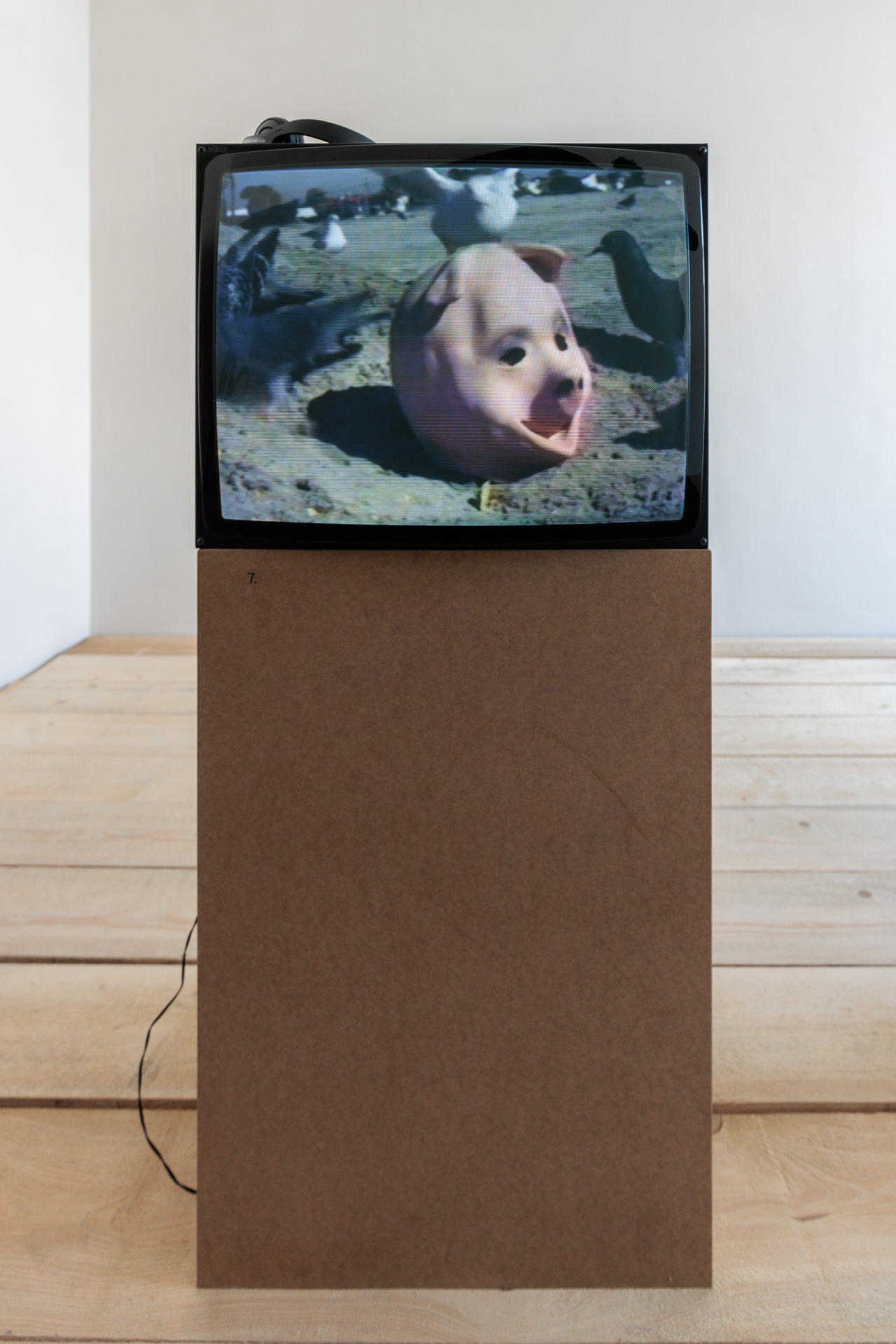
Julia Heyward, “360°,” 1981
Miracles in Reverse and The Gabriel Frequency form the first and third chapters of Heyward’s long-term project Nothing Random Access Memory (Nothing RAM), conceived as a time-based triptych. In both works, projected visual sequences are shaped live by the artist during performance through an interactive interface, extending her improvisational method into a digitally mediated form. In Miracles in Reverse, this takes the shape of an early interactive setup built around a DVD-ROM system, through which Heyward performs while simultaneously manipulating visual elements in real time. The Gabriel Frequency, developed two decades later with Perry Hoberman, expands this into a panoramic projection environment, operating somewhere between psychedelic horror, musical, docudrama, and pseudo-surveillance military footage. Drawing on belief systems circulating around communities in the Mojave Desert, the work overlays the vast desert landscape of romanticized Americana with unsettling narration and imagery of military activity, ritual practices, predator-prey dynamics, planetary motion, and speculative apocalyptic scenarios. A 360-degree camera perspective evokes a drone-like, omnipresent viewpoint akin to satellite imaging, producing the sense of an ecosystem under constant surveillance. The performance culminates in Heyward’s cathartic litany as the Archangel Gabriel, green wings strapped to her back, screaming “mind control, birth control, foreign control, crowd control … we have Mother Nature under control.” Staging a tension between free will and systems of oversight, and permeated by surveillance paranoia and conspiratorial thinking, the work reflects the pervasive mistrust in official authorities, dominant narratives, and image regimes that defines today’s post-truth visual culture.
Across the exhibition, an interlinked Gesamtkunstwerk unfolds in motion, with motifs and choreographies recurring across decades and media. It feels curatorially significant that the exhibition is not confined to historical material or presented as a purely retrospective framing of Heyward’s practice: The opening-night performances introduced two new iterations of Miracles in Reverse, foregrounding its continued development into digital, interactive media and demonstrating how institutional support can sustain its evolution in the present. Seen today, the work resonates within a climate shaped by intensifying religious fundamentalism, authoritarianism, militarized conflict, and a pervasive mistrust of shared reality. Many of these dynamics were already taking shape in the Cold War and Reagan-era context in which Heyward was working – a period that promoted the ideal of the American dream while simultaneously normalizing paranoia and initiating the neoliberal restructuring that would erode its material basis. The dismantling of labor protections, the outsourcing of domestic production, and the consolidation of market logics helped destabilize the very promises of stability and upward mobility that the dream relied upon.
In the present, under a US presidency built on nationalist mythology, media spectacle, and the open fabrication of political reality, “miracles in reverse” are a lived condition. The promise to “make America great again” rests on the projection of a past that never existed, while material inequalities deepen and shared reality fragments under post-truth politics. Within this landscape, Heyward’s cathartic choreographies and insistent refrain to “keep moving” reads both as a symptom of physical, existential, and psychic strain and as a possible counter-response: speaking, singing, shaking, screaming this externally imposed authority loose.
“Julia Heyward: Miracles in Reverse,” Kunstverein Nürnberg, January 31–April 19, 2026.
Sonja Teszler is a Europe-based writer with a particular interest in conceptual, research-driven practices, and in artists from the Eastern European diaspora. Her reviews and interviews have appeared in Frieze, ArtReview, Flash Art, Arts of the Working Class, Sculpture Magazine, Something Curated, PW-Magazine, and thisistomorrow, among others.
Image credits: all images courtesy of Kunstverein Nürnberg, photos Lukas Pürmayr