

WILL TO LOUSINESS Isabel Jacobs on Eva Švankmajerová at DOX, Prague
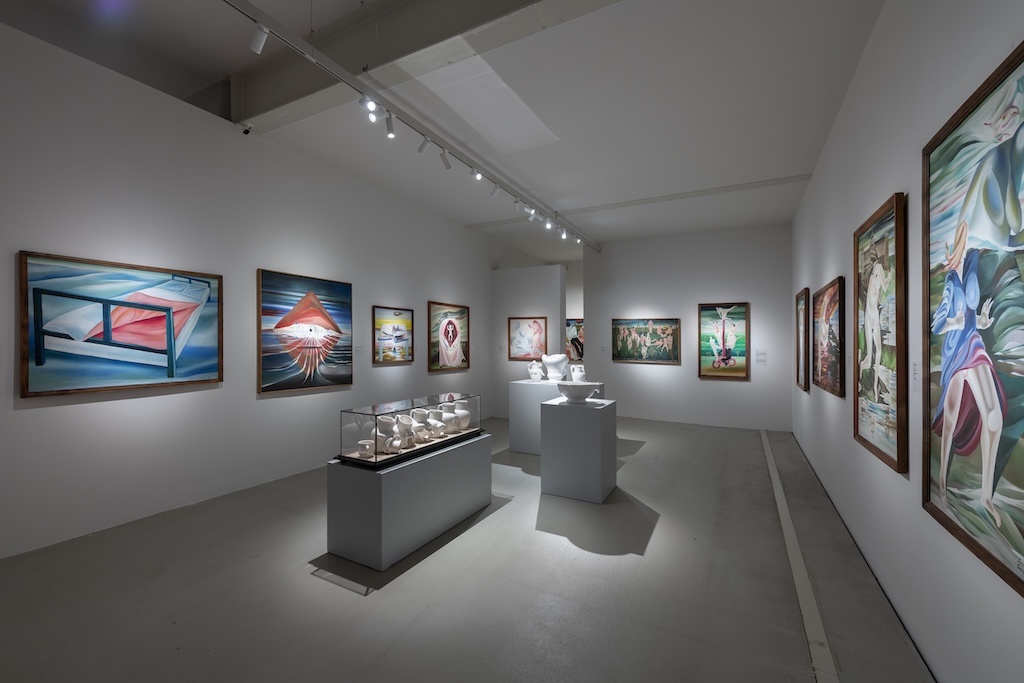
“Eva Švankmajerová: Woe to the Painting That Needs a Verbal Interpretation,” DOX Centre for Contemporary Art, Prague, 2025-26
Twenty years after her death, the work of Eva Švankmajerová has not received much critical recognition, especially outside of the Czech Republic. In contrast to other women surrealists such as Dorothea Tanning or Meret Oppenheim, she remains largely unknown; neither has she been included in major global surrealism exhibitions like some of her Czech colleagues in “Surrealism Beyond Borders” at Tate Modern in 2022 for example. Amid a wave of international exhibitions celebrating the recent centenary of surrealism, the retrospective “Eva Švankmajerová: Woe to the Painting That Needs a Verbal Interpretation” at DOX gives a full overview of the artist’s multimedia practice from the mid-1960s to the final years of her life. Her work offers a glimpse into women’s life under state socialism, filtered through a surrealist looking glass.
At the heart of the show is a recurring motif: the female body as a site of eroticism, trauma, and labor. While her paintings, large and luminous, take center stage, there are also ceramics, painted furniture, and film posters. Visitors enter through a room with self-portraits inspired by her childhood and family life. From there, the exhibition unfolds in a roughly chronological structure, following along major series, including the Emancipation Cycle from the late 1960s. This series of paintings in particular deals with womanhood and the limits of female liberation in socialist Czechoslovakia, reflecting her own role as a woman artist in the Surrealist Group of Czechoslovakia, later the Group of Czech and Slovak Surrealists. From 1970 onward, Švankmajerová was the informal head of the group, stirring up what was notoriously a boys’ club (with the exception of Toyen, who adopted a gender-neutral pseudonym challenging the sexism of the surrealist movement). As Švankmajerová’s work brilliantly shows, the Prague artists were not just a branch of Parisian surrealism but a force in its own right. The relationship between the visual and the verbal – which also inspired the exhibition’s title – is both representative of the poetic orientation of Czech surrealism and at the core of her practice.
Švankmajerová’s painted riddles from the 1960 and ’70s, known as her Rebus paintings, are infused with visual puzzles and letters dotted across the canvas. They appropriate folk sayings, proverbs, puns, and political slogans, playfully subverting their original meaning. Rebus No. 1: Threshing with steam engines is now taking over (1966), a cheeky parody of the obsession with agriculture in socialist realist painting and film of the time, is littered with letters, arranged in rows as if to make the painting readable from left to right like a visual poem. The letters from the original Czech title (“Teď zmaha se mlácení parními stroji”) appear in pairs, merging with motifs of a toilet bowl and a couple sitting on a bench.
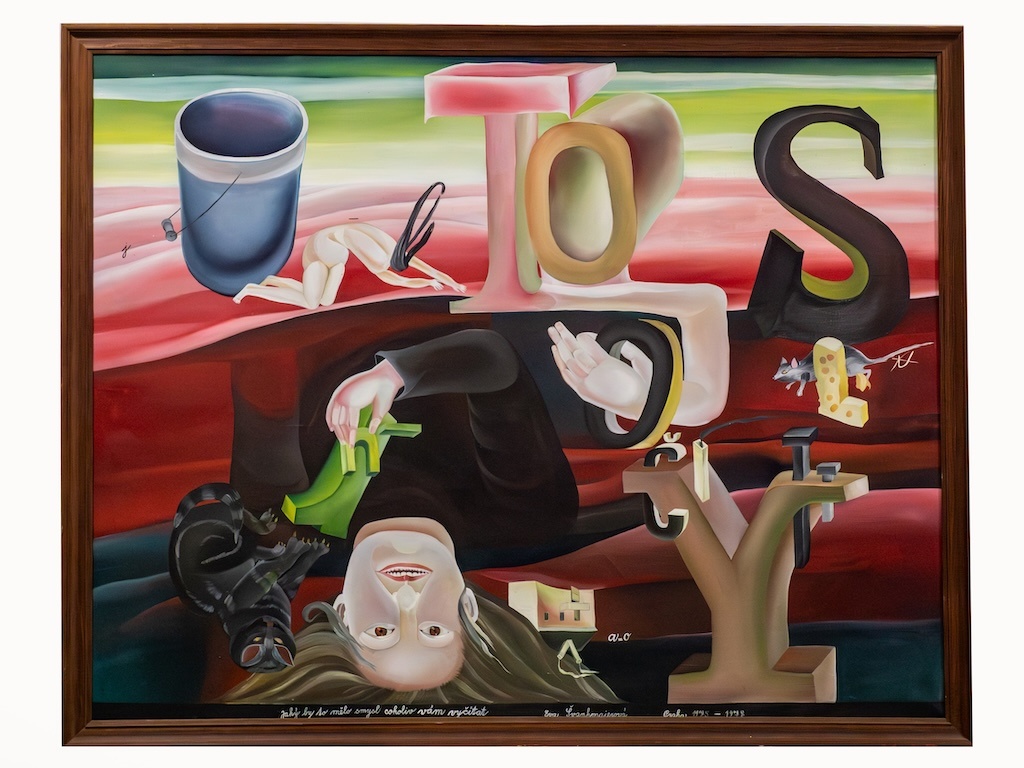
Eva Švankmajerová, “Rébus (Jaký by to mělo smysl cokoliv vám vyčítat),” 1975-1978
Švankmajerová’s rebuses continue the tradition of the obrazová báseň (“picture-poem”), a genre unique to Poetism, a Czech avant-garde movement of the 1920s that prepared the ground for surrealism in Prague. The picture-poem was pioneered by artists such as Karel Teige and further developed by surrealists such as Jindřich Štyrský and Toyen. The genre was a form of collage inspired by both psychoanalysis and Soviet constructivism. In Czechoslovakia, surrealism not only challenged but also fused with the emerging Marxist doctrine of socialist realism, producing a hybrid genre of socialist surrealism.
The rebus Peace will be preserved if the people take the matter of preserving peace into their own hands – J. V. Stalin (1967) is an example of such hybridity. It is more pictorial than the picture-poem, dissolving the linear structure of verse into one non-hierarchical surface. Organized around Stalin’s face, the rebus constellates symbols (near his left ear a camel balancing the letter M on its back; a sea with fish that rises to his moustache; a mass of people near his right ear; a tree growing from his forehead) into a dense visual field that works through simultaneity rather than sequence. Painted on the eve of the Prague Spring – a brief window of “socialism with a human face” – the work can be read as a commentary on both the specter of Stalinism and attempts at political liberalization in socialist Czechoslovakia. These absurdist picture-poems bring Švankmajerová close to another woman surrealist from the postwar period, Unica Zürn. Whereas Zürn splits up words into letters, rearranging them into anarchic anagrams, Švankmajerová treats letters as found objects, bringing them into a new nonsensical order.
Both Zürn and Švankmajerová were overshadowed by their more-famous artist-husbands. In the late 1950s, studying wood carving, puppetry, and scenography at the Academy of Performing Arts in Prague, Švankmajerová (née Dvořáková) met her husband, Jan Švankmajer, an animator and filmmaker. After her studies, she made a living designing costumes and sets for movies, including Švankmajer’s. She played a crucial role in shaping the dark fairytale aesthetic of his films such as Alice (1988), whose poster, for example, is displayed at DOX. A horror adaptation of Lewis Carroll that influenced Tim Burton’s later adaption of the Alice in Wonderland novel, Švankmajer’s Alice blends stop-motion animation with dreamy scenes, emphasizing the terrifying and disturbing side to the little girl’s journey. Throughout Švankmajerová’s paintings, the figure of Alice reappears in different guises, often dressed as Little Red Riding Hood. Awakening sexuality and infantile fantasy are key threads throughout Švankmajerová’s paintings, which uncover new surrealist meaning in Czech folkloric imagery, such as the forest or werewolves.
After the violent crackdown of the Prague Spring in 1968, Švankmajerová emigrated with her family to Austria, returning to Czechoslovakia a year later. During so-called Normalization, a period of censorship and repression, she was only able to exhibit her work abroad or in small underground galleries, circulating samizdat (“self-published”) magazines. Though well-known in surrealist circles, Švankmajerová remained a marginal figure in the public art world. The exhibition at DOX, curated by Anna Pravdová in collaboration with Jan Švankmajer, is an important step in popularizing her central role in the circle of Czechoslovak surrealists, as well as highlighting the significance of Czech surrealism more broadly.
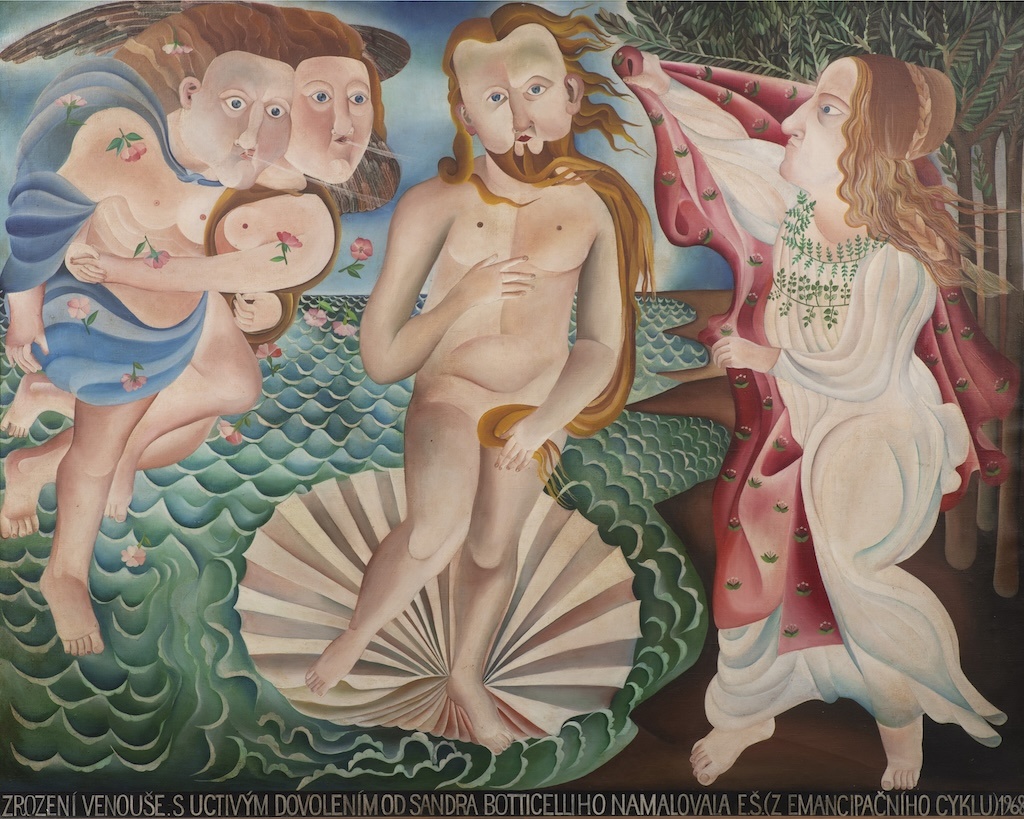
Eva Švankmajerová, “Zrození Venouše (Emancipační cyklus),” 1968
Švankmajerová’s Emancipation Cycle is the most memorable and playful series in the show. It is made up of “copies” of famous paintings by Sandro Botticelli, Édouard Manet, Peter Paul Rubens, and other male masters. Her adaptation of Botticelli’s Venus, for example, appropriates the eroticism of art historical references, exposing how desire has been structured and canonized through a male gaze. The cycle is both hilarious and cringe. Švankmajerová replaces female figures with male ones (and vice versa), thereby destabilizing fixed gender roles and representations of bodies. The Birth of Little Venouš (1968), her cheeky copy of Botticelli, breaks down the image into its most basic components and replaces airy realism with simplified forms and crude contrasts. Venus is replaced by little Venouš, modestly covering his protruding belly with a strand of golden hair. This transformation is not simply an inversion of the male gaze or a gender swap but the emergence of a hybrid subject. Venouš represents both Botticelli’s Venus and a young boy – an overt provocation in the patriarchal society of Czechoslovakia of the 1960s.
The Emancipation Cycle remains challenging to audiences in the Czech Republic even today, where traditional gender roles remain deeply entrenched; the country ranks among the lowest of all European states in the Gender Equality Index. It is tempting to read the series as explicitly feminist, yet Švankmajerová seems to adopt a more ambiguous position. The cycle operates as a double-edged critique, simultaneously confronting the patriarchal structures of art history and questioning the rhetoric of feminist liberation itself. As the works and the accompanying texts in the exhibition suggest, female emancipation is not possible in a society created by men: Copying male masterpieces becomes a tool of subversion but also an expression of tragic surrender to the fact that gender representations, while potentially fluid, are structured by society’s expectations.
The Emancipation Cycle is as much a parody of conventional gender relations as of the very idea of mastery itself. In her text “Reminiscences of the Old Masters,” reproduced in the exhibition, Švankmajerová describes a girl painting “lousily” in the Louvre – and lousiness is indeed her painterly language of choice, subverting the authority of canonical images. Crudely painted, The Abduction of the Sons of Leucippus (1969), a copy of Rubens’s The Abduction of the Daughters of Leucippus (1618) – also known as The Rape of the Daughters of Leucippus – is a comical orgy. The painting depicts the abduction of Phoebe and Hilaeira, daughters of King Leucippus, by Castor and Pollux. Red cloth symbolizing blood flows over the canvas. The twins’ libidinal bloodthirst is mirrored in their horses. In Švankmajerová’s reworking, bodies take on an almost cubist shape, exposed flesh everywhere, and again there are radically inverted power dynamics: The perpetrators now have breasts and the tortured figure in the middle is a helpless male. She makes Rubens’s opulent painting totally her own by bringing its subterranean trauma and sexual violence to the surface.
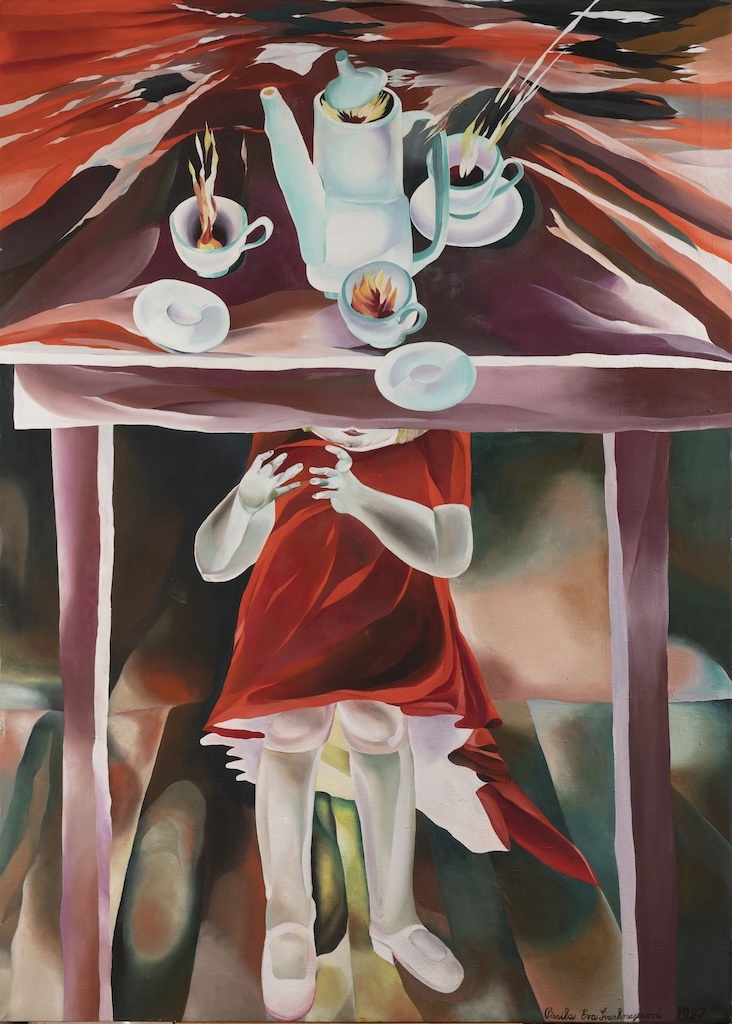
Eva Švankmajerová, “Přesila,” 1987
Švankmajerová turns toward her own body in countless self-portraits, for example Eva Švankmajerová in Hradčany, dedicated to my dear J. (1972), set against the backdrop of the city of Prague. Echoing Oppenheim’s fur objects, the artist’s hair morphs into two furry arms, their fingers playing with one of her nipples. Both the Emancipation Cycle and her self-portraits play with the possibilities of recreating the female body, making it animalistic or grotesque. While the figure of the little girl populates paintings from all periods of her work, it is the laboring female body that interests her most. The working woman is a staple of socialist propaganda that Švankmajerová repeatedly subverts.
In a text titled “Emancipation Errors and Eroticism,” the artist describes a childhood under the gaze of communist propaganda posters featuring plump women tractor drivers with headscarves. Later, she found herself doing the nasty kind of manual labor called women’s work. The mixed-media Worker (1986) directly repurposes socialist realist imagery, mounting a newspaper clipping onto a woman’s torso, her head replaced by an agricultural scene with women in peasant headscarves sorting through the harvest. The role of women in socialist society – often carrying the double burden of household and wage labor – is also ironized in The Women’s Regiment on the Obstacle Course (1968), a tableau of nudes doing gymnastic exercises in the park. The painting mocks socialism’s cult of sport and body culture, motifs one would encounter in Soviet propaganda paintings such as Aleksandr Deyneka’s portraits of female athletes. The same thread is taken up in Acrobats (1973), where women perform acrobatic tricks on a motorbike while the male driver rides on undisturbed. Here, exercise is portrayed as a site of struggle both against socialist body imagery and patriarchal ideology.
In the 1970s, Švankmajerová participated as a volunteer, together with her husband, in experiments with LSD in the military hospital in Prague. Her paintings became more colorful and cinematic in those years. While the rebuses maintain a strict separation between background and characters, works like Superiority (1987) are raw and dynamic, with bodies in motion blurring with their milieu, as are her self-portraits of the same time. In Superiority, a little girl in a red dress – echoing the figure in Little Red Riding Hood: Find the Wolf (1968–69), the artist’s alter ego – hides beneath a table. A tea set sits above her, cups filled with flames, as if the whole scene were animated by a dark, fiery force. The table is a recurring motif throughout her later paintings that deal more explicitly with motherhood and sexuality. Section (1976) is an almost surgical composition: A baby lies on a blood-red cloth on a table, surrounded by scissors and thread, the table itself evoking a woman’s body draped in dress-like fabric. In Defloration (1981), the table is laid bare, pierced by a stone that breaks through its surface to leave a vagina-shaped opening.
In those paintings, the visceral corporeality of the female body, as a site of birth and lust, turns into monstrosity. Švankmajerová’s paintings, centered around women’s bodies merging with their milieu, are often deliberately ugly, just like her lousy copies of masterpieces. The force of the artist’s socialist surrealism does not lie in hidden meanings. Rather than a higher plane of reality, she seeks the everyday: banal, impossible, messy, poor and provincial. If this is interpreted as a feminist strategy, then it is because it refuses the heroics of both mastery and prefabricated gestures of emancipation. Švankmajerová’s will to lousiness is a position of stubborn refusal, one that insists on the limits of painting as a medium of liberation.
“Eva Švankmajerová: Woe to the Painting That Needs a Verbal Interpretation,” DOX Centre for Contemporary Art, Prague, November 14, 2025–February 15, 2026.
Isabel Jacobs is a writer and philosopher based between London and Prague. She holds a PhD from Queen Mary University of London, specializing in Central and Eastern European culture. She is a research fellow at the Institute of Philosophy, Czech Academy of Sciences, and contributing editor at Translator, a magazine of translated reportage from around the world. Her work has appeared in e-flux Notes, the Los Angeles Review of Books, and Senses of Cinema. She is currently writing a book on Alexandre Kojève and aesthetics.
Image Credits: 1. Photo Jan Slavík, Copyright DOX Centre for Contemporary Art, Prague; 2. Copyright Galerie Klatovy / Klenová; 3. + 4. Courtesy of DOX Centre for Contemporary Art, Prague