

COMING TO TERMS Xenia Benivolski on “Bells and Cannons: Contemporary Art in the Face of Militarisation” at the Contemporary Art Centre, Vilnius
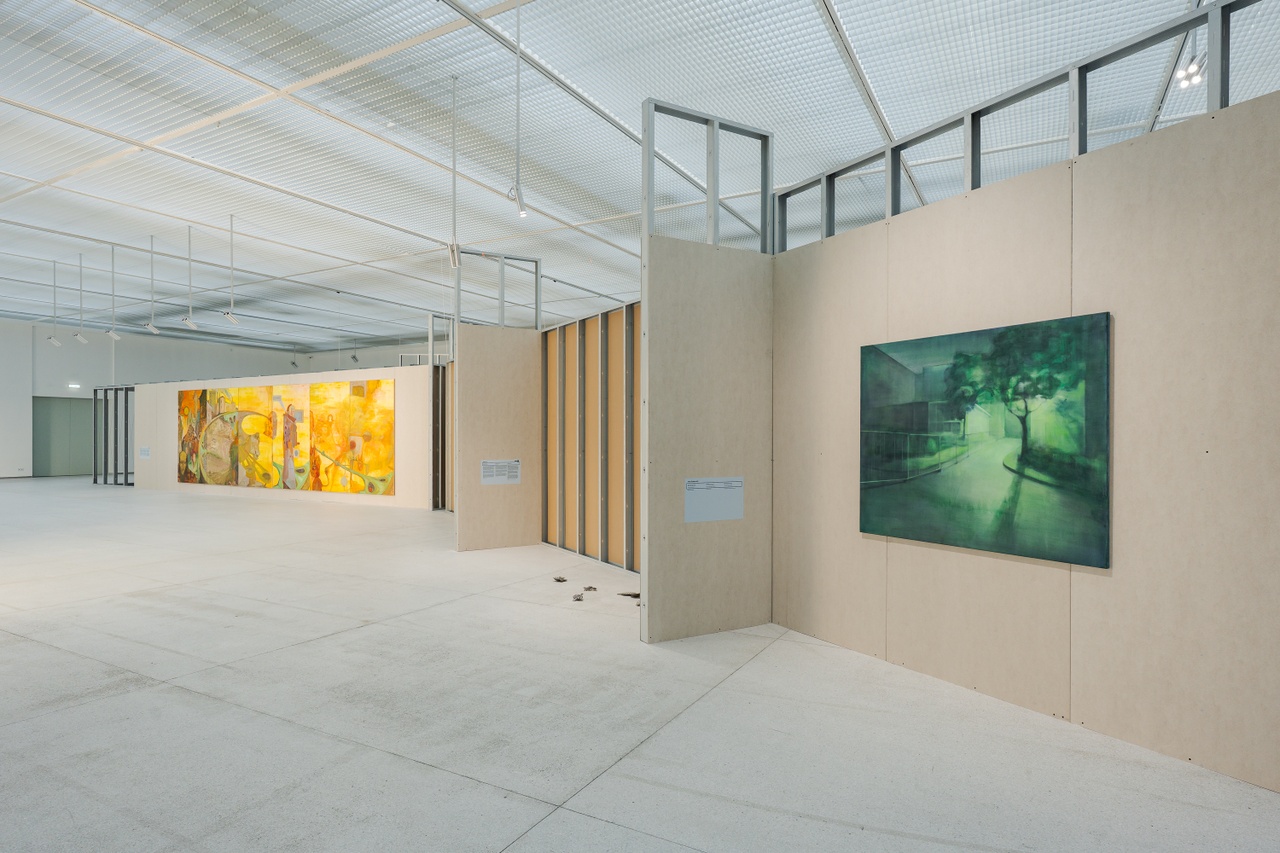
“Bells and Cannons,” Contemporary Art Centre, Vilnius, 2025-26
In the Platonic view, everything good contains its opposite, and order arises from fixed forms, which create a sense of predictability. Europe often locates itself in a fragile contradiction, clinging to the stabilizing notion that history repeats itself, while also invoking Walter Benjamin’s Angel of History, a figure propelled violently into the future by the very disasters that make repetition impossible. The exhibition “Bells and Cannons: Contemporary Art in the Face of Militarization” focuses on how the material transformation of cultural objects into military ones, and vice versa, in the first half of the 20th century reinforced this binary tension, suggesting that in perpetuating simplistic cultural notions of moral duality, Europe might be caught up in a denial of its own futurity. The European identity is so closely tied to the postwar lessons of the early 20th century that it struggles to recognize fully the complex militarization that now permeates every aspect of life, both real and digital. This makes continued faith in the European idea feel both essential and abstract, eclipsing reality in favor of suspended hope without true optimism – nostalgia for a world that no longer exists.
During the wars of the early 20th century, church bells and cannons were produced by the same artisans and often smelted from the same metals, their sounds and bodies occupying both spiritual and militaristic registers at once. While Soviet forces smelted bells and crucifixes in Georgia, Latvia, and Armenia, German Nazi forces looted an incredible number of bells from Western European towns and villages to be melted into bullets and tanks. Bell towers became lookout platforms and sniper posts. After the wars, things presumably returned to relative normalcy: Tanks were melted back into bells and priests returned to their towers. The portal seemed to have closed for good. Yet something insidious has shifted under this surface. One might speculate, as I do in this review, that the ideological project of postwar European identity has always harbored the conditions for its own reversal. What does this mean for artists living through war, and for those whose work exposes how deeply civilian infrastructures are already entangled with military systems? Could it imply that any political or cultural assembly can also be read as a proto-army, just as any bell, under pressure, can be refashioned into a cannon?
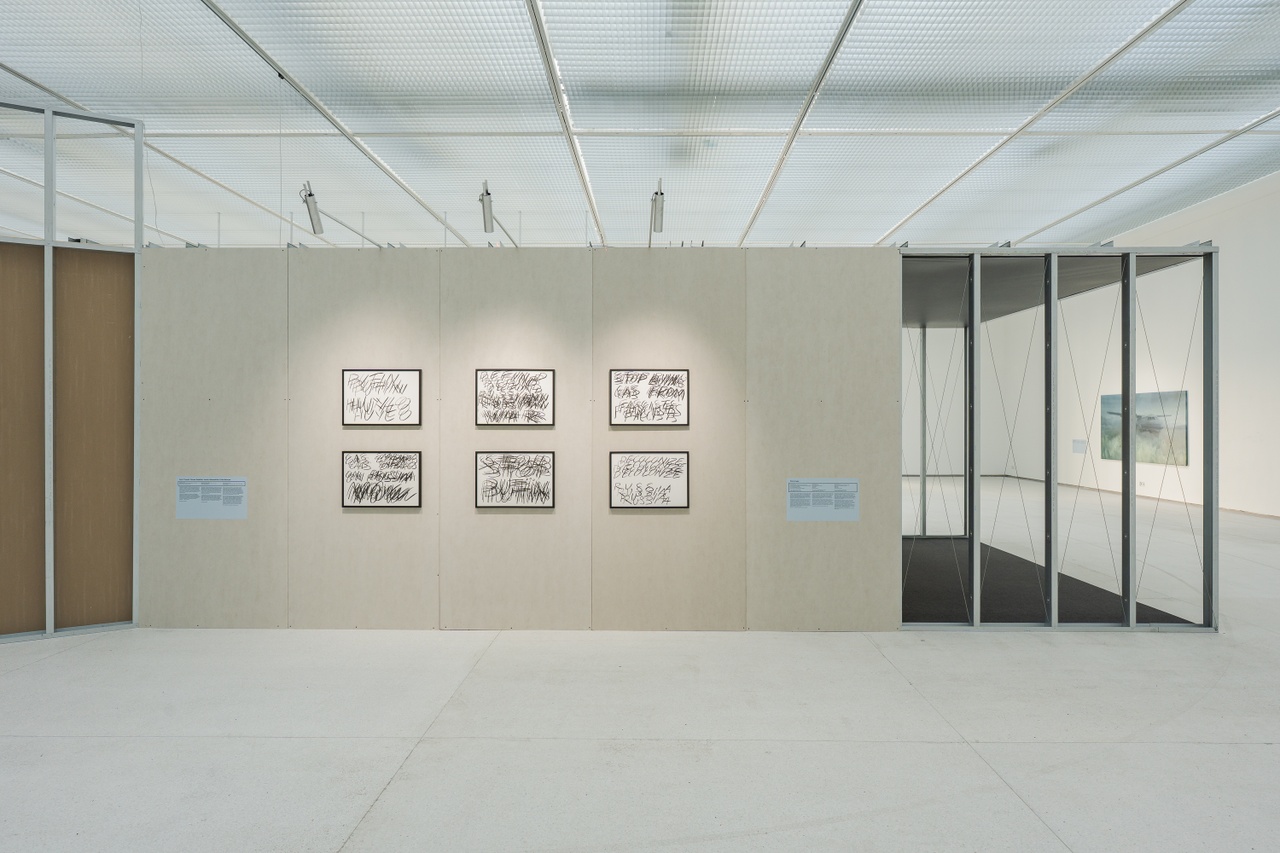
“Bells and Cannons,” Contemporary Art Centre, Vilnius, 2025-26
The exhibition is part of “Aspects of Presence,” a collaboration between the Contemporary Art Centre in Vilnius, the Akademie der Künste in Berlin, and the Goethe-Institut in Lithuania. It unfolds in three stages: a symposium that took place at the academy, this exhibition, and ultimately, a publication. The project takes as its premise the current deployment of a German Brigade to Lithuania, a NATO measure to reinforce its eastern EU border in response to Russia’s ongoing war of aggression against Ukraine. In the coming years, thousands of soldiers will relocate to Lithuania, with full operational readiness planned for 2027. With this shift, Lithuania anticipates Karl Marx’s promised farce: the new cold war in the age of industrial meaning-making.
A strand of futurism sits within the idea of war, framed as technological innovation: Many communication technologies in use today, from radio to television and the internet, were first developed in military contexts and now appear as mundane parts of daily life. In the center of the exhibition, Fedir Tetianych’s Cold War–era drawings imagine a planetarium in Kyiv, an architectural scheme based on his earlier artistic sketches of “biotechnospheres”: speculative bunkers; mobile shelters designed for self-containment during an ecological or military crisis. This sense of entrapment becomes explicit in Trevor Paglen’s video work Behold These Glorious Times! (2017), a montage of hundreds of thousands of images sourced online, which eventually devolve into flickering facial-recognition grids: schemes that visualize the way that AI categorizes human faces and reveal computational infrastructures operating without scrutiny. In Michael Stevenson’s Strategic-Level Spiritual Warfare (2014/2025), a heavy metal door sourced from a military compound is run remotely by competing AI agents that determine whether it opens or closes. The mechanized sculpture reinforces the notion that crucial mechanisms are currently functioning independently of human needs. Considered alongside the increasingly inaccessible global systems of control, these works suggest that the same technologies once tied to futurist optimism have imbued older moral or religious ideas of power with even deeper forms of opacity.
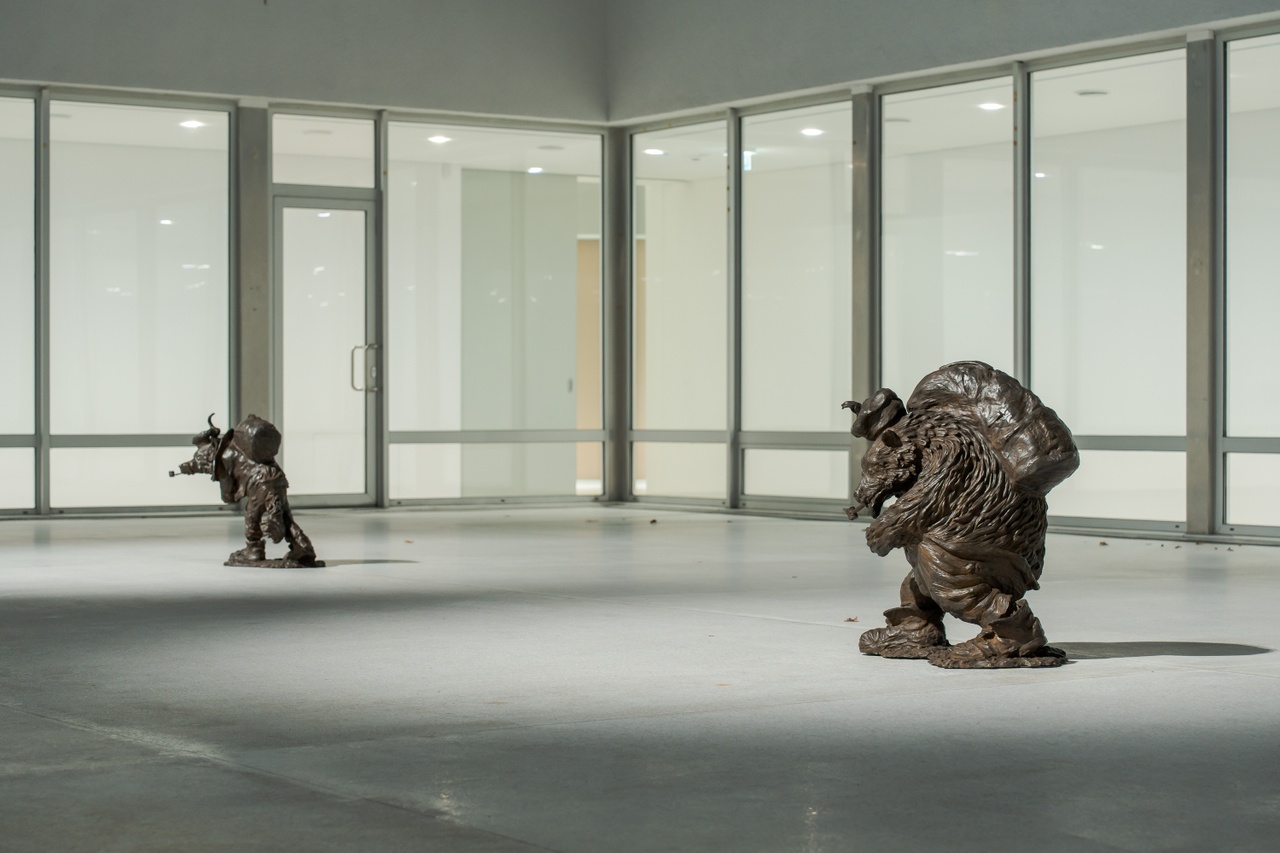
Peter Wächtler, “Lupo” and “Orso,” 2019
Some works in the exhibition refer to modernity through the gestural language of mid-century European art, [1] using stark symbolism and expressive lines to evoke catastrophe, anxiety, and the cost of human life. Sana Shahmuradova Tanska’s paintings straddle religious imagery. In her Apocalypse Survivors/Tethys Sea Inhabitants #8 (2023), faces and figures are caught up in a ghostly windstorm that seems to be a vision of rupture, between heaven and hell. Jan Eustachy Wolski’s Plexiton (Excerpts 1 to 6) (2024) consists of multiple jute panels painted in a golden yellow palette. At the center is a semi-modern traveler moving through an expressionist landscape of factory stacks, organs, machinery, and troubled faces. In the didactic wall text, Wolski describes the yellow ground as a reference to industrial production and energy extraction, but to me it recalls the radiant background of tarot imagery, especially the evocative Magician card. Nearby, Wolski’s sculpture Untitled (Far Rainbow) (2022) presents a human-like figure made from plywood, its geometric body recalling early automata. The figure appears to navigate a cluster of small paintings, each one depicting a different scene of horror. Behind it, a moody pastoral painting by Indré Rybakovaité depicts a warplane resting among the grasses of Tempelhof Airport (Berlin Tempelhof Airport, 2025).
Despite these invocations of a shared European past, clearly, there is no way back to the Europe that existed before Russia’s invasion of Ukraine. Kateryna Aliinyk’s paintings Angels in the Bushes and Awe of Vines (both 2025) render longing amplified by the impossibility of returning to the landscape of her childhood in the Ukrainian city of Luhansk. Inside that world, rough gestural vines reference infrastructural networks, like electrical wires and underwater cables that come between her and an idealized landscape. The works resonate strongly with Basma al-Sharif’s affecting video Deep Sleep (2014), filmed across Malta, Greece, and Cyprus. It depicts seascapes, ruins, cliffs, and shorelines from the region. The soundtrack includes field recordings from the Gaza Strip, connecting the Mediterranean landscapes in the video to al-Sharif’s broader project of locating herself across multiple geographies at once. These recordings, together with the film’s drifting temporalities and trance-state production, are an attempt to collapse borders and evoke parallel versions of Palestine that exist beyond fixed territorial definitions. In the video, the sound of church bells emerges through throbbing visualizations of infra-color tones and extended sequences of binaural drones, situating the viewer in a state between clarity and disorientation.
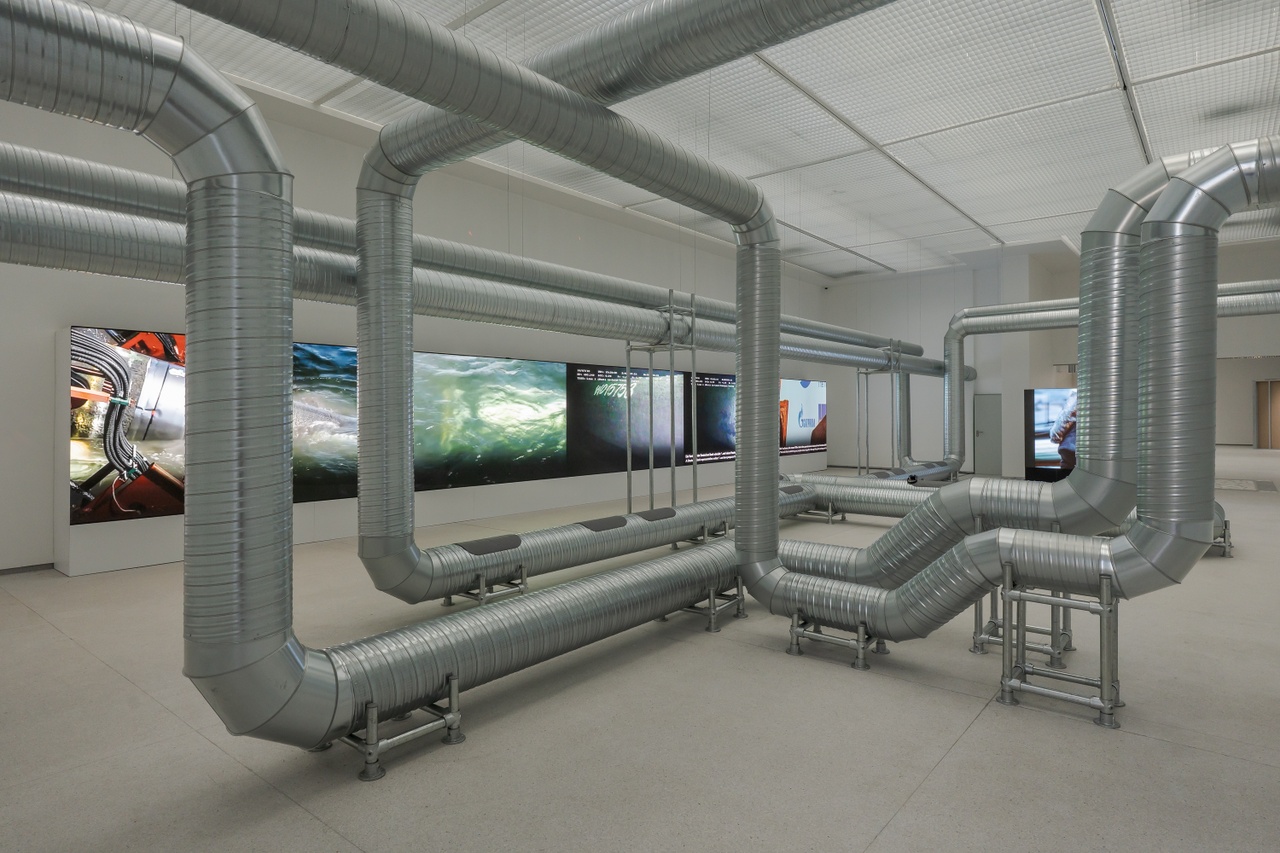
Philipp Goll, Oleksiy Radynski, Hito Steyerl, “Leak,” 2024
Placed against this backdrop of paradoxical displacement, Nikita Kadan’s quickly executed scrawled drawings, with texts such as “Stop Putin” or “Stop buying gas from fascists,” offer a welcome glimpse of raw humanity, bringing us back to the unconscionable reality of greed and war. These works shift attention toward Germany’s long dependence on Russian oil and gas and its consequences, which soon becomes the focus of the show. In the courtyard, Peter Wächtler’s bronze sculptures of a bear and a wolf, Orso and Lupo (both 2019), stand in an otherwise empty space. The short, weary figures, anthropomorphized and dressed like sailors who have left their boat behind, move across a void without destination. The courtyard becomes a landscape without orientation. The bear and the wolf can be read as deserters or disillusioned soldiers. Within the exhibition’s broader focus on entanglement and dependency between Russia and Germany, they may signify the collapse of older nationalist symbols. [2]
At the very end of this broad and meandering historical framing, the show’s final act gathers works that address global infrastructure and resource extraction most directly. At the entrance to the room, Oleksiy Radynski’s film installation Where Russia Ends (2024) describes the colonization of the Sakha people and the extraction of the fossil fuels on which Western economies (and others) have come to rely. Hito Steyerl’s Leak (2024) is a massive, multi-screen installation depicting images of underwater pipelines and news reports, with running commentary text, detailing ways in which German–Russian cooperation on fossil fuel production has also led to cultural closeness. It dominates the space, flanked by polished pipes that foreground the scale and materiality of energy circulation, and Philipp Goll’s exhaustive wall text, Timeline: The End of the Pipeline (2024), which articulates the long arc of German–Russian economic cooperation, and its roots in colonial extraction in Siberia, where companies such as Mannesmann supplied pipes for the Russian Empire’s oil networks. These extractive systems reshaped Indigenous Siberian territories from the 19th century onward and continued through the Soviet period and the Cold War, ultimately producing Germany’s deep dependence on Russian natural gas, with the country accounting for more than half of its supply by 2022 (according to Goll’s wall text graphic). Together, these interconnected works situate the show as hinging on Europe’s present political impasse inside a longue durée of resource extraction and structural dependency.
Curiously, the scale of Steyerl’s very large installation produces its own tension. Projects of this visibility rely on institutional resources and cultural capital, and their aesthetic force tends to concentrate attention. This work saturates the perceptual field, leaving little breathing room for its companions. Thankfully, the exhibition does not attempt to rectify the situation. Instead, it allows it to reveal how the art world inevitably reproduces the very hierarchies and dependencies that the exhibition seeks to examine.
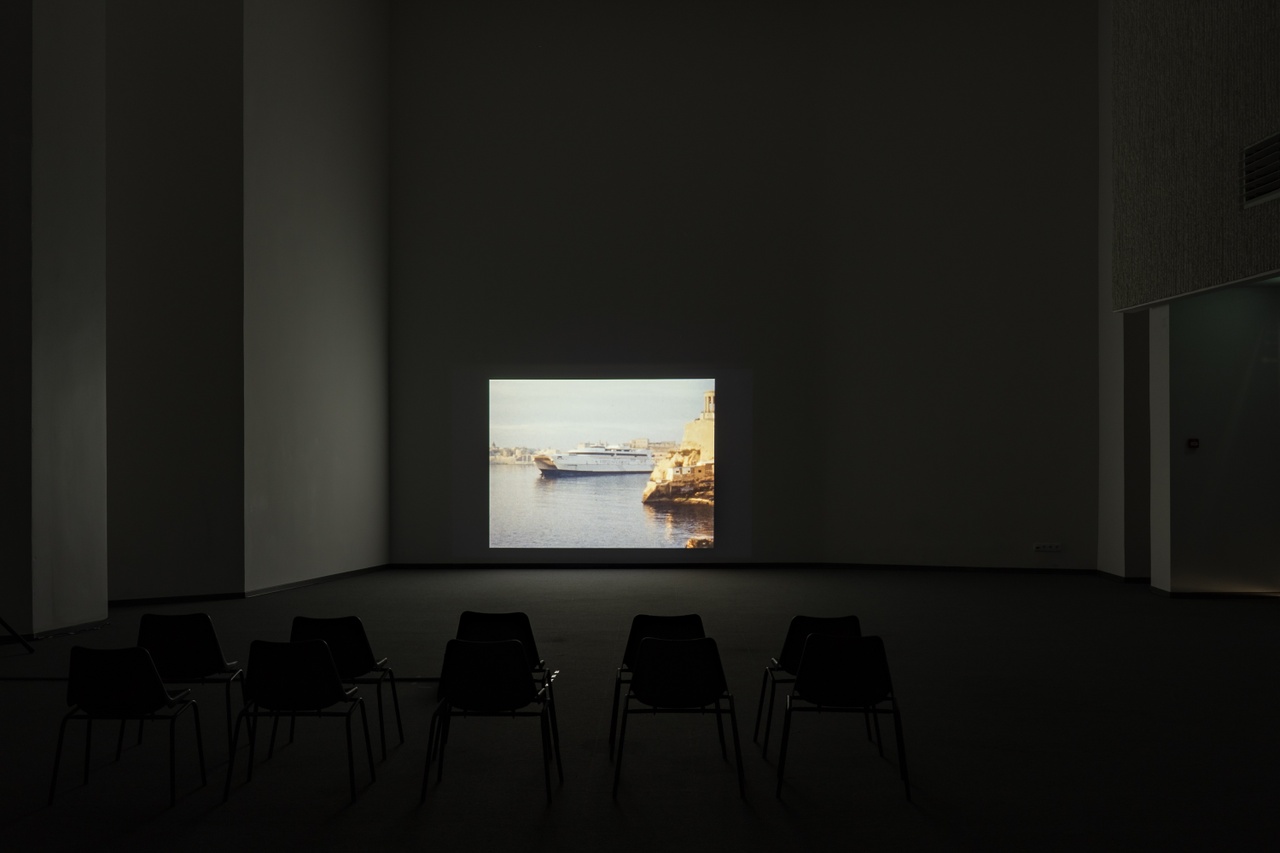
Basma al-Sharif, “Deep Sleep,” 2014
“Bells and Cannons” raises the question of whether an understanding of wartime art as a gesture in the modernist lineage prevents Europe from fully acknowledging contemporary conditions. Sometimes it seems as if art produced in times of war remains aesthetically stuck in mid-century forms, as if no conceptual shift has occurred since. But while these late modernist forms echo earlier wartime ideologies, they sit uneasily beside the automated infrastructures and extractive systems that shape the present – the exhibition’s tension lies precisely in the strange paradox. Even after the collapse of the USSR, the gas trade remained central to the relationship between Germany and Russia through the construction of Nord Stream I and II, revealing the persistent belief that trade could somehow neutralize political violence.
Wars of the 20th century were tightly bound to ideas of technological progress, and modernist aesthetics held both horror and a belief in what might come next. That futurist horizon is now gone. The present is shaped by ecological collapse and the steady narrowing of any possible exit, yet Western Europe continues to turn back to the interpretive frameworks it already knows. The tension between automated, self-perpetuating systems and the institutions meant to govern them produces another recognition: that the machine caters to the moral failures of a small number of actors, at the cost of the wider world. Still, there is a kind of paralysis, a lingering expectation that normality will soon return, even as the violent images we are confronted with daily make that expectation untenable. Here, the metaphor of bells and cannons comes full circle: In this loop of complicity and victimhood, destruction and creation, artists are forever caught in the mechanisms that shape the present, subject to the limited binary that guides both digital and moral code. In this sense, the exhibition points to a failure of political imagination that obstructs any clear path forward and underscores the impossibility of return, not only for Palestinians and Ukrainians whose homes and lives have been irreparably destroyed, but for all of us.
“Bells and Cannons: Contemporary Art in the Face of Militarisation,” Contemporary Art Centre, Vilnius, October 10, 2025–March 1, 2026.
Xenia Benivolski is a writer and curator living in Brussels and Toronto.
Image credits: 2. Courtesy of the artist and Voloshyn Gallery, Kyiv; 3. Courtesy the artist and Galerie Lars Friedrich, Berlin; 4. Courtesy the artist, Andrew Kreps Gallery, New York and Esther Schipper, Berlin/Paris/Seoul; 5. Courtesy the artist, Andrew Kreps Gallery, New York and Esther Schipper, Berlin/Paris/Seoul; all photos Andrej Vasilenko
Notes
| [1] | It bears mention here that over the past decade there has been a marked return to late-modernist aesthetics, especially in European art, and critics such as Hal Foster and Benjamin H. D. Buchloh, have widely noted it. The phenomenon is always framed as a return (to the vocabulary of mid-century expressionism, minimalism, brutalist form, and postwar abstraction), never a revival, which gives away the notion that modernity never really died. Artists might reach back to late modernity because it sometimes feel like it represents a coherent politics that feel cogent in the light of the dispersed and intersecting social landscapes since the year 2000, or because technological advances demand a change in perspective, but from my somewhat cynical perspective, much of the appeal has to do with the implied historicity and, therefore, potential market value it provides. |
| [2] | The bear and the wolf draw on familiar nationalist imaginaries, the bear long associated with Russia, and the wolf circulating in Germanic and Central European nationalist mythology. Here, both appear diminished, reduced to pitiful and uncertain characters, signaling the breakdown of the narratives that once sustained those dependencies. |