

Jeff Wall
The Thinker (1986/2025)
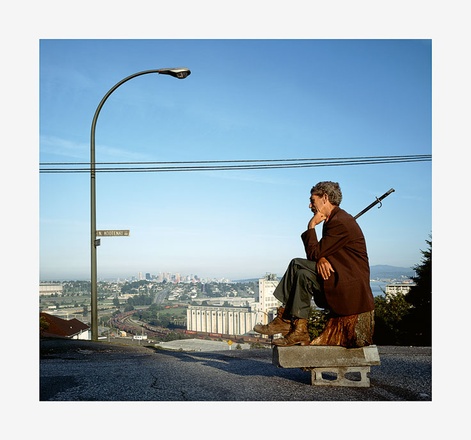
In a way that few other contemporary artists have done, Jeff Wall has contributed to establishing color photography as a self-reflexive medium, one that actively engages in a dialogue with art history while retaining its specific appeal to a broad audience. Such is also the case for his second edition for TEXTE ZUR KUNST, “The Thinker,” which is based on his 1986 work of the same name held by the Lothar Schirmer Collection in Munich for several decades: In pensive posture, a man sits on an elevation overlooking Vancouver. Away on the low horizon, the city skyline is visible, with its industrial port to the right, connected by railroad tracks to the grain silos at the center of the image. The panorama showing the structural change the region underwent in the 1980s and the figure’s plain clothing suggest that the man is a worker. A closer look reveals the dagger stuck in his back, which, in combination with the posture, creates the image’s ambivalence, characteristic of the artist. The dagger expands the photograph’s frame of reference, going beyond Auguste Rodin’s bronze sculpture – referenced in both the title and the man’s posture – and incorporating Albrecht Dürer’s proposal for a memorial to the Peasants’ War of 1525. Wall thus links “The Thinker” to a particular moment in German history. The piece’s thematic tensions include its blending of Rodin’s heroic thinker, lost in introspection with the peasant stabbed in the back, creating, as Wall puts it, an “imaginary monument, dedicated to disappointment and failure.” But it’s the photograph’s documentary quality, alongside its precisely staged composition, that makes the work a commentary on societal conditions.