

Leiko Ikemura
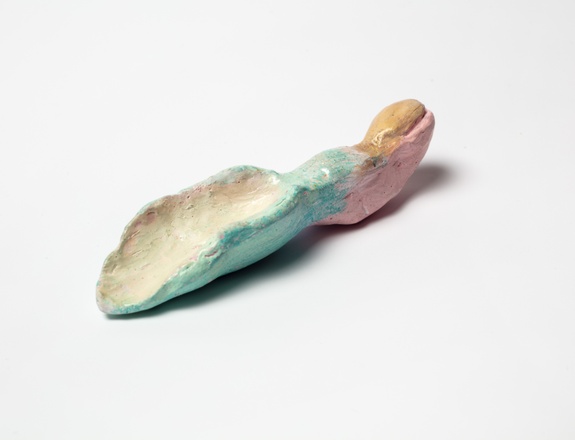
Milk Lady (2026)
Leiko Ikemura draws, paints, takes photographs, and writes poetry, but her sculptures make up a considerable part of her output. They often present themselves as hybrid creatures, their forms teetering on the edge of disintegration yet legible as girls’ or women’s bodies with animal or vegetal attributes. Although their ambiguous constitution – with traces of the imperfect and often manual work on the material deliberately left visible – gestures toward existential themes such as the passage of time and the declining arc of life, there is always also something whimsical about the artist’s figures. In that spirit, Ikemura’s first edition for TEXTE ZUR KUNST interprets its real-world references with a dose of wit. As a tongue-in-cheek allusion to our “Misogyny” issue, the artist has a female figure fuse not with a natural counterpart but with a domestic utensil: a spoon she has cast in plaster, shaped like an unconventional and distinctive worry stone. The spoon is often seen as a symbol of loving care, which is typically expected of women; this is suggested by the title “Milk Lady” as well as the figure’s pose, reminiscent of the classical reclining nude. The colors of the varnish shimmer in pastel tones and underscore this association: Toward the top end of the handle, yellow and salmon-colored shades hint at hair and skin; the outside of the spoon’s hollow, meanwhile, sports a milky-mint hue, as if the “Milk Lady” had dressed for spring. Many of Ikemura’s figures exude an air of introversion and mysticism; this one, by contrast, poses, if not quite lasciviously, then certainly pertly, raising her head as though on the lookout for an opportunity to spoil someone’s food with more than a grain of salt – or sweeten their coffee with a dash of sugar.