

Martha Jungwirth
Untitled (Maja I) (2025)
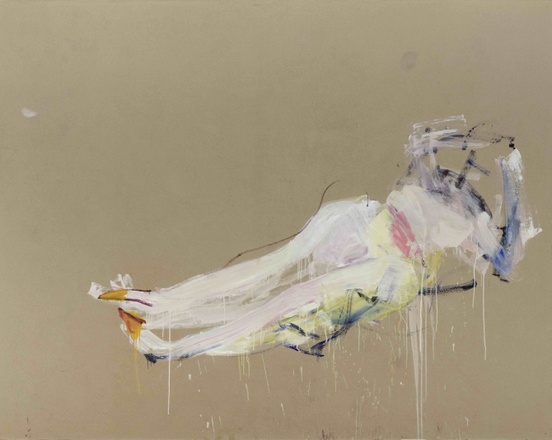
Martha Jungwirth’s work “Untitled (Maja I)” (2022), which the artist selected for her first TEXTE ZUR KUNST edition, is a hybrid in multiple respects. For one, the gesturally abstracted figure mixes two art historical references: While its palette of flesh tones refers to Francisco de Goya’s controversial nude “La maja desnuda” (1795–1800), its loosely suggested items of clothing, such as a pink sash and yellow toe caps, also imply that painting’s successor, “La maja vestida” (1800–07). Moreover, Jungwirth’s radical reduction of Goya’s motifs transforms the figure into a mixture of human and animal – an impression that is underscored by the formal isolation of the reclining body and its suspension against a sand-colored background. The feet of this flowing figure become fins, while the arms, which Goya used to emphasize the lascivious elements of the figure’s pose, have mutated into the pincers of a scorpion, recalling the so-called living fossils of Jungwirth’s “Australidelphia” (2020) series. Originally part of a group of three large-format paintings, Jungwirth’s “Maja” suggests an archaic animality at first glance, although one that should be understood as symbolizing painterly transgression rather than regression. But in contrast to modernist abstraction, Jungwirth’s work remains bound to the real world, reconfiguring our relationship to a reality whose supposed progress actually reveals itself as the opposite in light of humans’ increasing subjugation of nature. Instead of referring to some sort of primordial condition, “Untitled (Maja I)” addresses the unstable nature of the postmodern subject, thus challenging categories of identity that were left largely unshaken by Goya’s paintings.