

Pamela Rosenkranz
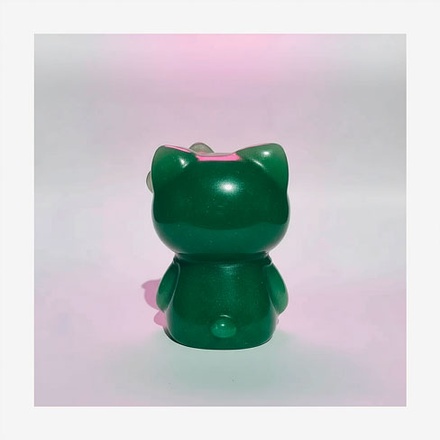
Jade Object (Affect Loop) (2025)
Pamela Rosenkranz’s first edition for TEXTE ZUR KUNST portrays an object that appears familiar while simultaneously defying clear categorization. The figure is seen from behind, encased in jade-like material and molded by pink light, oscillating between the luster of minerality and digital artificiality. Jade – a mineral imbued with ritual and cultural-historical significance – here encounters the sleek aesthetics of industrial manufacturing and post-photographic image production. The complementarity of green and pink creates a field of tension that stimulates physiological reactions. Focusing on the intersection between cognitive disposition and cultural projection, Rosenkranz examines how images can activate biological programming. Her practice explores cognitive functions like attention and care, as well as reflexes that were originally produced by evolution but are now strategically exploited in the fields of media and consumption. In this context, “cuteness” is not merely an incidental quality. Rather, it is an element within a system of affective control, one that generates intimacy and dependence. The object in Rosenkranz’s edition has a smooth surface that defies narrative interpretation. It directs our gaze toward the mechanisms that structure our perception: color stimuli, iconic silhouettes, the extension of objects by projection. The edition’s subject matter thus activates areas of the brain that are associated with reaction more than with interpretation. Between archaic drive and capitalist conditioning, a terrain emerges where instinct and imagination coalesce. The question of representation is opened for discussion: What is actually seen here, and what is merely triggered?