
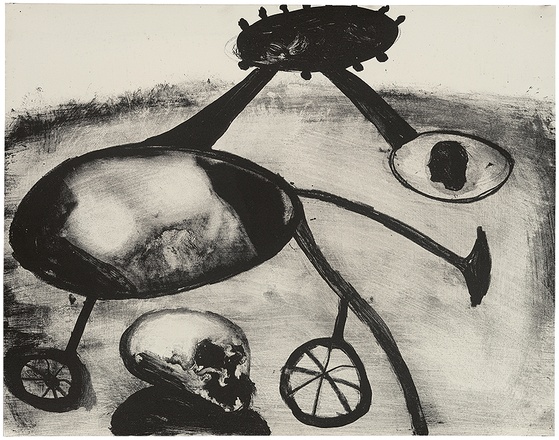
Pol Taburet
Machina Camera (2026)
Pol Taburet’s images are often inhabited by human-animal hybrids, whose distorted proportions and ambiguous features evoke unease and a sense of alienation. The central figure in “Machina Camera,” Taburet’s first edition for TEXTE ZUR KUNST, produces a similar effect but combines the characteristics of a living creature with those of a mechanical apparatus. Like a fusion of Kafkaesque vermin and lunar roving vehicle, it moves across richly textured terrain in which the artist’s hand – thanks to his direct work on the limestone printing plate – is as present as the stone’s porous texture.Taburet began exploring lithography in early 2025, inspired by Francisco de Goya’s nightmarish scenes and sinister creatures. In “Machina Camera,” such echoes seem to intermingle with the surreal compositions of Joan Miró, whose imagination was often spurred by collages of machine parts and mechanical instruments. Regarding Taburet’s oeuvre, “Machina Camera” recalls “Papa Tonnerre’s Tales,” a lithographic series informed by Creole oral traditions. Rendered in gestural strokes, the protagonist in this image carries a silhouette portrait on one of its limbs. Beneath its belly lies a skull, a recurring motif in Taburet’s work, riffing on the classic memento mori. A planetary horizon suggests that we are viewing the scene from orbit, alluding to the macro-historical perspective that the image invites us to assume: While silhouette portraits were largely supplanted by photography in the mid-19th century, today it is artificial intelligence that competes with “machina cameras” of all sorts. Quirkily surreal and haunting at the same time, Taburet’s edition addresses a major cause of contemporary malaise: the unforeseeable consequences of technologies and their transience.