
SIMULTANEOUSLY AND EQUALLY Flora Klein on Helen Frankenthaler at the Kunstmuseum Basel
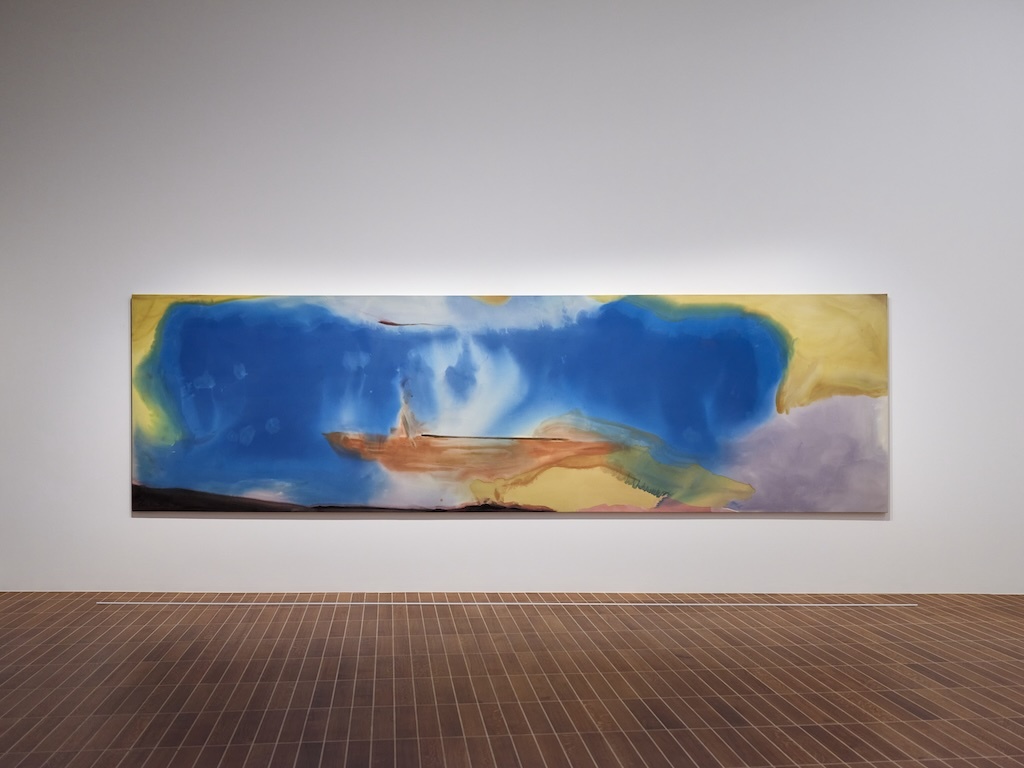
Helen Frankenthaler, “Movable Blue”, 1973
A photograph on the cover of the exhibition booklet shows Helen Frankenthaler in her socks amid a large canvas that has been rolled out onto her studio floor, bending to pour diluted paint from a bucket. We might imagine how she goes on to shift the pools of liquid across the cotton, perhaps with a broom or a sponge. On the ground, the color puddles transform into lakes and oceans before eventually flooding the canvas completely. There is something humble in bending over a painting. Once the canvas is dried, Frankenthaler will lift it into an upright orientation on the wall. This brings about a significant shift in perspective. Upright is equal to dominance: A painting on the wall embodies presence and power. Think of a diver who – for a short instance mid-flight – faces the water like they’re standing in front of a wall, before arching the last curve and splashing through the surface and into the water. Like each step of the diver’s trajectory, equally and all at once, Frankenthaler’s paintings seem to bring about, suspend, and collapse a simultaneity of orientations and perspectives.
The survey-style exhibition of Frankenthaler’s work at the Kunstmuseum Basel unfolds chronologically across nine rooms on the top floor of the institution’s new build. In the first gallery are the early works, immediately stating the artist’s energy, skill, and boldness; the following two rooms display her early soak-stain paintings (my favorites!). After a short biopic intermezzo, the tour continues to a spacious passage opening onto the stairwell, where luminous large-scale acrylic works are on show. The scale of this room serves the paintings well. From gallery six onward, the exhibition becomes increasingly didactic: small reproductions of Rembrandt as well as original art historical treasures of European painting, such as works by Gustave Courbet, André Derain, and Édouard Manet, hang directly alongside what the wall text refers to as Frankenthaler’s paraphrasing of these references in the 1980s. The final gallery hosts a selection of her late works, including framed drawings on paper with collaged elements, as well as surprisingly fresh impasto landscape formats.
Shatter, an early soak-stain painting from 1953, comparatively modest in size, reminds me of Rorschach or a red-wine-soaked tablecloth after a greasy dinner. I think of the fluids that are excreted from our bodies, onto fabrics and floors, leaving traces: urine, blood, discharge, semen, snot, vomit, pus – but also of Jesus’s sweat absorbed by the shroud. Opposite, on the left-hand side of the second gallery, Eden (1956) catches my eye: a huge painting, fungi-like, in sickly yellow-green-mint with blue and salmon pink. Its paleness is attractive. Besides the poured parts, some areas are painted with a brush, and others, I think, with hands and fingers. Lines and fields, equally energetic and hesitant, stretch across the expansive surface like lichen. I have the feeling that, ever since its making, the painting has been quietly growing and continuing to absorb moisture, slowly decaying. Something puzzles me: In the center, to the right of a scrawled 3D coordinate system, sits the outline of an onion shape, in which “100 100” is written – enigmatic, yet completely integrated into the composition.
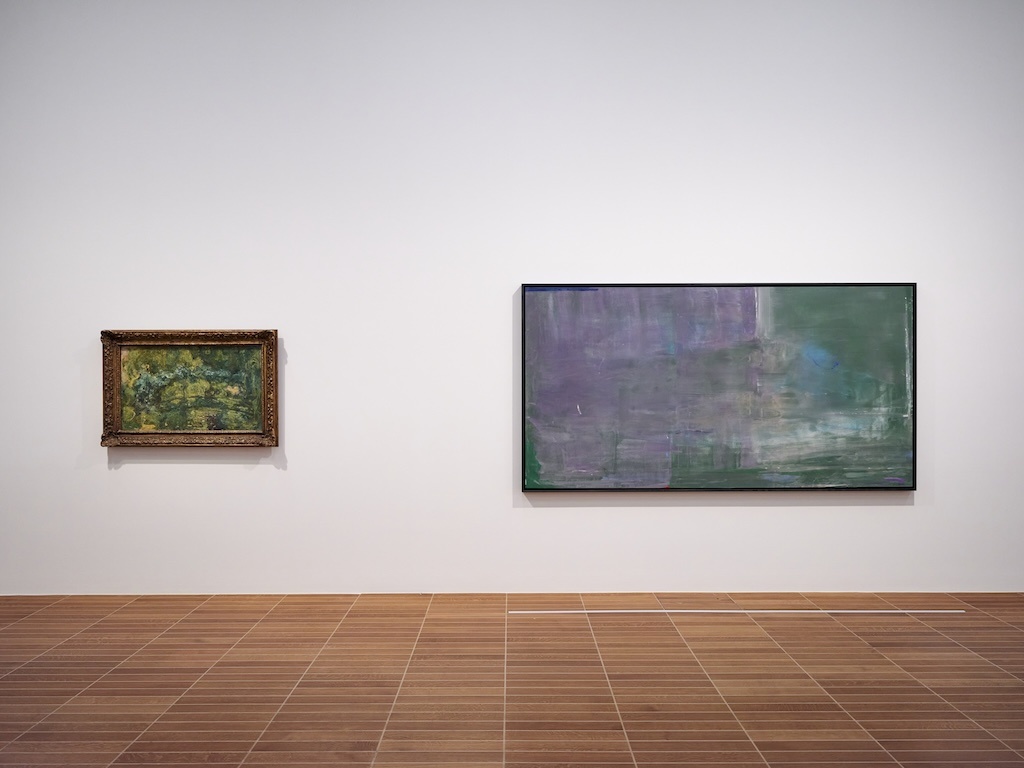
Claude Monet, “La passerelle sur le bassin aux nymphéas”, 1919; Helen Frankenthaler, “Claude’s Message,” 1976
That we have the tendency to recognize things – water, sky, or horizon – in an abstract painting isn’t a concept that needs particular attention. Frankenthaler, however, makes play of our visual instincts and directly provokes landscape associations. Riverhead (1963) is an allover, multilayered, translucent painting in a broad landscape format, cast predominantly in various watery shades of blue, with hues of violet, green, brown, and pink, though a strong and luminous ochre sheds its light from the top right-hand corner. The studio floor has imprinted itself onto what was the underside of the canvas, which the artist has then turned over, treating the reverse as the painting’s front. A ghostly grid sits neither above nor below the cloud screen of color. Cloud Burst (2002) is an almost illustrative late work in dramatic dusky pink, with a dark grey, again in the top right-corner, which spills out and seems to threaten to take over the picture.
Elsewhere, Frankenthaler reverses the water-sky horizon composition: Mediterranean (1981) hangs directly next to Courbet’s thickly framed La Méditerranée (1857). Not only the titles but also the color palettes of the paintings are almost identical. At once, Frankenthaler draws upon, reinterprets, and pays homage to the stormy, somber expanse of Courbet’s small landscape. She inverts the dense, dark-green sea of Courbet’s oil painting, blows it up and places it in the sky region as a large band that extends in an unusually straight line from the upper left-hand half of the picture across to the center, boldly defining the weighting of the image. Courbet’s bright, yellowish mint-green becomes, in Frankenthaler’s work, a vast plain instead of a vast sky. Both paintings are light and oppressive at the same time. Courbet’s places us in our heads: We stand on a rocky coast, gazing wistfully at the foaming, dark sea with its still, deep horizon, abstraction merely hinted at. Frankenthaler transports us wholesale into an immersive landscape where abstraction is fully formed and sure of itself.
Frankenthaler, a true New Yorker, was born into a bourgeois German-Jewish family and belonged to the more affluent second generation of Abstract Expressionists – in contrast to the first generation, where many artists, such as Lee Krasner, Janet Sobel, and Hedda Sterne were immigrants themselves or children of those who had crossed the Atlantic (a superb Sterne painting hangs one floor below, in the Kunstmuseum’s permanent collection). Famously, the 23-year-old Frankenthaler, after a summer of making after-nature watercolors by the sea in Nova Scotia, upped her game when back in her Manhattan studio: She poured heavily diluted paints onto large sheets of raw cotton rolled out onto the floor. In 1952, her first soak-stain painting, Mountains and Sea (see!), not on display in this exhibition, took shape in one afternoon. Frankenthaler knew that she has created something radical: Her materials – paint and fabric – merge in full, collapsing the traditional hierarchical order between the paint and its support. As the exhibition booklet states, “This soak-stain technique becomes her trademark and provides the decisive impetus for what would be called Color Field painting.”[1]
How abstract is Frankenthaler’s abstraction? Or is it about something else, such as the body or our senses? Generally, powerful forces like gravity and dissolution are at play here, and Frankenthaler offers the multisensory experience of such phenomena back to us via color, liquid, and fabric. If we return to Riverhead (1963) as an example, the blue expanse of color, in its materiality, is both of water and from it. The studio floor and the canvas serve as the riverbed – the carrier that merges with the applied paint – and together they form, shape, and transform into a landscape. The painting’s title and its way of making are tautologically intertwined: The source in the painting Riverhead is the paint itself.
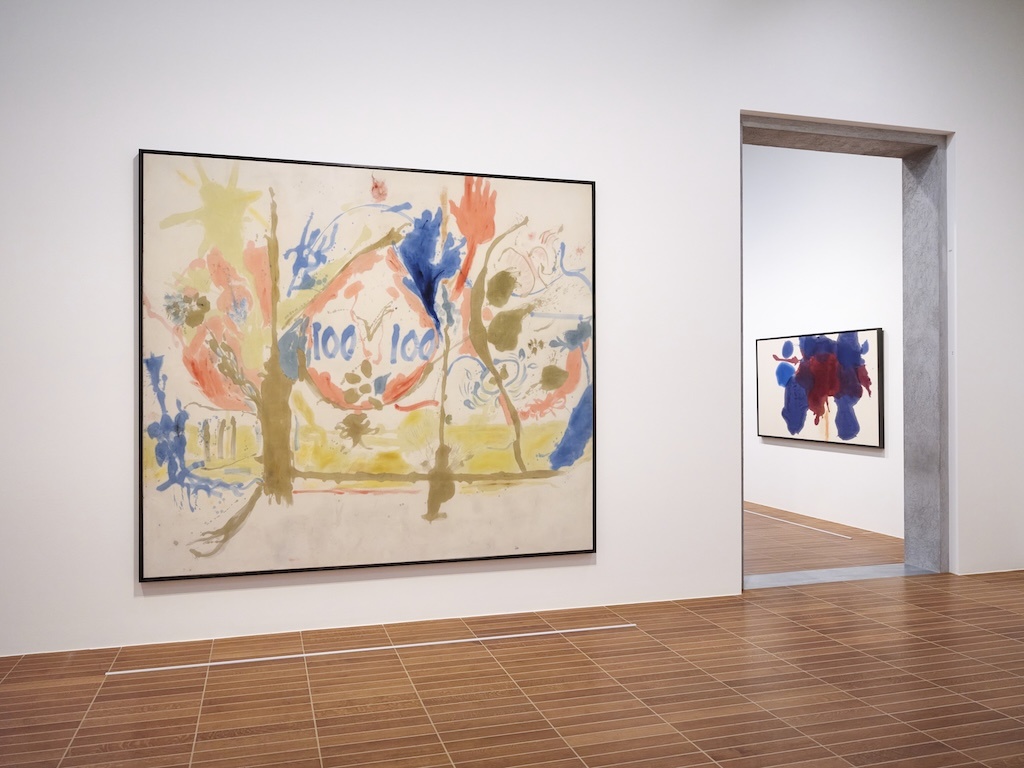
“Helen Frankthaler,” Kunstmuseum Basel
The second half of the exhibition focuses on the so-called paraphrased works, like Mediterranean (1981) after Courbet. A postcard-sized reproduction of Titian’s Portrait of a Lady in White (1561) is pinned next to Frankenthaler’s painting of the same title, whilst Manet’s original still life Poissons (1864) hangs next to Frankenthaler’s For E.M. (1981). I cannot help but feel that Manet and co. are there to attest to Frankenthaler’s place in art history. Does Frankenthaler need this? No. Does it detract from or enhance her works? Surprisingly, it does neither. What is impressive about the juxtapositions is that her works are in no way inferior and stand entirely on their own. Even if this exercise in comparative looking is enjoyable at times, the somewhat cumbersome curatorial move primarily leads to one thing: It simplifies the experience of her paintings, as our encounter is reduced to a mode of comparison. This inevitably obscures, indeed almost renders inaccessible, the full range and plainly psychedelic quality of her works. It is as though the museum does not quite trust its own proposal for an abstract painting exhibition after all and shoehorns realism in through the back door.
So what’s happening with abstraction in this exhibition? Are we really unable to put up with it? I observed quite the opposite: Visitors stand in front of the paintings for long stretches, engaging in animated conversation about them and, where space allows (and if there isn’t a vitrine in the way), they walk slowly toward and along them before stepping backward, taking in the images at their own pace. For it is lovely to be engulfed by the surfaces, to flow with them, to dissolve into them – after all, we too are merely water, and nothing.
Be it from a dive into the Atlantic, Titian’s silk dress, or thermodynamics, abstraction comes from wherever, and something is processed in the studio. Through abstract painting we might metabolize whatever it is that our experience makes of the real world, which Frankenthaler’s works convey to us in fine and multifaceted ways – European painting, one’s own body and its dispersion, movement, and action, the weather, landscape, chance, indecision, holes, entropy, and light, not excluding the materiality and quality of paint and fabric themselves, all interacting simultaneously and, above all, equally.
“Helen Frankenthaler,” Kunstmuseum Basel, April 18–August 23, 2026.
Flora Klein is a painter. She lives in Berlin and teaches at the Zurich University of the Arts (ZHdK).
Image credit: © Helen Frankenthaler Foundation, Inc. / VG Bild-Kunst, Bonn, 2026, ASOM Collection, photos Samuel Bramley
Note
| [1] | See also Mary Gabriel, Ninth Street Women (Back Bay Books, 2018), 312, 344–45, 457–61. |