
FROM SUFFERING TO SAINTHOOD Daniel Culpan on Tracey Emin at Tate Modern, London
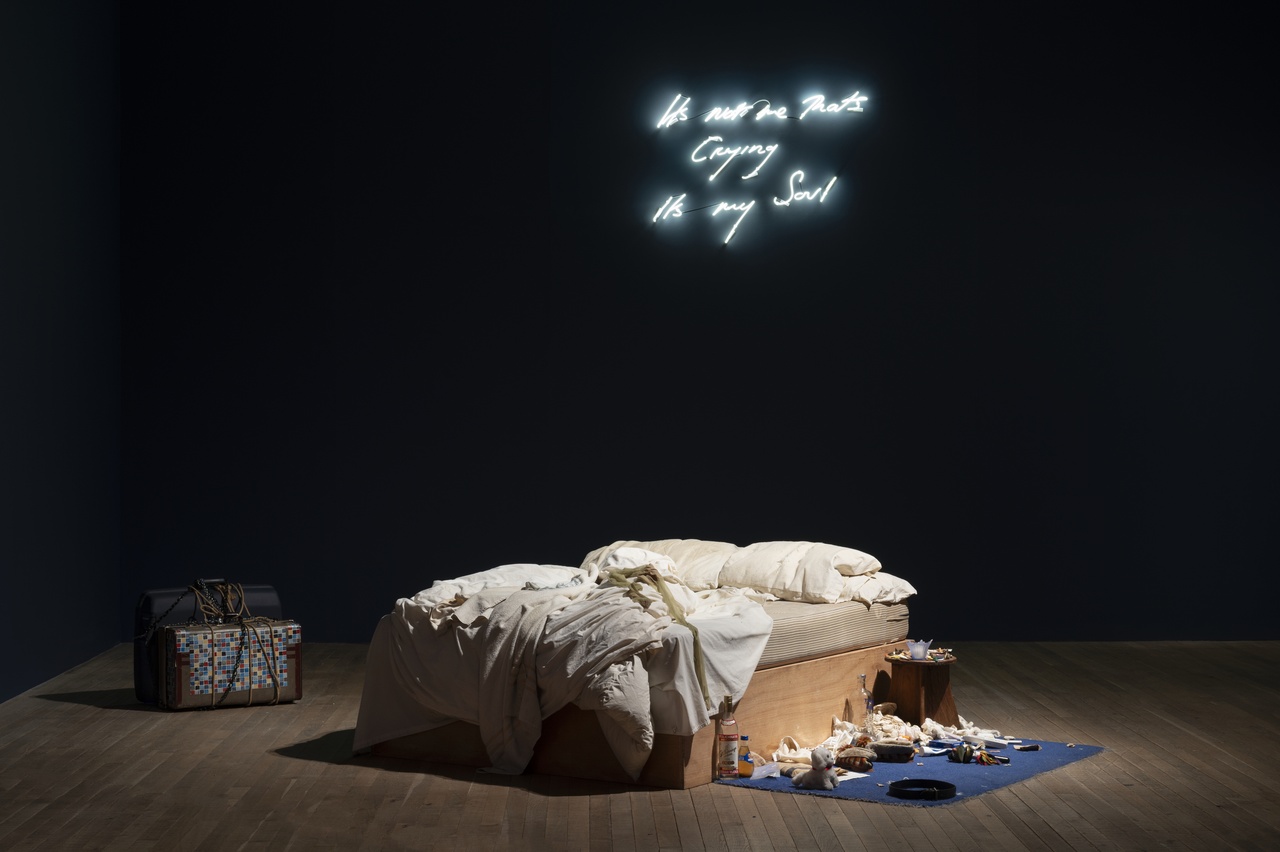
“Tracey Emin: A Second Life,” Tate Modern, London, 2026
If relentlessly mining one’s private life in one’s work has become a truism of contemporary art, then it can be argued that Tracey Emin – following in the footsteps of artists such as Judy Chicago and Mary Kelly – became its most notorious proponent in the mid-1990s, as part of the loosely grouped Young British Artists (YBAs). Emin’s work can be described as a raw, unapologetically frank living diary, in which the very stuff of her life (including her passport and even a single tooth, as captured in 1993’s My Future) documents everything from her childhood to her abortions. Her “Mad Tracey from Margate” [1] persona, drunkenly walking off a Channel 4 TV discussion about 1997’s Turner Prize, appears to align with the surface chaos of her work. 1998’s My Bed – a disheveled mattress and sheets, surrounded by the detritus of a four-day sex and drinking binge – was nominated for the prize the next year, sealing Emin’s reputation for both outré behavior and outrageous art.
While many of her YBA contemporaries have faded from view, Emin has seen her career grow from early notoriety to blue-chip recognition, with the longtime support of White Cube’s Jay Jopling. In 2007, she was also elected a Royal Academician, and in 2013 she received a CBE (Commander of the Order of the British Empire) – promoted to DBE (Dame Commander of the Order of the British Empire) in 2024 – for services to arts. Moreover, since surviving bladder cancer in 2020, Emin – whose great subject could be said to be the suffering female body, as I will discuss in more detail later – has not slowed down. The title of her career-long retrospective at Tate Modern, “A Second Life,” catches the doubleness of Emin’s public image – from enfant terrible to a central pillar of the international art establishment – and the ways in which the artist’s work has, for better or worse, come to both anticipate and reflect its times. This is underscored by the curation of the show itself, which moves largely chronologically through Emin’s life, with over 90 works installed across 10 rooms. The sheer scope of the exhibition emphasizes the triumphant arc of Emin’s career, moving from the crude energy of her early installations such as It’s Not the Way I Want to Die (2005), a rollercoaster-like structure in reclaimed metal and wood, to the grand scale and symbolism of her later paintings, which turn to questions of mortality and transcendence, a topic that was already foreshadowed in earlier works such as Death Mask (2002).
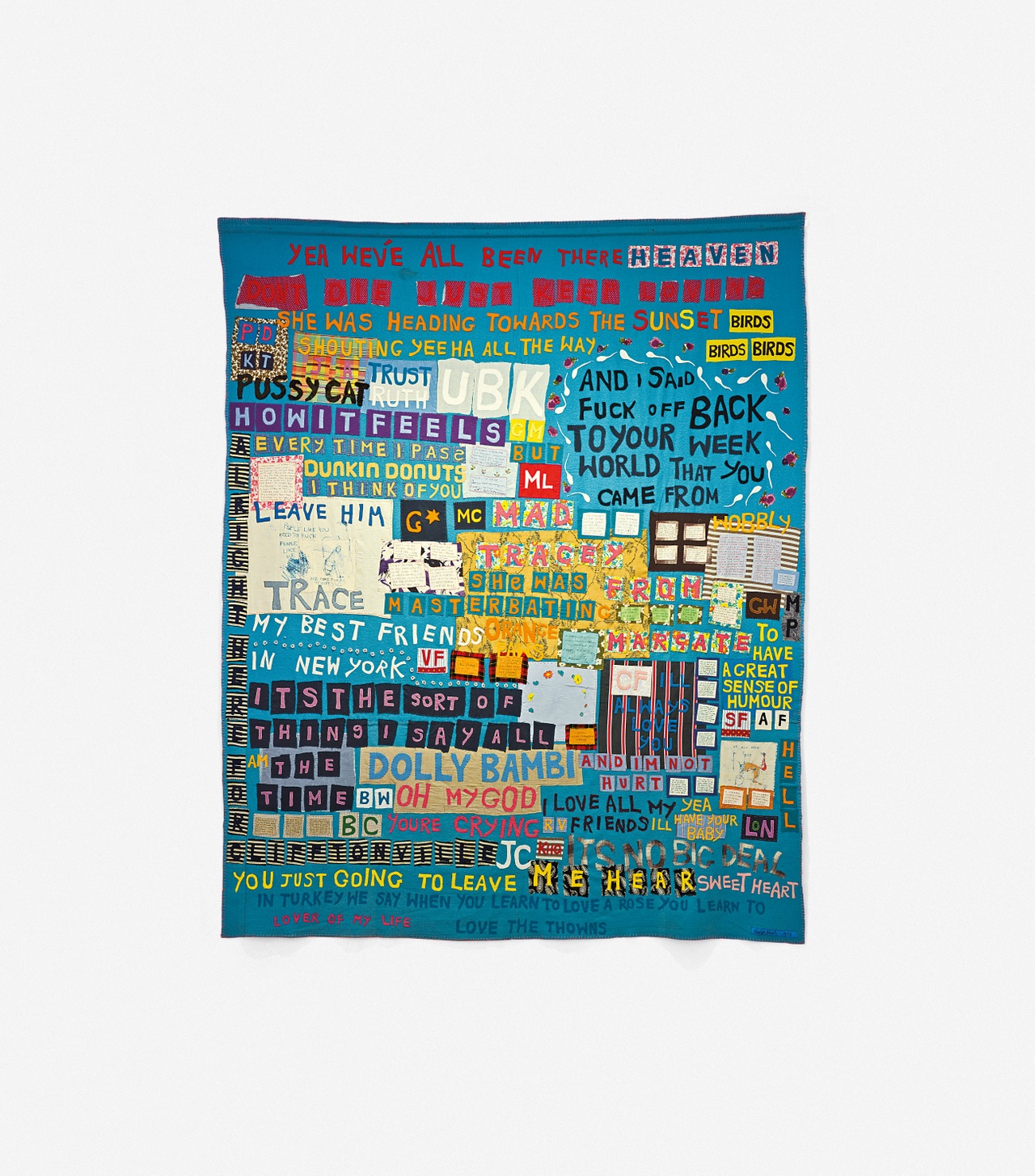
Tracey Emin, “Mad Tracey from Margate. Everyone‘s been there,” 1997
Emin’s earliest displayed work includes her appliquéd blankets. Their seemingly crude execution couples the traditionally female-coded craft of quilting with brutal emotional candor. Hotel International (1993) is a kind of embroidered origin story, marking the conception of Emin and her twin brother, as well as the relationship between Emin’s parents (“Pam Cashin loved Envar Emin so much”). Mad Tracey from Margate. Everyone’s Been There (1997) is bracingly lewd in its stream of hand-stitched non-sequiturs (“And I said fuck off back to your week world that you came from”). Seemingly sincere, deliberately direct, aesthetically confronting, these works provoked a hostile (and often gendered) response from critics: The London Evening Standard’s Brian Sewell described Emin’s work as “the stuff of the teenage girl besotted with boy bands rather than the serious business we might expect of a famous woman of forty-eight.” [2] For a certain kind of “stiff upper lip” English sensibility, Emin’s exploration of vulnerability and weakness proved deeply uncomfortable: an intolerable mirror for so many carefully repressed emotions. As she tells the art critic Martin Gayford in the recently published book My Heart Is This: Tracey Emin on Painting, “I’m making work for people who are emotional – sentimental, aggressive, angry, violent, jealous, all those kind of things.” [3] – evidently “those things” which are completely at odds with the “English sensibility” just described.
Why I Never Became a Dancer (1995) is both a defiant rebuke of misogyny and a kind of heartsick valentine to the Margate of Emin’s youth. The almost-six-minute film is projected alone in the exhibition’s second room, its sound spilling out into the surrounding galleries, unable to be contained. Shot on Super 8, Why I Never Became a Dancer features hazy shots of the seaside town’s “Golden Mile,” with its lido and amusement arcades and seagulls. In a matter-of-fact voiceover, the artist recounts her years of adolescent sexual adventure. “There was always sex. It was something you could just do, and it was for free.” Finding another kind of bodily escapism on the dance floor, Emin goes on to recount being hounded from a dance contest as a teenager by several men with whom she’d had sex, all chanting “slag.” She vows to leave Margate forever and ends by dancing to Sylvester’s “You Make Me Feel (Mighty Real)” (she declares: “Wayne, Freddy, Tony, Doug, Richard – this one’s for you”).
Emin’s own body is frequently her source – echoing the feminist body politics of forebears such as Carolee Schneemann and Hannah Wilke. Developing from works like Schneemann’s Interior Scroll (1975), that artist’s response to critics who deemed her art to be too ‘personal’, and from Wilke’s appropriation of everyday materials (chewing gum, laundry lint) to comment on the commodification of the female form, Emin uses her own lived experience as a way of questioning the larger social body and its attitudes toward female sexuality. Yet if, for the artist, emotional pain is also a kind of landscape to be continually explored, then Margate is its epicenter. (As the artist writes in her dreamlike 2005 memoir, Strangeland, “It’s a strange thing when you come from a place – or, rather, when you have somehow created the place that you came from.” [4] ) Be it her two abortions or the rape she suffered at 13 – Emin repeatedly emphasizes that this place is the wound from which her oeuvre stems. Yet the faultlines – and fortunes – of this English coastal resort have tracked the contradictions of Emin’s own fame. Despite Kent receiving millions of pounds in EU funding, the county overwhelmingly voted to exit the EU in 2016’s referendum – with 63.8% of voters in Margate’s district of Thanet opting to leave. With a significant number of refugees and migrants residing in the coastal town, it’s become the locus for an increasingly divisive and xenophobic discourse around UK immigration (exemplified by Kent County Council’s 2025 election of a leader from the far-right populist party, Reform UK).
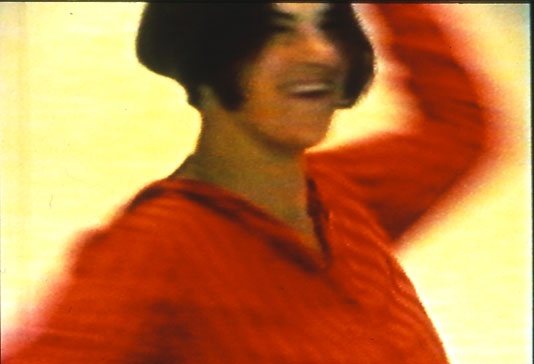
Tracey Emin, “Why I Never Became a Dancer,” 1995
Emin’s own early work tracks the anti-immigrant attitudes of her childhood. Emin – It’s More Than a Name – It’s Hereditary (1963–93) includes photographs of the artist’s parents as a young couple, alongside handwritten notes explaining how her English mother was spat at in the street and abused with racial insults for being in a relationship with the artist’s Turkish-Cypriot father. Yet Emin’s political sympathies have been nothing if not idiosyncratic. Rising to prominence at the height of Tony Blair’s neoliberal “Cool Britannia,” Emin later lent her very public support to the UK’s Conservative Party (apparently swayed by their arts ministers) – earning the ire of much of the liberal art establishment. Since distancing herself from the right, she has become something of an ambassador for Margate’s regeneration. The Tracey Emin Artist Residency (TEAR), launched in 2023, offers apprentice artists a 14-month art course, situated within its custom-built TKE Studios.
If this “homecoming” perhaps represents the admirable philanthropy of an elder stateswoman who has tenaciously made it against the odds, it’s far removed from the desperation and estrangement of much of Emin’s work about her own beginnings, which made her name as an artist. Included in the Tate retrospective is the 1996 film How It Feels, following the artist as she returns to the clinic where she underwent a traumatic abortion, an event that precipitated her “emotional suicide” of 1992, in which she destroyed much of her early work and gave up painting. Yet if much of Emin’s output in the ’90s broke taboos about the kinds of emotional experience women could address in public, the reception of her work has shifted with the changing tenor of the times.
Personal pain has become perhaps the 21st century’s most marketable commodity. The omnipresence of the “trauma narrative”; the remorseless self-analysis of autofiction, whose emphasis on the authentic and personal, however staged, echoes Emin’s own oeuvre; the “misery memoir” as a self-branding exercise; and the redemptive “tell-all” documentary: all of these forms have become lucrative products within the cultural marketplace. [5] They’ve underwritten the kind of therapeutic discourse – and the primacy of the I – that has in turn become the modern lingua franca. It’s also the prism through which much contemporary art is now received. It can often seem as if a work of art’s success is measured by how many tears it manages to wring from the viewer: [6] the cathartic swells of emotion and identification that dominate both social media and the modern PR machine become the proof of its value. Whereas Emin’s perspective was once boldly insurrectionary, it can frequently feel in flattening lockstep with the zeitgeist – as much a barometer of the modern audience’s appetite for maudlin excess as the artist’s own examination of the self.
The intimate self-exposure of Emin’s Self-Portraits (2020–25), a series of photographs cataloguing her naked body both after her 2020 cancer surgery (resulting in a full hysterectomy, her bladder and part of her vagina removed, and a lifelong stoma), are affecting precisely because of their artlessness: blunt-force portraits of a body marked by pain and illness. Seemingly taken on a smartphone in hotel rooms and in front of mirrors, urostomy bag and bloodied towels on show, they hold nothing back. As a result, Emin herself appears to highlight the lack of distinction between her autobiographical works and the aesthetics of diary-like social media feeds, which also define her own Instagram activity. [7] In the age of the selfie, in which the endlessly exhibited individual becomes the unquestioned (and unquestioning) subject, these works have lost much of their extraordinary, emancipatory power.
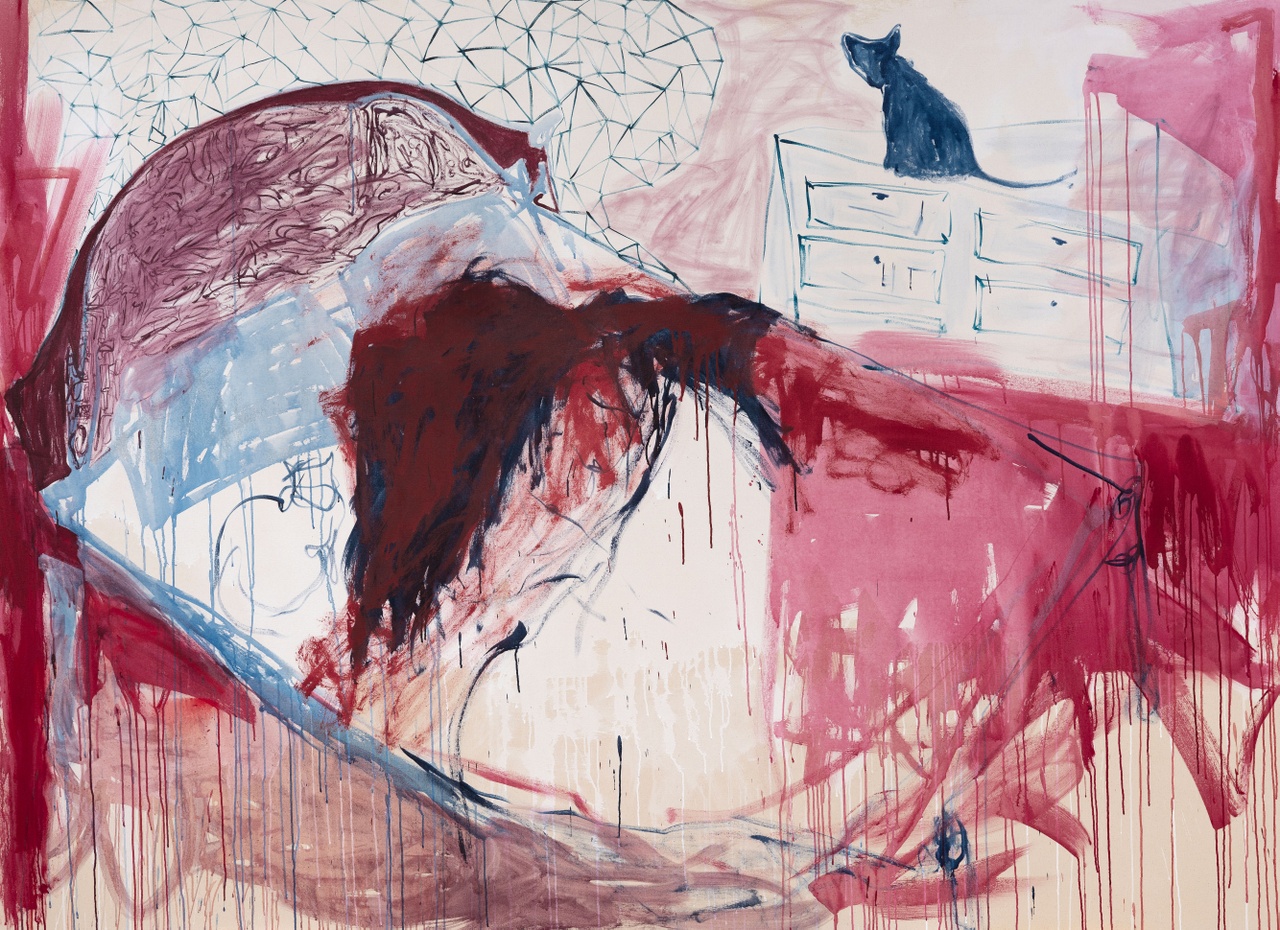
Tracey Emin, “The End of Love,” 2024
Emin’s sculptural works – many of which are on display, including some placed outside Tate Modern – often seem lumpen and repetitious. Their emotive titles – I Held Your Heart (2017), I Want You Because I Can’t Have You (2014) – do all the heavy lifting. (Conversely, the lack of her more caustic neon works – her handwriting a distinctive signature – is a curious omission.) Rediscovering My Bed, it’s striking how much more tender and fragile the work appears, removed from the glare of its erstwhile tabloid frenzy. A self-portrait of both neglect and longing (as she tells Gayford: “We die in bed, fuck in bed, we give birth in bed, we read in bed, we cry in bed” [8] ), it also connects Emin to a lineage of artists who’ve explored this in-between space, from Walter Sickert, Edvard Munch, and Sigmund Freud to Louise Bourgeois.
One of Emin’s more surprising career developments has been her return to painting. Following her early abandonment of the form, it now appears to be her preferred medium. The show’s final room is dominated by the artist’s canvases from the last decade, featuring prone bodies emerging from linework that bleeds and drips, alongside scrawled outpourings of emotional text beneath blacked-out faces: “Like a Fool I Followed Love to The end Like The sad huanted [sic] Soul That I am” (I Followed You to the End, 2024). The artist’s annual ritual of painting the crucifixion is also displayed, underscoring the quasi-religious sentiment of much of Emin’s more recent work: her survival of a near-fatal illness leading to artistic rebirth. Has the artist herself been sanctified? (The hagiographic tone of the exhibition’s accompanying catalogue certainly suggests as much.) Judging by the packed crowds at Tate Modern, it seems that the altar of Emin has no shortage of worshippers, all seeking to be transfigured by the image of her pain.
“Tracey Emin: A Second Life,” Tate Modern, London, February 27–August 31, 2026.
Daniel Culpan is a writer based in London.
Image credit: 1: Courtesy Tate Modern, photo Jai Monaghan; 2, 3: Courtesy the artist; 4: Courtesy the artist and Tate
Notes
| [1] | Mad Tracey from Margate, directed by Simon Chu, (United Kingdom, 1999). |
| [2] | Brian Sewell, Naked Emperors: Criticisms of English Contemporary Art from the London Evening Standard (Quartet Books, 2012), p. 173. |
| [3] | Martin Gayford, My Heart Is This: Tracey Emin on Painting (Thames & Hudson, 2026), p. 39. |
| [4] | Tracey Emin, Strangeland (Sceptre, 2005), p. 28. |
| [5] | See Hanya Yanagihara’s A Little Life (Doubleday, 2015), Karl Ove Knausgård’s My Struggle (Forlaget Oktober, 2009-2011), Tara Westover’s Educated (Random House, 2018), Dr. Gabor Maté’s The Wisdom of Trauma (USA, 2021). |
| [6] | See Tania Bruguera’s 2018 Tate Modern commission, 10,148,451, for a very literal example of this approach. |
| [7] | See the daily diary Emin shared on White Cube’s Instagram account during the COVID-19 pandemic. |
| [8] | Gayford, My Heart Is This: Tracey Emin on Painting, p.78. |