

NOTHING IN PARTICULAR Freya Field-Donovan on Andreas Gursky at White Cube, London
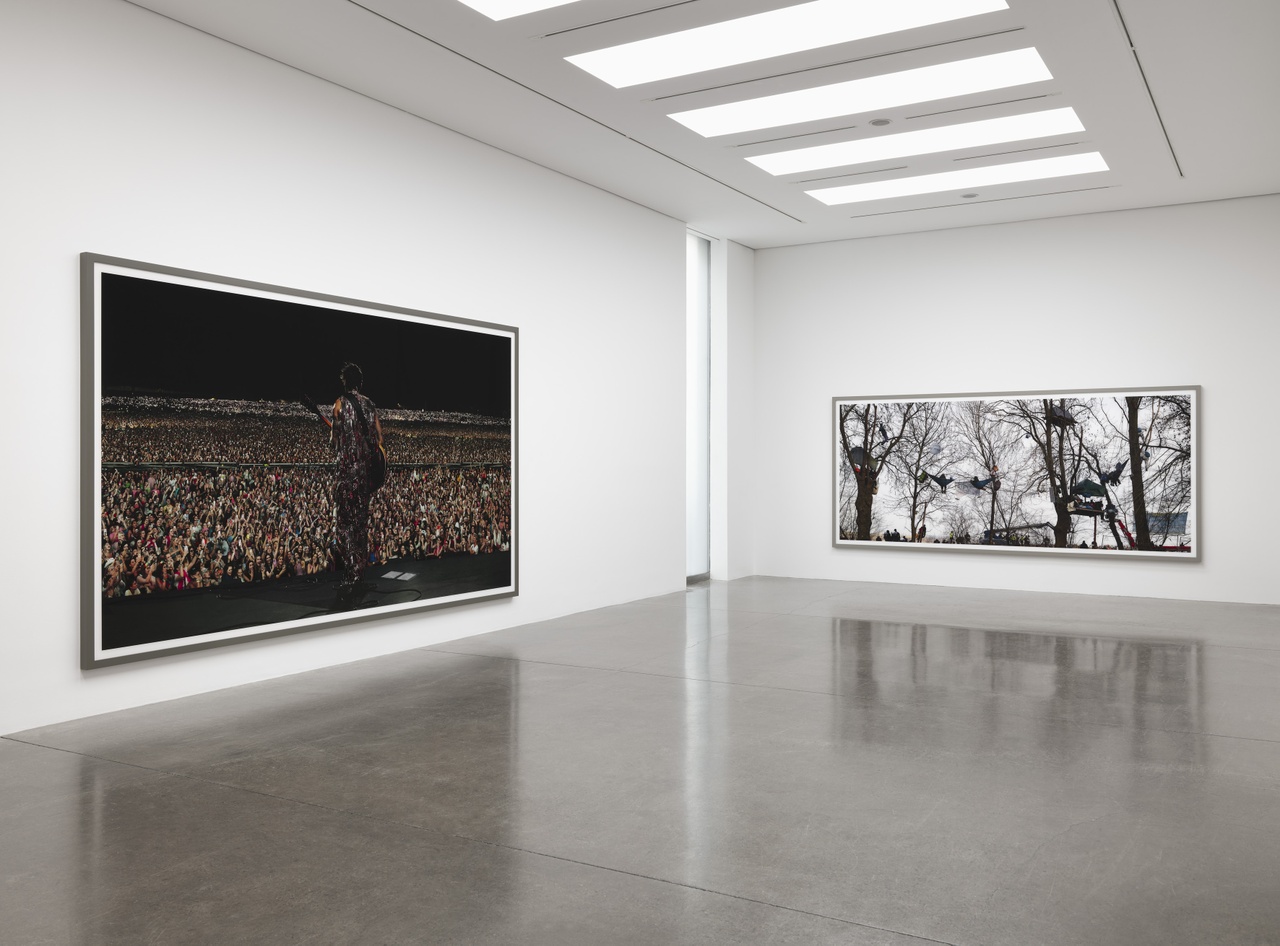
“Andreas Gursky,” White Cube Mason's Yard, London, 2025
Andreas Gursky’s latest show in London maps familiar territory for the artist. The exhibition at White Cube’s Mason’s Yard space showcases a series of new and newish photographs, alongside a few older works – many of the newer images are of sites Gursky previously photographed in earlier decades, updated to demonstrate the passage of time and subsequent technological developments. Their subjects include a German steel works, a Harry Styles concert, an environmental protest, a Japanese printing company, some Alps, a domestic oven, a woman holding an infant. The impossible, non-human perspectives Gursky is famed for are now so ubiquitous in their style as to almost appear like those automatically generated screen savers that haunt laptop screens around the world. They are intentionally distant from anything approaching a subjective viewpoint, rarely depicting the human figure or gaze. Cold, flat, and enormous, they instead offer an unsettling view of technology shorn of human agency. Whilst Gursky is known as a photographer of globalization – capturing the awesome scale of production and consumption that has transformed geopolitical relations since the 1980s – the most interesting narrative developed by the exhibition is about the country of his birth. The first room, which one enters on the ground floor before descending to the larger, subterranean gallery space below, sets up a curious story, one grounded in the specific dynamics of the postwar German state.
The first picture you see is a huge image of Harry Styles mid-performance at a concert (Harry Styles, 2025), with the camera looking out from behind the singer’s back and beyond him to the assembled crowd. Combining imagery from stages in both Frankfurt am Main and Bologna, the work has been digitally reconfigured so that each person in the audience is rendered with equal clarity. Most of the figures hold phones above their heads, illuminating their faces. Their disquietingly visible features are animated by heightened states of excitement. Styles, on the other hand, resembles a shimmering wound: part glitz, part scorched flesh. The reflective surface of his costume merges with the visual grammar of the crowd below. The resulting image is horrible. There is something monstrous about the combination of Styles’s undulating, phallic figure and the crisp, uncanny faces of the audience, at once rapturous and unfocused. Everyone’s eyes look to different horizons. There is no shared ground. Appearing like a disemboweled Leviathan from Hobbes’s famous frontispiece, these eerie, hungry figures spill out around Styles.
Perpendicular to Harry Styles is a photograph titled Lützerath (2023), which shows bare, delicate trees against a dull grey sky. The vertical compositional structure created by the trees is broken up by a series of ropes, pulleys, and platforms that make up a horizontal network of habitats in the tree tops. Figures appear supine in tarps, banners with slogans are visible, and little suspended tents protect the wooden platforms from rain. The photograph is reminiscent of the documentation of Gordon Matta Clark’s Tree Dance performance from 1971, except for the diggers, cranes, police, and security guards at the bottom of the picture plane. Without the accompanying printout listing the pictures’ titles and dates, one wouldn’t know this was a small hamlet in North Rhine-Westphalia, or that the photograph was taken in 2023. When I first saw it, I thought of a treetop occupation in the Peak District that I used to drive past as a child – a protest against proposed quarrying that began in 1999. Such documentary images chime with the now iconic aesthetic of the alter-globalization movement, typified by photographs of the Battle of Seattle in 1999.
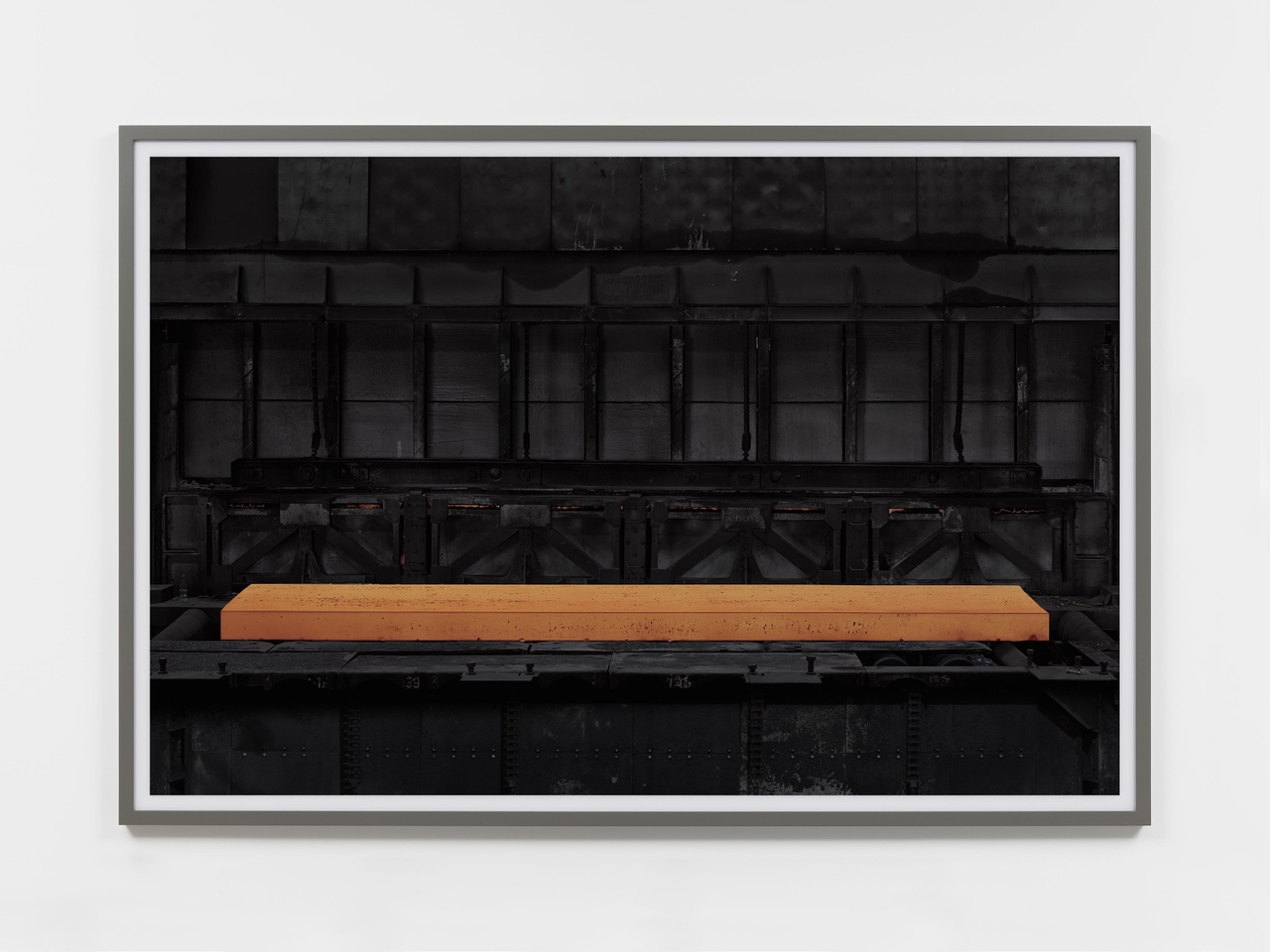
Andreas Gursky, “Thyssenkrupp, Duisburg,” 2025
If the iconography of Lützerath doesn’t historicize the image, the story behind it does. In 2020, Germany decided to start phasing out coal and replacing it with renewables. But the war in Ukraine and the subsequent energy crisis reversed priorities. The village of Lützerath sat on top of a reserve of lignite – a crude brown coal, easily mined from near the earth’s surface. After losing supplies of Russian gas, the German state decided to destroy the village to extract the fuel below. Expert reports disagreed on whether this would meaningfully address energy needs or constitute an environmental catastrophe. Most residents accepted resettlement payments and left; some stayed to protest and were joined by activists who occupied the town for roughly two years. When police eventually arrived to clear the way for demolition, it took a matter of days. Read together with Thyssenkrupp, Duisburg (2025) – a photograph of the newly modernized steel production facility located a few miles down the Rhine from Düsseldorf– one can discern the traces of familiar news cycles recurring across Western media outlets. Industrial decline, hopelessly belated modernization projects, climate emergency, and civil unrest unable to impact government policy, all producing a growing sense of deep irrationality, incoherence, and drift. Whilst these images were taken in Germany, this story could be modified only slightly and applied to any number of countries. However, it is another photograph in the first room you enter that grounds this exhibition in a uniquely German context.
On the opposite wall to Lützerath hangs a photograph titled Thomas Ruff (1984), which shows Gursky’s then fellow student at work on his Porträts series – the passport-style photo series of friends and colleagues that Ruff produced between 1981 and 2001. Both artists studied photography under Bernd and Hilla Becher at the Kunstakademie Düsseldorf in the 1980s and became key figures in the so-called Düsseldorf School. The photograph both introduces an origin story for Gursky’s style and marks the passage of time, reinforced by comparative shots of his student-era kitchen oven alongside its contemporary equivalent – a nod to the Bechers’ typological grids, according to the exhibition’s press release. The regional focus matters too: Düsseldorf is the capital of North Rhine-Westphalia, where most of the German locations in the exhibition are found. As the former industrial powerhouse of the nation – famed for its coal, steel, and chemicals – it now sits at the center of Germany’s struggle to refashion its industrial strategy amid global competition and shifting geopolitics. Gursky’s focus on this region frames both his subject (technology and its development) and his own artistic lineage.
Perhaps the most significant aspect of Gursky’s inheritance from his education in Düsseldorf is his commitment to anti-subjective perspectives. Objectivity is central to the Bechers’ work, which sought to remove any traces of their own subjectivity through consistent framing, serial methodology, and a staunch commitment to collaborative practice. The way they grouped photographs was always based on the similarity of type or form, rather than experience, time, or location. The art historian Sarah E. James has suggested that the framework adopted by the Bechers must be conceived of in the specific context of postwar Germany. [1] The 1950s – the decade in which the Bechers’ collaboration began – has been interpreted as a period of political sobriety in West Germany, one that sought to deal with the trauma of World War II and the experience of fascism by constructing a public sphere defined by what James has termed a “pragmatic pluralism” that announced the end of ideology. [2] The contradictions and hypocrisies that flourished under this banner do not need rehashing here. What is important to note for our purposes is that this period of postwar reconstruction had profound impacts on cultural production. The Bechers’ formal concerns demonstrate a quietism that sought to form artistic identity negatively, and Gursky’s repertoire was developed in this mold, defined by a cold restraint that rejects the thrall of collective passions. This sense of restrained pluralism – whether you believe it to have ever really existed or not – no longer prevails over public life in Germany today.
Looking at Gursky’s work in this light, it’s hard not to think that there might be some not-so-subtle echoes of historical images in the photograph of Harry Styles. The merged crowds were selected from audiences in Germany and Italy respectively, while the composition, shot from behind the back looking out, is reminiscent of Heinrich Hoffmann’s photographs of rapt audiences listening to Adolf Hitler. In this context, Gursky’s anti-subjective perspectives reveal their ideological foundation, and the Styles image reads as a warning about the crowd: irrational, frenzied, blind to consequence. If this image is a warning – a negative view of atavistic forces finding form in new technology – then what worldview does the exhibition as a whole construct?
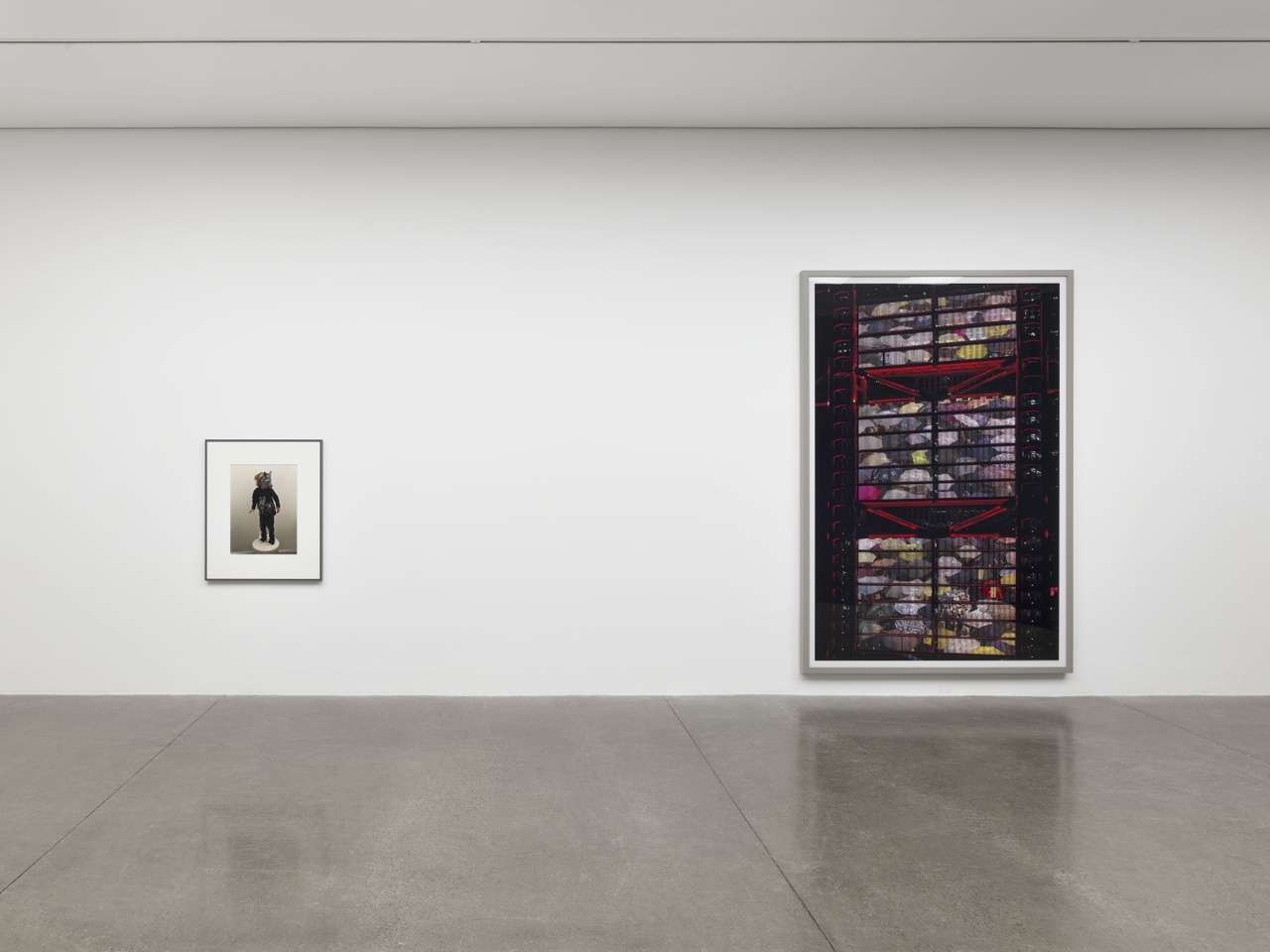
“Andreas Gursky,” White Cube Mason's Yard, London, 2025
A criticism that has sometimes been leveled at Gursky’s work is that it renders capital accumulation sublime by evacuating the human body from the frame. In this exhibition, he re-inserts the human scale through the inclusion of intimate, domestic scenes: a child standing on a toilet in a wolf mask, a woman holding a baby, a game of Jenga, a bathroom towel. These images have a Richter-like quality, blurring ever so slightly at the edges, appearing grainy, hazy, painterly almost. Hands are the central motif that unify these images: The child’s hands extend dynamically, accentuating his contrapposto atop the toilet seat; the woman’s press the baby to her body; fingers carefully grip wooden blocks; even the towel appears hand-sized. But these intimate photographs are swamped by the epic scale of the others in the show: giant, augmented images of climate-change-ravaged Alps, steelworks, or tech headquarters.
The hand has historically been used to symbolize the capacities of human labor: our collective ability to impress social will upon matter and nature. Here, they are rendered minuscule, incapable of affecting those interrelated juggernauts of climate change and capitalism. Like the photographs themselves, these sites of profit, extraction, and collapse are de-socialized, removed from political will and historical forces. The dialogue between these registers of images sets up an interplay between the human domain (domestic, private) and the non-human (environmental collapse, technology, ailing production, or excessive profit). There is no civic space in Gursky’s work – no possibility of collective endeavor, no public, no negotiation of perspective or sensuality. The two crowds in the first room foreclose these possibilities in opposing ways. The political content of Lützerath is obscured, becoming an aestheticized image of defeat that collapses past and present, while the feminized hydra around Styles recreates a spectacle of historic fascism, updated for the age of the iPhone.
The Bechers proposed that artistic agency and aesthetic experience needed to be reformed after the Holocaust in line with Theodor W. Adorno’s famous dictum. They attempted this by looking at manufactured forms, suggesting a dialogic negotiation between similarity and difference, history and the present, through the careful documentation of the remnants of past regimes of labor. Their objectivity sought to reformulate the production and reception of art through the industrial process, reaching for an iterative, pedagogical way of seeing and making art in a world in need of repair. By contrast, Gursky’s show, in spite of its nods to history and pervasive sense of nostalgia, offers only a dreadful image of the present – a present made up of fear and awe. The only respite comes with moments of private intimacy, moments that bear no relationship to the larger forces shaping the world. We are left alone, peering in or out at this or that detail in the picture plane, but mainly at nothing in particular.
“Andreas Gursky,” White Cube Mason’s Yard, London, October 11–November 8, 2025.
Freya Field-Donovan is an Art Historian based in London. She completed her PhD at University College London in 2022, supervised by Dr. Stephanie Schwartz. She is currently the Rosalind, Lady Carlisle Research Fellow in Art History at Girton College, Cambridge, where she is researching the American film historian, translator, and filmmaker Jay Leyda (1910–1988).
Image credits: 1. © Andreas Gursky/VG Bild-Kunst Bonn, 2025, photo © White Cube (Theo Christelis); 2. © Andreas Gursky/VG Bild-Kunst Bonn, 2025, courtesy White Cube; 3. © Andreas Gursky/VG Bild-Kunst Bonn, 2025, photo © White Cube (Theo Christelis)