
OF BIRTHING AND MILKING Ruri Kawanami on Leiko Ikemura at Contemporary Fine Arts, Berlin
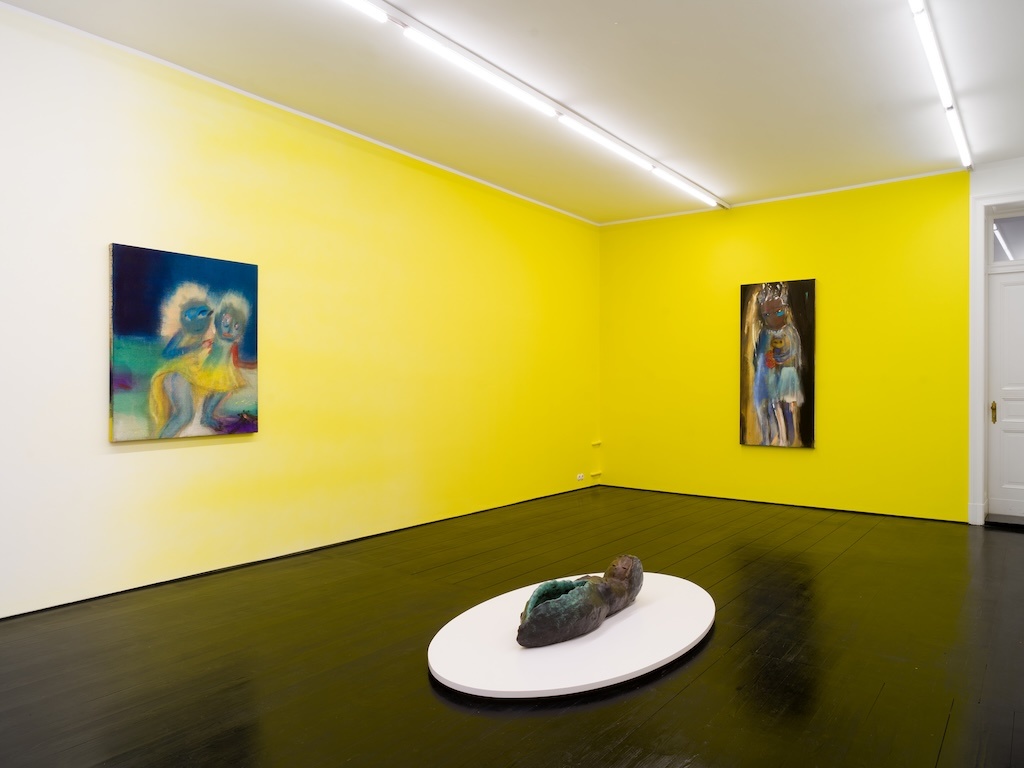
Leiko Ikemura, “de sensu,” Contemporary Fine Arts, 2026
The Buddhist scholar Helmut Brinker once distinguished birth and rebirth as biological and ontological concepts. The former, according to him, refers to the beginning of life in a physical sense, while the latter denotes a “metaphysical state of transcendental existence that is always preceded by death”. [1] Rebirth, thus, carries a sense of “reincarnation” and “renascence,” a survival and a revival of what has once died. [2] What Leiko Ikemura adds to this discussion is, perhaps, an ecological dimension. In her work, births and rebirths are imagined to be part of ecological transactions, in which what precedes new life is not a singular death in a chronological timeline but an expenditure of force and energy as cyclic movement: nourishment given to and taken back from a motherly nature. To Ikemura, ecology parallels a maternal force of birthing and milking, or at least that is what “de sensu,” her solo exhibition at CFA in Berlin, wants you to register.
Walk into the gallery in Berlin-Charlottenburg, and the squared gallery spaces present themselves as subtly scenographed: A darker, anthracite entrance gives way to an inner chamber whose walls turn gradually from pale white to dusky yellow; to the left, this releases into a stark emerald green in the adjoining chamber. According to the exhibition text, this color scheme suggests three different times of day. That this spatial dramaturgy, in addition to the title itself, was Ikemura’s own idea is unsurprising given that recent exhibitions in Chur and Emden (both 2025) make the case that her increasing attentiveness to site-specific environments, partly in collaboration with her architect partner, Philipp von Matt, nearly counts as yet another artistic medium of hers. On view is a modest number of ten works from 2025 and 2026, most of which are publicly shown for the first time. At the heart of the yellow chamber, on a low white oval pedestal, lies the patinated bronze sculpture Milk Lady (2026). This figure of milking presents the only medium other than painting in this show – a small surprise given the artist’s expanding array of multidisciplinary storytelling, which has, since 2018, gradually included video installations, glassworks, and written words. The Milk Lady reclines deeply, with her pensive eyes cast downwards to her lower body part, whose organic shape looks like a protective shell or a cocoon. As much as it protects, it also reveals, through an oblong opening accentuated with green patina, the hollowed-out interior we have come to expect from Ikemura’s sculptures: a void, or utsuro, [3] a generative depth capable of conceiving and bearing. Above hangs the painting mamagirl (2025), a brown figure crowned in silver, holding a cat-like creature in her left arm, and whose merciful gaze is cast downwards to the bronze.
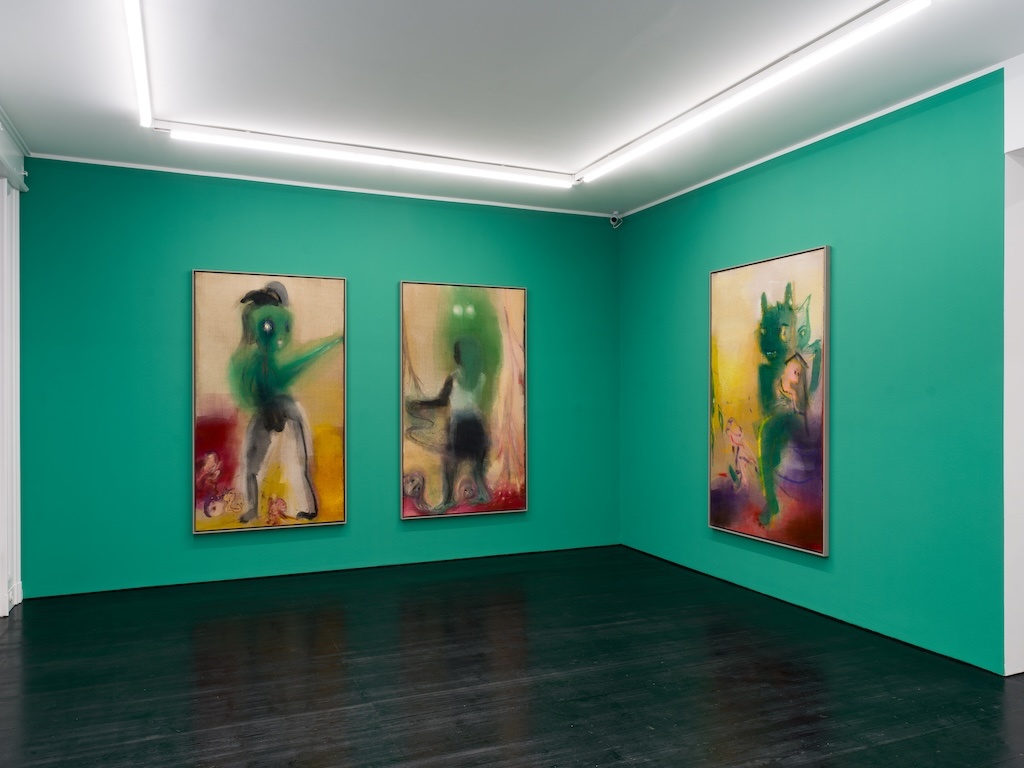
Leiko Ikemura, “de sensu,” Contemporary Fine Arts, 2026
Compared to the suspended stillness in the yellow chamber, the green gallery is marked by the tensions of a force that gives life and takes it away. At the feet of the green creatures (Green Baby, Green Spirit, and Green Mom, all 2025) lie ponds that evoke images of a crimson sea filled with unrecognizable features that had been cast loose, among them a Dumbo-like plush animal. Yet, all that fanatical force of birthing falls completely silent within the dark room, a port of entrance and departure, or a night, where two mid-size yellow landscape paintings are presented. The exhibition scenography is subtle, but it does suggest a cyclic repetition of a day that is born and a night to which the day will always return, analogous to a life, and enforces this narrative prior to any work in the gallery.
Ecology has remained a visible constant in Ikemura’s work, most vividly since the 2011 triple-catastrophe in Fukushima. In the Usagi Kannon series, begun in 2012 as a response to the catastrophe, we see a figure of motherly protection and care taking the shape of a Buddhist kannon, a bodhisattva of mercy and goddess of compassion. Taking form as a rabbit-human chimeric figuration, the kannon observes life events affected by the nuclear disaster, namely births, non-births, miscarriages, and defects. The expansion of ecology as a maternal force was also quite explicit in Ikemura’s recent exhibitions, such as “Motherscape” at the Albertina in Vienna (2025–26), where in many works the transformative power of nature appears to fuse the boundary between the human body and landscape. Yet, “de sensu” makes another point about ecology, finding it to be something that cannot be exhausted in a mere pictorial representation, as the exhibition’s major claim to go “beyond the purely visual” and to perceive it “through the senses” [4] suggests. By shifting from vision to kinaesthetic senses, the exhibition calls for an embodiment of this regenerative, maternal power. And it is in this urge toward the “senses,” toward embodied experience, that a very fragile line emerges, between essentializing nature’s reproductive power as feminine and maternal and liberating that same power of creation and healing as a transcendental experience, beyond individual constitution.
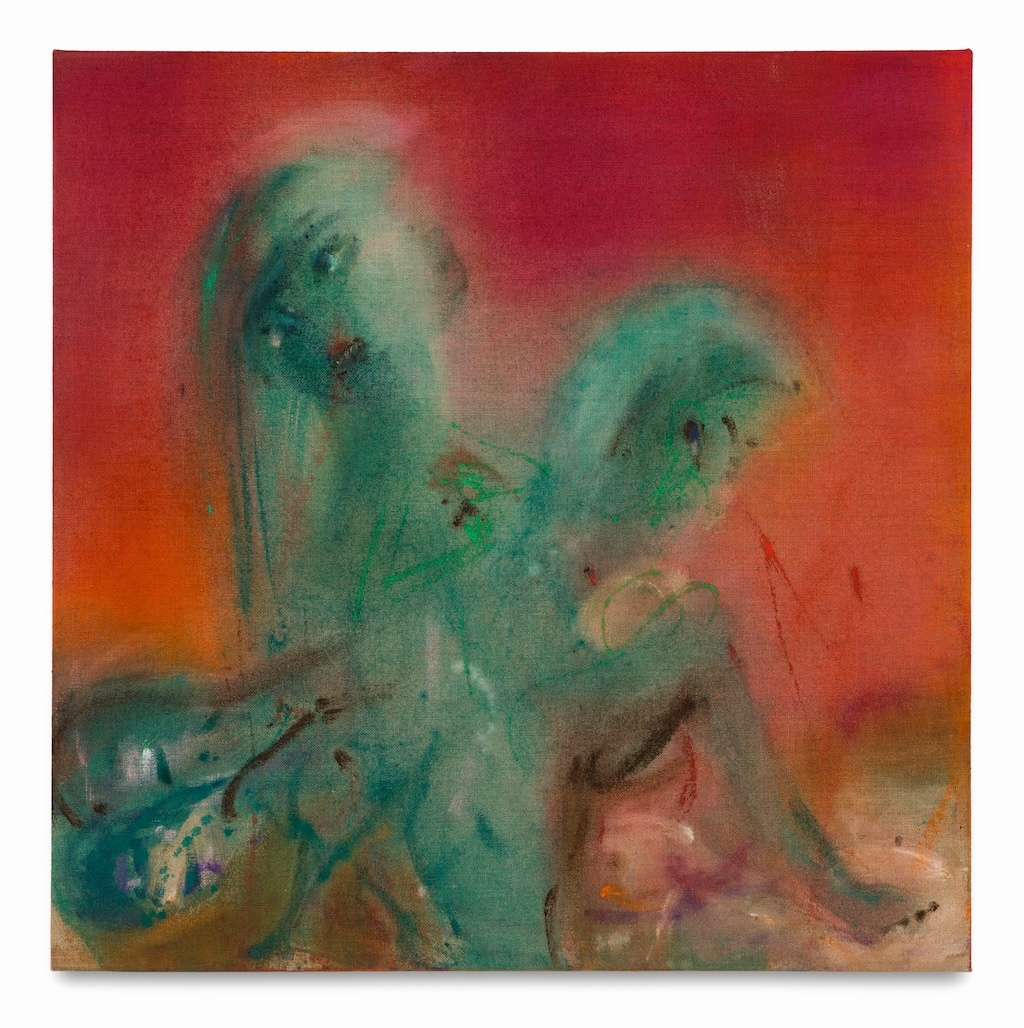
Leiko Ikemura, „triple“, 2025
Ikemura once said in an interview that “the idea of motherhood as an artist is found in the birthing of an object.” [5] And it was her authored choice, in a time where women artists were often marginalized in a field heavily dominated by male painters, to perceive of herself “more like a medium or mother” rather than an artist, saying that “I feel as though every one of my works was born through me.” [6] In this context, a recent surge of distinctively female archetypes – mother, witch, miko (巫, female shaman and medium) – in feminist art discourse as figures of spiritual resistance risks to be recruited for the very argument they try to deconstruct: the often male-connotated genius-artist. For Ikemura, creation takes the form of a primordial motherhood not confined to biology but rather a mother-medium with transcultural and transhistorical memories: a site of both genesis and returns.
Throughout the oeuvre, that mother has created then released countless numbers of ghosts, demonic beings, animal- and human-like creatures, yōkais, and other spirits that sometimes take the shape of a doll, a toy (see the Dumbo at CFA) or, oftentimes, of a girl, or two, or three, multiplying playfully on the painted surface as they wish. Many of Ikemura’s current works on view in Berlin carry her most recognizable iconographies, prominently the above-mentioned reclining figure type, a Madonna and Child type (mamagirl, Green Mom), and a female spirit frantically mutating in double (Green Mom), triple, or quadruple projections (Triple).
Perhaps the most intriguing aspect in the artist’s recent creations is what we make of the figures’ corporality, particularly their faces, which since the mid-1990s had been abstracted by pigments bleeding onto the coarse jute surface in her paintings, or concealed physically, by eyes painfully buried in hands in sculptures, for example. Works from around 2010, however, increasingly expose faces to an open investigation, disclosing their expressions as something more fixed and palpable, thereby demarcating what used to resist immediate access and often dissolved into apparition. This disclosure has coincided with a heightened degree of manipulating the figurative on the abstract plane, so that now in Ikemura’s paintings we often see bold, flat brushwork reminiscent of East Asian ink-conceptualism alongside explanatory brush lines that, at times, recall contemporary anime-inflected vocabulary. In the CFA exhibition, the most striking example of this development can be found in mamagirl. Ikemura reveals the figure’s face with unprecedented clarity: a red spot on her forehead as a recognizable ethnic identifier, an almost explanatory linear brushwork contouring the eyes.
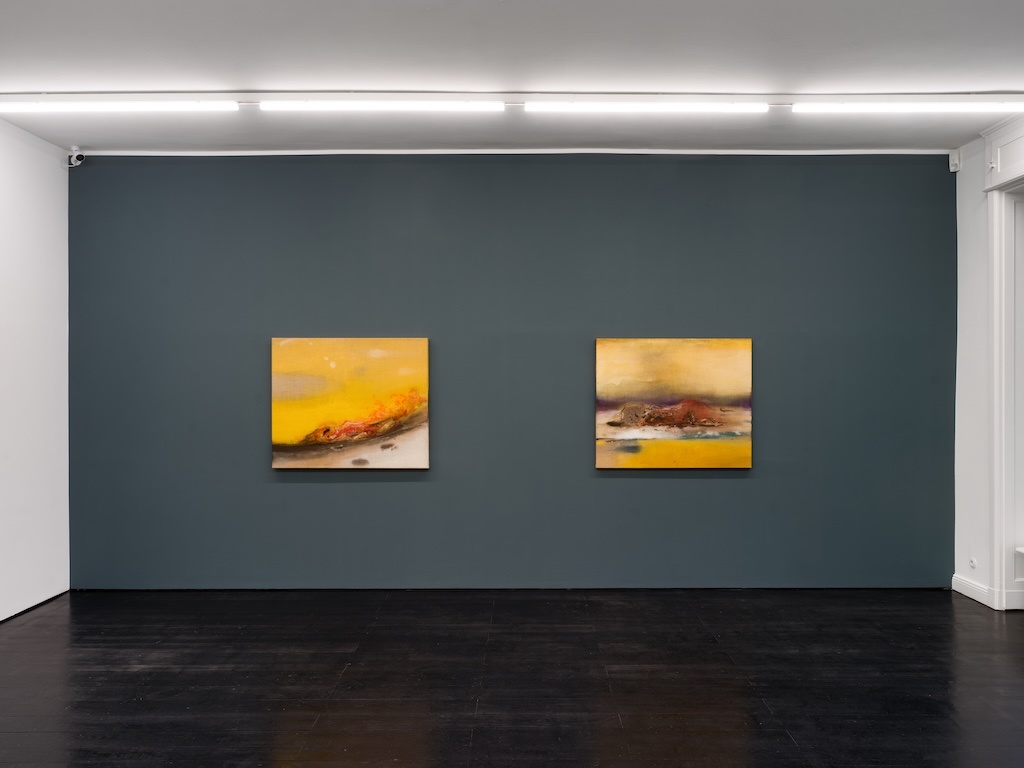
Leiko Ikemura, “de sensu,” Contemporary Fine Arts, 2026
In her crisscrossing of abstraction and figuration, Ikemura carries a concern shared by a generation of figurative painters, neoexpressionists, and other contemporaries since the 1980s, a generation no longer strictly confined to the allegedly false opposition of pure abstraction and recognizable subject matter. Some see in her spontaneous brushstroke a technique affiliated with prewar Surrealist automatism, [7] while others might find in her jute paintings, with their bleeding, washed-out color application, an intended affinity with ink-abstraction in the manner of the Bengal School [8] and Abanindranath Tagore; for his part, Tagore was, in turn, captivated by the Japanese ink-dripping technique of the early 20th century. Cross-cultural references can be made endlessly here. Which reading is made depends mostly on which identity one wants to attribute to the artist. While the transcultural lineages running through her work cannot be dismissed– Ikemura, a Swiss-Japanese artist, left Japan in the early 1970s and developed her practice in Spain, Switzerland, and Germany – the critical instinct to assign her work to a set of stylistic references, a nomenclature-centered reflex the art market especially indulges in, risks the familiar trap of rendering works legible only through the filters of existing vocabularies. While naming streams of influences and connections can create the appearance of marketable value, it often conceals, as much as it describes, the very transcultural nature of an artist positioned semi-permanently in-between.
For now, the show’s insistence on experience beyond the purely visual is nowhere more palpable than in the materiality of Ikemura’s works, in particular, in the touch that they suggest: the smoothened bronze sculpture that bears traces of the hands that caressed it; the soaked-in pigments on the textured surface of the jute that carry a history of grappling with the coarse fibers. Since the late 1990s, jute has dominated as a material bearer of Ikemura’s painterly expressions. As a supporting medium, it resists the very images it supports, in a way a finely woven white canvas ground does not. The weave is so loose that pigments have to be worked well into the cloth, leaving the seep often uneven and the surface textured. Beneath the glossy varnish and scratchy brushstrokes, we see the dusty yellow ground peeking out.
What binds the haptic, tactile experience to ecological renewal, births, and rebirths is, consistently, the figure of mothering: the act of birthing and milking. The act of giving that is also, quietly, an act of taking. And it is through the hand, and not the eye, that “de sensu” wants us to feel that nourishment and extraction are, in the end, two sides of the same ecology.
“Leiko Ikemura: de sensu,” Contemporary Fine Arts, Berlin, September 11–October 24, 2026.
Ruri Kawanami is an art historian and writer, currently lecturing at the Art History Institute of the Freie Universität Berlin, where she works on questions of global contemporaneity through East Asian art. Her essays have appeared in art journals such as Bijutsu Techō and Gendai Shisō.
Image Credit: © Leiko Ikemura, courtesy Contemporary Fine Arts, photo: Nick Ash.
Notes
| [1] | Helmut Brinker, “The Rebirth of Zen Images and Ideas in Medieval Japan,” in Births and Rebirths in Japanese Art, ed. John T. Carpenter and Mark Poysden (Hotei, 2001), 13. |
| [2] | Ibid.,13. |
| [3] | Utsuro (虚) has been an operative term for Ikemura’s sculpture-making. It refers to a void, emptiness, or hollowness and cognates with utsuwa, a vessel, container, or casting mold. A container, in this logic, is defined by the emptiness it holds inside. See “Long Interview with Leiko Ikemura,” in Leiko Ikemura: Transfiguration; From Figure to Landscape, exh. cat., ed. Maiko Hara, Kenjiro Hosaka, Ichiro Mori, and Reiko Nakamura (National Museum of Modern Art, Tokyo, 2011), 208. |
| [4] | See the “de sensu” exhibition webpage . |
| [5] | “An Interview with Leiko Ikemura,” Sainsbury Institute for the Study of Japanese Arts and Cultures, August 2021. |
| [6] | Ibid. |
| [7] | Catherine David, “Traveling Culture(s) and Memor(y)ies,” in Leiko Ikemura: Motherscape, ed. Elsy Lahner and Ralph Gleis (Hatje & Cantz, 2025), 54–63. |
| [8] | Catherine David mentioned the West Bengal School in relation to Ikemura’s dripping technique; see, David, “Traveling Culture(s) and Memor(y)ies.” For Abanindranath Tagore and the imported Japanese atmospheric ink-dripping style, see Aida Yuen Wong, “Landscapes of Nandalal Bose (1882–1966): Japanism, Nationalism and Populism in Modern India,” in Okakura Tenshin and Pan-Asianism (Brill, 2009), 95–110. |