
ANNETTE WEISSER TO BRUCE HAINLEY Berlin, September 22, 2026
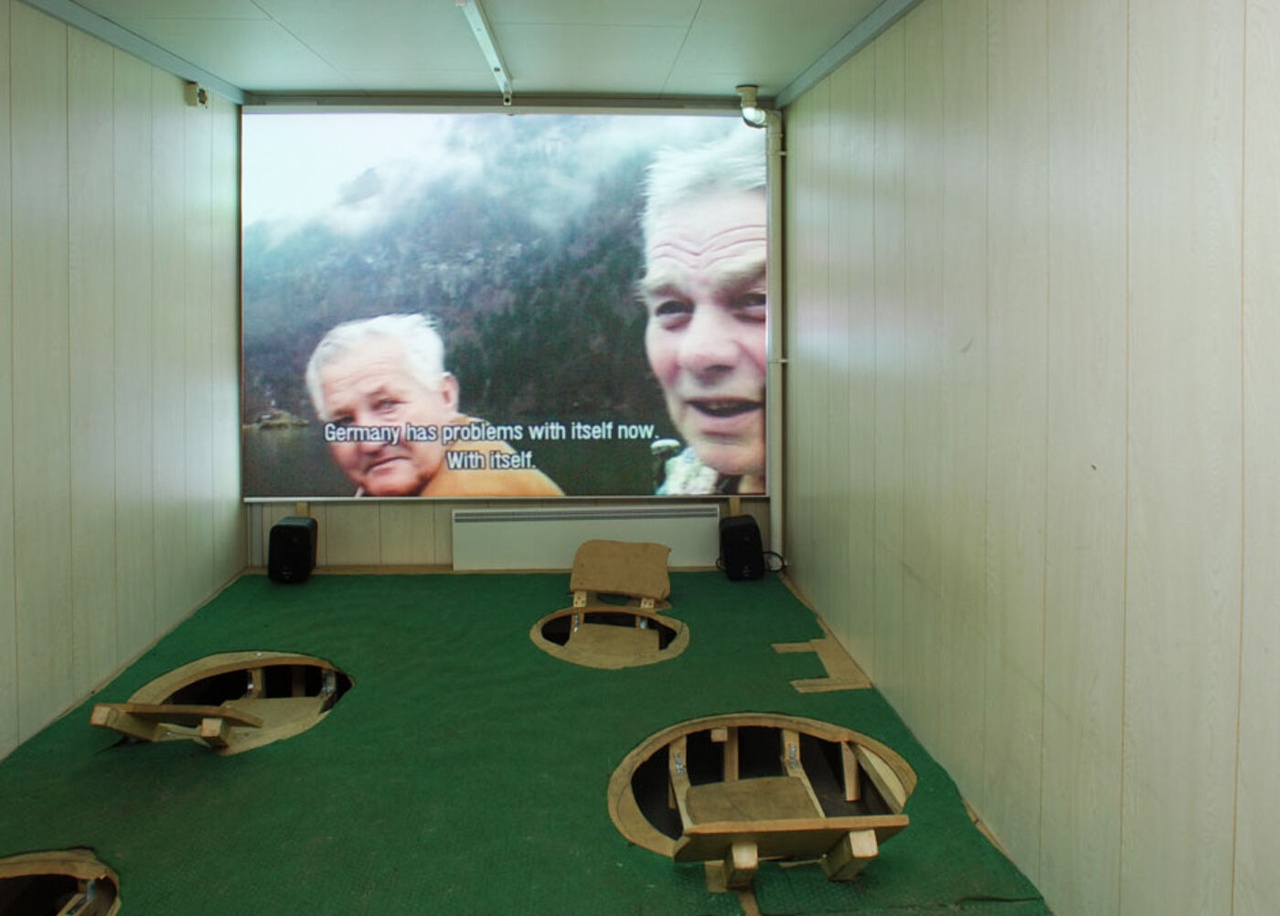
Erik van Lieshout, “Rotterdam-Rostock,” 2005-06
In his previous letter to Annette Weisser, Bruce Hainley offered insights into the work of Wim T. Schippers, whose puckish pieces are perfect for lifting spirits. Now, Weisser brings Hainley – and us, as readers of their correspondence – back to today’s less-than-rosy political reality. Alarmed by the AfD’s election results in Saxony-Anhalt, she wonders how to cultivate moral courage, solidarity, and a sense of community in times when right-wing forces are gaining influence at a disturbing rate. She currently finds stronger impulses for this in poetry than in contemporary art – and specifically recommends a poem by Ariana Reines.
Dear Bruce,
Thank you for your wonderful letter. It lifted my spirits and reminded me that the horrors of the present can and perhaps must coexist with memories of lighter times. I mean, Going to the Dogs is just so, so funny! And weirdly touching, too. Strangely, even though I knew Schippers’s work for Dutch television, I wasn’t familiar with Going to the Dogs. It’s immediately clear that this is about the audience watching the audience watching the dogs. Roll over, John Cage 4′33″!
I’ve learned to appreciate the crass, sometimes tethering-on-vulgar Dutch humor as an effective antidote to the consensus-driven, formerly very liberal Dutch society. Erik van Lieshout is a master in the art of pissing everyone off and unearthing deeply repressed truths in the process – like in his video film Rotterdam–Rostock, which he produced for the 4th Berlin Biennale in 2006, when he cycled from Rotterdam to Rostock, camping, hanging out with folks, chatting about this and that and asking in his super-friendly, accepting manner (he comes from a family of social workers) if they consider themselves racist. I remember how the politically inclined, conceptually leaning art crowd back in Berlin – me included – sneered at his brand of confrontational therapy. It took me a minute to understand that Lieshout’s piece worked in both directions, and that it revealed as much about our prejudices as about theirs.
The AfD got 44 percent of the vote in the election in Saxony-Anhalt two weeks ago. That’s 932,910 votes compared to the 1,018,472 votes Die Linke got in the election in Berlin last weekend. Let’s put things into perspective, we tell ourselves. Needless to say, what the AfD offers to their base is completely unrealistic both in terms of economy and jurisdiction. But that does not matter, because their appeal is purely emotional. The endgame is to win a supermajority and initiate system change. I don’t need to explain this to a US citizen; you know how this is rolled out. By coincidence, or perhaps not, the fifth and final season of Babylon Berlin is streaming right now in Germany. In the episode I watched last night, a young woman, newly converted to Nazism (which wasn’t called Nazism in 1933, obviously), meets the heroine, Fräulein Ritter, in the subway and tries to convince her to join the “Bewegung.” When Ritter politely declines, the convert prophesizes that she will come around eventually. Most other passengers on the subway are shown reading books. It occurred to me that these extras in their poor, brownish period costumes are in fact Berliners like me; they’re the same people I ride the subway with every day, people who probably cast their ballots for the Berlin parliament last Sunday, too. That scene made me see my fellow passengers on the subway in a different light, wondering what they are feeling. Are the heat waves of the summer, which had cost thousands of lives nationwide that no government representative cared to address, still lingering in their bones? (Apparently, it’s the price we all must pay for progress, like traffic deaths.) Are they worried about the price jumps at the supermarkets? (Buy less meat, I silently yell at them) But what is getting addressed by our leaders are the price jumps at the gas stations, as a last-ditch effort to prevent the AfD from repeating its success in the next round of elections. Public money is spent, again, on subsidizing the very same industry that had contributed to killing grandmothers in their nursing homes just a few weeks ago.
It’s maddening.
For quite a while now I practice public friendliness. I force myself to look up from my phone in the subway and I try to make eye contact. (Perhaps that’s my version of the “German stare,” which apparently is a thing on social media.) I smile at children and the elderly, and at the Arab mother who has a hard time taming her three boys. I reprimand young men when they’re being obnoxious. My son finds my behavior terribly awkward and calls me a “Karen.” But I believe there comes a time when strangers will have to rely on strangers, and that in a real emergency it comes down to a few people to organize resistance. Some of my friends, in Berlin and elsewhere, do the same thing. It’s the minimum of what we can do to overcome the feeling of helplessness in face of the overwhelming problems we, as a society, are dealing with – or rather, not dealing with. I imagine that Zivilcourage is like a muscle that needs constant training. You began your last letter with the chilling account of ICE agents deporting a man from your return flight to Houston. Did you make eye contact with other passengers? What would have happened had you gotten up and told this lone brown man I walk with you? In a Steven Spielberg movie, more passengers would have joined the protest. Maybe I’m naive. I’m not sure what I would have done either, but that’s exactly the kind of situation I’m trying to prepare myself for.
A side effect of living in a reality that makes moral demands on me daily is that I feel increasingly exasperated by contemporary art. It’s like a parallel universe to me now, one that I just occasionally enter, usually to find things more or less unchanged. Just yesterday, the first “documenta 16” press release announced a one-week workshop: “how to fall – a course centered on forms and strategies that attend to the risk and the potential that comes from states of falling.” Really? How about a workshop centered on forms and strategies of standing up? Standing up for someone else, even? I’ve come to see this art-world fixation on vulnerability – usually one’s own – as problematic on so many levels. I can easily imagine slender, sensitive young people – most likely white – collapsing beautifully on a padded wooden floor. And then what? How is that helping anyone? I mean, I get it. I have participated in as well as organized workshops centered on being together in a room, and I know how a heightened physical awareness for each other can feel wonderful. How this experience – sometimes, for a short while – can even extend to daily life outside the safe space of the institution. But we’re in a different moment now, and I’m waiting for the art world to catch up and offer workshops in civil disobedience and self-defense. Am I being alarmist? Probably. But now that our column is coming to its end (these are the next-to-last letters we’re exchanging), there is even less reason for optimism than a year ago.
You and I have talked about art school education often. You told me that before the summer, some of your brightest students said they’re going to participate in an electrician training program. We both agreed that this was a brilliant idea. Since I’m a free agent now, I’m thinking seriously about what kind of school might be better equipped to deal with the challenges of the near future. Obviously, it would enable students to become less dependent on public services. Chris Kraus recently said in a conversation we had over Zoom that she thinks the neoliberal model of education is over. Capital doesn’t rely on a certain percentage of the population being well-educated any longer. For the most part, AI will take care of the kind of thinking that’s needed to run its systems of extraction. (Interestingly, AI leaders are now advocating universal basic income to mitigate the disruptive social effects of mass layoffs.) Chris mentioned Ariana Reines, who predicted that higher education as we know it – free thinking, no fixed outcomes, experimentation, at least in the humanities – will withdraw into small, private institutions. Like in the middle ages, it will become a niche commitment to study the arcane philosophical writings of yore. From what I can tell from anecdotal evidence, enrollment at even the most renowned art schools in Germany and in the US is low. Partially because of demographics, but also – and that’s just my personal experience from teaching undergrads for six years – because many young people don’t see how traditional art education addresses the anxieties of their generation. “At our age, we won’t be affected by [climate change / the rise of fascism / AI] in the same way as our students” has become a recurrent phrase in conversations with former colleagues. How is this reflected in current curricula? Right now, helping to build one of those tiny institutions where students train as electricians in the morning, grow veggies in the afternoon and read poetry at night isn’t the worst thing I can think of.
Since our little secret regarding the title of our column has already been lifted, I’d like to deviate from the established pattern and propose, honoring the late, great Dolly Parton, that we do some slow dancing with the moon. Before or after, we might read the poem “A Partial History” by Ariana Reines, from 2019 (three years into Trump1), which I came across late at night, when I fell into a rabbit hole of internet “research.” I was immediately struck. The precise observations; her x-ray eyes wide open, penetrating her/our very milieu – call it academia, or bohemia, or the hedonistic left – not stopping at the walls of our skins, going deeper, down to the bones. We devolved / With such ease and swiftness it seemed / To alarm even our enemies. More than anything that I’ve seen, heard or read recently, this poem, along with Heike Geißler’s slim volume Verzweiflungen (2025), captures my current state of mind. Both writers start with the first-person singular, and both work towards a “we,” as a desperate invocation of community that keeps falling apart.
It’s a long poem, but so is the night.
Xoxo, Annette
Annette Weisser is a writer and an artist living in Berlin.
Image credit: Photo © Uwe Walter