
TIME AFTER TIME Xenia Benivolski on “Collection as Cosmos” at Van Abbemuseum, Eindhoven
“Collection as Cosmos,” Van Abbemuseum, Eindhoven, 2026-30
“There is a reason,” wrote James Baldwin, “that some people wish to colonize the moon, and others dance before it as before an ancient friend.” [1] I can think of more than one reason; in fact, I imagine reasons as abundant as cosmologies: these systems we have of making sense of the world around us, nebulous structures for thinking and acting as one with the universe. The rehanging of the Van Abbemuseum’s collection in Eindhoven, presented under the title “Collection as Cosmos” on the occasion of the institution’s 90th anniversary, is a complex and multi-stakes reimagining of what a museum collection could and should do.
Envisioned by Yolande Zola Zoli van der Heide, the curatorial worldview is shaped alongside various interlocutors, including Another Roadmap Africa Cluster and the artists G. and Nolan Oswald Dennis. Baldwin’s distinction is between forms of relation: possession and intimacy. While today the stars make the news serving as the speculative backdrop of billionaires, satellites, platform infrastructures, space mining fantasies, and crypto-messianic dreams of escape, “Collection as Cosmos” reads the interstellar as a subjectively complex, paradoxical, stratified, and wonderfully uneven field of signs, taking the notion of artistic constellations literally and, in doing so, unsettling the naturalized formations produced by the capitalist historical era.
I write this under an orange sky in Toronto where my neighbors and I are hiding from the effects of raging forest fires to the northeast. Thick smoke reflects the city light at night, coloring both day and night the same unbearable, unbreathable beige, devoid of stars. I think about the life of artworks, so often prolonged beyond mercy in the glass coffins of museum display cases. A museum collection is full of inherited coordinates, mythological figures, and crystallized relations animating partial maps, misread omens, and possible futures. While it occasionally risks the tendency to make every object legible through its relation to every other, this exhibition’s serious proposition is that collections are systems for organizing time and meaning. “Collection as Cosmos” understands cosmology as a technology that organizes material objects to frame a specific worldview, regulate social memory, and mediate humanity’s relationship with time, nature, and power.
“Collection as Cosmos,” Van Abbemuseum, Eindhoven, 2026-30
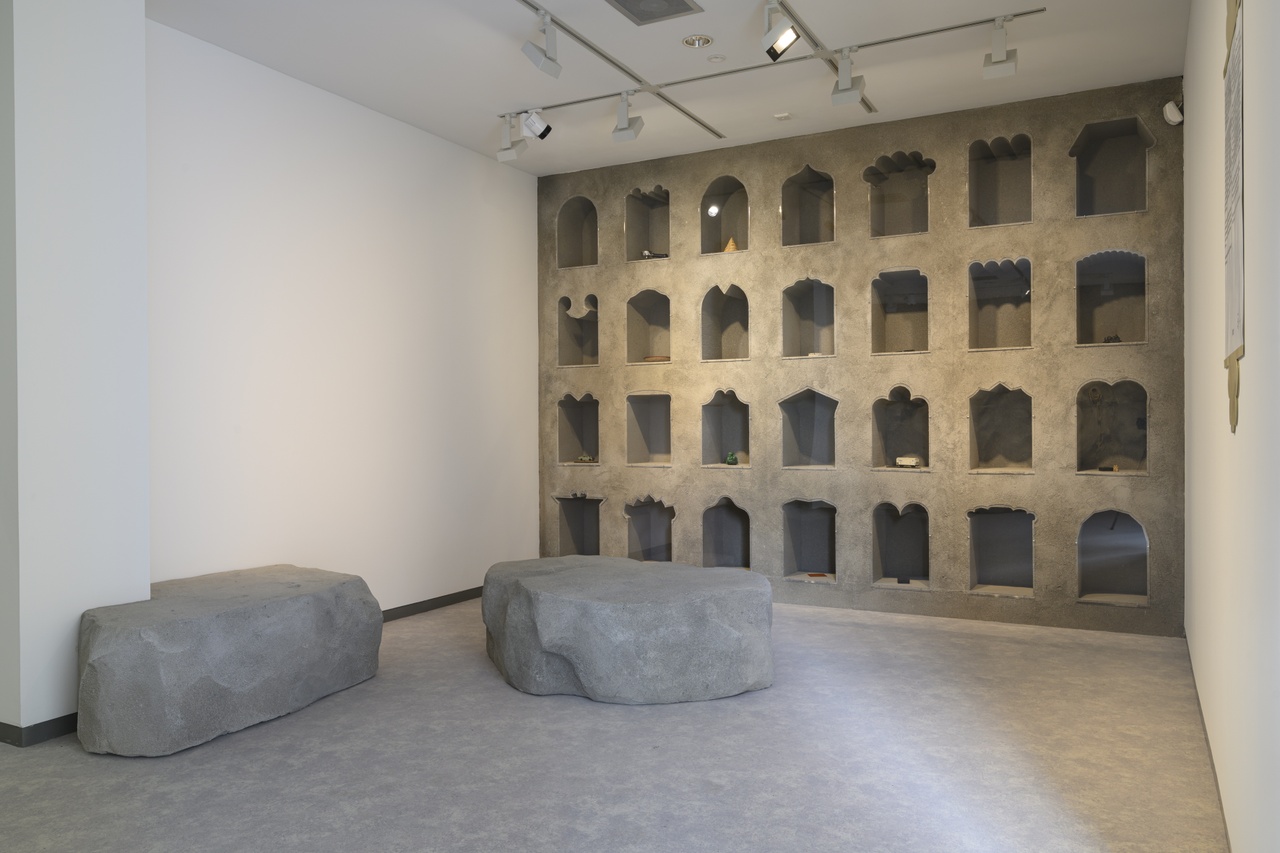
The show begins in a newly constructed grotto, which makes reference to prehistoric domestic spaces where people lived and stored their belongings while it simultaneously, playfully, evokes the dioramic spaces of natural history museums. Personal, palm-sized objects loaned by 90 local residents who happen to be the museum’s neighbors are placed in relation to works from the collection. The idea was developed with Another Roadmap Africa Cluster, a group of scholars across the African continent. In small enclosures containing various objects, the grotto stages an encounter between personal histories and the grand narrative of humanity in a nimble disarrangement of cultural authority. It’s a curatorial gesture that frames the space as microcosmic, semiotic storage, offering shelter to the storytelling objects while also returning them to a premodern intimacy without framing that intimacy as latent or naive.
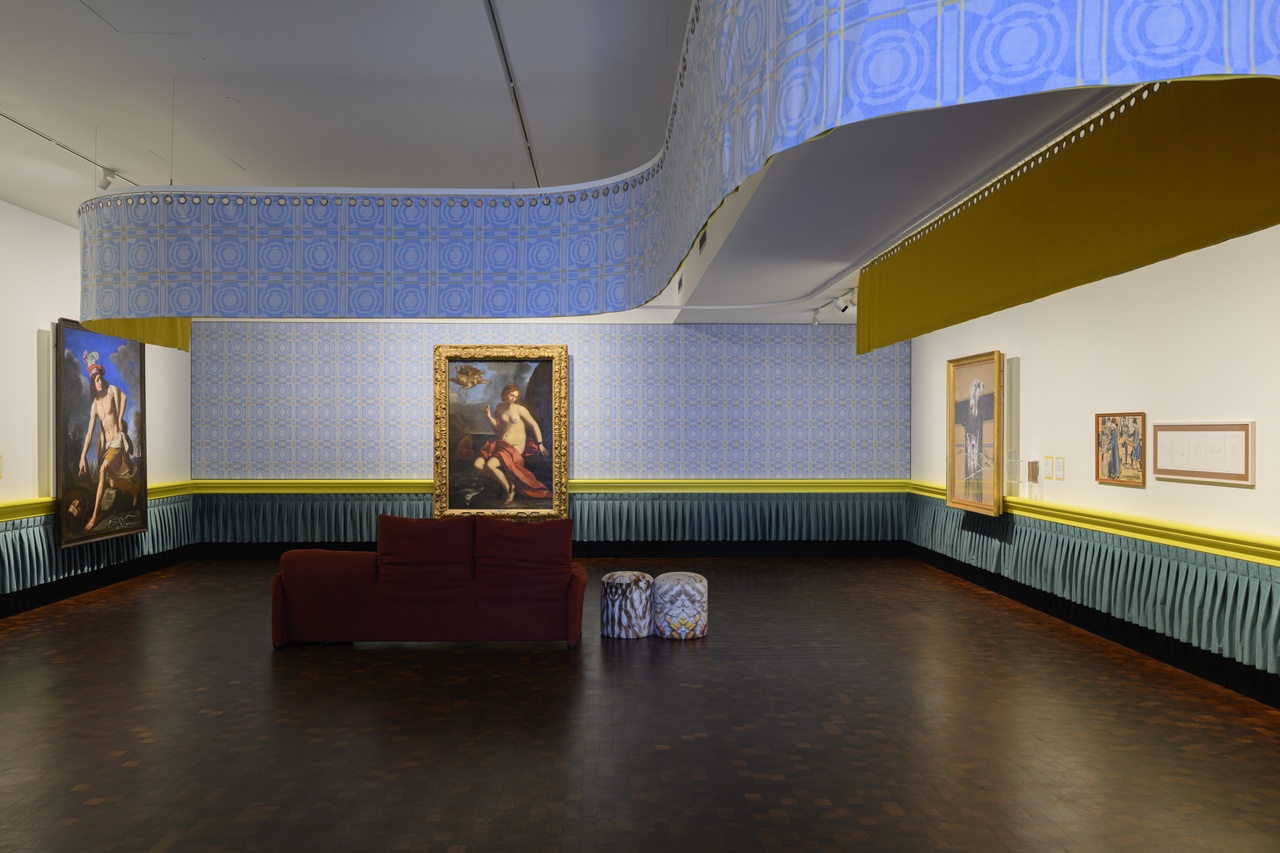
The Van Abbemuseum was founded in 1936, and its collection has accumulated through nearly a century of acquisition. Its historical focus is modern and contemporary art, with particularly strong holdings in 20th-century avant-garde and postwar art. But it’s the anomalous entries to the catalogue on which this re-hanging hinges. For example, Guercino’s Andromeda (undated) is the oldest work in the collection. Painted in the latter half of the 17th century, it’s placed at the center of a room that meditates on the life cycle of artworks. The painting entered the collection in 1942 and has previously been on display only twice. In comparison, Francis Bacon’s Fragment of a Crucifixion (1950), acquired in 1966, has been exhibited 18 times. What is the life of a work like, once it enters a collection? In a process of deaccessioning developed with the artist and death doula G. and outlined in the accompanying wall text, Andromeda will leave the collection and begin a more public life at another museum. G’s work deliberately reframes removal from a collection as a form of transformation or “death.” Deaccessioning becomes an act of care: If artworks have lives, they may also have deaths and reincarnations, forms of senescence, and, ultimately, dignity.
Rebecca Horn, “The Moon, the Child, and the River of Anarchy,” 1992
In general, “Collection as Cosmos” is full of linked beginnings and endings – each space enacts a life cycle of sorts, clustered around themes such as landscape, language, childhood, and others, while bringing together works from disparate eras and producers. Walking through the various rooms, each its own world, feels galactic. In the “Gemini Room,” for example, mirrors, doubles, couples, and doppelgängers become a way of thinking across time and space. Entering, one sees a reflection of Marc Chagall’s Homage to Apollinaire (1913) in a large, mirrored wall divider. The painting itself contains a doubling of cubist bodies often read as Adam and Eve and is placed alongside Joan Jonas’s gestural painting Double Lunar Dogs (1981). The body appears again in the next room, containing Robert Morris’s 9 H-Shapes (1967) – nine aluminum elements of equal size that can be arranged in different configurations, shifting attention toward the negative space between them which includes the viewer. At moments like this, the exhibition is at its best when it trusts more direct propositions relationally both within each room and in the connections between them.
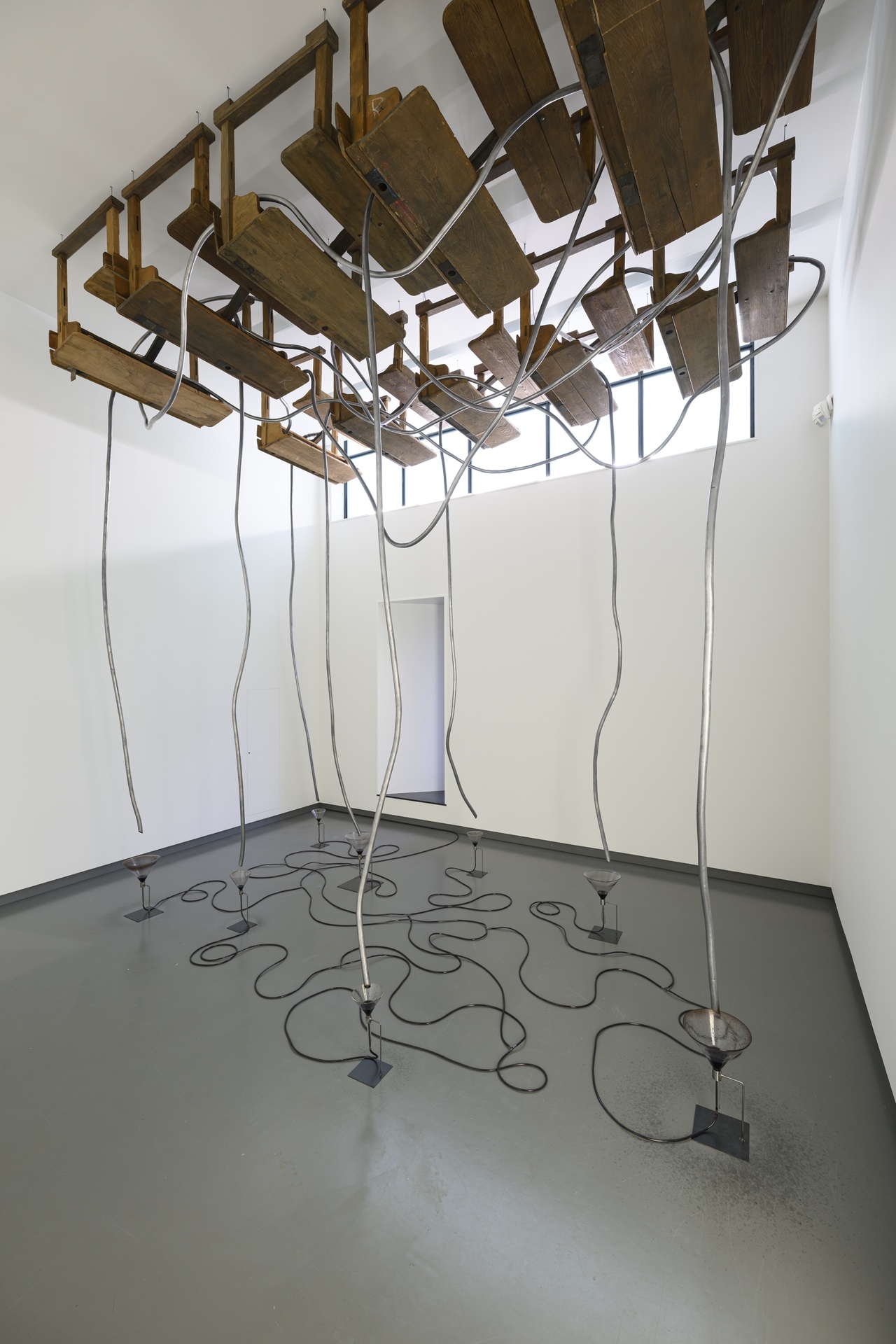
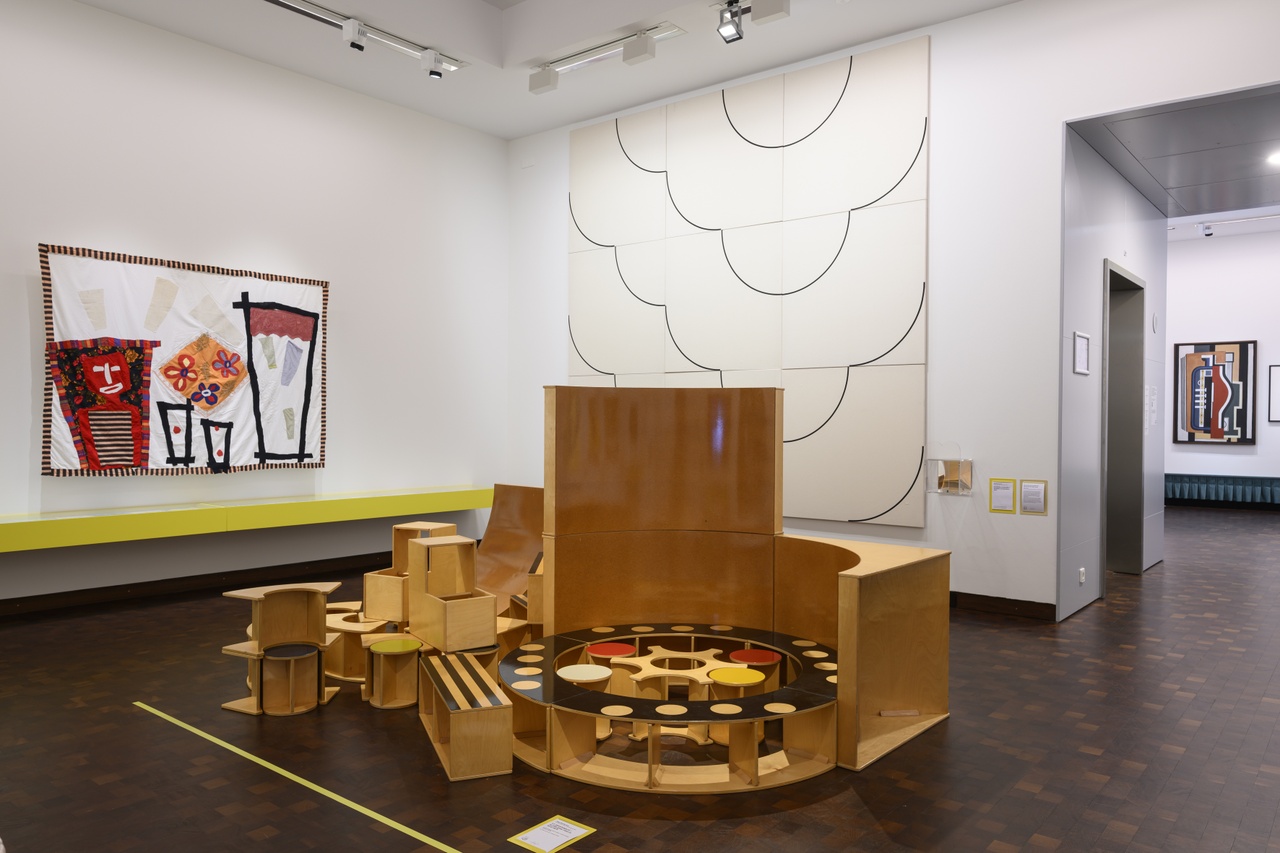
For example, a room organized around language begins with the observation that a few letters can generate endless meaning: poems, libraries, and stories about past, present, and future. Jo Baer’s Cardinations (1974), repeated rounded forms that resemble the letter e, change as one moves past them. In the next hallway is Rebecca Horn’s The Moon, the Child, and the River of Anarchy from 1992. Rows of school desks hang upside down from the ceiling while lead pipes twist between them. Black ink circulates through the pipes, collected by funnels and pumped back upward in a closed, ominous system. The installation is linked to Horn’s traumatic memories of boarding school – there is a palpable sense that memory shapes its own time loop: The cycle of trauma and abuse, compartmentalized and contained in a literal passageway, doesn’t allow the audience to linger. Instead, you are ushered into the next room, where in a counterimage, Paul Panhuysen’s colorful play structures (Play Object, 1972–75), as building blocks children could use to make their own worlds, fill the center of the space. Nearby, Karel Appel’s 1956 Tragisch naakt / Tragic Nude, inspired by children’s drawings, hangs close to Erzen Shkololli’s textile works, made during the war in Kosovo in 1998 and positioned alongside postcard-size drawings by children in refugee camps (Patchwork III / Lapjeskleed III, 1998). The room’s arrangement is a bit of a risky pairing – “childlike” form can easily become a vague aesthetic category detached from historical violence. Yet the proximity of play, war, trauma, pedagogy, and survival lends it complexity. After emerging from the density of Horn’s installation, and with the “language” room in the background, one is led by these groupings of works to consider how – despite trauma and violence – world-making, play, and creating meaning from what’s available form the very building blocks of society, such as language.
“Collection as Cosmos,” Van Abbemuseum, Eindhoven, 2026-30
Further down the labyrinth, themes of landscapes, skies, and stars hang in clusters, generating dense comparisons across time and genre: Ana Mendieta’s Atabey (Esculturas Rupestres) / Mother of the Waters (Rupestrian Sculptures) (1981/2021), Lubaina Himid’s Meat Mountains (1984–85), and Hendrik Chabot’s Slapende boer / Sleeping Farmer (1936) appear together here. On the other side of the turning doors, materials related to the 1913 Russian Futurist opera Victory over the Sun, including set and costume designs by Kazimir Malevich, introduce cosmism. In that opera, its protagonists capture the sun and establish a machine-driven world, overthrowing linear time, religion, and reason. The juxtaposition generates thoughts of celestial temporality as the driver of industrial change, leading to a meditation on the nature of labor. Downstairs, Ayoung Kim’s “Delivery Dancer: Time Curves,” her first solo exhibition in the Netherlands, offers another version of temporal disobedience. [2] A three-channel video and a large sundial form a speculative world in which women delivery drivers move through competing calendar systems. Kim’s work links logistics, cosmology, and erased temporal systems to ideas that also organize labor and technology.
In the exhibition’s final section, on the top floor, Nolan Oswald Dennis’s Black Liberation Zodiac (Khunuseti), dated 2017–∞, recalls how people historically read the night sky to know when to plant, harvest, and rest. A series of dark rooms covered in astronomical maps and constellations, the installation remaps the southern zodiac by including symbols of Black liberation in its cartography: Panthers, raised fists, and other political emblems are placed among the stars. Walking through the installation simulates a journey through space, at the end of which visitors are invited to look out the window and see the entrance to the museum. Once again, the end is just the other side of the beginning.
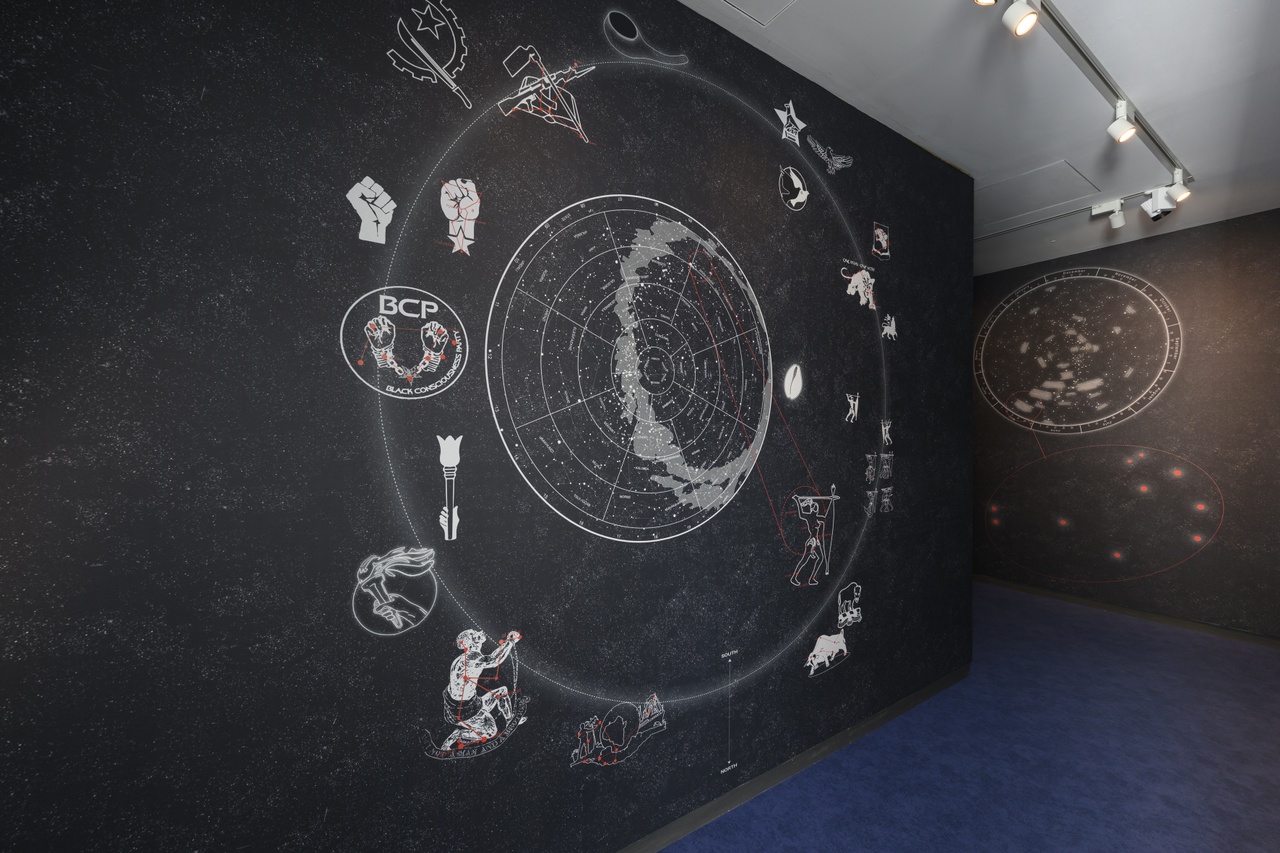
Nolan Oswald Dennis, “Black Liberation Zodiac (Khunuseti),” 2017
For a collection display, “Collection as Cosmos” is unusually willing to think about impermanence. Deaccessioning, temporary commissions, revived projects, living artworks, games, choirs, scores, murals remade after erasure: All of these complicate the museological fantasy of indefinite preservation. Take De Onkruidenier’s Forever Summer (2020), for example. Around 30 households in Brabant and the surrounding area received seeds of eight tomato varieties, becoming caretakers of a living artwork. The work draws an analogy between greenhouses and museum storage: Both regulate temperature and humidity in order to keep change at bay. Yet by placing the plants in domestic care, Forever Summer asks whether preservation might depend on circulation, seasonality, and use, rather than on removing things from life. Yet again, we return to the question of dancing with the moon: stewardship over possession. At times, “Collection as Cosmos” wants so much from its premises – cosmology, accessibility, grief, childhood, language, labor, liberation, ecology, civic life – that the collection risks an illustration of a curatorial worldview already decided in advance – directly contradicting its promise. Yet the exhibition’s excess is dangerously, generously untidy.
“Collection as Cosmos,” June 6, 2026–May 2, 2030, Van Abbemuseum, Eindhoven.
Xenia Benivolski is a writer and curator living in Brussels and Toronto.
Image credit: © Van Abbemuseum, photos Peter Cox
Notes
| [1] | James Baldwin, No Name in the Street (Dial, 1972), 52. |
| [2] | The project is part of “System Thinkers,” the museum’s new long-term initiative launched alongside the collection reopening; artists Ayoung Kim, john gerrard, Ayumi Paul, Kate Crawford, Vladan Joler, and the ADEZIV network are invited to develop new work through research. The initiative presents artistic practice as a physically embedded mode of institutional inquiry. |